This site is supported by our readers. We may earn a commission, at no cost to you, if you purchase through links.
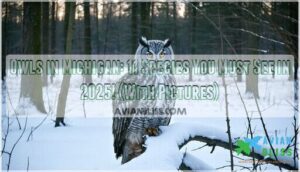 You’ll find eleven distinct owl species across Michigan’s diverse landscapes, each adapted to specific ecological niches.
The Great Horned Owl dominates suburban areas, while Barred Owls inhabit dense forests with their unmistakable "who-cooks-for-you" calls.
Eastern Screech Owls nest in backyard cavities, and massive Great Gray Owls patrol northern wilderness areas.
Short-eared Owls hunt grasslands at dusk, contrasting with the tiny Northern Saw-whet Owl’s secretive woodland behavior.
Snowy Owls migrate south during harsh winters, creating seasonal birding opportunities.
These nocturnal raptors serve as essential ecosystem indicators, controlling rodent populations while reflecting habitat health.
Understanding their unique identification markers, preferred territories, and behavioral patterns transforms casual observation into meaningful wildlife encounters.
Table Of Contents
- Key Takeaways
- Types of Owls in Michigan
- Habitat and Distribution of Michigan Owls
- Identifying Michigan Owls: Field Guide
- Conservation Status of Michigan Owl Populations
- Attracting Owls to Your Backyard
- Frequently Asked Questions (FAQs)
- What’s the most common owl in Michigan?
- Is it good or bad to have an owl in your yard?
- Can an owl pick up a 10 lb cat?
- What kind of owl goes hoo hoo hoo?
- What is the most common owl in Michigan?
- What time of year do owls hoot?
- How do I know what kind of owl I have?
- What do Michigan owls eat?
- How long do owls in Michigan typically live?
- When is the best time to spot owls?
- Conclusion
Key Takeaways
- You’ll find eleven distinct owl species across Michigan, from the massive Great Horned Owl with its 60-inch wingspan to the tiny 8-inch Northern Saw-whet Owl, each adapted to specific habitats ranging from dense forests to suburban backyards.
- You can identify Michigan’s owls by examining key features like facial disk shapes, ear tufts, distinctive calls (such as the Barred Owl’s "who-cooks-for-you" hoot), and flight patterns that reveal their unique hunting strategies.
- You’ll encounter both year-round residents like Great Horned and Eastern Screech Owls, plus seasonal visitors including Snowy Owls that migrate south during harsh winters, creating prime birding opportunities from December through February.
- You can attract owls to your property by creating owl-friendly habitats with native plants, installing proper nest boxes 12-20 feet high, reducing artificial lighting, and maintaining unmowed areas that support the rodent populations owls hunt.
Types of Owls in Michigan
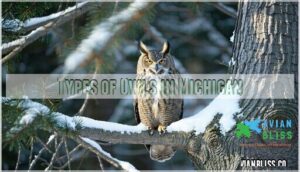
You’ll encounter eleven distinct owl species across Michigan’s diverse ecosystems, ranging from the massive Great Horned Owl with its 60-inch wingspan to the diminutive Northern Saw-whet Owl at just 8 inches long.
From massive Great Horned giants to tiny Saw-whet jewels, Michigan’s eleven owl species showcase nature’s incredible diversity.
These raptors include year-round residents like the Barred Owl, winter visitors such as the Snowy Owl, and rare northern species that occasionally venture south from Canada’s boreal forests.
Common Owls
Three michigan owl species dominate the state’s nocturnal landscape with remarkable adaptability.
You’ll encounter these feathered hunters showcasing diverse owl behavior and specialized hunting tactics across varied habitats.
Michigan owls demonstrate incredible survival strategies:
- Barred owl populations utilize distinctive hooting calls for territorial communication
- Great grey owl specimens employ asymmetrical ear openings for precise prey location
- Eastern screech owl individuals exhibit dual color morphs enhancing camouflage effectiveness
Their feather patterns and nesting habits reflect evolutionary perfection in predatory design.
Rare Owls
While common species dominate Michigan’s owl populations, rare owls represent nature’s most elusive treasures.
The Great Gray Owl, North America’s longest species at 33 inches, occasionally graces Upper Peninsula forests during harsh winters.
Snowy Owls create dramatic silhouettes against snowy landscapes, their white plumage contrasting sharply with telephone poles.
Northern Hawk Owls hunt by daylight, spotting prey from incredible distances.
Boreal Owls remain Michigan’s most secretive residents, their repetitive hoots echoing through dense conifers.
These rare species face significant habitat loss, making each sighting a remarkable wildlife encounter worth celebrating.
Migratory Owls
Several migratory owl species transform Michigan’s winter landscape into a birder’s paradise. These remarkable travelers follow predictable migration patterns that respond to food availability and harsh northern climates.
Michigan owls you’ll encounter during seasonal movements include:
- Northern Saw-whet Owls – Arrive in October, following migratory patterns through dense forests
- Snowy Owls – Sweep across open fields from November through March, displaying distinctive flight behaviors
- Short-eared Owls – Navigate grasslands and marshes with exceptional long-distance flying abilities
Owl tracking data reveals these species time their seasonal movements precisely. Snowy Owls’ wintering habits concentrate along Great Lakes shorelines, where they hunt during daylight hours.
Michigan birding enthusiasts can observe owl species migration most effectively between December and February, when Arctic visitors establish temporary territories in agricultural areas and wetlands.
Year-Round Residents
While many Michigan owls migrate with seasons, feathered champions like Great Horned Owls, Barred Owls, and Eastern Screech Owls call this state home year-round.
These resident species demonstrate remarkable adaptability, maintaining stable territories through harsh winters and scorching summers.
You’ll find these Michigan owls thriving in diverse owl habitats—from dense forests to suburban backyards—showcasing impressive owl behavior that includes consistent breeding success and territorial fidelity across varied landscapes.
Understanding the unique michigan owl sounds is essential to identifying these species in their natural habitats.
Habitat and Distribution of Michigan Owls
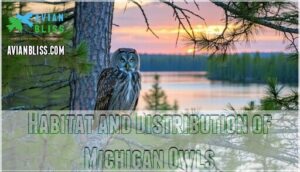
You’ll find Michigan’s owls distributed across diverse ecosystems, from the boreal forests of the Upper Peninsula where Great Gray Owls hunt year-round to the agricultural grasslands of southern counties where Short-Eared Owls patrol open terrain.
These species demonstrate remarkable habitat specificity, with Barred Owls preferring dense woodlands near water sources while Snowy Owls concentrate along Great Lakes shorelines during winter migrations, creating distinct geographic patterns that reflect each species’ ecological requirements, influenced by their unique adaptations and the presence of dense woodlands and water sources.
Forests and Woodlands
Michigan forests offer prime real estate for owl species seeking shelter and sustenance.
Dense tree canopy provides excellent cover while forest floors teem with prey like mice and voles.
Woodland ecology creates perfect hunting grounds where Michigan owl species thrive year-round.
You’ll find Great Horned Owls dominating these Michigan forests, claiming territories in mature timber stands.
Barred Owls prefer dense woodlands near water sources, while tiny Saw-whet Owls favor coniferous areas.
Michigan wildlife benefits from responsible timber management practices that preserve owl habitats.
- Owl nesting sites: Hollow trees and abandoned hawk nests
- Hunting zones: Forest edges and clearings at dusk
- Prey availability: Abundant rodents and small mammals
Wetlands and Grasslands
Beyond Michigan’s dense forests, vast wetlands and grasslands offer spectacular owl habitats that’ll surprise even seasoned birdwatchers.
These open landscapes host several michigan owl species perfectly adapted to wetland conservation areas and grassland ecology.
Short-eared owls dominate michigan wetlands, gliding low over marshes hunting voles with their distinctive flight patterns. These wetland owls prefer areas exceeding 250 acres, making michigan grasslands ideal hunting grounds.
Northern saw-whet owls also inhabit these mixed environments, thriving in the boundary between wetlands and woodlands.
Grassland habitats support owl migration patterns, particularly during winter months when snowy owls occasionally visit reed-filled areas.
The rich prey diversity in these owl habitats creates perfect conditions for michigan birdwatching enthusiasts.
Habitat Owl Species Key Feature
Urban and Suburban Areas
City lights don’t deter all michigan owl species from calling urban areas home.
Urban owls prove that nature adapts – even the wildest hunters can thrive among streetlights and suburbia.
Eastern Screech-Owls have mastered the art of Urban Owls adaptation, thriving in Suburban Habitats where most raptors struggle.
These resourceful hunters navigate City Wildlife challenges by exploiting park systems and residential tree coverage for Backyard Owling opportunities.
Urban Conservation efforts can substantially impact michigan urban areas owl populations through strategic habitat management:
- Installing species-appropriate nest boxes in quiet residential zones
- Reducing artificial lighting that disrupts nocturnal hunting patterns
- Maintaining native vegetation corridors for prey species movement
- Creating pesticide-free zones to protect food chain integrity
- Supporting michigan birdwatching programs that monitor owl habitats and promote owl conservation in michigan
Northern and Southern Regions
You’ll find Great Gray Owls and Northern Hawk-Owls dominating the Upper Peninsula’s boreal forests, where cooler temperatures and dense coniferous cover create ideal Northern Migration corridors.
These michigan owl species thrive in Geographic Diversity that southern regions can’t match.
Down south, Barn Owls and Eastern Screech-Owls prefer Southern Habitats like agricultural fields and woodlots.
Climate Effects drive this Regional Owl Distribution pattern, making michigan birdwatching location-dependent for successful owl species in michigan identification.
Identifying Michigan Owls: Field Guide
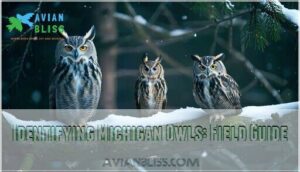
You’ll need to examine specific morphological features and behavioral patterns to accurately distinguish Michigan’s eleven owl species in their natural habitats.
Focus on key identification markers including facial disk shapes, ear tuft presence, wing spans ranging from 22 inches in Northern Saw-whet Owls to 60 inches in Great Horned Owls, and distinctive vocalizations that serve as reliable taxonomic indicators.
Physical Characteristics
Identifying owl species characteristics requires examining key morphological features that distinguish Michigan’s eleven species.
Facial Markings create distinct identification patterns – Barn Owls display heart-shaped disks while Barred Owls showcase prominent facial rims. Ear Tufts vary dramatically between species, with Great Horned Owls sporting prominent tufts versus Snowy Owls’ smooth profiles.
Plumage Colors and Eye Shapes provide additional identification markers:
- Golden-yellow eyes paired with mottled brown plumage identify Great Horned Owls
- Bright amber eyes contrast against Great Gray Owls’ sooty-gray feathers
- Dark brown eyes distinguish Barred Owls from yellow-eyed species
Beak Sizes complement these owl plumage variations for accurate field identification.
Flight Patterns

Michigan owl species showcase distinct wing beats and flight patterns that reveal their hunting strategies.
Each species employs unique soaring techniques, creating a living textbook of aerodynamics in motion. Understanding the principles of bird flight patterns is essential to appreciating the diversity of owl species.
You’ll recognize these signature flight characteristics:
- Great Horned Owls demonstrate powerful, measured wing beats—like watching a master craftsman work with deliberate precision through dense woodlands.
- Barn Owls exhibit graceful, moth-like flight patterns with minimal noise, their specialized feathers creating near-silent movement perfect for surprise attacks.
- Short-Eared Owls display erratic, buoyant flight speed variations, alternating between active flapping and extended glides during their impressive migration routes across Michigan’s diverse landscapes.
Distinctive Calls and Hoots
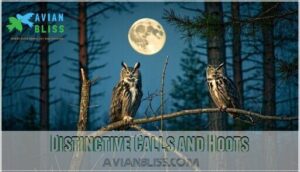
Deciphering owl vocalizations transforms nighttime birdwatching into an acoustic adventure.
Michigan’s owl species identification relies heavily on distinctive hooting patterns and call frequencies.
The Great Horned Owl stutters deep "hoo-h’HOO-hoo-hoo" notes, while Barred Owls famously ask "Who cooks for you?"
Eastern Screech-Owls produce haunting whinnies, and Barn Owls shriek like horror movie soundtracks.
Audio recordings help train your ear to recognize these unique sound waves echoing through Michigan’s forests.
Nesting Habits
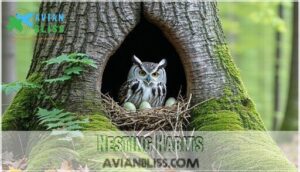
Understanding owl nesting behaviors in Michigan reveals fascinating breeding patterns across diverse species.
Great Horned Owls commandeer abandoned hawk nests, while Barn Owls prefer secluded barns and silos for their nesting sites.
Barred Owls select hollow tree cavities, and Long-Eared Owls construct platforms in dense evergreens.
Most species lay 2-6 eggs using twigs and feathers as materials.
Installing properly designed nest boxes enhances owl habitats, supporting roosting behavior and successful breeding across Michigan’s varied ecosystems.
Conservation Status of Michigan Owl Populations
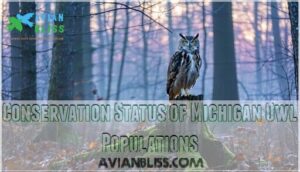
You’ll find that Michigan’s owl populations face significant conservation challenges, with species like the Snowy Owl experiencing a 64% population decline since 1970 and the Long-Eared Owl showing an alarming 91% decrease during the same period.
These declining numbers result from habitat loss, vehicle collisions, climate change impacts, and reduced prey availability across the state’s diverse ecosystems.
Threatened and Endangered Species
Three owl species face critical conservation challenges in Michigan’s changing landscape.
The Short-eared Owl and Barn Owl are both listed as endangered, while Long-eared Owls hold threatened status.
Michigan owl species conservation efforts focus on addressing primary threats that drive species decline:
- Vehicle collisions during migration periods cause significant mortality rates
- Pesticide contamination reduces prey availability and affects reproductive success
- Climate disruption alters breeding cycles and traditional nesting territories
These threat assessments guide targeted conservation programs protecting Michigan’s vulnerable owl populations from further decline.
Understanding the role of michigan birds is essential for developing effective conservation strategies.
Habitat Loss Challenges
Deforestation Impact and Urban Expansion create serious problems for michigan owl habitats.
You’ll find Habitat Fragmentation splits forests into smaller patches, making it harder for owls to find mates and food.
Ecosystem Degradation from pesticides reduces prey populations, while missing Wildlife Corridors prevent owls from moving between suitable areas.
Owl habitat loss across michigan wildlife communities forces species like Barn Owls and Great Gray Owls into shrinking territories, affecting their owl conservation status.
Conservation Efforts and Programs
While habitat challenges threaten Michigan’s owls, dedicated conservation strategies are making a real difference.
You’ll find multiple organizations working tirelessly to protect these magnificent birds through thorough michigan owl conservation programs.
Key conservation efforts include:
- Michigan Audubon’s research initiatives advancing owl conservation efforts and migration studies
- Whitefish Point Bird Observatory conducting species research and banding programs
- Conservation Reserve Program preserving grassland habitats for Barn Owls
- Nest box programs providing alternative nesting sites across the state
- Ducks Unlimited’s wetland restoration protecting critical owl hunting grounds.
These wildlife protection programs demonstrate how environmental policies and community involvement create lasting impact for michigan bird conservation success.
Human Impact on Owl Populations
While conservation efforts show promise, human activities continue threatening Michigan’s owl populations through multiple pathways.
Climate change disrupts migration patterns and prey availability, forcing species like Snowy Owls to adapt rapidly. Habitat destruction from urban expansion fragments woodland territories essential for nesting and hunting. Pollution effects include pesticide contamination weakening eggshells and reducing reproductive success.
Human disturbance factors impacting owl conservation efforts include:
- Light pollution confusing nocturnal hunting behaviors and breeding cycles
- Vehicle collisions killing migrating owls along major transportation corridors
- Noise pollution masking territorial calls and prey detection abilities.
Michigan owl species conservation requires addressing these human impacts on owl populations through thorough owl habitat restoration initiatives.
Attracting Owls to Your Backyard
You can transform your backyard into an owl habitat by establishing specific environmental conditions that meet their territorial and nesting requirements.
Creating appropriate shelter structures, maintaining prey populations, and reducing artificial lighting will increase your chances of attracting Michigan’s resident owl species to your property.
Creating Owl-friendly Habitats
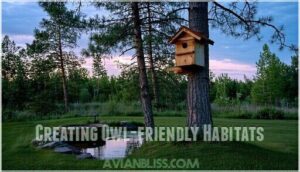
Designing your backyard for owl habitat success requires strategic planning that mimics nature’s blueprint.
Native plants like spruce, pine, and juniper create essential shelter while attracting prey species that sustain Michigan’s owl populations.
Owl boxes positioned 20+ feet high in secluded areas provide vital nesting opportunities.
Reduce light pollution with motion-sensitive fixtures to maintain nocturnal hunting conditions.
Water sources support the ecosystem balance owls need.
| Habitat Element | Primary Function | Implementation Strategy |
|---|---|---|
| Native Plants | Shelter and prey attraction | Plant Michigan evergreens and prairie grasses |
| Dead Trees/Snags | Natural perches and nests | Retain existing or install artificial alternatives |
| Reduced Lighting | Nocturnal activity support | Use directional, motion-activated fixtures |
| Water Features | Ecosystem support | Install shallow basins or natural ponds |
| Unmowed Areas | Food supply habitat | Designate wild zones for rodent populations |
Successful owl conservation starts with owl-friendly habitats that replicate natural Michigan bird habitats.
Creating effective owl nesting sites is crucial for attracting owls to your backyard.
Proper Feeding Practices
Never hand-feed Michigan’s owl species—this disrupts their natural hunting techniques and compromises essential owl nutrition within established food chains.
You’ll inadvertently weaken their prey selection abilities and alter critical feeding habits that’ve evolved over millennia.
Instead, cultivate an ecosystem that supports the Michigan owl species diet through indirect methods:
- Plant native berry bushes to attract small mammals that form the foundation of bird species diet
- Eliminate pesticide use to preserve the delicate food web from insects to apex predators
- Maintain unmowed grass patches where voles and mice thrive as primary prey
- Install shallow water sources that concentrate small animals during dry periods
- Create brush piles from fallen branches to shelter rodent populations year-round
These practices enhance the natural owl diet while respecting their wild feeding habits.
You’re basically designing a prey buffet that allows owls to maintain their sophisticated hunting skills.
By using effective owl feeding systems, you can create a welcoming environment for owls in your backyard.
Installing Nesting Boxes
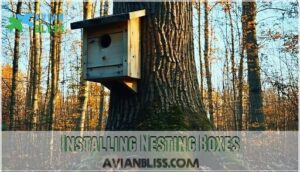
Three critical factors determine successful Box Installation for Michigan owl species.
Select Nest Box Designs with 8-inch entrance holes for Screech Owls or 6-inch openings for Boreal Owls.
Mount boxes 12-20 feet high on sturdy trees, facing southeast to avoid prevailing winds.
Add 2-3 inches of wood shavings as Nesting Materials—never use treated lumber or metal.
Install Birdhouse Plans near established owl nesting sites during late winter.
Proper Owl Habitat creation supports Michigan birdwatching while advancing owl conservation efforts through strategic owl nesting habits accommodation.
Effective nest box placement requires consideration of nest box tips to attract owls and other bird species.
Tips for Attracting Owls
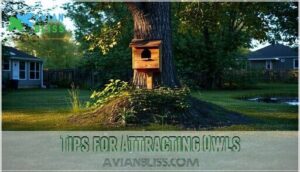
Transform your backyard into an owl sanctuary with strategic habitat creation that mimics Michigan’s natural ecosystems.
These proven owl watching tips will enhance your bird feeding and backyard birdwatching experience:
- Diversify food sources: Maintain brush piles and native vegetation to support rodent populations that owls hunt
- Install proper owl boxes: Position owl nesting structures 10-15 feet high in quiet areas away from human activity
- Reduce artificial lighting: Minimize outdoor illumination to preserve natural hunting conditions and attract nocturnal species
Using proper owl nesting boxes is vital for attracting owls to your backyard.
Patience and consistent habitat management create ideal Michigan owl watching locations right at home.
Frequently Asked Questions (FAQs)
What’s the most common owl in Michigan?
Like a feathered phantom haunting Michigan’s woodlands, you’ll most likely encounter the Great Horned Owl (Bubo virginianus).
This adaptable predator’s widespread distribution and remarkable versatility make it the state’s most commonly observed owl species year-round, being a year-round presence.
Is it good or bad to have an owl in your yard?
Having an owl in your yard is excellent! You’ve got a natural pest control expert that’ll eliminate rodents, mice, and rats without chemicals.
They’re beneficial predators that maintain ecological balance while staying mostly invisible.
Can an owl pick up a 10 lb cat?
Most owls can’t lift a 10-pound cat.
Great Horned Owls, Michigan’s largest species, typically carry prey weighing 2-3 pounds maximum.
Your cat’s size provides natural protection from owl attacks, though small kittens remain vulnerable to harm.
What kind of owl goes hoo hoo hoo?
You’ll hear Great Horned Owls making those classic "hoo-hoo-hoo" calls echoing through Michigan’s forests.
These powerful nocturnal hunters use their deep, rhythmic hoots to communicate with mates and establish territory year-round.
What is the most common owl in Michigan?
Throughout Michigan’s forests, one feathered sentinel reigns supreme like a woodland monarch.
You’ll encounter the Great Horned Owl most frequently—this adaptable predator dominates diverse habitats from dense woodlands to suburban neighborhoods with remarkable territorial persistence.
What time of year do owls hoot?
During breeding season from late winter through early spring, you’ll hear most owl species become vocal champions.
February through April marks peak hooting activity as they establish territories and attract mates before nesting begins.
How do I know what kind of owl I have?
Look for key features like size, ear tufts, facial patterns, and calls.
Great Horned Owls have prominent "horns," while Barred Owls make "who-cooks-for-you" sounds.
Note wingspan, coloring, and hunting times for accurate identification.
What do Michigan owls eat?
Surprisingly, these silent hunters aren’t picky eaters!
Michigan owls feast on small mammals like mice, voles, and shrews, plus insects, amphibians, and even fish.
You’ll find they’re nature’s pest control specialists.
How long do owls in Michigan typically live?
You’ll find Michigan’s owls typically live 10-20 years in the wild, though some species like Great Horned Owls can reach 25 years.
Captive owls often live longer due to veterinary care and consistent food sources.
When is the best time to spot owls?
Early birds might catch worms, but you’ll spot owls best during winter evenings from January through February.
Dawn and dusk offer prime viewing windows when these nocturnal hunters become active in Michigan’s forests.
Conclusion
Michigan’s nocturnal landscape transforms into a living symphony when you understand these remarkable raptors.
You’ve discovered eleven distinct owls in Michigan, each serving as nature’s precision-engineered pest controllers.
From suburban Great Horned Owls to elusive Northern Saw-whets, these species indicate ecosystem health while providing unforgettable wildlife encounters.
Your newfound identification skills will enhance every twilight adventure, whether you’re creating backyard habitats or exploring remote wilderness areas.
Conservation awareness guarantees future generations will experience these magnificent predators’ haunting calls echoing through Michigan’s diverse landscapes.