
This site is supported by our readers. We may earn a commission, at no cost to you, if you purchase through links.

That flash of red at your feeder doesn’t tell you much about family life. Cardinals guard their nesting spots closely, tucking them into places most people walk right past without a second glance.
So where do cardinals nest? Not high in the canopy like you might guess. They favor low, tangled cover, a Y-shaped fork in a shrub, a thorny thicket, a spot barely off the ground where predators struggle to reach.
Knowing these habits changes how you look at your own yard, and it might just bring a nesting pair closer than you’d expect.
Table Of Contents
- Key Takeaways
- Cardinals Nest in Dense Shrubs
- Typical Cardinal Nesting Heights
- Best Plants for Cardinal Nests
- Where Cardinals Avoid Nesting
- What Cardinal Nests Look Like
- When Cardinals Build Nests
- How Cardinals Choose Nest Sites
- Attracting Nesting Cardinals Nearby
- Frequently Asked Questions (FAQs)
- Where do Cardinals nest?
- Do Cardinals abandon their nests?
- When do Cardinals build nests?
- How do northern cardinals build a nest?
- How long does a mother cardinal sit on her eggs?
- What month do cardinals lay eggs?
- What kind of trees do cardinals nest in?
- What do cardinal nests look like?
- Do cardinals come back to the same nest every year?
- Do cardinals mate for life?
- Conclusion
Key Takeaways
- Cardinals nest low, usually 1 to 15 feet off the ground, tucking their cup-shaped nests into dense shrubs, thorny thickets, or Y-shaped branch forks rather than high in trees or in birdhouses.
- Nest building happens fast, taking just 3 to 9 days, and pairs raise 2 to 3 broods between March and August, building a fresh nest each time to avoid predator detection.
- Disturbance is deadly to cardinal nests, with displaced nests failing 80 to 95 percent of the time, so avoiding trimming shrubs or foot traffic near nesting sites is critical from March through August.
- You can attract nesting cardinals by planting dense native shrubs like dogwood, hawthorn, and blackberry, and by placing feeders 10 to 15 feet from cover so birds have a safe escape route.
Cardinals Nest in Dense Shrubs

If you want to spot a cardinal nest, start by looking down, not up. These birds stick close to the ground, tucked into thick, tangled greenery where they feel safe. Here are the spots they turn to most often.
Dense shrubs like honeysuckle or holly are favorite hideouts, and knowing more about where cardinals nest at night can help you understand why they pick such well-hidden spots.
Low Trees and Saplings
Picture a young dogwood, barely taller than you, its branches spreading low and horizontal to catch scraps of understory light. That compact crown structure is exactly what cardinals seek.
Shaded saplings grow dense, layered twigs instead of racing upward, creating the sturdy, hidden forks cardinals need. This shade-tolerant growth pattern offers both camouflage and a stable foundation for nest-building.
Thick Vines and Brambles
Saplings offer structure, but tangled blackberry brambles offer something better: built-in armor. Thorny canes weave into dense thickets that predators avoid entirely.
Woody vine stems, ridged and up to 2 cm thick, give nests a sturdy anchor. Ripening berry clusters attract insects too, meaning food sits close to home. That combination of thorns and structure makes brambles prime nesting real estate.
Y-shaped Branch Forks
Not every fork will do. Cardinals look for a true Y, where two branches split at roughly 40 to 90 degrees, giving branching architecture stability that cradles the nest from below.
Wide U-shaped forks distribute load bearing strength better than narrow V-shapes, and thickened growth rings around the junction add stiffness—so the nest architecture rests on a solid, well-supported base.
Forest Edges and Hedgerows
That sturdy fork means little without the right neighborhood. Cardinals favor forest edges and hedgerows over deep woods, where scalloped edge design and dense thickets offer cover and food.
- Hedgerow corridors link habitat patches
- Edge microclimates stay milder
- Pollinator diversity feeds nearby insects
- Overgrown fields work well
- Straight edges offer less shelter than jagged ones
These structures provide essential nesting sites for various bird species.
Suburban Garden Cover
Why do cardinals turn up in ordinary backyards so often? Because a well-planted garden mimics wild thickets.
Native shrubs, vertical privacy screens, and trellis vines create layered cover close to feeders. Add canopy tree shade and native ground covers underneath, and you’ve built genuine backyard wildlife habitat.
Seasonal planting keeps that shrub thicket density year-round, giving cardinal nests the privacy they need without ever leaving your yard.
Typical Cardinal Nesting Heights

Height matters just as much as location when a cardinal picks a nest site. You won’t find these nests way up in the treetops or down on bare ground. Here’s what to know about how high cardinals usually build.
One to Fifteen Feet
Height matters more than you’d think for survival. Cardinal nests usually sit one to fifteen feet off the ground, giving cover from cats and snakes below.
This vertical nesting range balances two risks: too low invites ground predators, too high exposes the nest to hawks. Four to ten feet usually works best, especially in shrubs with thick cover for elevation survival.
Low, Hidden Placements
Down near the ground, cardinals often tuck their nests into thickets and tall grasses where leaf litter does the hiding. This spot brings low-level foraging access to seeds and invertebrates.
Ground predator risks run higher here, but thick cover and thicket nesting stability help offset that trade-off, keeping eggs concealed within dense, low-growing vegetation.
Dense Foliage Protection
Think of dense foliage as a cardinal’s built-in climate control and camouflage system. Thermal buffering cuts nest temps by 1-3°C, while wind speed drops 40-60% at nest height. Humidity stays a steady 70-90%, and leaf turnover breaks up predator silhouettes.
- Lower heat stress
- Calmer nest conditions
- Better moisture retention
- Harder-to-spot outlines
Shrub thickets simply offer safer, steadier nesting sites.
Avoiding Exposed Branches
A bare, exposed branch is a red flag to a nesting cardinal — no cover, no chance. That’s why you’ll rarely spot a nest sitting out in the open.
Instead, look for branching forks tucked deep in shrub thickets. This placement blocks predator sightlines, cuts wind movement, and adds branch cushioning during storms — all while keeping the nest hidden in thickly covered foliage.
Best Plants for Cardinal Nests

Not every shrub in your yard will catch a cardinal’s eye. These birds have clear favorites, and knowing them can shape how you plant your garden. Here are the top picks cardinals turn to when building their nests.
Dogwood and Hawthorn
Dogwood and hawthorn offer cardinals two of their favorite nesting spots.
Dogwood’s Y-shaped branches hide nests well, with spring blooms and red fall fruit as a bonus. Hawthorn’s protective thorn structures deter predators like snakes and squirrels.
Both thrive in slightly acidic soil and provide dense cover, making them smart choices for your yard.
Blackberry and Rose Bushes
Blackberry canes form dense, thorny thickets that build on hawthorn’s protective structure, giving cardinals another armored option.
- Sharp prickles deter predators
- Rose bushes add wind shelter and pollinator activity
- Both need well-drained, slightly acidic soil
Berries ripen black by midsummer, while rose hips follow blooming. Regular thicket maintenance keeps canes productive and nest-friendly, supporting cardinal nests tucked deep within the foliage.
Honeysuckle and Spicebush
Sweet-scented honeysuckle and aromatic spicebush give cardinals fragrant, tangled cover for nest construction. Honeysuckle attracts hummingbirds but nonnative types risk invasive spread. Spicebush, a native butterfly host plant, helps swallowtail larvae and woodland understory balance.
| Plant | Native Status | Wildlife Value |
|---|---|---|
| Honeysuckle | Often nonnative | Hummingbirds, moths |
| Spicebush | Native | Butterflies, birds |
Evergreen Shelter Plants
Winter strips leaves off dogwood and honeysuckle, but junipers, yews, and hollies stay full. That year-round foliage gives cardinals shelter when other cover disappears.
These conifers and broadleaf evergreens tolerate shade, thriving as understory shrubbery beneath taller trees.
Planting them near saplings creates layered, natural shelter that protects nests through cold months, making them valuable native plants for birds and broader wildlife habitat.
Native Thicket Landscaping
Layering evergreens with fruiting shrubs works best as part of a full native thicket design, not a single hedge. Mix 8–12 species across a 10×20 meter area, and you’ll build a genuine wildlife corridor with edible shrubs like chokecherry.
Dense multi-stem shrubbery slows runoff, cuts erosion up to 60%, and holds moisture through dry spells, all while offering cardinals’ thick nesting materials and cover.
Where Cardinals Avoid Nesting

Cardinals are picky, and knowing what they skip can help you understand what they need. Certain spots just don’t offer the safety or cover they’re looking for. Here’s where you won’t find them setting up house.
Birdhouses and Cavities
Put up a birdhouse hoping to host cardinals, and you’ll wait forever. Cardinals never use enclosed cavities, no matter the entrance hole diameter or interior depth.
Nesting habits favor open, exposed cups tucked into branches, not boxes built for chickadees or wrens. Ventilation, mounting height, and predator deterrence features that work for cavity nesters mean nothing here. This bird species habitat runs on greenery, not carpentry.
Open Lawns and Fields
A wide-open lawn might look inviting, but for cardinals, it’s the opposite of home. No cover means no safety from hawks or roaming cats.
These spaces serve people well, offering urban greenspace utility, pollinator margin plantings, and habitat corridor connectivity along their edges. Regular mowing keeps them tidy, but that same maintenance strips away any chance of a hidden nesting oasis cardinals need.
Deep, Shaded Forests
Deep in a mature forest, sunlight barely touches the ground, less than 2% during the growing season.
Cardinals need dense foliage at low branching forks, and shade-tolerant plants there rarely form that thick, tangled shrubbery. The cool, damp microclimate and rich, mycorrhizal soil favor ferns and mosses instead, not the nesting materials or open sightlines cardinals rely on.
Sparse Ornamental Shrubs
A thin, leggy shrub might look tidy in a yard, but to a cardinal it screams inadequate nesting cover.
- Sparse branching offers no fork strong enough to cradle a nest
- Gaps in foliage raise predation risk and visibility concerns
- Thin stems create structural weakness under nestbuilding materials
Cardinals favor thick saplings and shrubbery instead, where habitat vulnerability drops and nesting period survival improves.
Frequently Disturbed Areas
Constant human foot traffic near a nest site is enough to make a cardinal abandon it. Displaced nests fail 80 to 95 percent of the time, so cardinals steer clear of busy walkways, patios, and trimmed edges.
Disturbed by foot traffic, cardinal nests fail 80 to 95 percent of the time, so the birds avoid busy paths entirely
They choose saplings and shrubbery further from daily disruption, tucked into branching forks where the nesting period stays calm, quiet, and free from repeated human presence.
What Cardinal Nests Look Like
Once you know where cardinals like to build, the next question is what they actually build. A cardinal’s nest isn’t random—it’s put together in layers, each one doing its own job. Here’s what makes up that cozy little cup.
Open Cup Shape

Picture a small bowl tucked into the leaves, wide at the top and sloping gently inward. That’s the open cup shape cardinal nests take once nestbuilding begins.
The rim stays smooth and even, giving the cup solid rim stability, while soft grasses inside offer real interior lining softness. Simple, sturdy, and built entirely from twigs found nearby.
Coarse Twig Base

Under that smooth rim sits the real workhorse: a coarse twig base, roughly 2 to 4 centimeters thick, built from 1-3mm twigs.
Dry, pliable, forked pieces interlock best, resisting wind. Bark stays intact for grip.
Small gaps between twigs allow drainage and airflow, keeping the cupped nest dry and temperature-steady while cradling the layers still to come.
Leafy Middle Layer
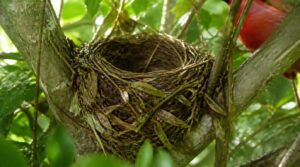
Above that twig base, cardinals weave in leaves, giving the cupped nest its middle layer. This layer works like the leafy middle layer of a garden: it moderates microclimate temperature, shields against wind, and helps hide the nest into branching forks of trees.
- Adds insulation between twigs and lining
- Reduces predator visibility
- Encourages mid-height plant diversity nearby
- Aids soil erosion prevention below
- Creates wildlife movement pathways through cover
Soft Grass Lining

Once the leafy layer settles in, the female cardinal turns her attention to comfort.
She lines the cupped nest with fine grasses and stems, building a soft inner texture that helps with thermal regulation and eases pressure on eggs. This careful insulation material selection shows real skill in nesting material sourcing, all for better interior nest comfort.
Rootlets, Bark, Fur
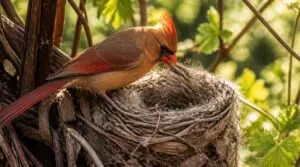
Grass alone won’t finish the job. The female tucks in rootlets, grapevine bark, and animal fur, three materials that add structural stability and warmth to the cup-shaped nest.
- Rootlets strengthen the walls
- Bark adds weatherproof insulation
- Fur fills tiny gaps
This final mix, alongside pine needles, gives cardinal nests their signature soft-yet-sturdy feel.
When Cardinals Build Nests

Timing matters just as much as location for cardinal nests. These birds work on a pretty tight schedule, packing in multiple broods over several months. Here’s what that timeline actually looks like, from first signs of activity to the final build.
March Through August
Six months, one busy calendar. Northern cardinals pack their entire breeding season into March through August, raising two to three broods of nestlings.
Warmer, milder springs tend to boost fledgling survival, while food supply drives success too.
Nestlings need steady protein early on, and by late summer, young cardinals shift toward independent foraging as insect abundance holds strong.
Early February Activity
Long before spring officially arrives, northern cardinals are already stirring. Milder February days trigger a shift in foraging patterns and early courtship displays, like head bobbing near cover.
You’ll notice:
- Rising territorial song
- Twig and bark gathering
- Bark-shredding for lining
- Dawn chorus timing shifts
- Weather-driven detours during snow or sleet
This groundwork sets the stage for nest building ahead.
Two to Three Broods
Most northern cardinal pairs raise two to three broods each season, though four is possible when food stays plentiful. Clutch size runs 2 to 5 eggs per attempt.
Warm springs and steady insect abundance push pairs toward that third brood, while nesting energy costs and harsher weather often limit success to just one or two rounds of nestlings.
New Nest Each Brood
Why start from scratch each time? Because a used cardinal nest carries scent and wear that predators learn to spot, raising risk for the next round of nestlings.
Rebuilding costs energy, but that renesting expense buys safety. The female rotates nest sites within the shrub, choosing a fresh fork each brood cycle—a smart trade-off across the breeding season that keeps avian reproduction odds in her favor.
Three to Nine Days
Ever wonder how a bird builds a home in under a week? A cardinal nest takes just three to nine days to complete, start to finish.
- Twig gathering (day 1-2)
- Cup shaping and stamping
- Leafy mat layering
- Soft lining with grass, fur
This rapid building cycle fits neatly into the busy breeding season, letting her return to incubating eggs sooner—efficient nesting labor at its finest.
How Cardinals Choose Nest Sites

A cardinal doesn’t just pick any spot in the yard and call it home. She weighs a handful of factors before she settles in, and each one matters to her survival. Here’s what she’s really looking for when she scouts out a nesting site.
Cover From Predators
Predator protection drives nearly every choice a cardinal makes. Dense, tangled cover hides the nest from view, muffles sound, and slows down snakes or squirrels trying to reach it. Thorny stems add another layer of defense.
Ground-level concealment matters too. Low nests avoid hawks scanning from above. Since displaced nests fail 80-95% of the time, that thicket safety isn’t optional—it’s survival.
Nearby Food Sources
Safety is only half the equation—a nest site also needs groceries close by. Cardinals build near hawthorn, blackberry, and dogwood, where berries ripen and insects gather for nestling protein.
Spring insect emergence times perfectly with hatching, and nearby feeders stocked with black oil sunflower seeds or mealworms sweeten the deal, making your yard genuinely attractive real estate.
Protected Branch Forks
Good groceries mean nothing without a sturdy crib. Northern cardinals favor a Y-shaped branch fork, wedging their cup-shaped nests where two limbs split for natural support.
This fork acts like built-in branch protection rules for the nest—stability without extra scaffolding. Just as fork access control limits who can push changes upstream, dense branching limits predator access, keeping the avian habitat secure through the whole nesting cycle.
Good Camouflage Plants
A branch fork is only as safe as the leaves around it. That’s why Northern cardinals lean on plants with background matching foliage, dense enough to hide a cup-shaped nest.
Dogwood and honeysuckle offer leaf texture concealment and seasonal pigment shifts, breaking up outlines the way disruptive coloration works in other species. Some tangled brambles even achieve a kind of masquerade effect, disguising the nest as just another snarl of growth.
Safe Feeding Distance
Camouflage hides the nest, but food still has to reach it safely. Northern cardinals nest near reliable seed sources while keeping predator escape paths open, usually 10-15 feet from feeders. This spacing avoids ambush zones without cutting off supply.
Watch for alarm calls near your feeder. They often signal a cardinal nest is close, and it’s worth adjusting placement rather than trimming cover blindly.
Attracting Nesting Cardinals Nearby

Want cardinals to build a nest in your yard instead of your neighbor’s? A few simple changes to your landscaping and habits can make your space much more inviting. Here’s what actually helps.
Plant Dense Native Shrubs
Want cardinals in your yard? Plant native shrubs in dense clusters, not single specimens. Dogwood, hawthorn, spicebush, and blackberry brambles offer thick cover Northern cardinals trust for cup-shaped nests.
These layered plantings reduce wind, stabilize soil, and boost pollinator activity. You’re not just gardening. You’re building a whole habitat that helps biodiversity while giving cardinals the concealment their nesting behavior depends on.
Keep Feeders Near Cover
Placement matters as much as food. Set feeders 10 to 15 feet from dense shrubs, giving cardinals a fast escape route if a hawk or cat appears.
- Keep a clear sightline between feeder and cover
- Mount feeders 4 to 6 feet high
- Add evergreens for winter protection
- Prune only to preserve escape paths
Good sightlines and steady cover work together—that’s the balance attracting cardinals long-term.
Offer Cardinal Seed Blends
Not every seed mix earns a cardinal’s visit. Black oil sunflower seeds should anchor your combination, with safflower mixed in—cardinals love it, but squirrels and blackbirds usually skip it.
| Seed Type | Benefit | Mess Level |
|---|---|---|
| Sunflower | High energy | Moderate |
| Safflower | Deters pests | Low |
| Shelled mix | Easy eating | Low |
Rotate mixes seasonally, since energy needs climb during breeding months.
Avoid Trimming Nesting Shrubs
That pair of shears can undo weeks of work in seconds. Cardinals abandon disturbed nests 80 to 95% of the time, so delay trimming until after nesting peaks, roughly March through August.
- Skip pruning near active cup-shaped nests
- Watch for adults carrying twigs (nest building)
- Reschedule yard work for fall or winter
- Check shrubs before cutting, even lightly
Patience now means fledglings later.
Keep Pets Away
A wandering dog can flatten a nest in seconds, and the fledglings inside won’t survive a fall like that. Keep a 4-foot fence or dense hedge between pets and nesting shrubs, with thorny hawthorn as backup.
Motion sprinklers, reflective tape, and citrus peel scattered near beds all discourage curious noses. A friendly word with neighbors about leash habits helps too—cardinals need calm, predator-free cover to raise their young safely.
Frequently Asked Questions (FAQs)
Where do Cardinals nest?
Home is where the heart is, and for cardinals, that means dense shrubs and thickets, 3 to 15 feet up. They favor tangled brambles, low branch forks, and thick cover that hides cup-shaped nests from hungry predators.
Do Cardinals abandon their nests?
Rarely, but it happens. Predator threats, harsh weather, or heavy human disturbance can trigger desertion, especially early in the season. Otherwise, cardinals stay committed, defending eggs and nestlings closely, then quickly renesting nearby if a brood fails.
When do Cardinals build nests?
Like clockwork stitched from an old pocket watch, Northern cardinals start building as early as February in mild climates, peaking March through August. Warmth triggers early spring cues, and pairs often raise two to three broods before summer ends.
How do northern cardinals build a nest?
She builds a cup-shaped nest in layered construction, stacking twigs, leaves, and bark, then shapes it by pressing her body inside. The male gathers materials while she works. She lines the interior with grasses and rootlets for insulation, finishing in three to nine days.
How long does a mother cardinal sit on her eggs?
Picture a still red shape hunched over her cup-shaped nest, barely moving for hours. She incubates for 11 to 13 days, leaving only briefly, turning eggs often, and relying on stored energy reserves until hatchlings emerge and post-hatch parental duties begin.
What month do cardinals lay eggs?
Northern cardinals usually start laying eggs in March or April, though warmer southern climates can see activity as early as February. Temperature and food availability drive this seasonal breeding window, with each new clutch tucked into a fresh cup-shaped nest.
What kind of trees do cardinals nest in?
Dogwood, hawthorn, and small maples top the list, offering sturdy branch forks for cup nests.
Evergreens like pines add winter cover, while low deciduous limbs, thick with spring leaves, give newly built nests the concealment they need to survive.
What do cardinal nests look like?
An open cup shape, roughly 4 inches wide and 2 to 3 inches deep. Layered twigs, leaves, and bark form a shaggy, camouflaged exterior, while grasses, rootlets, and fur create a soft, insulated lining for eggs.
Do cardinals come back to the same nest every year?
Not exactly. Cardinals show strong territory fidelity, returning to the same general area, but they rebuild each season. This annual rebuilding reduces parasites and predation risk, so a fresh cup-shaped nest replaces the old one every time.
Do cardinals mate for life?
Till death (or a better offer) do us part — cardinals mostly stick together. Pair bonds often last across seasons, reinforced by courtship feeding and seasonal fidelity, though losing a mate usually sends the survivor hunting for a new partner.
Conclusion
Next spring, that tangle of shrubs by your porch might hold more than leaves. Now that you know where cardinals nest, you’ll spot the signs: a low fork, a thick hedge, brambles left untrimmed.
Cardinals don’t need much, just dense cover and a little patience from you.
Leave the thicket alone, plant native shrubs, and watch closely. Somewhere near eye level, hidden in plain sight, a pair may already be building their future.
- https://www.audubon.org/field-guide/bird/northern-cardinal
- https://www.birdsandblooms.com/birding/attracting-birds/bird-nesting/cardinal-nest
- https://nestwatch.org/learn/focal-species/northern-cardinal
- https://www.allaboutbirds.org/guide/Northern_Cardinal/lifehistory
- http://www.wildbirdsgpw.com/northern-cardinals-courting-nest-creation