This site is supported by our readers. We may earn a commission, at no cost to you, if you purchase through links.
 Did you know crows hold “funerals” for their dead, gathering to study potential dangers?
Or that hummingbirds can hover like helicopters, thanks to their unique wing rotation? Some birds, like woodpeckers, have shock-absorbing skulls to protect their brains during relentless pecking.
And let’s not forget the kiwi—it has feathers more like fur and nostrils at the tip of its beak! Birds also sleep with half their brain awake, keeping one eye open for predators.
These little known bird facts reveal how fascinating and adaptable our feathered friends are. Curious about how crows gift shiny objects or parrots mimic speech? Stay tuned to learn more about these amazing birds and their unique abilities!
Table Of Contents
- Key Takeaways
- Bird Social Behaviors
- Unique Bird Anatomy
- Bird Intelligence
- Strange Bird Features
- Bird Sleeping Habits
- Frequently Asked Questions (FAQs)
- What are some odd facts about birds?
- What is the least known bird?
- What is a most common little bird?
- What are some interesting bird facts?
- What do you know about 15 amazing bird species?
- What is the tiniest bird in the world?
- What is the earliest known bird?
- What is the most common bird in the world?
- Which bird has a longer bill than its body?
- What is the smallest bird facts?
- Conclusion
Key Takeaways
- Birds showcase incredible intelligence, like crows holding “funerals” to study danger and using tools to solve problems.
- Unique behaviors like “anting” help birds maintain feather health, while hummingbirds hover and fly backward thanks to their unique wing rotation.
- Some birds have wild anatomical features, such as woodpeckers’ shock-absorbing skulls and the ostrich’s billiard ball-sized eyes for survival.
- Birds adapt their sleep to survive, with strategies like unihemispheric sleep to rest one brain half while staying alert to predators.
Bird Social Behaviors
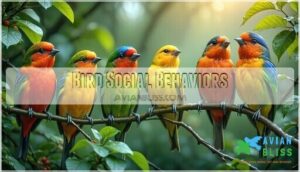
You’ve probably never realized how complex and fascinating bird social interactions can be.
Get ready to uncover surprising secrets about how birds communicate, form relationships, and navigate their intricate social worlds.
Crow Funerals
Ever wondered why crows gather around their dead? These intelligent birds aren’t mourning—they’re investigating potential threats.
Crow funerals are actually sophisticated social learning events where the murder of crows assesses environmental dangers. By examining a deceased companion, they gather critical information about potential predators or risks.
This behavior showcases their remarkable avian intelligence and complex social behavior, demonstrating how they use death as an opportunity to learn and adapt, ultimately enhancing their survival chances.
Anting Behavior
Because some birds have quirky maintenance routines, anting is a fascinating avian behavior where feathered friends use ant species strategically.
When birds rub formic acid-laden ants across their plumage, they’re performing a natural parasite control method that serves an evolutionary purpose.
To further combat these issues, birds may require additional parasite treatments to maintain feather health and protect against unwanted hitchhikers.
This unusual bird habit helps maintain overall health and protect against unwanted hitchhikers.
Northern Shrike Hunting
After discovering how ants interact with bird feathers, prepare to be shocked by the Northern shrike’s gruesome hunting strategy.
These small predators have a macabre approach to meal preparation: impaling prey like insects, rodents, and small birds on sharp branches or thorns.
They’re basically creating a personal meat locker, storing food for later consumption with surgical precision and remarkable efficiency.
Corvid Social Structures
After the Northern Shrike’s predatory precision, nature reveals another marvel: corvid social structures. These intelligent birds form complex societies where hierarchies aren’t just about survival—they’re an art form.
Imagine their world through these snapshots:
- Breeding pairs rule their tight-knit groups
- Yearlings learn intricate social skills
- Juvenile cliques form complex communication networks
Crows, ravens, and blue jays showcase remarkable cooperative breeding and social learning strategies that challenge our understanding of bird intelligence. These birds also exhibit complex flock dynamics for safety, demonstrating their complex societies and social learning capabilities, which are a key part of their bird intelligence.
Gift Giving in Crows
Crows aren’t just intelligent—they’re thoughtful gift-givers who form unique bonds with humans.
After establishing complex social structures, these birds demonstrate remarkable cognitive abilities by exchanging trinkets with people who feed them.
Their gift-giving behavior reveals a sophisticated understanding of social reciprocity that challenges our perception of animal intelligence.
| Gift Type | Typical Object | Emotional Significance |
|---|---|---|
| Shiny | Bottle caps | Social connection |
| Natural | Pebbles | Acknowledgment |
| Crafted | Wire pieces | Trust demonstration |
| Rare | Small toys | Relationship building |
| Personal | Found items | Individual recognition |
Unique Bird Anatomy
You’ll be amazed by the extraordinary adaptations hidden within bird anatomy that defy your wildest imagination.
From woodpeckers’ shock-absorbing skulls to hummingbirds’ incredible beaks, you’re about to discover how these feathered creatures are engineered with mind-blowing biological precision.
Hummingbird Flight

If you’re wondering how birds can pull off mind-blowing aerial stunts, hummingbirds are the ultimate sky acrobats.
Their flight capabilities will blow your mind with these incredible skills:
- Hover like a helicopter
- Fly backward effortlessly
- Wing beats up to 80 times per second
- Zero gravity-like maneuverability
- Inspire cutting-edge drone technology
These tiny dynamos defy physics, transforming flight from simple movement to an art form that leaves other birds in the dust.
Owl Eye Movement
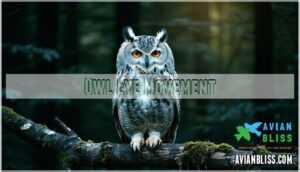
Nocturnal predators with an extraordinary superpower, owls can twist their heads a jaw-dropping 270 degrees without losing blood flow.
Their unique eye structure enables incredible head rotation and precise depth perception during night hunting. Owls’ asymmetrical ear placements further enhance their hunting prowess.
| Feature | Description | Significance |
|---|---|---|
| Head Rotation | 270-degree turn | Survival advantage |
| Neck Vertebrae | Specialized design | Blood flow preservation |
| Eye Positioning | Fixed in skull | Enhanced binocular vision |
| Hunting Efficiency | Uninterrupted tracking | Predatory success |
| Anatomical Adaptation | Unique blood vessel network | Remarkable bird vision |
Their ability to twist their heads is supported by a specialized design of neck vertebrae, which allows for a full range of motion without compromising blood flow, making them highly efficient predators with remarkable bird vision.
Woodpecker Skull

After an owl’s unblinking stare, you’ll be amazed by woodpeckers’ superhuman skull design.
Their remarkable brain protection involves shock-absorbing skull structures that withstand incredible pecking impacts.
These evolutionary adaptations allow woodpeckers to hammer surfaces at 15 mph, enduring forces that would cause human concussions.
Their unique bird anatomy lets them peck up to 8,000 times daily without injury, thanks to their incredible pecking abilities.
Sword-Billed Hummingbird Beak

After the woodpecker’s skull-pounding prowess, prepare to be amazed by nature’s most extreme beak design! The sword-billed hummingbird rocks a beak longer than its entire body – imagine having a nose that extends past your feet!
This wild adaptation lets them reach deep into flower tubes others can’t touch.
- Beak length exceeds body size by remarkable margins
- Critical for accessing unique nectar sources
- Evolutionary marvel of specialized feeding adaptation
- Enables pollination of long, narrow tropical flowers, which is a critical aspect of their ecosystem.
Bird Skeletons
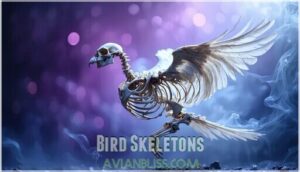
After a hummingbird’s incredible beak, you’ll be shocked by bird skeletons.
Their bones aren’t just hollow—they’re engineering marvels. Bone pneumatization creates air-filled structures that actually strengthen flight skeletons.
Unlike mammals, birds have fused bones that provide rigidity, with a keeled breastbone and wishbone uniquely adapted for aerial performance.
These skeletal adaptations make birds lightweight yet incredibly strong.
Bird Intelligence
You might be surprised to learn that birds are far more intelligent than you’ve been led to believe.
From problem-solving ravens to tool-using crows, these feathered creatures demonstrate remarkable cognitive abilities that challenge our traditional understanding of animal intelligence.
Raven Problem Solving

Can ravens outsmart humans in problem-solving? These intelligent birds demonstrate remarkable cognitive abilities that challenge our understanding of animal intelligence.
Their ability to excel at complex reasoning is notable, and they achieve this through:
Advanced social learning and intricate tool use showcase ravens’ remarkable cognitive abilities, redefining what we know about animal intelligence.
- Advanced social learning techniques
- Intricate tool manipulation strategies
- Sophisticated pre-planning capabilities
Their raven cognition reveals adaptable problem-solving skills that showcase remarkable bird intelligence, proving these creatures are far more intellectually sophisticated than we once believed.
Crow Tool Use
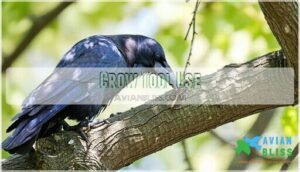
After witnessing ravens’ impressive problem-solving skills, you’ll be blown away by crow tool use – a demonstration to bird intelligence that’ll make your jaw drop!
| Complexity | Material | Purpose |
|---|---|---|
| Simple | Twigs | Probing |
Crows craft tools with precision, selecting materials strategically and demonstrating remarkable cognitive flexibility in manipulating their environment. Their learned behaviors reveal extraordinary innovation in habitat adaptation. You can even find specialized crow products designed for observing this behavior.
Parrot Mimicry

After watching crows wield tools with precision, you’ll be stunned by parrots’ jaw-dropping vocal mimicry skills.
These feathered linguists can perfectly imitate human speech, regional dialects, and even complex sounds like phone rings or car alarms.
Their remarkable vocal learning abilities showcase an incredible evolutionary adaptation that goes far beyond simple bird sounds, revealing their astonishing communication prowess.
These abilities demonstrate that parrots acquire language effectively through their incredible evolutionary adaptation, which is a key aspect of their remarkable vocal learning abilities.
Bird Communication

After parrots blow your mind with their speech skills, get ready to explore how birds truly communicate!
Bird communication isn’t just chirping—it’s a complex symphony of sounds, movements, and signals. Here’s what makes their dialogue fascinating:
- Chickens have over 200 distinct noises
- Birds use vocal mimicry across species
- Alarm calls warn entire flocks of danger
- Visual signals complement intricate sound patterns
Feathered friends craft sophisticated conversations that’ll make you rethink everything you know about animal communication.
Self-Awareness in Birds
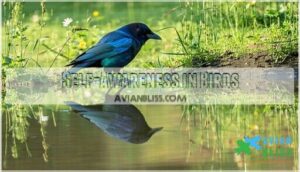
A surprising majority of birds demonstrate remarkable self-awareness through the Mirror Test, revealing complex cognitive abilities beyond simple instinct.
Crows and magpies can recognize their own reflections, suggesting an unexpected depth of consciousness.
These feathered thinkers challenge our understanding of animal intelligence, showing that bird consciousness extends far beyond basic survival skills.
Strange Bird Features
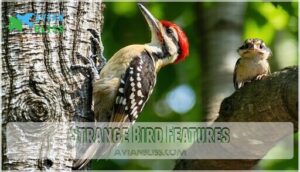
You’ve probably never imagined the bizarre anatomical quirks hiding within the bird kingdom.
From woodpeckers with shock-absorbing skulls to hoatzin chicks sporting wing claws, these feathered creatures boast features that will make you question everything you thought you knew about avian biology.
Ostrich Eyes
After exploring bird intelligence, let’s zoom in on the remarkable ostrich eye—nature’s most impressive optical marvel.
These massive peepers, nearly the size of billiard balls, dominate an ostrich’s head, offering unparalleled vision across sprawling savannas.
With specialized eyelashes that shield against dust and harsh sunlight, these eyes aren’t just big—they’re survival machines perfectly adapted to protect these enormous, flightless birds, making them a true optical marvel.
Kiwi Feathers
After those massive ostrich peepers, kiwi birds sport another marvel: hair-like feathers that break all bird fashion rules.
Unlike sleek, streamlined plumage on other birds, kiwi feathers look more like fuzzy whiskers, packed with sensory bristles that compensate for their poor eyesight.
These unique, hair-like structures help kiwis navigate New Zealand’s dense forest floors through touch and sensation, utilizing their poor eyesight to an advantage.
Hoatzin Chicks
Hoatzin chicks are like tiny throwbacks to the dinosaur age.
Born with wing claws, they climb trees to escape predators, blending mammalian-like movements with avian traits.
These unusual birds also excel at swimming, using their wings in a breaststroke motion.
Despite their fascinating chick development and unique nesting behavior, their survival rate is low due to predators like toucans and monkeys.
Woodpecker Tongues
Bird tongues are nature’s Swiss Army knives, and woodpeckers’ tongues are engineering marvels that’ll blow your mind.
- Wraps around their entire skull
- Extends nearly 4 inches
- Contains barbed, sticky tips
- Acts like a sophisticated probe
- Can dart in and out lightning-fast
Their incredible tongue length and structure let woodpeckers extract insects from deep tree bark with precision that would make a surgeon jealous. Evolution’s design is truly remarkable.
Raven Beaks
Those razor-sharp raven beaks are nature’s Swiss Army knives of survival.
With incredible beak strength and precise morphology, ravens use their powerful tools for everything from cracking nuts to preening feathers.
These intelligent birds demonstrate remarkable feeding adaptations, leveraging their beaks to manipulate objects, tear meat, and showcase their problem-solving skills in ways that continue to amaze researchers.
Bird Sleeping Habits
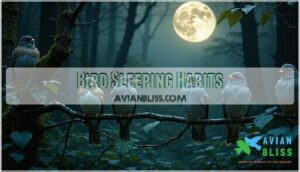
You might think birds simply close their eyes and drift off like humans do, but their sleep strategies are far more complex and fascinating.
Ever wondered how some birds can stay half-alert while resting, or how they manage to perch securely during nighttime hours?
Unihemispheric Slow-Wave Sleep
Ever wondered how some birds stay alert while catching some Z’s?
Unihemispheric slow-wave sleep lets them rest half their brain while keeping the other half on guard.
This mind-blowing adaptation helps birds survive in tricky environments.
Sleep strategies for smart birds:
- Half-brain rest maintains vigilance
- Predator detection remains active
- Environmental monitoring continues
- Motion possible during rest
- Biological survival mechanism
It’s nature’s ultimate multitasking superpower, and this ability is a key part of their biological survival mechanism.
Sleeping With One Eye Open
After mastering unihemispheric slow-wave sleep, some birds take vigilance to the next level.
They literally keep one eye open while snoozing, a mind-blowing survival strategy that lets half their brain rest while the other half stays alert.
This incredible adaptation helps them dodge predators and guarantee their survival in the wild, proving that in the bird world, sleep is both a necessity and a strategic advantage.
Toe Grip Mechanism
Ever wondered how birds stay perched without falling? Your toe grip mechanism is a marvel of evolutionary design.
Here’s how they lock in place:
- Tendon locking prevents accidental slips
- Perching reflex activates automatically
- Claw structure maximizes grip strength
- Skeletal adaptations enable constant hold
- Muscle tension maintains effortless balance
Their anatomical superpowers keep them securely anchored, turning sleep into a gravity-defying balancing act that’ll make you appreciate bird physiology. You can even purchase items related to the toe locking mechanism.
Nighttime Roosting
Roosting safety is essential for birds, and many species choose communal roosts to share warmth and improve predator avoidance.
Roost selection often depends on shelter and elevation, reducing threats during sleep.
Some bird species, like sparrows, tuck into dense foliage, while others, like starlings, prefer urban nooks.
These bird habits highlight fascinating bird behavior and adaptive strategies for nighttime survival, showcasing their ability to thrive in various environments with adaptive strategies.
Sleep Patterns in Birds
While roosting behavior offers safety, sleep patterns in birds reveal fascinating adaptations.
Many use unihemispheric sleep, keeping one eye open to stay alert. Migratory birding species combat sleep deprivation by napping mid-flight.
Avian REM sleep is brief but essential for recovery. Birds use thermogenesis to stay warm during sleep.
Bird research shows these habits guarantee survival, blending rest with vigilance—a true marvel of bird behavior and evolution.
Frequently Asked Questions (FAQs)
What are some odd facts about birds?
Birds are full of surprises.
Did you know some vultures cool off by pooping on their legs?
Meanwhile, crows can solve puzzles, and hummingbirds are the only birds able to fly backward.
What is the least known bird?
The least known bird might be the nocturnal, secretive common poorwill.
It’s the only true hibernating bird, slowing its metabolism and oxygen intake by 90%, blending into rocky habitats so well, it’s rarely spotted.
What is a most common little bird?
Tiny but mighty, the house sparrow takes the crown as the most common little bird.
You’ll spot them everywhere—chirping on fences, hopping on sidewalks, or scavenging crumbs, thriving in cities and countrysides alike.
What are some interesting bird facts?
Imagine a bird using ants like spa treatments—over 200 species do this to maintain feathers.
Crows hold “funerals” to assess danger, while hummingbirds, the only birds flying backward, fiercely chase off hawks despite their tiny size. complete concepts
What do you know about 15 amazing bird species?
You’ve got to love nature’s variety!
From Harris’s hawks hunting like wolves to sword-billed hummingbirds sipping nectar with their extra-long beaks, and crows solving puzzles, these 15 bird species redefine intelligence, teamwork, and adaptation. Teamwork, and adaptation.
What is the tiniest bird in the world?
The world’s tiniest bird, the bee hummingbird, measures just about 2 inches long and weighs less than a dime.
Found in Cuba, it’s so small that it’s often mistaken for an insect!
What is the earliest known bird?
The earliest known bird is Archaeopteryx, a fascinating mix of bird and dinosaur traits.
It lived about 150 million years ago, had feathers for flight, but also sported teeth and a long, bony tail.
What is the most common bird in the world?
Feathered flocks flourish worldwide, but the house sparrow takes the crown as the most common bird.
These adaptable, social creatures thrive in urban areas, chirping cheerfully while scavenging crumbs and nesting near human habitats, making them highly social creatures.
Which bird has a longer bill than its body?
The sword-billed hummingbird boasts a bill longer than its body, perfectly designed for sipping nectar from deep, slender flowers.
It’s like nature handed this bird a custom straw for its favorite floral drinks!
What is the smallest bird facts?
Weighing just 2 grams, the bee hummingbird takes the crown as the smallest bird.
Its tiny size doesn’t hold it back—it makes up for it with rapid wingbeats, dazzling iridescence, and fierce territorial defense!
Conclusion
It’s almost mind-boggling how much there’s to discover about birds.
These little known bird facts reveal their extraordinary behaviors, unique anatomy, and impressive intelligence, proving they’re more than just creatures of flight.
From crows mourning their dead to hummingbirds defying gravity and kiwi feathers resembling fur, each fact deepens our appreciation for these fascinating animals.
Observing birds offers a glimpse into nature’s complexity, encouraging curiosity and respect for their remarkable adaptability and survival skills.