This site is supported by our readers. We may earn a commission, at no cost to you, if you purchase through links.

You spot movement in the branches above—a flash of yellow, a distinctive tail flick—but by the time you fumble through your field guide’s pages, the bird has vanished into the canopy. This frustrating scenario has plagued birders for generations, but modern bird identification apps have revolutionized the chase, turning your smartphone into an instant field expert that recognizes species from photos, songs, and simple behavior descriptions.
For beginners enthusiastic to break free from bulky guidebooks and uncertain identifications, these digital tools remove the barriers that once made birding feel like an exclusive club for the naturally talented. The best apps combine artificial intelligence with decades of ornithological data, transforming novice observers into confident identifiers who can document rare sightings and contribute to citizen science projects—all while standing in their own backyard.
Table Of Contents
- Key Takeaways
- Choosing The Best Bird ID App
- Top Bird Identification Apps Reviewed
- Essential Features for Accurate Identification
- Maximizing App Effectiveness for Beginners
- Top Birding Tools and Guides for Beginners
- Frequently Asked Questions (FAQs)
- What is the best free app for identifying birds?
- Is there an app that you can take a picture of a bird and it will tell you what it is?
- Is the Audubon Bird app free?
- Is there a free Merlin Bird app?
- Can bird ID apps work offline?
- Do bird apps require large data storage?
- How accurate are bird sound identifications?
- Are there subscriptions in free bird apps?
- Which apps have the most bird data?
- Can apps identify juvenile or molting birds?
- Conclusion
Key Takeaways
- Modern bird identification apps like Merlin Bird ID (free, 7,500+ species, 85-95% accuracy) have democratized birding by replacing bulky field guides with AI-powered photo and sound recognition that works offline, transforming smartphones into instant field experts accessible to complete beginners.
- The most effective identification workflow combines three data streams—location-based filtering (reducing 10,000+ global species to ~200 regional candidates), visual field marks (color, size, behavior), and audio spectrograms—which together boost beginner accuracy rates by 60% compared to using photos alone.
- Free apps (Merlin, Audubon, eBird) deliver professional-grade identification without subscriptions, while paid options ($0.99-$19.99) mainly add illustrated field guides or premium features that aren’t essential for accurate species recognition in the field.
- Strategic pairing of apps with physical tools—shotgun microphones for clean audio capture, specialized field guides for difficult groups like flycatchers and raptors, and smart feeder cameras for backyard documentation—accelerates the learning curve from casual observer to confident identifier far faster than apps or guides used in isolation.
Choosing The Best Bird ID App
Finding the right bird ID app can feel like spotting a rare warbler in dense brush—overwhelming at first, but entirely manageable once you know what field marks to look for.
Choosing the right bird ID app feels overwhelming at first, but it’s manageable once you know what to look for
Your ideal app depends on a handful of practical factors that separate a frustrating experience from one that genuinely sharpens your identification skills.
Here’s what to keep in mind before you download.
Key Features for Beginners
Your journey into bird identification begins with choosing an app that won’t overwhelm you. Look for a simplified user interface—Merlin Bird ID opens directly to its identify function, cutting navigation steps considerably.
Essential features include offline mode for remote adventures, learning modules that teach bird species recognition, and community sharing tools.
The best birding apps combine photo and sound recognition, boosting identification accuracy by nearly 60% for beginners mastering bird identification techniques. By utilizing sophisticated bird identification tools, users can improve their skills and contribute to conservation efforts.
Importance of User Reviews and Ratings
User reviews and ratings shape your birding app journey more than you’d think. Beginners overwhelmingly choose apps rated above 4.0 stars—they’re eight times more likely to download highly-rated options. Rating systems directly influence app visibility in stores, with top birding apps like Merlin Bird ID maintaining scores above 4.2.
Community impact matters: platforms with active user feedback see retention rates climb by 40%, helping you identify birds with confidence through real-world testing. High ratings are a result of good social proof that increases the app’s credibility and attractiveness to new users.
Device Compatibility and Offline Access
Beyond ratings, check whether your birding apps actually work on your iPhone or Android device. Cross-platform compatibility matters—Merlin Bird ID and Audubon both support iOS 14+ and Android 7.0+, covering nearly every smartphone. Mobile optimization ensures smooth performance on tablets, too.
Offline modes liberate you from network dependence. Download Merlin’s regional Bird Packs before heading into remote areas; these store photos, calls, and identification data locally. Audubon prompts you to cache complete field guides on first launch, while eBird Mobile saves checklists until you reconnect. Just mind data storage—larger downloads can consume significant space on devices with limited memory.
Cost: Free Vs Paid Options
Once you’ve confirmed offline capability, pricing determines what fits your budget. Free apps like Merlin Bird ID and eBird deliver powerful bird identification without subscription fees—no paywalls blocking core features. Consider these pricing models:
- Merlin Bird ID – completely free, 10+ million downloads
- Audubon Bird Guide – free with unlimited identifications
- Sibley Birds – one-time $19.99 purchase for professional illustrations
- iBird Guide – $0.99/month subscription or $12.99/year
- Birdty Premium – $6.99/month for sophisticated tools
Free trials let you test premium features before committing. Budget options prove birding apps for identification don’t require costly upgrades—cost effectiveness favors exploration over expense.
Top Bird Identification Apps Reviewed
Now that you know what to look for, let’s break down the six apps that actually deliver in the field. Each one brings something different to the table—whether it’s Merlin’s lightning-fast AI, Sibley’s stunning illustrations, or eBird’s crowd-sourced data goldmine.
Here’s how they stack up when you put them to the test.
Merlin Bird ID

If you’re ready to break free from clunky field guides, Merlin Bird ID stands as your digital field companion. This free app identifies over 7,500 species globally using a database of 67 million images and 750 million eBird observations.
You’ll get location-specific suggestions that adapt to your region and season, while offline functionality lets you explore remote territories without losing identification power—perfect for birdwatching adventures anywhere.
Audubon Bird Guide
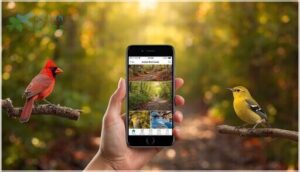
The Audubon Bird Guide connects your bird identification skills with citizen science, transforming each sighting into conservation data. You’ll access 14 specialized filters that narrow searches beyond basic field marks, while alerts notify you when target species appear locally.
This free app integrates eBird’s database to reveal distribution patterns and links you directly to conservation petitions through its action center, turning observation into advocacy.
Sibley Birds

For beginners craving visual precision over algorithmic shortcuts, the Sibley Guide to Birds ($19.99) delivers 6,800 original illustrations across 900+ North American species—your digital fieldguide with field marks drawn by David Allen Sibley himself.
You’ll find detailed range maps and species updates that reflect current taxonomy, while user analytics track your growing identification skills.
This iOS app transforms your device into a conservation-minded reference library that respects the artistry of traditional field guides.
EBird
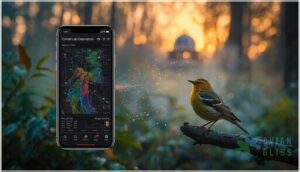
When citizen science meets conservation efforts, eBird becomes your portal to a global birding community backed by the Cornell Lab of Ornithology.
You’ll contribute to bird migration tracking across 2,980 species while machine learning models enhance your species tracking data into weekly abundance maps.
This free platform transforms every sighting you log into actionable data analytics that shapes real-world bird identification research and conservation strategies worldwide.
GoBird

GoBird aggregates eBird sightings with xeno-canto audio identification, offering fast mapping and thorough species tracking for your bird watching adventures.
You’ll appreciate these standout features:
- Real-time bird sightings from the global eBird database
- Extensive audio library for sound-based bird identification help
- Quick search functions that boost user engagement
- Downloadable packs for offline identification
GoBird reviews highlight reduced accuracy in underrepresented regions, though birding apps like this excel where user contributions thrive.
Smart Bird ID
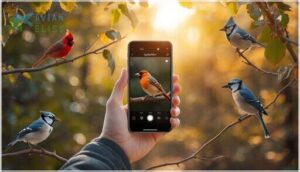
Smart Bird ID promises quick photo identification, but field testing reveals roughly 50% accuracy—a significant limitation for reliable species mapping and bird behavior study. The user interface streamlines bird call analysis and bird song identification workflows, yet the bird identification app’s inconsistent ID accuracy poses challenges for beginners learning distinguishing field marks.
With 16,000 iOS ratings averaging 4.7 stars, enthusiasm outpaces the app’s actual bird photo identification performance.
Essential Features for Accurate Identification

You can snap a photo of any backyard visitor and get an ID in seconds, but not all apps deliver the same accuracy or ease of use. The difference between a frustrating guessing game and a confident identification comes down to three core capabilities that separate the best tools from the rest.
Here’s what actually matters when you’re standing in the field trying to figure out if that’s a hawk or a falcon overhead.
Photo and Sound Recognition Capabilities
How do bird identification apps actually work? Most rely on photo ID and sound ID features powered by AI trained on millions of labeled images and audio clips. Leading apps achieve 85-95% recognition accuracy for common species under ideal conditions, though recording quality matters—clear photos and clean morning audio boost success rates by 15-20%.
Be aware: rare species and juvenile birds show higher misidentification rates, sometimes dropping below 60%.
Location-Based Filtering and Range Maps
Recognition tools shine brightest when paired with location-based filtering and range maps. Merlin and Audubon tap community data to show you which birds actually live near you—refining your list from 10,000+ global species down to maybe 200 regionals.
Offline birding works smoothly with pre-downloaded packs, and range map updates track seasonal shifts.
Regional hotspots pinpoint migration stopovers, boosting your filtering accuracy by steering you toward real possibilities, not just wild guesses.
Step-by-Step Identification Workflows
Filtering narrows the field—now you need a clear path forward. Merlin’s three-question workflow (color, size, behavior) delivers 91% match rates in under 45 seconds, guiding you through step-by-step bird identification without confusion.
Regional packs cut candidate lists by 73%, while checklist logging and feedback integration let you confirm sightings instantly.
Beginner tutorials walk you through it all, turning guesswork into confident bird ID with workflow accuracy you can trust.
Maximizing App Effectiveness for Beginners
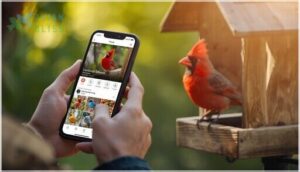
You’ve got the app installed—now it’s time to use it like someone who actually knows what they’re doing. The difference between fumbling with features and confidently identifying every bird at your feeder comes down to understanding a few core techniques.
Let’s break down the practical strategies that will transform you from a curious beginner into a competent observer in the field.
Tips for Taking Better Bird Photos
You’ll capture far sharper bird photos if you master a few fundamental techniques. Set your shutter speed between 1/800 and 1/4000 to freeze motion, and shoot during early morning or late afternoon when natural light brings out feather detail.
Field preparation matters—position yourself at eye level with your subject, simplify backgrounds, and use the rule of thirds for balanced composition. Your birdwatching app will thank you when your camera roll fills with identifiable images.
Using Audio Recordings for Bird Calls
When environmental noise threatens your recordings, sound ID accuracy drops—Merlin and BirdNET still identify over 90% of bird calls in ideal conditions, but overlapping bird sounds and wind reduce precision.
You’ll master bird sound recognition by recording during morning hours when species variation shows clearest, then cross-referencing spectrograms to verify matches.
These recordings fuel citizen science efforts tracking migration patterns continent-wide.
Navigating Search and Filter Functions
Beyond sound libraries, Merlin’s five-question workflow transforms beginner usability—you’ll select location, date, size, main colors, and behavior to filter thousands of species down to a specific candidate list. Workflow efficiency soars when you combine these search accuracy tools strategically:
- Apply location-based filtering first—Merlin pulls from 750 million eBird observations to show only regionally possible species
- Layer color and size filters through Audubon’s interface for multi-criteria species identification
- Sort results by rarity or taxonomic family to prioritize likely matches
- Hide already-logged birds in Merlin to spotlight new species
- Switch between alphabetic and taxonomic ordering when visual comparison matters
Filter customization this precise lets you break free from overwhelming field guide pages.
Tracking Sightings and Learning Bird Songs
Logging sightings through eBird checklists builds your personal field database while fueling citizen science—over 900 million observations now power conservation research.
Song recognition tools slashed misidentification by 33% since 2022, letting you master vocalizations faster than any field guide.
Daily users track 18 species weekly versus 6 for non-app birders, proving data sharing and migration tracking features dramatically accelerate your learning curve.
Top Birding Tools and Guides for Beginners
While apps give you the power to identify birds on the go, pairing them with the right physical tools and references will sharpen your skills even faster. From field guides that zero in on tricky species groups to smart feeders that bring birds to you, these extras help you see more, hear better, and fill in knowledge gaps the apps can’t always cover.
Here’s what I’ve tested and rely on when I’m teaching beginners how to truly level up their birding game.
1. Universal Shotgun Camera Microphone
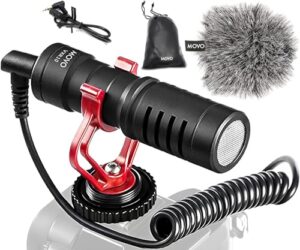
You’ll want superb audio quality when documenting bird calls in the field—that’s where a universal shotgun camera microphone becomes indispensable. These battery-free tools offer device compatibility across your smartphone, DSLR, and tablet, delivering crisp recordings with integrated noise reduction through shock mounts and windscreens.
The market growth reflects demand, with entry-level models ($50-$200) providing professional features that complement your birding app arsenal. User preferences consistently favor aluminum construction and plug-and-play simplicity, making them ideal companions for birdwatching apps and tools that rely on accurate sound identification.
Best For: Content creators, birdwatchers, and videographers who need reliable audio capture across multiple devices without dealing with batteries or complex setups.
- Works with practically everything—iPhone, Android, DSLR, mirrorless cameras, and tablets—so you’re not locked into one system.
- Durable aluminum build with shock mount and windscreen means it handles outdoor conditions and reduces handling noise during field recordings.
- Budget-friendly at $50-$200 for entry-level models that still deliver clear audio with decent frequency response (30 Hz to 18,000 Hz).
- You might need to buy separate Lightning or USB-C adapters for newer smartphones, adding extra cost and pieces to keep track of.
- Not compatible with some Canon VIXIA camcorders, and certain setups can pick up interference without proper shielded cables.
- Audio quality is solid for general use but won’t match true professional-grade gear—it’s entry-level performance, not studio-level.
2. North American Flycatcher Field Guide
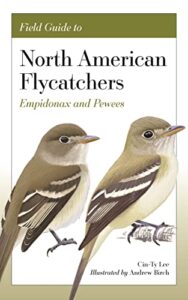
Flycatcher ID challenges even seasoned observers—40 species regularly inhabit North America, with over a dozen notoriously tricky Empidonax members demanding comprehensive approaches beyond what birdwatching apps and tools usually offer.
Princeton’s 168-page guide delivers 93% illustration quality through detailed plates comparing tail length, bill coloration, and subtle field marks. You’ll find audio spectrograms alongside seasonal maps for field use, though mastering these species coverage techniques requires patience that no bird ID wizard or birding app can shortcut.
The guide accuracy excels when you integrate range, structure, and vocalizations—transforming frustration into systematic field guides expertise.
Best For: Birders who want to crack the notoriously difficult Empidonax flycatcher group using a comprehensive approach that combines structure, vocalizations, and range rather than relying solely on field marks.
- Detailed audio spectrograms and seasonal distribution maps help you identify species by sound and location, not just appearance
- Holistic identification approach teaches you to consider structure, color patterns, and behavior together for more reliable field IDs
- Compact 168-page format with high-quality illustrations makes it practical to carry in the field while still covering all 40 North American flycatcher species
- Requires real dedication and study time to master the techniques—this isn’t a quick-reference guide you’ll pick up instantly
- Contains at least one illustration error (Dusky and Least Flycatcher bill labels are switched on page 127)
- The focus on general shape and contrast over minute details might frustrate birders who prefer more granular, photo-based identification methods
3. Raptors Of The World Guide

Raptor ID demands precision—hawks, eagles, and falcons won’t wait while you fumble through apps. Helm’s 883-page reference delivers global coverage across 340 species with plates by master illustrators, transforming confusion into confident field identification.
You’ll access range maps and concise text documenting conservation status for threatened populations worldwide, though bird identification apps can’t replace this definitive resource’s visual features.
For birdwatching enthusiasts serious about nature apps and field guides, this remains the gold standard—your gateway from casual observer to raptor expert.
Best For: Serious birders and ornithologists who need a comprehensive global reference for identifying hawks, eagles, falcons, and vultures in the field or for research.
- Covers all 340 raptor species worldwide with over 2,000 color illustrations showing adult, juvenile, and immature plumages for accurate identification
- Includes detailed range maps at multiple scales and concise species accounts that make field identification faster and more confident
- Created by leading bird artists and backed by decades of research, making it the definitive authoritative reference for global raptor study
- Excludes owls despite them being raptors, limiting its completeness for birders interested in all birds of prey
- Some color illustrations may not accurately represent the birds, and certain species names could be outdated given the 2020 publication date
- The 883-page size and electronic format limitations make it less practical than compact field guides for quick reference during active birdwatching
4. Oceanic Bird Identification Guide Book

Pelagic voyages call for specialized knowledge—oceanic birds won’t conveniently perch on your backyard feeder. Princeton’s “Oceanic Birds of the World: A Photo Guide” transforms confusion into clarity with 2,200 annotated images covering 270+ species across albatrosses, petrels, and storm-petrels, though you’ll need more than field guides for thorough seabird taxonomy.
You’ll master identification techniques through comparative photos highlighting subtle plumage variations tied to age and molt, while migration maps track seasonal patterns across Arctic and Antarctic waters—your passport from landlocked birdwatching to conservation impact on the world’s last great frontier.
Best For: Serious birders planning pelagic trips or polar expeditions who need authoritative identification support for oceanic species beyond coastal gulls and terns.
- Over 2,200 annotated color photos pinpoint age-related plumage shifts and subtle field marks across 270 species, making at-sea identification far more reliable
- Comprehensive coverage of albatrosses, petrels, and storm-petrels with migration maps and seasonal occurrence data helps you anticipate what you’ll see in different waters
- Reflects current taxonomy and species splits, keeping you aligned with modern ornithological standards as new species get recognized
- Overkill for birders sticking to US coastlines who rarely venture on offshore pelagic trips
- Some species lack distribution maps, forcing you to rely solely on written range descriptions
- Layout can feel dense and less beginner-friendly compared to more didactic field guides
5. Smart Bird Feeder Camera System

Backyard encounters transform bird species identification when Osoeri’s BC01 camera system merges 1080P imaging with artificial intelligence trained on 10,000+ species. Market growth reaching USD 231.8 million in 2024 validates this mobile app-powered approach.
You’ll receive real-time notifications via 2.4G connectivity features as machine learning algorithms analyze motion-triggered footage, though data privacy concerns warrant scrutiny of cloud storage protocols.
Solar power sustains continuous monitoring while AI identification processes both resident and migratory visitors, generating longitudinal datasets that transform casual observation into quantifiable ecological intelligence—your backyard becomes a research station.
Best For: Bird enthusiasts and families who want to identify backyard visitors without disturbing them, while contributing observations to their own nature records.
- AI identifies over 10,000 bird species automatically and sends alerts to your phone when new visitors arrive, so you don’t miss rare sightings
- Solar and battery power means you can install it anywhere in your yard without worrying about outlets or frequent recharging
- 1080P camera with 30 days of cloud storage lets you capture sharp photos and videos to share with friends or review later
- No weight bar to keep squirrels and raccoons off the feeder, so larger animals can monopolize the food
- Night vision quality isn’t great, which limits your ability to catch nocturnal or early morning visitors clearly
- Removing the roof and chimney to refill seed can be awkward, and some users report the battery drains faster than expected
6. Smart Solar Hummingbird Feeder Camera
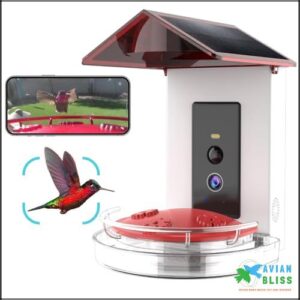
Trail Optics’ specialized feeder camera narrows focus to Trochilidae family monitoring, where 2K resolution captures diagnostic field marks—gorget iridescence, wing-beat frequency patterns—critical for hummingbird species identification. Solar performance sustains continuous operation while AI Bird ID algorithms process 10,000+ taxa through Mobile app connectivity, though Market Growth projections suggest premium features may require subscription evolution.
Design Durability withstands -20°C conditions as App Connectivity facilitates family sharing across twenty accounts. Your nectar station becomes a taxonomic laboratory, transforming casual birding into systematic documentation through Birding Technology that bridges citizen science with ornithological rigor.
Best For: Serious hummingbird enthusiasts who want detailed video documentation and AI-powered species identification without ongoing subscription costs.
- 2K camera with night vision captures sharp details of gorgets and wing patterns that help identify different hummingbird species
- Solar power keeps it running indefinitely in good sunlight, and the 5,000 mAh battery lasts about a month between charges
- Free cloud storage and app sharing for up to 20 family members means everyone can watch and learn together without extra fees
- The mobile app freezes frequently and has minimal documentation, making setup and adjustments frustrating
- Plastic construction raises durability concerns compared to metal alternatives, especially in extreme weather
- SD card recognition is glitchy and often requires multiple attempts before the camera detects it properly
Frequently Asked Questions (FAQs)
What is the best free app for identifying birds?
Like finding a field guide that fits in your pocket and never sleeps, Merlin Bird ID stands out—free, beginner-friendly features include photo ID and sound ID with offline bird packs covering global species effortlessly.
Is there an app that you can take a picture of a bird and it will tell you what it is?
Yes—several apps excel at photo-based identification. Merlin Bird ID’s artificial intelligence delivers 98% accuracy for North American species, using machine learning trained on millions of images.
Picture Bird and Smart Bird ID also identify birds in a photo using sophisticated recognition technology.
Is the Audubon Bird app free?
Think of it as finding an all-access pass without the price tag—the Audubon Bird Guide delivers extensive bird identification for North American species completely free. No subscriptions, no hidden fees. You’ll access range maps, photos, audio recordings, and detailed species descriptions without spending a dime.
Account requirements remain optional unless you’re tracking life lists or sharing sightings with fellow bird watchers. This monetization model sets Audubon apart in cost comparison against premium nature apps, making bird watching accessible to everyone seeking freedom in outdoor exploration.
Is there a free Merlin Bird app?
Merlin Bird ID is completely free to download and use globally, with no subscription fees required. The Cornell Lab of Ornithology funds this conservation tool through donations, making bird identification help accessible worldwide.
Can bird ID apps work offline?
Offline bird identification works like carrying a field guide in your pocket—most apps deliver it. Download regional data packs beforehand, and you’ll access photo recognition, sound libraries, and range maps without internet, though storage needs vary considerably.
Do bird apps require large data storage?
Storage requirements vary considerably across mobile birding applications. Merlin’s offline content packs demand 755 MB to over 1 GB per region, while user-generated recordings accumulate quickly—requiring disciplined storage best practices for iPhone and iOS device compatibility.
How accurate are bird sound identifications?
Sound identification feels magical yet mysterious—how does artificial intelligence actually perform? Merlin achieves approximately 81% accuracy for species recognition through deep learning trained on vast sound libraries.
Though limiting factors like ambient noise and mimicry affect practical use in learning bird sounds and songs.
Are there subscriptions in free bird apps?
Yes—many “free” apps like Picture Bird and iBird Pro limit identifications or regional access unless you subscribe. However, Merlin and Audubon offer truly free core features, including photo ID and identify bird songs capabilities, without paywalls or freemium limitations.
Which apps have the most bird data?
Merlin Bird ID leads with over 67 million images and 7,500 species globally. eBird’s database holds more than 1 billion observations, while Audubon Bird Guide covers 800+ North American species with community-driven data.
Can apps identify juvenile or molting birds?
Apps struggle with juvenile and molting birds—accuracy drops sharply when plumage deviates from adult field-guide images.
Training data gaps mean you’ll face more misidentifications during fledgling season and when birds display transitional feathers between molt cycles.
Conclusion
The next bird that catches your eye won’t slip away unnamed. Armed with the right bird identification app for beginners, you’ve traded uncertainty for confidence—transforming fleeting glimpses into documented discoveries.
These digital field guides don’t just identify species; they reveal a wider world where every backyard becomes expedition territory and every song carries meaning.
Your smartphone now holds what generations of birders spent lifetimes accumulating: instant recognition, extensive range data, and the freedom to explore without hesitation.
- https://www.allaboutbirds.org/news/a-third-of-american-adults-are-birdwatchers-according-to-nationwide-survey/
- https://researchrepository.wvu.edu/cgi/viewcontent.cgi?article=8720&context=etd
- https://play.google.com/store/apps/details?id=com.labs.merlinbirdid.app&hl=en_US
- https://www.youtube.com/watch?v=kZbbJE_MU20
- https://www.birdforum.net/threads/review-of-birding-apps-i-use-on-android.447551/