This site is supported by our readers. We may earn a commission, at no cost to you, if you purchase through links.
Red-winged Blackbirds have vanished from half their Minnesota haunts since 1967, yet American Goldfinches are quietly gaining ground. Your backyard sits at the crossroads of this changing landscape, where 13 common species compete for feeders, nesting sites, and the native plants that fuel their survival.
Understanding which birds call your yard home—and why some are thriving while others struggle—starts with learning to recognize their field marks, behaviors, and seasonal rhythms. The chickadees at your suet feeder and the robins hunting your lawn each tell a story about habitat, climate, and the simple choices you make in your outdoor space.
Table Of Contents
Key Takeaways
- Minnesota’s backyard bird populations are shifting dramatically, with Red-winged Blackbirds declining over 50% since 1967 while American Goldfinches increase by 0.87% annually, reflecting broader habitat and climate changes across the state.
- Creating effective bird habitat requires layering native plants like serviceberry and Wild Bergamot with proper water sources and feeders, since a single chickadee brood needs 9,000 caterpillars that only native vegetation can reliably provide.
- You can identify Minnesota’s 13 most common backyard species by focusing on size comparisons, distinctive behaviors like the goldfinch’s upside-down feeding or the Song Sparrow’s backward-hopping “Samba” dance, and seasonal plumage changes that alter appearance throughout the year.
- Participating in citizen science projects like the Minnesota Breeding Bird Atlas and Christmas Bird Count directly supports conservation by providing data that informs habitat management decisions and tracks how climate change is shifting migration dates by up to 10 days.
Most Common Backyard Birds in Minnesota
Minnesota’s backyards host a rich variety of bird species throughout the year, from summer visitors to year-round residents. You’ll find everything from tiny hummingbirds to large waterfowl making their homes in the state’s diverse habitats.
Here are the 13 most common backyard birds you’re likely to spot in Minnesota.
American Robin
The American Robin is Minnesota’s most recognizable backyard bird, spotted in all 87 counties and 85% of surveyed areas. You’ll find these adaptable migrants from March through November, with some overwintering when fruit’s plentiful. The robin’s continental concern score is relatively low, at 5/20.
Minnesota’s robin population has grown 0.74% yearly since 1966.
- Foraging habits: They hunt earthworms and insects on lawns, also eating fruits from over 50 plant types
- Nesting locations: Usually 5-20 feet up in trees or on structures like mailboxes
- Migration patterns: Most winter in southern states, returning each spring
- Conservation efforts: Minnesota’s robin population has grown 0.74% yearly since 1966
Red-winged Blackbird
You’ll spot Red-winged Blackbirds in 50% of Minnesota summer checklists, though their population has declined by over 50% since 1967. Males arrive weeks before females to claim wetland territories, pairing with up to 15 mates. These adaptable birds nest in marshes and ditches, consuming 75% seeds annually but switching to insects during the breeding season. Despite their adaptability, wetland habitats are essential for their survival.
| Characteristic | Details | Minnesota-Specific |
|---|---|---|
| Population Status | 5.6–8.8 million statewide | Declining 1.49% annually |
| Habitat Preference | Wetland marshes, ditches | 52% wetlands lost |
| Migration Pattern | Late August–October south | Males return February |
| Mating Habits | Polygynous breeding | Up to 15 females/male |
| Diet Diversity | 75% seeds, 25% insects | Dragonflies, corn, snails |
American Goldfinch
If you’ve enjoyed wetland blackbirds, you’ll love the cheerful American Goldfinch, showing up in 42% of summer checklists. Minnesota’s populations are actually increasing by 0.87% annually—bucking the continental decline trend. These strictly vegetarian birds delay nesting until late summer when thistle seeds ripen, and you’ll spot them hanging upside-down at feeders using their feet to grip seedheads.
- Males molt into vivid yellow breeding plumage each spring
- Nesting begins in July when thistles provide nest-building materials
- Niger seed at feeders attracts goldfinches year-round in southern Minnesota
- Breeding densities reach 15 birds per survey route statewide
Song Sparrow
While goldfinches grab attention with bright colors, you’ll hear Song Sparrows before you see them—their melodic trills echo through Minnesota backyards from March through August. These brown-streaked birds with distinctive chest spots show up in 79.7% of surveyed blocks. Watch them scratch the ground beneath feeders, hopping backward in their signature “Samba” dance while hunting seeds.
| Song Sparrow ID | Details |
|---|---|
| Size & Markings | Brown cap, streaked breast with central spot, 11-18 cm length |
| Feeding Habits | Ground foragers preferring millet; digest 80-90% of food |
| Migration Patterns | Year-round residents; northern birds migrate south in winter |
Black-capped Chickadee
You’ll find this acrobatic resident year-round in Minnesota backyards, appearing in 43% of summer checklists. The Black-capped Chickadee masters winter adaptations through food caching—storing seeds in bark crevices—and nest excavation in rotting wood.
Population trends show stable numbers despite slight recent declines. Listen for their distinctive two-note whistle and “chick-a-dee-dee” vocal communication.
At bird feeders, they grab black oil sunflower seeds and dart away, a behavior unique among backyard birds.
American Crow
You’ll recognize this clever bird by its all-black plumage and distinctive caw vocalizations—American Crows thrive in Minnesota year-round, appearing in 41% of checklists.
Their crow intelligence shines through problem-solving foraging behavior and a complex social structure with helper birds assisting at nests.
Urban adaptation makes them common in backyards, where they feast on everything from insects to fruit, showcasing striking bird behavior flexibility.
Blue Jay
This bold blue sentinel appears in 37% of summer checklists across Minnesota, making it one of the most reliable backyard birds you’ll encounter at your bird feeders year-round.
Blue Jay populations remain stable despite West Nile threats, thanks to their adaptability. You’ll notice their fascinating traits:
- Acorn caching behavior aids forest populations—they hide up to 1,000 nuts daily
- Migration patterns vary, with only 20% traveling south each fall
- Feeder visits peak during winter when backyard bird identification becomes easier
Their intelligence and striking appearance make them unforgettable Minnesota residents.
Northern Cardinal
This crimson-crested beauty appears in 33% of summer checklists, making Northern Cardinal identification easy for Minnesota backyard bird enthusiasts. You’ll spot males’ vivid red plumage variations year-round at bird feeders, while females display subtle tan with rosy accents.
Their urban adaptation is striking—about 624,000 adults thrive statewide, with cardinal territories concentrated around the Twin Cities.
Watch mating rituals in spring when males feed females sunflower seeds during courtship. Their diet composition shifts seasonally between seeds and insects.
Downy Woodpecker
Appearing in 25% of summer checklists, the Downy Woodpecker ranks as Minnesota’s third most common woodpecker, with roughly 220,000 breeding adults statewide. You’ll notice regional variation in population trends—some northern forests show slight declines while urban areas remain stable.
- Watch their dietary habits shift from insects to tree sap in winter
- Look for nesting preferences in dead trees 12-30 feet high
- Attract them to bird feeders with suet and sunflower seeds
- Their human interaction makes backyard bird identification rewarding year-round
Mourning Dove
Minnesota’s Mourning Dove population of roughly 12 million makes these ground-feeders easy to spot, especially around the Twin Cities. You’ll hear their mournful cooing from May through September when breeding pairs raise three broods. Attract them with cracked corn and millet on platform feeders.
Despite hunting controversy, these migratory birds remain abundant, though populations show a concerning 2.1% annual decline since the 1960s.
Ruby-throated Hummingbird
While Mourning Doves prefer seeds on the ground, Ruby-throated Hummingbirds seek nectar sources above. You’ll spot these tiny jewels hovering at your sugar water feeders from May through August.
Females build camouflaged nests using spider webs, raising young on nectar and insect consumption.
Despite their eastern population doubling since the 1950s, recent population decline of 17% signals conservation concerns for Minnesota’s only breeding hummingbird.
Mallard
You’ll find Mallards year-round in Minnesota wetlands and backyard ponds, making them the state’s most abundant waterfowl. These adaptable ducks nest in both seasonal wetlands and upland forests, with population trends showing slight increases despite regional habitat loss.
Conservation efforts focus on protecting breeding habitats in the Prairie Pothole Region, where local production underpins about half of Minnesota’s harvested Mallards.
Canada Goose
While Mallards occupy wetlands, Canada Geese have claimed urban parks and golf courses, thriving where open lawns meet water. You’ll spot these monogamous pairs defending territories fiercely during breeding season, with peak nesting from early April through May.
Goose population growth has exceeded management goals—reaching 320,000 birds statewide by 2015—prompting urban goose management strategies like egg oiling and relocation to balance human-wildlife interactions.
Identifying Minnesota Backyard Birds
Identifying birds in your Minnesota backyard doesn’t have to be complicated. You can narrow down species quickly by focusing on a few key features that are easy to spot.
Here’s what to look for when you’re trying to figure out which bird just landed in your yard.
Size, Shape, and Silhouette
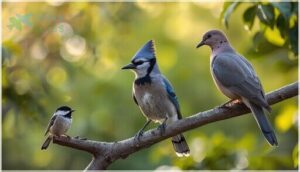
You can identify Minnesota backyard birds by examining their size, shape, and silhouette—three physical traits that remain visible even at a distance. Start with these bird identification techniques:
- Relative Bird Sizes: Compare birds to familiar species. Mourning Doves measure 9.1 to 13.4 inches, while Black-capped Chickadees are tiny at 4.7 to 5.9 inches—much smaller than sparrows.
- Silhouette Recognition: Notice body proportions like the Blue Jay’s prominent crest or the Downy Woodpecker’s compact body and stiff tail used for climbing.
- Shape Adaptations: Look for distinctive features—chickadees have round heads on small bodies, while Mourning Doves show sleek bodies with pointed tails.
These bird characteristics and features help you distinguish species before you even see their plumage.
Color Patterns and Markings
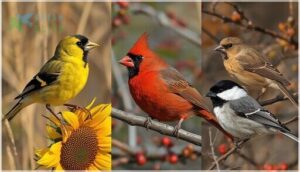
When you’re out with a bird identification guide, pay close attention to plumage variation and seasonal changes. For instance, American Goldfinches shift from bright yellow to muted olive-gray, while juvenile robins show more mottled camouflage.
Noticing these regional differences and subtle markings makes backyard bird identification easier, especially when distinguishing young birds from adults by their plumage and appearance.
Distinctive Behaviors
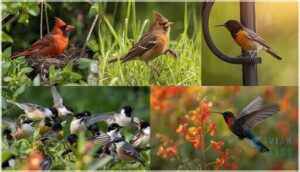
Watching backyard birds in Minnesota, you’ll spot unique behaviors that help with bird identification. For example:
- Territorial defense—robins sing loudly, red-winged blackbirds confront intruders.
- Foraging habits—goldfinches prefer seeds, robins hunt worms.
- Social flocks—chickadees gather in mixed groups.
- Nesting rituals—cardinals build hidden nests.
- Migration patterns—hummingbirds vanish in fall.
These details make bird watching rewarding.
Bird Songs and Calls
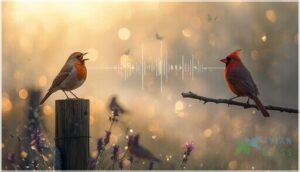
Minnesota mornings come alive with bird songs and calls—each species offering its own dialect. Songbirds like robins and cardinals use song complexity for mate attraction and territorial defense. Urban noise nudges some birds to sing higher.
Vocal learning shapes these tunes early in life, while call functions—like alarms or flock contact—help you master birdsong identification right in your backyard.
Attracting Birds to Your Minnesota Yard
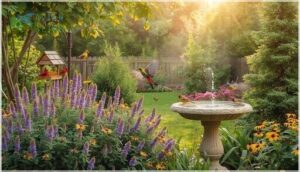
Turning your Minnesota yard into a bird haven doesn’t require a lot of fancy equipment or expert knowledge.
With a few simple adjustments to your outdoor space, you can attract a wide variety of species throughout the year. Here’s what works best for bringing more birds to your backyard.
Choosing Bird Feeders and Food
Setting up the right feeding station can turn your yard into a bustling hub for local species. Different feeder types and seed preferences matter—a lot. Here’s what works best:
- Tube feeders with black-oil sunflower seeds draw chickadees and finches year-round
- Platform feeders loaded with mixed seeds attract cardinals and mourning doves
- Suet feeders provide high-fat nutrition for woodpeckers during winter months
- Sock feeders filled with nyjer seed specifically appeal to American Goldfinches
- Hopper feeders with safflower and cracked corn accommodate jays and blackbirds
Nutritional content drives bird feeding behavior, so choose quality seeds over filler grains.
Providing Water Sources
You’ll attract more species with fresh water than just bird feeders alone. Birdbaths 1 to 3 inches deep work best—shallow enough for safe bathing. Place yours near shrubs for quick cover but in open sight for predator watching.
Winter water access matters most when natural sources freeze. Clean every few days to prevent disease transmission among backyard birds, keeping your bird feeding station healthy year-round.
Planting Native Vegetation
Native plants create a living buffet that keeps backyard birds coming back. Sustainable gardens with species adapted to Minnesota help attract insects year-round—critical protein for raising chicks. Here’s what works:
- Seasonal Resources: Purple coneflower and black-eyed Susan provide seeds into winter when food gets scarce.
- Habitat Benefits: Native shrubs like serviceberry offer both cover and berries during breeding season.
- Attracting Insects: Zig-zag goldenrod nourishes over 100 larval species—natural bird food you don’t buy.
Gardening for birds means less maintenance, more wildlife.
Setting Up Nest Boxes and Shelter
You’ve built the buffet—now add the bedrooms. Nest boxes give cavity-nesting species like chickadees and bluebirds safe shelter they can’t find elsewhere.
Mount boxes on metal poles at least five feet high to manage predators. Choose entrance holes matching your target birds—1.125 inches works for chickadees, while larger species need bigger openings.
Install them in spring when birds scout for nesting sites, and your backyard becomes home.
Creating Bird-Friendly Landscapes
Beyond nest boxes and feeders, your whole yard can become habitat. Native plantings like Wild Bergamot and Little Bluestem provide food and shelter. Add water features with shallow edges for safe drinking.
Layer trees, shrubs, and ground cover to create varied landscape structure. Consider yard certification programs—they show these bird-friendly practices actually boost backyard birding success and species richness.
Bird Migration and Seasonal Activity
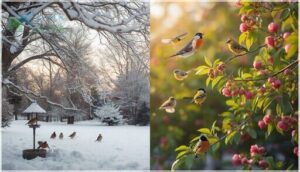
Minnesota’s bird population shifts dramatically with the seasons, and understanding these patterns helps you know which species to expect throughout the year. Some birds stick around all winter, while others head south when temperatures drop.
Let’s look at how migration affects your backyard birding and what to watch for during different times of the year.
Migratory Vs. Resident Birds
In Minnesota, roughly 60% of birds you’ll see are migratory birds using the Mississippi Flyway, while residents like Black-capped Chickadees stick around all winter. Migration triggers include day length and temperature shifts.
Urban impact from light pollution in Minneapolis threatens these travelers.
Winter survival depends on local food sources for resident birds, while climate effects and flyway importance influence seasonal bird activity patterns across Minnesota bird habitats.
Seasonal Bird Watching Tips
Knowing which season you’re in helps you spot the right birds. Fall birding peaks from October through November with raptors and sandhill cranes, while winter feeding draws chickadees and redpolls to your suet. Spring migrants like robins return from March through April, and summer nesting brings fledglings to feeders. Each season shifts bird migration patterns and seasonal bird activity, making citizen science projects valuable year-round for tracking these changes.
Best Seasonal Bird Watching Strategies:
- Fall (October-November): Watch for migrating raptors, sandhill cranes in harvested fields, and rare species congregating near open water like the Mississippi River.
- Winter (December-February): Stock feeders with sunflower seeds and suet to attract snow buntings, northern owls, and common redpolls while participating in Christmas Bird Counts.
- Spring (March-April): Observe early before trees leaf out to catch colorful migrants and listen for increasing bird songs as waterfowl and shorebirds return to wetlands.
Breeding and Nesting Seasons
When spring arrives, you’ll notice birds building nests and raising young from April through August. Each species has unique nesting habits—robins prefer open cup nests in trees, while chickadees seek cavities. Understanding breeding season timing and nesting behavior helps you protect these active sites in your yard.
| Species | Nesting Habitats | Clutch Size | Breeding Duration |
|---|---|---|---|
| American Robin | Tree branches, shrubs | 3-5 eggs, multiple broods | April-July |
| Red-winged Blackbird | Wetland cattails, marshes | 3-5 eggs | Late March-July |
| American Goldfinch | Shrubbery, tall plants | Single brood | Late July-August |
| Song Sparrow | Dense foliage, low branches | 2-5 eggs | Mid-April to late July |
Bird Conservation and Citizen Science
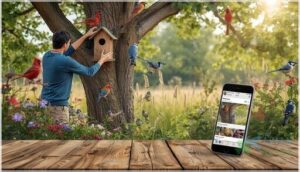
Watching birds in your backyard is more than just a hobby—it’s a way to help protect the species you love. You can make a real difference by creating safe habitats, joining local monitoring efforts, and understanding the challenges birds face today.
Here’s how you can take action to support Minnesota’s backyard birds.
Protecting Backyard Bird Habitats
Your backyard can become a conservation hub with a few smart choices. Habitat preservation starts with native plantings that support the ecosystem and reducing hazards like window collisions. Here’s how you protect local birds:
- Plant native shrubs like serviceberry to provide natural food and shelter
- Keep cats indoors to reduce predation on fledglings
- Install bird-proof mesh on roof vents for safe nesting
- Remove invasive plants that crowd out habitat restoration efforts
- Join community engagement programs promoting bird-friendly yards
These steps address environmental threats while strengthening conservation at home.
Participating in Bird Monitoring Projects
Across the state, you can join citizen science efforts that track bird populations and strengthen conservation. More than 800 volunteers contributed over 22,000 hours to the Minnesota Breeding Bird Atlas, achieving 92% coverage statewide. Citizen scientists participate in surveys like the Christmas Bird Count and Great Backyard Bird Count, providing data accuracy through volunteer training in bird identification and standardized protocols.
| Project | Volunteer Training | Habitat Coverage |
|---|---|---|
| Breeding Bird Atlas | 86-species song test required | 5,596 blocks surveyed |
| Loon Monitoring Program | Field standardization exercises | 600+ lakes across six regions |
| Christmas Bird Count | Citizen scientists identify species | Statewide point counts |
| Marshbird Survey | Call-playback methods taught | Random wetland sampling |
| Bioacoustics Monitoring | Device deployment training | Private lands included |
These efforts produce measurable project impact, informing land use decisions and habitat management across the region.
Addressing Climate and Environmental Threats
Climate change and environmental threats are reshaping the ecosystem you’re trying to protect. Minnesota’s temperatures have risen 1.8°F in a century, shifting migration dates by up to 10 days.
Climate change is reshaping Minnesota’s ecosystem, warming temperatures by 1.8°F and shifting bird migration dates by up to 10 days
Habitat fragmentation from urban sprawl, pollution reduction needs, and invasive species all demand your attention.
Conservation efforts like native planting and habitat preservation directly counter these pressures, making your yard a critical refuge during climate mitigation challenges.
Frequently Asked Questions (FAQs)
What diseases can affect Minnesota backyard birds?
Wild birds face invisible dangers that can sweep through populations quickly. Avian influenza, poxvirus infections, fungal diseases, bacterial infections, and parasitic infestations threaten Minnesota’s feathered visitors, requiring vigilant bird conservation efforts.
How do I clean bird feeders properly?
You should clean bird feeders every two weeks using hot soapy water, then disinfect with a nine-parts-water-to-one-part-bleach solution. Rinse thoroughly, air dry completely, and wear gloves for safety.
Are there invasive bird species in Minnesota?
You might notice European starlings crowding your feeders—they’re one of Minnesota’s most widespread invasive species.
These aggressive birds, along with house sparrows and mute swans, cause ecological alterations and nesting competition, prompting regulated control efforts.
What predators threaten backyard birds in Minnesota?
Raptor predation by Cooper’s Hawks and Sharp-shinned Hawks threatens songbirds, while feral cats kill billions of birds annually.
Nest predation from raccoons and crows greatly impacts population stability across Minnesota ecosystems.
When is the best time to stop feeding hummingbirds?
Like setting a table for travelers, you should keep sugar water in bird feeders until mid-October.
Ruby-throated Hummingbirds migrate through late September, and proper feeder maintenance aids late migrants needing energy for their journey south.
Conclusion
A single Black-capped Chickadee needs 9,000 caterpillars to raise one brood—a number your native oaks and willows can deliver if you let them.
The backyard birds of Minnesota depend on these small decisions: the feeder you fill, the pesticides you skip, the dead snag you leave standing. Each choice ripples through migration routes and nesting success.
Your yard isn’t just a viewing platform. It’s habitat, and right now, these thirteen species are counting on you to keep it that way.
- https://www.dnr.state.mn.us/eco/mbs/about_bird_list.html
- https://southern-wings.fishwildlife.org/online-guide/minnesota
- https://conservancy.umn.edu/collections/747e7e0a-e378-4cd6-a9ff-163485c68fc1
- https://www.lauraerickson.com/page/some-common-minnesota-backyard-birds/
- https://queticosuperior.org/birds-in-decline-survey-shows-dwindling-populations-in-mn-forests/