This site is supported by our readers. We may earn a commission, at no cost to you, if you purchase through links.

When you examine a single feather under magnification, you’re looking at one of nature’s most intricate engineering achievements—a structure so precisely organized that hundreds of tiny barbules lock together like a zipper to create a surface that can lift a bird into flight.
Each feather on a bird’s body fulfills a distinct purpose, from the stiff asymmetrical flight feathers that generate thrust during takeoff to the fluffy down feathers that trap warm air against the skin.
Understanding the types of bird feathers reveals how these specialized structures enable everything from the hummingbird’s aerial acrobatics to the penguin’s underwater hunting, with each variation in shape, texture, and arrangement reflecting millions of years of evolutionary refinement for specific survival challenges.
Table Of Contents
- Key Takeaways
- Feather Structure and Key Components
- Major Types of Bird Feathers
- Functions of Different Feather Types
- Specialized Feathers and Their Adaptations
- Feather Development and Growth
- Evolution and Diversity of Feather Types
- Frequently Asked Questions (FAQs)
- What are three types of bird feathers?
- What is fright stress or shock moult?
- What are bird feathers made of?
- Why do some birds have crests?
- What are the 5 types of feathers in birds?
- What are the different feather patterns of birds?
- Do birds have different types of feathers?
- Do birds have feathers?
- Which birds have powder down feathers?
- What kind of bird does my feather come from?
- Conclusion
Key Takeaways
- Bird feathers consist of six distinct types—contour, flight (remiges and rectrices), down, semiplumes, filoplumes, and bristles—each engineered through millions of years of evolution to serve specific survival functions from aerodynamic lift to thermal insulation.
- The interlocking barbule system in pennaceous feathers creates a zipper-like structure that forms smooth, stiff vanes essential for flight, while plumulaceous regions with loose barbules trap air pockets for remarkable insulation without adding bulk.
- Feathers are composed of beta-keratin with disulfide cross-links that provide exceptional durability, and they develop through a precise biological process starting from dermal papillae, progressing through pin feather stages, and eventually requiring replacement through energetically costly molt cycles.
- Specialized feathers like powder down (which produces waterproofing dust), ornamental breeding plumage (signaling mate fitness), and sensory filoplumes (detecting airflow changes) demonstrate how feather structure has adapted beyond basic flight and insulation to solve diverse ecological challenges.
Feather Structure and Key Components
When you look at a feather, you’re seeing one of nature’s most complex structural achievements. Each feather is built from the same protein material—beta-keratin—but the way its components are arranged determines whether it’s designed for flight, insulation, or display.
The barbs and barbules that branch off the central shaft create an interlocking system that you can explore in detail through this guide to bird feathers and plumage.
Understanding the basic architecture of feathers reveals how birds accomplish everything from soaring at high altitudes to surviving freezing temperatures.
Calamus, Rachis, Barbs, and Barbules
You’ll find four key structures working together in every feather.
The calamus anchors the feather base to your bird’s skin, while the rachis extends upward as the central shaft, providing stability. Barbs branch off the rachis like ribs, and tiny barbules extend from each barb, interlocking to create the vane structure—this extraordinary feather anatomy showcases nature’s engineering in plumage diversity.
For a deeper look at the interplay between barbules and barbicels structure, explore how these microscopic hooks help lock feathers together.
Pennaceous Vs. Plumulaceous Microstructure
Beyond those branching structures lies the real engineering: feather microstructure. Pennaceous regions feature tightly interlocked barbules with hook-like structures that create smooth, stiff vanes—essential for aerodynamic stability during flight. In contrast, plumulaceous zones display loosely arranged barbules that trap air for insulation mechanics.
This microstructure variation reflects feather evolution’s response to dual demands:
- Pennaceous surfaces resist flutter and maintain aerodynamically contoured shapes
- Plumulaceous fluff compresses to store warming air pockets
- Barbule architecture shifts from interlocking hooks to flexible fibers
- Many feathers combine both structures for flight capability and thermoregulation
Feather barbules come in various forms, and understanding the differences between barbule types can help identify bird species and reveal evolutionary adaptations.
Feather Composition (Beta-Keratin)
What makes these intricate structures so durable? Feather composition centers on beta-keratin, a tough protein rich in beta-sheet networks that form the rigid yet lightweight core you find in rachis and barbs.
Disulfide bonds cross-link these keratinous structures, creating outstanding resistance to wear and environmental stress. This keratin architecture facilitates feather morphology and function—from flight mechanics to waterproofing—while supporting feather composition and repair throughout a bird’s molt cycles.
Major Types of Bird Feathers
Birds possess six distinct feather types, each engineered for specific survival functions. From the sleek contour feathers that shape a bird’s silhouette to the microscopic filoplumes hidden beneath, this diversity reflects millions of years of evolutionary refinement.
Let’s examine each type and understand how its unique structure supports the bird’s daily needs.
Contour Feathers

Think of contour feathers as your bird’s outer shell—the sleek, overlapping layers that create its recognizable bird silhouette. These specialized structures combine feather aerodynamics with practical protection, making them essential for flight efficiency and wind resistance.
Here’s what sets them apart:
- Central rachis with interlocking barbules forms the stiff vane
- Overlapping arrangement reduces air penetration during flight
- Beta-keratin composition provides lightweight strength
- Waterproof barrier when properly maintained with preen oils
- Color patterns serve camouflage or mate attraction purposes
Flight Feathers (Remiges and Rectrices)
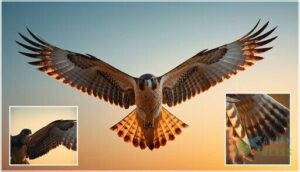
When you watch a bird soar, you’re witnessing the precision of flight feathers—remiges on the wings and rectrices on the tail. These specialized structures showcase exceptional feather asymmetry, with primaries attached to the carpometacarpus generating thrust while secondaries on the ulna create lift.
Beyond flight feathers, many species rely on specialized bristles around the beak to sense prey, especially bird species that hunt insects in low-light conditions.
The tail’s rectrices function as a rudder, enabling precise steering through complex airfoil design that optimizes wing aerodynamics and flight mechanics.
Down Feathers
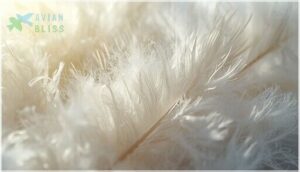
Beneath the outer feather layer lies nature’s finest insulator—down feathers. You’ll find these closest to the skin, where their short rachis and fluffy, unhooked barbules create a lightweight thermal regulation system through outstanding air trapping. Unlike the interlocking vanes of flight feathers, down’s plumulaceous microstructure maintains feather loft when dry, though moisture management becomes critical since wet down loses insulating capacity.
- Down feathers form the core insulating layer directly under contour feathers, trapping stable air pockets that reduce heat loss
- The barbules don’t interlock like flight feathers, creating numerous micro air spaces for remarkable down insulation
- Feather loft provides substantial warmth without added bulk, making down remarkably efficient for thermal regulation
- Waterfowl species rely on down for both buoyancy and temperature control in aquatic environments
- Moisture management is essential—when wet, water displaces trapped air and dramatically reduces insulation effectiveness
Semiplumes
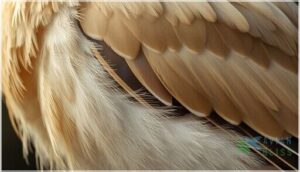
Sandwiched between down and contour layers, semiplumes bridge two worlds with their distinctive hybrid architecture. You’ll recognize these feathers by their firm rachis—giving structure—paired with loose, fluffy barbs that create a soft, plumulaceous texture near the tip.
This unique feather anatomy delivers dual semiplume function: they smooth plumage contours where feathers meet while adding flexible insulation layers that reduce drag at wing bases and joints.
| Feature | Semiplumes | Purpose |
|---|---|---|
| Rachis | Long and firm | Provides structural support |
| Barbs | Loose, soft barbs | Creates insulating air pockets |
| Location | Under contour feathers | Plumage smoothing and gap filling |
Filoplumes
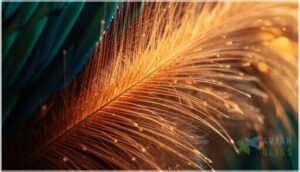
You won’t easily spot filoplumes—these hairlike feathers sit hidden beneath your bird’s outer plumage, acting as complex feather sensors. Each filoplume features a slender shaft tipped with a small tuft, positioned one to three per feather to monitor movement through tactile sensing.
Why filoplume morphology matters for birds:
- Aerodynamic control: Nerve endings detect subtle feather position shifts during flight, enabling split-second adjustments for flight stability
- Strategic placement: Higher filoplume densities near wing and tail feathers monitor critical flight surfaces
- Mechanical feedback: The terminal tuft contacts nearby feathers, transmitting vibration data about feather alignment
- Precision sensing: Filoplumes help detect feather bunching or misalignment, maintaining efficient lift and maneuverability
Bristles

Think of bristles as nature’s tactical sensors—stiff, hairlike feathers concentrated around your bird’s bill, eyes, or nostrils. Rictal bristles guard sensitive tissues from debris during feeding, while their reduced barbules create a simple filamentous appearance.
In insectivorous species, bristle function extends to prey capture, guiding midair insects toward the beak. This protective mechanism demonstrates feather evolution’s extraordinary versatility in bird anatomy.
Functions of Different Feather Types
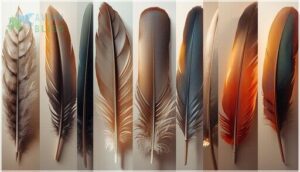
Feathers aren’t just about helping birds fly—they’re multifunctional tools that solve some of nature’s toughest survival challenges. Each feather type you’ve learned about has evolved to perform specific jobs, from keeping a bird warm in freezing temperatures to helping it vanish into its surroundings.
Let’s examine how different feather structures translate into distinct functions that keep birds alive, reproducing, and thriving in diverse environments.
Flight and Aerodynamics
You’ll notice that flight feathers generate wing lift through their asymmetric airfoil design, where the curved upper surface creates faster airflow and lower pressure above the wing.
This aerodynamic force counters gravity during avian flight, while the interlocking barbules form a unified surface that resists wind resistance.
The pennaceous structure of these specialized remiges and rectrices allows for precise flight maneuvers through controlled adjustments in feather angle and positioning.
Insulation and Thermoregulation
Beyond powering flight, feather structure drives thermal regulation through complex air trapping mechanisms. Down feathers create dense insulating layers next to your bird’s skin, while contour feathers seal in warmth.
Here’s how feather density controls microclimate:
- Plumulaceous underlayers optimize air retention during rest periods
- Semiplumes augment insulation without sacrificing mobility
- Seasonal molts adjust feather density to match environmental demands
This microclimate control system keeps birds comfortable year-round.
Waterproofing and Weather Protection
Staying warm means nothing if you get soaked. Pennaceous feathers form interlocking aerodynamic seals that block rain and wind, while oil glands near the tail produce a feather coating you’ll see birds spread during grooming.
This water barrier combines with structural waterproofing—those hooked barbules create weather resistance that keeps moisture away from insulating down layers. Together, feather structure and maintenance guarantee effective moisture management for thermoregulation in any climate.
Camouflage and Display
Feathers serve opposing roles in camouflage and courtship. Drab contour feathers on some species mirror bark textures and leaf litter through melanin pigments and disruptive color patterns—adaptive camouflage that creates visual deception against predators.
Yet breeding plumage transforms males into vivid displays with iridescent patches and tail fans, display signals that attract mates while compromising concealment. You’ll observe how feather function shifts between survival and reproduction across bird behavior and ecology.
Sensory and Tactile Roles
While feathers display or hide birds, specialized types also function as sensory receptors. Filoplumes detect airflow changes near flight feathers, providing tactile feedback that enhances bird balance during aerodynamic maneuvers.
Rictal bristles around the beak sense airborne particles, guiding foraging precision. This sensory integration through feather anatomy transforms avian anatomy into a network of feather sensors monitoring airflow detection and environmental contact continuously.
Specialized Feathers and Their Adaptations
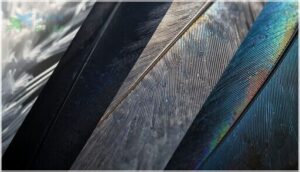
Beyond the standard feather types you’ve learned about, birds have evolved some truly extraordinary specialized feathers that serve unique purposes.
These adaptations include everything from self-cleaning powder down to elaborate ornamental plumes designed purely for courtship displays. Let’s examine four specialized feather types that showcase how evolution has fine-tuned these structures for specific survival and reproductive needs.
Powder Down Feathers
You’ll find powder down feathers clustered on the breast and pelvic regions of parrots and certain herons, where they serve a notable function in bird grooming. Unlike typical down feathers, these specialized structures continuously grow without molting, shedding fine waxy powder along their barbules.
During feather preening, birds distribute this powder across their plumage for waterproofing and feather maintenance, creating an effective protective layer that reduces dirt buildup.
Ornamental and Breeding Plumage
During courtship displays and mating rituals, many species transform their appearance with elaborate breeding plumage. You’ll observe males developing ornamental feather ornaments—extended crests, elongated tail feathers, and intensified plumage colors ranging from iridescent blues to vivid reds.
These breeding signals indicate individual fitness and health. The microstructure of these specialized bird feather types creates striking visual effects that augment plumage effectiveness in attracting mates.
Bristle Feathers in Insect Catching
You’ll notice stiff, hair-like facial bristles around the beak and eyes of insectivorous species—specialized feather structures enabling tactile sensing and prey capture. These facial bristles contain mechanoreceptors providing sensory feedback during rapid insect detection, functioning like whiskers that detect airflow and contact.
- Rictal bristles fringe the gape, shielding eyes from debris during aerial strikes
- Herbst corpuscles at bristle bases transmit rapid tactile signals during pursuit
- Bristle length correlates with prey type across different foraging niches
- Tactile cues complement vision, improving strike accuracy in cluttered habitats
Sensory Filoplumes
You’ll find slender, hair-like filoplumes tucked beneath contour and flight feathers, acting as refined feather mechanics sensors that monitor position and movement.
These specialized structures in bird anatomy and physiology feature Herbst corpuscles—sensory receptors converting mechanical stimuli into neural signals—providing critical sensory feedback for flight stability and bird balance during complex aerial maneuvers across all avian biology contexts.
Feather Development and Growth
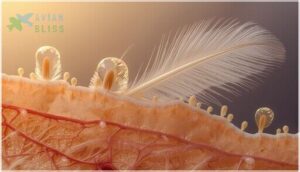
You might think feathers simply appear on a bird’s body, but their development follows a precise biological process that begins long before a feather takes its final form. Each feather grows from a specialized structure in the skin, progresses through distinct maturation stages, and eventually gets replaced through molting.
Understanding how feathers develop reveals why birds can maintain their impressive flying and insulating capabilities throughout their lives.
Feather Formation From Papilla
You might be surprised to learn that every feather on a bird starts from a tiny bump called the dermal papilla. This papilla initiation triggers epidermal collar formation around its base, creating the feather follicle where your bird anatomy and physiology knowledge really begins.
As cells multiply in this collar, they organize into barb ridges that undergo the keratinization process, transforming soft tissue into the rigid feather structure and function you observe during feather growth and formation in avian biology.
Growth Stages and Maturation
Once feather emergence begins, you’ll observe the pin feather stage—a narrow shaft wrapped in keratin that protects the delicate internal blood supply during bird evolution and development.
As the sheath opening progresses through the keratinization process, preening birds crack and flake away brittle fragments, revealing the intricate feather structure and function.
This maturation cycle transforms living tissue into lightweight, rigid morphology essential for feather maintenance and grooming.
Molt and Feather Replacement
Once mature feathers wear out, you’ll witness impressive Molt Patterns as birds shed and replace their plumage through carefully timed Annual Replacement cycles. This Feather Regeneration demands substantial Energetic Costs—about 7 percent conversion efficiency in small species. Different Molt Strategies reflect body size and habitat:
- Small songbirds complete full wing replacement annually
- Large raptors retain primaries across multiple years
- Desert dwellers molt twice yearly against abrasive conditions
Keratin synthesis drives this striking Feather Growth, balancing flight safety with Developmental Biology constraints.
Evolution and Diversity of Feather Types
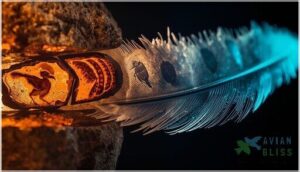
The feathers you see on modern birds didn’t appear overnight—they’re the product of millions of years of evolutionary refinement. Fossil evidence reveals a fascinating step-by-step progression from simple structures to the complex, specialized feathers we observe today.
Understanding this evolutionary journey helps explain why different feather types exist and how they’ve adapted to meet specific survival needs.
Fossil Evidence and Ancestral Feathers
The fossil record reveals astonishing details about ancient plumage and feather origins. Pennaceous structures preserved from the Jurassic period showcase barbules and hooks in dinosaur feathers that predate modern bird flight. Transitional forms like Anchiornis display both symmetrical and asymmetrical impressions, while melanosomes reveal color patterns from extinct species, offering invaluable fossil evidence for understanding dinosaur biology and evolution.
| Fossil Type | Key Evidence |
|---|---|
| Pennaceous Impressions | Interlocking barbules dating to Jurassic period |
| Feathered Dinosaurs | Symmetrical and asymmetrical flight feather forms |
| Melanosome Preservation | Original color patterns revealing camouflage or display functions |
Evolution of Feather Structure
Understanding how ancient filaments became today’s complex plumes reveals key evolutionary biology principles. Simple tubular structures first provided insulation, then barbs branched outward to increase structural complexity.
Barbules developed microscopic hooklets that interlocked, creating pennaceous vanes with impressive aerodynamic features.
This feather morphology evolved asymmetry for sophisticated flight control, transforming avian anatomy and physiology through incremental evolutionary adaptations guided by ecological pressures.
Adaptations for Flight and Survival
Beyond structural complexity, you’ll find that aerodynamic lift and feather flexibility revolutionized avian flight and aerodynamics. Flight feathers developed asymmetrical vanes and interlocking barbules—creating wind resistance while maintaining exceptional flexibility during flight maneuvers.
These survival strategies allow birds to generate thrust, execute precise turns, and navigate challenging environments. The combination of structural resilience and adaptive morphology represents one of nature’s most impressive engineering solutions for powered flight.
Birds’ feathers represent one of nature’s most impressive engineering solutions, combining structural resilience with adaptive design for powered flight
Frequently Asked Questions (FAQs)
What are three types of bird feathers?
You might assume bird plumage is uniform, but feather classification reveals striking diversity. The three primary bird feather types—contour feathers, flight feathers, and down feathers—each serve distinct functions in avian feather morphology.
What is fright stress or shock moult?
Fright molt occurs when acute fear triggers rapid feather shedding, leaving bare patches on the head, neck, or breast.
Stress response causes broken, frayed plumage that regrows during the next molt cycle through normal feather regeneration.
What are bird feathers made of?
Bird feathers are built from beta-keratin, a tough fibrous protein that forms layered microstructures combining strength and flexibility.
Trace minerals like calcium and phosphorus stiffen the rachis and barbules during growth.
Why do some birds have crests?
Those showy head plumes—crests—aren’t just ornamental feather types. You’ll find they serve as visual displays for bird communication, signaling mood, dominance, and mating readiness through specialized contour feathers that convey critical social information.
What are the 5 types of feathers in birds?
You’ll find contour feathers creating shape, flight feathers powering movement, down feathers trapping warmth, semiplumes adding insulation, and filoplumes monitoring position—each serving distinct functions in avian survival and performance.
What are the different feather patterns of birds?
Like fingerprints in nature, feather patterns reveal species identity through edge shapes, barring, mottling, and vane textures that influence feather function, coloration, and plumage arrangements across different bird feather types.
Do birds have different types of feathers?
Yes, you’ll discover six distinct feather types on birds: contour feathers shape the body, flight feathers power movement, down feathers provide insulation, plus semiplumes, filoplumes, and bristles serve specialized functions.
Do birds have feathers?
Yes, birds have feathers—these specialized structures made of beta-keratin distinguish them from all other animals.
Feathers evolved from simple hollow tubes into the complex, diverse forms you see today across avian species.
Which birds have powder down feathers?
Herons, cockatoos, and certain pigeons possess powder down feathers that continuously disintegrate into a fine powder.
You’ll notice this dust during preening sessions—it’s nature’s waterproofing agent, conditioning their contour and down feathers while removing dirt.
What kind of bird does my feather come from?
Identifying feather species requires careful Feather Analysis of size, shape, color patterns, and structural features.
Compare your specimen against field guides or online databases for Bird Identification, noting remiges asymmetry or contour feather characteristics for accurate Avian Classification.
Conclusion
Feathers aren’t just for the birds—they’re blueprints of survival written in keratin. Each type of bird feather you’ve examined here represents a specific evolutionary solution, from the aerodynamic precision of remiges to the thermal efficiency of down.
When you watch a raptor bank against the wind or notice a robin fluffing its plumage on a cold morning, you’re witnessing millions of years of structural refinement in action—nature’s masterclass in form meeting function.