This site is supported by our readers. We may earn a commission, at no cost to you, if you purchase through links.
Virginia hosts ten woodpecker species—more than most people realize when they hear that first stuttering knock against a backyard oak. The Pileated, North America’s largest woodpecker, shares this state with the federally endangered Red-cockaded, a bird so specialized it nests exclusively in living longleaf pines.
seven species stay year-round, one arrives only in winter, and a handful of rare wanderers occasionally blow in from far outside their normal range.
Whether you’re scanning the Appalachian ridgelines in Shenandoah or watching a Downy work at a suet feeder in Richmond, knowing what you’re looking at—and where to find it—makes every sighting sharper.
Table Of Contents
- Key Takeaways
- Woodpeckers Found in Virginia
- How to Identify Each Species
- Where Woodpeckers Live in Virginia
- Best Places to See Woodpeckers
- Feeding, Nesting, and Conservation
- Frequently Asked Questions (FAQs)
- What is the most common woodpecker in Virginia?
- Where do woodpeckers stay at night?
- Is it good to have woodpeckers in your yard?
- What does it mean if a woodpecker is pecking my house?
- What attracts woodpeckers to your house?
- What sounds do Virginia woodpeckers make?
- How do Virginia woodpeckers impact trees?
- Why do woodpeckers tap on houses?
- What are signs of woodpeckers in an area?
- How can I deter woodpeckers humanely?
- Conclusion
Key Takeaways
- Virginia hosts ten woodpecker species ranging from the 6‑inch Downy to the crow‑sized Pileated, with seven staying year‑round and the Yellow‑bellied Sapsucker arriving only in winter.
- The federally endangered Red‑cockaded Woodpecker nests exclusively in living longleaf pines and relies on flowing tree resin to keep predators away from its cavities.
- You can tell similar‑looking species apart by focusing on bill length, tail feather markings, plumage patterns, and each bird’s distinctive drumming rhythm.
- Retaining dead snags, planting native trees, and cutting pesticide use are the most effective ways to attract and support woodpeckers in your own yard.
Woodpeckers Found in Virginia
Virginia is home to ten woodpecker species, ranging from the tiny Downy to the crow-sized Pileated. Seven stay year-round, one arrives only in winter, and a handful show up so rarely that spotting one feels like a lucky day.
For a closer look at what each species needs, backyard woodpecker habitat and feeding tips can help you attract more of them throughout the seasons.
Here’s a closer look at each species you might encounter across the state.
Downy Woodpecker
The Downy Woodpecker is the smallest woodpecker you’ll find in Virginia, measuring just 6.25 inches long. Despite its size, it’s one of the most visible woodpecker species identification targets in Virginia — especially at suet feeders year‑round.
A useful ID tip is the bill length relative to the head, which differs between Downy and Hairy species.
- Territory Size stays compact, generally under 10 acres
- Cavity Excavation Behavior favors soft, decaying wood in snags
- Predator Avoidance relies on stillness and bark‑blending plumage
Hairy Woodpecker
If the Downy left you wanting more, the Hairy Woodpecker delivers — same bold black-and-white pattern, but noticeably larger at 9 to 10 inches. Its bill morphology is the key: the bill nearly matches head length, unlike the Downy’s stubby profile.
You’ll find this year-round resident across mature pine forests and open woodlands, where its territorial drumming echoes with real force.
The Hairy Woodpecker, like many woodpeckers, relies on large trees essential for nesting.
Red-bellied Woodpecker
Moving from the Hairy, the Red‑bellied Woodpecker brings a different look entirely.
At around 9 to 11 inches, this year-round Virginia resident sports a boldly barred black-and-white back, pale underparts with a soft reddish wash, and a vivid red cap.
Males show red from bill to nape; females only on the nape.
Watch for it across mixed woodlands and suburban feeders.
Red-headed Woodpecker
Unlike the Red-bellied’s subtle markings, the Red-headed Woodpecker makes no effort to blend in.
That bold crimson head, black back, and clean white underparts make it one of the easiest birds in any identification guide for Virginia woodpeckers.
Watch for territorial aggression at feeding sites and dramatic mating displays in spring.
Sadly, population trends show a 70% decline, largely tied to habitat fragmentation across the state.
Northern Flicker
The Northern Flicker stands apart from Virginia’s other woodpeckers — it spends much of its time ground foraging for ants and beetles rather than hammering bark. That unmistakable yellow wing patch flashes brilliantly in flight, making it a highlight in any identification guide for Virginia woodpeckers.
Watch for its territory song and mating display in spring.
Its urban adaptation makes suburban parks surprisingly reliable birdwatching hotspots across Virginia’s varied habitat.
Pileated Woodpecker
The Pileated Woodpecker is Virginia’s largest woodpecker, stretching 16 to 19 inches with a blazing red crest and bold white face stripes.
Its cavity excavation impact reshapes old forests, creating nest sites for owls and wood ducks.
Watch for its seasonal foraging patterns and mating displays across Shenandoah’s national forest trails and Great Dismal Swamp wildlife refuge — both reliable birdwatching hotspots.
Yellow-bellied Sapsucker
The Yellow-bellied Sapsucker visits Virginia each fall and stays through winter — making it the only woodpecker you won’t spot here in summer.
This identification guide staples sap well patterns into maples, birches, and hickories across Virginia’s birdwatching hotspots, sometimes weakening smaller trees through repeated girdling.
Watch for:
- Bold white wing stripe visible on perched birds
- Stuttering, irregular drumming distinct from other species
- Nasal mew-like call near fresh sap wells
Red-cockaded Woodpecker
The Red-cockaded Woodpecker is Virginia’s rarest resident — federally endangered since 1970 and clinging to mature longleaf pine forests in the coastal plain.
Clan dynamics define this species: small family groups of two to five adults share territory exceeding 200 acres, cooperate in cavity nesting, and rely on sap well chemistry as predator deterrence, with resin flows actively repelling rat snakes from nest entrances.
Red-cockaded Woodpeckers live in tight-knit clans that use flowing tree resin as a natural fortress against predators
Rare and Accidental Visitors
Beyond Virginia’s eight regulars, a handful of species show up when weather scrambles migration routes. Storm-Induced Strays and Weather-Driven Dispersal events account for most Rare Vagrant Sightings logged here, especially during Irregular Migration Events and Seasonal Irregularities in late fall:
- Lewis’s Woodpecker — sporadic winter stray from the West
- Gila Woodpecker — extreme rarity, wind-displaced east
- American Three-toed Woodpecker — occasional cold-season wanderer
- Ivory-billed Woodpecker — likely extinct; historically linked to Great Dismal Swamp National Wildlife Refuge
How to Identify Each Species
Telling woodpeckers apart takes more than a quick glance — size, bill shape, plumage, and even sound all play a role.
Once you know what to look for, identification becomes second nature in the field.
Here are the key features that’ll help you confidently name every species you encounter in Virginia.
Size and Shape Differences
Size alone can tell you a lot. Virginia’s woodpeckers span a surprisingly wide body length range — from the compact 6-inch Downy Woodpecker to the crow-sized Hairy Woodpecker at nearly 10 inches. Crest size variation, neck length contrast, and tail feather structure all shift noticeably across species too.
| Species | Length | Build |
|---|---|---|
| Downy Woodpecker | 6–7 in | Compact, short-necked |
| Hairy Woodpecker | 9–10 in | Stocky, broad-shouldered |
| Red-bellied | 9–10 in | Rounded, slightly puffed |
| Red-headed | 9–10 in | Chunky, large-headed |
| Northern Flicker | 11–12 in | Lean, elongated |
Bill Length and Head Profile
Once you’ve clocked the size, shift your eyes to the bill. Bill-to-head ratio is one of the sharpest tools in any identification guide for Virginia woodpeckers.
The Downy’s bill is roughly a third of its head length; the Hairy’s nearly matches it. These bill morphology variations and aerodynamic head profiles reflect each species’ foraging niche — and they’re visible even at a distance.
Plumage Patterns and Red Markings
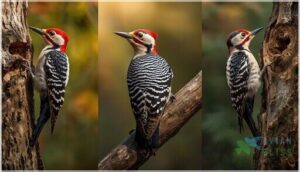
Now that the bill has your attention, let plumage do the rest of the work.
Virginia’s woodpeckers wear surprisingly distinct patterns — barred chest patterns, scaled back edges, and mottled wing speckles, each narrow your options fast.
Red crown variation is equally telling: the Red-headed Woodpecker sports a fully crimson hood, while the Red-bellied and Red-cockaded show red only on the nape or cheek. Bright wing bars and red plumage placement are your identification guide for woodpecker plumage differences.
Distinctive Calls and Drumming
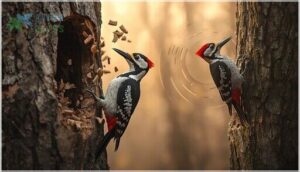
Plumage gets you close — but sound seals the deal. Each species carries its own acoustic fingerprint. The Pileated’s slow, powerful drumming contrasts sharply with the Red-bellied’s rapid bursts.
Woodpecker vocalizations and drumming patterns reflect species-specific drum signatures shaped by seasonal drumming peaks in late winter. Even habitat influences tone — hollow snags enhance drums farther, making auditory identification surprisingly reliable in the field.
Downy Vs. Hairy Woodpecker
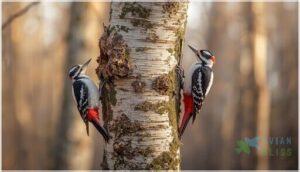
Once you’ve tuned your ear to drumming, the next challenge is telling these look‑alikes apart. The Downy Woodpecker and Hairy Woodpecker are the trickiest pair in woodpecker species identification in Virginia.
Here’s what to check:
- Bill length — Downy’s is noticeably stubby; Hairy’s nearly matches its head width.
- Tail feather markings — Downy shows black spots on outer tail feathers; Hairy’s are solid white.
- Foraging height preference — Downy works on lower trunks and shrubs; Hairy climbs higher into mature bark.
Pileated Vs. Northern Flicker

These two species are easy to mix up at a glance, but size alone gives them away fast.
| Feature | Pileated Woodpecker | Northern Flicker |
|---|---|---|
| Length | 16–19 inches | 11–12.5 inches |
| Foraging style | Dead tree excavation | Ground probing for ants |
| Key marking | Red crest display | Black malar stripe |
Watch the wingbeat pattern in flight — Flicker undulates; Pileated flies straight and strong.
Habitat preferences of Virginia woodpeckers also help: Pileated stays deep in mature forest, Flicker works open edges.
Woodpecker species identification in Virginia gets easier once you know where to look.
Seasonal Clues for Identification
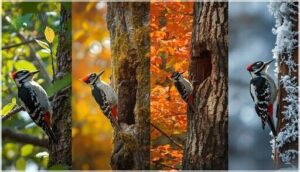
The season you’re birding in shapes what you see and hear.
Spring bud cues bring early insect activity, pushing woodpeckers into the open.
Plumage contrast peaks on forest edges.
Fall leaf color helps reveal habitat preferences of Virginia woodpeckers by exposing snags and cavities.
Winter drumming patterns shift, and seasonal call shifts signal who’s still around — essential clues for any identification guide.
Where Woodpeckers Live in Virginia

Virginia woodpeckers aren’t all crowded into one type of landscape — each species has carved out its own niche across the state’s remarkably varied terrain. From Blue Ridge ridgelines to the flat coastal plain, where you look matters as much as what you’re looking for.
Here’s a breakdown of the key habitat types worth knowing.
Mountain Forests and Hardwood Woods
Virginia’s Appalachian Mountains are home to some of the state’s richest woodpecker habitat.
Elevational species zonation shapes which birds you’ll find where — Pileated Woodpeckers favor mature forests with tall canopy layer diversity, while Deadwood habitat and snags draw Hairy and Downy species. Soil moisture gradients and fire regime impacts create the structural variety that sustains notable woodpecker diversity in Virginia.
Pine Forests and Coastal Plain Habitat
Longleaf Pine forests along the Coastal Plain create one of the most specialized woodpecker habitats in the state.
Fire Regime Effects keep canopies open, supporting Pine savannah conditions where Groundlayer Plant Diversity thrives on nutrient-poor soils — a product of Soil Nutrient Dynamics shaped by centuries of burning.
Habitat Connectivity links wetland habitat near Great Dismal Swamp to upland stands, supporting Sap Well Ecology and the endangered Red‑cockaded Woodpecker.
Suburban Yards and City Parks
Your suburban backyard might be more valuable to woodpeckers than you’d expect.
Downy, Hairy, and Red-bellied Woodpeckers regularly visit urban parks and suburban backyards where Dead Wood Habitat, Native Plant Corridors, and strategic Suet Feeder Placement meet their needs.
Rain Garden Integration and Low-Impact Lighting help these spaces double as birdwatching hotspots.
Even a single dead snag can become a nesting cavity.
Farmland Edges and Open Woodland
Farmland edges are some of the most productive spots for spotting woodpeckers in Virginia. These forest edge habitats — often 20 to 60 meters wide — pack in Edge Plant Diversity, Insect Prey Abundance, and Microclimate Benefits that keep birds active year‑round.
Northern Flickers love open woodlands and grassy margins for ground foraging. Good Hedgerow Management and Mosaic Habitat Design turn these transitional zones into reliable birdwatching hotspots worth adding to your identification guides for Virginia woodpeckers.
Dead Trees, Snags, and Nest Sites
Dead trees pull their weight in ways living ones can’t. Snags, especially those meeting snag size requirements matching 15+ inches in diameter, support pileated nesting, while smaller species use narrower stems.
Decay stage preference matters too — partially barked trees harbor the most insects. Cavity excavation depth varies by species, and secondary cavity users like screech-owls move in after woodpeckers leave.
- Pileated woodpeckers need snags 38+ cm wide
- Downy and Hairy prefer snags with 10–30% bark coverage
- Red-cockaded pine habitat requires living longleaf pines, not dead wood
- Over 25 species depend on abandoned tree cavities for nesting
Winter Habitats for Sapsuckers
Unlike the resident species that rely on dead trees and snags year-round, the Yellow-bellied Sapsucker brings something different to Virginia winters — a temporary but reliable presence from October through March. You’ll find them in River Bottomland forests, Mixed Hardwood-Pine stands, and Edge Habitat along roads and fields.
| Habitat Type | Key Feature |
|---|---|
| River Bottomland | Mature hardwoods with high sap flow |
| Mixed Hardwood-Pine | Accessible birch, maple, hickory |
| Edge Habitat | Open visibility, easy tree-to-tree movement |
| Southwest-Facing Trunks | Sun-warmed bark keeps Sap Well Clusters active |
Watch for sapwells drilled in neat rows — that’s your sign that a sapsucker is working the area. Winter birding opportunities for woodpecker observers peak here.
Best Places to See Woodpeckers
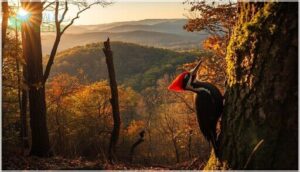
Virginia rewards woodpecker watchers who know where to look, from sweeping mountain forests to quiet coastal refuges. A handful of sites consistently deliver sightings of multiple species in a single outing.
Here are the best spots to add to your list.
Shenandoah National Park
Shenandoah National Park ranks among Virginia’s top birdwatching hotspots for woodpecker enthusiasts. Its mature forests and abundant dead trees create ideal conditions for seven species year-round.
Key spots and tips to make the most of your visit:
- Big Meadows – reliable pileated and red-bellied woodpecker sightings
- Fox Hollow Trailhead Hotspot – hairy woodpeckers frequent mixed woodlands here
- Limberlost Trail – listen for drumming along accessible paths
- Hawksbill Mountain – northern flicker foraging during Seasonal Migration Timing windows
- Citizen Science Monitoring programs track population trends supporting Habitat Restoration Projects shaped by Historical Land Use patterns
George Washington National Forest
George Washington National Forest stretches across roughly 1.1 million acres of mature forests, making it one of Virginia’s leading birdwatching hotspots.
Its vast trail system, shaped by Historic Land Use and Fire Management practices, helps Pileated and Red-headed Woodpeckers.
Aquatic Habitats and dead trees near stream corridors also benefit cavity nesters, while conservation status of endangered woodpeckers remains closely monitored here.
| Species | Habitat | Best Trail Area |
|---|---|---|
| Pileated Woodpecker | Mature hardwood forest | Appalachian Trail ridgelines |
| Red-headed Woodpecker | Open woodland edges | Valley floor corridors |
| Red-cockaded Woodpecker | Pine stands | Southern forest tracts |
Great Dismal Swamp
Tucked into southeastern Virginia’s wetland habitats, Great Dismal Swamp spans nearly 113,000 acres of cypress forest restoration and peatland hydrology that woodpeckers depend on year-round. Its dead trees and flooded flats rank it among Virginia’s top birdwatching hotspots.
The refuge’s Red-cockaded Woodpecker recovery program directly targets the conservation status of endangered woodpeckers, reflecting both its Refuge Wildlife Diversity and its legacy tied to Historic Maroon Communities.
Mason Neck and Coastal Sites
Mason Neck State Park sits on a wooded peninsula in Fairfax County, where the Great Marsh Trail and Woodmarsh Trail cut through oak‑hickory forest toward the Potomac River. This coastal edge foraging habitat draws Pileated, Red‑bellied, Downy, and Northern Flicker year‑round.
Canoe birding tours reveal marsh‑border activity you’d miss on foot. For woodpecker species diversity in Virginia, few birdwatching hotspots this close to the Chesapeake Bay deliver as reliably.
Local Parks and Greenways
You don’t need to travel far—Virginia’s local parks and greenways put woodpeckers surprisingly close to home. The James River Park system, Old Dominion trail corridors, and state parks with riparian buffer zones are reliable starting points.
Top spots to check:
- Wooded greenway edges with mature oaks
- Creek-side trails with standing snags
- ADA-accessible paved paths through mixed hardwoods
- Citizen science program birding routes
Backyard Birding Hotspots
Your own backyard can become one of the best birdwatching locations for woodpeckers in Virginia.
Smart Suet Feeder Placement, Snag Retention Strategies, Native Tree Planting, Water Feature Design, and Seasonal Habitat Layers work together to pull woodpeckers close.
| Feature | What to Do | Species It Attracts |
|---|---|---|
| Suet feeders | Mount vertically near trees | Downy, Hairy, Red-bellied |
| Native oaks/cherries | Plant along yard edges | Northern Flicker, Pileated |
| Snags | Retain dead standing trees | Red-headed, Pileated |
| Shallow birdbath | Keep 1–2 inches deep | All backyard woodpeckers |
Best Times of Day and Year
Timing your visit makes all the difference. Virginia woodpeckers follow predictable daily and seasonal rhythms you can use to your advantage.
- Morning drumming peaks from sunrise through midmorning offer your best window for activity
- Spring breeding surge (March–June) brings courtship, cavity excavation, and feeding flights
- Winter feeder activity highlights resident species against bare branches, plus seasonal migration of Yellow-bellied Sapsuckers arriving in October
- Afternoon foraging lull and evening roosting behavior bracket a quieter midday period
Feeding, Nesting, and Conservation
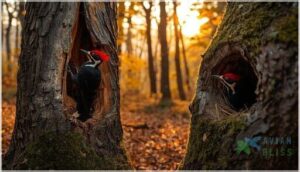
Woodpeckers don’t just pass through Virginia — they eat, nest, and shape the landscape in ways most people never notice. Once you understand what they need to survive, attracting them (and living alongside them) gets a lot easier.
Here’s what you should know about their feeding habits, nesting behavior, and how to keep them protected.
What Virginia Woodpeckers Eat
Virginia woodpeckers aren’t picky eaters — they’re opportunists. Their diet shifts with the seasons, balancing Fruit Insect Balance throughout the year. You’ll notice suet feeders draw consistent visitors, especially in cold months when energy demands peak.
| Food Type | Who Eats It |
|---|---|
| Suet feeders | Downy, Hairy, Red-bellied |
| Sunflower Seed Use | Red-bellied, Pileated |
| Peanut Preference | Most species |
| Winter Berry Reliance | Red-bellied, Sapsucker |
| Mast Seed Storage | Red-headed Woodpecker |
Sap Wells, Insects, and Acorns
Beyond suet, some of the most fascinating feeding behaviors happen right on the bark. Yellow-bellied Sapsuckers drill neat rows of sap wells into deciduous forest trees, returning repeatedly to harvest fresh sap and the Sap Insect Communities that gather there — ants, flies, even wasps.
Red-headed Woodpeckers take a different approach, caching acorns in tree cavities for leaner months.
Seasonal food shifts keep every species resourceful year‑round.
Nesting Cavities and Breeding Behavior
Every woodpecker’s nest tells a story of careful nest site selection and real labor. Both parents generally share cavity excavation timing and duties, chiseling wood for one to three weeks.
Here’s what makes each species’ approach distinct:
- Downy Woodpeckers excavate shallow cavities with 1–1.5-inch entrance holes in decaying wood
- Red-cockaded Woodpeckers use a resin maintenance strategy, drilling sap wells around living pine entrances to deter predators
- Pileated Woodpeckers favor large-diameter dead trunks, carving the state’s biggest cavities
- Red-bellied Woodpeckers show clear male female roles — males start multiple holes, females choose the final nest
- Yellow-bellied Sapsuckers show notable clutch size variation, laying three to seven eggs on bare wood chips
Nestling development period runs roughly 25–30 days before fledging.
How to Attract Woodpeckers
Once the nest is built, keeping woodpeckers around long-term comes down to habitat. Start with Native Tree Planting and Snag Retention — dead wood holds the insect larvae woodpeckers depend on.
Open Yard Structure with scattered trees beats dense plantings every time.
Low Pesticide Practices and Insect Habitat Enhancement keep natural prey abundant, making your yard a reliable stop for backyard feeders year-round.
Best Feeders, Foods, and Water Sources
Once your yard has the right habitat, the right feeders seal the deal.
Suet Cage Design matters — metal cages with tail-prop brackets work best for backyard feeders, handling everyone from Downies to Pileateds.
Add peanut butter mix suet for cold months, and use hulled sunflower seeds in seed feeders to cut the mess.
Scatter mealworms on platform feeders and place birdbaths in partial shade.
Preventing Woodpecker Damage
When woodpeckers target your siding, you’ve got practical options. Physical exclusion using taut bird netting — held 3 inches from the surface — blocks access effectively. Reflective deterrents like Mylar tape disrupt drumming spots with flashing movement.
Repair and seal any holes immediately, and don’t overlook habitat cleanup: insect infestations in wood are the real invitation. Legal home measures mean nonlethal methods first, always.
Protected Species and Conservation Status
All woodpeckers in Virginia fall under the Federal Migratory Bird Treaty Act, but the Red-cockaded Woodpecker carries extra weight. Here’s where things stand:
- Federal Threat Listing downlisted it from endangered to threatened in October 2024.
- State Endangered Designation remains in Virginia, reflecting its isolated northern population.
- Habitat Restoration Strategies center on longleaf pine planting and Prescribed Fire Management.
- Population Monitoring Techniques tracked growth from 2 breeding pairs in 2002 to 74 adults by 2022.
- Protected areas like Piney Grove Preserve anchor ongoing Conservation efforts.
Frequently Asked Questions (FAQs)
What is the most common woodpecker in Virginia?
Like a little shadow at your feeder, the Downy Woodpecker is Virginia’s most common woodpecker, with population estimates near 1 million birds statewide — proof of its impressive urban adaptation across nearly every habitat.
Where do woodpeckers stay at night?
most species shelter inside tree cavities they’ve excavated themselves.
cavity roost types range from snag roost sites in dead wood to living pine cavities used by red-cockaded woodpeckers.
Is it good to have woodpeckers in your yard?
Having woodpeckers visit is mostly a net positive. They devour beetles, grubs, and carpenter ants — natural pest control benefits that protect your trees.
Just watch for any wood siding they might target.
What does it mean if a woodpecker is pecking my house?
That relentless drumming on your siding isn’t random.
It usually signals one of three things: insect infestation clues hidden beneath the wood, territory drumming signals during breeding season, or a search for a nesting cavity.
What attracts woodpeckers to your house?
Three things pull woodpeckers straight to your house: insect infestations hiding behind cedar siding or rough wood surfaces, the resonant boom of metal drumming spots like gutters, and a nearby tree canopy that keeps them close.
What sounds do Virginia woodpeckers make?
Each species has its own acoustic signature. You’ll hear sharp "pik" notes from Downys, rolling "churr" calls from Red-bellieds, and deep, slow territorial drumming echoing through forests from Pileateds.
How do Virginia woodpeckers impact trees?
Virginia woodpeckers shape forest health through insect suppression, cavity provisioning, and nutrient cycling.
Their bark drilling controls pest larvae, while tree cavity creation provides habitat for owls and ducks — balancing structural damage against lasting ecological benefit.
Why do woodpeckers tap on houses?
Woodpeckers tap on houses for four main reasons: Territory Drumming to claim space, Insect Foraging behind Wood Siding, building Roosting Cavities, or nest excavation — with Seasonal Pressure peaking in spring.
What are signs of woodpeckers in an area?
Listen for sharp, rhythmic drumming on hollow trunks or gutters.
Look for sap wells, bark damage, tree hole patterns, and fresh wood chips at the base of trees — all reliable signs of nearby drilling behavior.
How can I deter woodpeckers humanely?
Hanging reflective tape, stretching bird netting, or moving predator decoys regularly are your most effective humane options. Fix insect infestations first — that removes the real reason they’re there.
Conclusion
Picture a hiker in Shenandoah, pause as a Pileated’s staccato drumming echoes through hemlocks—this guide turns curiosity into recognition.
Virginia’s woodpeckers, from the endangered Red-cockaded to backyard Downy, reveal forest health in every tap and flutter.
Knowing their calls, habitats, and needs transforms fleeting glimpses into stewardship. Each sighting becomes a thread in a larger story: protecting these birds safeguards the wild rhythms they embody. The woods echo with their presence, inviting us to listen closer, observe deeper, and cherish the intricate balance they represent.
- https://www.youtube.com/watch?v=UTVWIloVPeU&t=2s
- https://camstreamer.com/embed/5tlcVPQgIrfngJT2Z2ABuvHDiog2eqLVTcfgtGyG
- https://dwr.virginia.gov/wildlife/nuisance/woodpeckers/
- https://digitalcommons.usf.edu/cgi/viewcontent.cgi?article=9366&context=wilson_bulletin
- https://unbscholar.dspace.lib.unb.ca/server/api/core/bitstreams/819ccfa7-bf3a-4b32-b4a1-8fd6ac0d1d5d/content