This site is supported by our readers. We may earn a commission, at no cost to you, if you purchase through links.
A flash of orange against black stops most people cold. It’s one of those sights that makes you look twice—sharp, almost too vivid for a backyard tree or roadside marsh.
That contrast isn’t accidental. Birds like the Baltimore Oriole and Red-winged Blackbird wear those colors for reasons rooted in survival, nutrition, and competition.
The orange comes from carotenoids absorbed through diet; the black holds melanin that toughens feathers against thousands of miles of migration.
Knowing what drives the coloration changes changes how you see the bird.
Here’s a closer look at the species behind that striking palette and how to find them.
Table Of Contents
- Key Takeaways
- What Are Orange and Black Birds?
- Do Blackbirds Have Orange Wings?
- Are There Black and Orange Birds in North America?
- Common Orange and Black Birds in North America
- The Significance of The Orange and Black Coloration
- Baltimore Oriole Vs Bullock’s Oriole Differences
- Migration Habits of Orange and Black Birds
- Attracting Orange and Black Birds to Your Backyard
- Identifying Bird Species With Black and Orange Colors
- Red-winged Blackbirds and Their Status as an Invasive Species
- Frequently Asked Questions (FAQs)
- What are orange and black birds?
- Do blackbirds have orange wings?
- Do blackbirds have orange breasts?
- Are there black and orange birds in North America?
- What birds are black and orange?
- What do Oreos eat?
- How rare is a golden oriole?
- What is the world of Orange and black birds?
- What is the significance of the orange and black coloration of these birds?
- What is the difference between a Baltimore oriole and a Bullock’s oriole?
- Conclusion
Key Takeaways
- Orange and black birds get their colors from two separate systems: diet-based carotenoids create the orange, while genetics-driven melanin produces the black—and you can’t fake either one.
- Melanin-rich black feathers are about 40% more resistant to wear than unpigmented ones, making that dark plumage a practical tool for birds logging thousands of migration miles.
- You can attract orioles and other orange and black species to your backyard by setting out nectar feeders, halved oranges, and a bubbling water feature before they arrive in early April.
- The Red-winged Blackbird isn’t invasive—it’s a native North American species whose massive winter flocks cause real agricultural losses, but legal protections keep management focused on deterrence, not removal.
What Are Orange and Black Birds?
If you’ve ever spotted a flash of orange and black darting through the treetops, you already know how hard these birds are to ignore. Orange and black birds are some of the most visually striking species in North America, and their bold plumage coloration isn’t accidental.
That same instinct for bold contrast shows up across many species, as you’ll find exploring these stunning black, red, and white birds with equally eye-catching patterns.
The orange hue comes directly from dietary carotenoids — pigments birds absorb from the fruits, insects, and seeds they eat. The deep black, by contrast, results from melanin pigmentation encoded in their genetics.
Sexual dimorphism is common across these species, meaning males usually wear the brightest colors while females stay duller and more camouflaged.
You’ll notice their habitat preferences vary widely too, from marshes to open woodlands. Understanding these color mechanics makes species identification far more obvious — and a lot more satisfying.
One distinctive behavior to watch for is the construction of hanging pouch nests by all orioles.
Do Blackbirds Have Orange Wings?
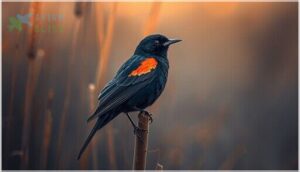
Most blackbirds don’t have orange wings — but the Red-winged Blackbird is the standout exception. The male’s scarlet-to-orange-red epaulet sits on the shoulder of the wing, making it one of the most recognizable orange and black birds in North America. Wing patch morphology matters here: that colored shoulder patch can be raised for full display or tucked away when the bird perches, so a seemingly all-black bird might just be hiding something.
Display behavior drives this coloration. Males flash their epaulets to defend territory and attract mates. Age-related coloration is worth noting too — young males show duller, reduced patches before their adult plumage fills in.
Male-female differences are sharp. Females are streaky brown, almost sparrow-like. For birdwatching tips and solid bird identification, habitat preference is your first clue: wetlands, cattails, and roadside ditches are Red-winged Blackbird territory.
Are There Black and Orange Birds in North America?
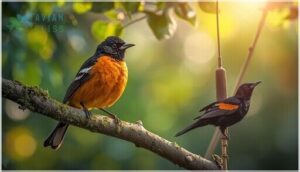
Red-winged Blackbirds may be the flashiest exception, but they’re far from alone. North America is genuinely rich with black and orange birds — and once you start looking, they turn up everywhere.
From wetland marshes to backyard feeders, guides covering black birds with distinctive wing markings can help you sort through the surprisingly diverse cast of species you might encounter.
Think about the Baltimore Oriole blazing through an elm canopy, or the quieter Orchard Oriole working an orchard edge. Their vivid patterns come from two biological systems working in tandem: carotenoid diet drives the orange tones, while melanin genetics locks in that deep, contrasting black. Neither works alone.
Here’s what makes these birds so visually striking:
- A male Baltimore Oriole looks like a lit match against green summer leaves
- Seasonal plumage shifts mean some birds look different in fall than in spring
- Hybridization zones in the Great Plains produce orioles with subtly blended patterns
Habitat preferences vary widely too — marshes, orchards, forest edges. Knowing where to look is half the work of any orange and black bird identification guide. Red‑winged blackbirds often form massive mixed flocks during migration.
Common Orange and Black Birds in North America

North America has no shortage of orange and black birds — and knowing a few key species makes spotting them much easier.
The Baltimore Oriole is hard to miss: a flame‑orange body against jet‑black wings, usually singing from high in an elm or cottonwood. Its orange tones come straight from a carotenoid diet — the bird is, quite literally, what it eats. The American Redstart is smaller but just as striking, flashing orange wing patches while chasing insects through deciduous woodlands. Scarlet Tanagers favor deep forest canopies in the east, while the Black‑headed Grosbeak works open woodlands out west.
Habitat preferences vary by species, so your location matters. Marshes bring Red‑winged Blackbirds. Orchards attract orioles. And nearly any backyard feeding setup can pull in a surprising variety — if you know what to offer.
The Significance of The Orange and Black Coloration
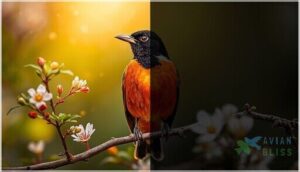
That bold orange-and-black pattern isn’t just for show — it’s doing serious work. Avian plumage coloration in these species provides four overlapping functions:
- Sexual Selection: Brighter males win mates faster and produce more offspring — Baltimore Orioles with saturated orange, secure partners roughly 23% quicker than duller rivals.
- Territorial Signaling: Larger orange patches help males claim territory up to two weeks earlier each spring.
- Feather Durability: Melanin-rich black feathers resist wear 40% better than unpigmented ones during long migrations.
- Predator Deterrence: The high-contrast pattern mimics toxic insects, reducing attack rates noticeably.
Coloration linked to diet and genetics means carotenoid pigments — sourced directly from berries and insects — function as honest health indicators. You can’t fake good color.
Carotenoid color cannot be faked — it is nature’s honest proof of health
Baltimore Oriole Vs Bullock’s Oriole Differences
Two orioles, one striking color scheme — but don’t let that fool you. Baltimore Orioles and Bullock’s Orioles are distinct species with clear differences once you know what to look for.
Plumage contrast tells the first story. Male Baltimore Orioles have a solid black head and back with fiery orange below. Male Bullock’s Orioles show an orange face with a black eye-line and more white on the wings.
| Feature | Baltimore Oriole | Bullock’s Oriole |
|---|---|---|
| Range | Eastern North America | Western North America |
| Male Head Pattern | Solid black | Orange face, black eye-line |
| Nesting Preferences | Deciduous parks, suburbs | Cottonwoods, streamside trees |
Range overlap happens across the Great Plains, where hybrid traits make identifying black and orange bird species genuinely tricky. Song differences exist but aren’t reliable alone — plumage and location matter most.
Migration Habits of Orange and Black Birds

orange and black birds are more varied than most people realize. Baltimore Orioles, for example, follow a loop route — crossing the Gulf of Mexico in spring and swinging back through Mexico in fall. Spring arrival in the eastern U.S. runs from late March through May. Fall timing shifts earlier than you’d expect, with some birds leaving breeding grounds by late August.
Bullock’s Orioles take flyway routes across western North America, while Orchard Orioles are among the earliest to head south — some departing by late July. Both species travel in small flocks, which helps with flock dynamics and navigation.
Stopover resources like fruit trees and shrubby cover are critical refueling points along bird migration routes in North America. Seasonal migration and habitat shifts also drive altitudinal migration in species like the Varied Thrush.
Attracting Orange and Black Birds to Your Backyard

Getting orange and black birds into your yard doesn’t take much — just the right setup at the right time. Put out Nectar Feeders in early April before orioles arrive. Add Fruit Feeding Stations with halved oranges, replaced every day or two. Layer in Native Plantings like serviceberry, trumpet vine, and black cherry for natural food and cover. Water Features with a dripper or bubbler seal the deal — orioles can’t resist moving water.
Here’s a quick backyard checklist:
- Hang oriole feeders in open spots near tall trees.
- Offer grape jelly in small shallow cups.
- Swap out fruit daily in warm weather.
Identifying Bird Species With Black and Orange Colors
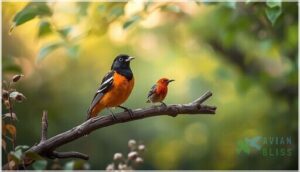
Color alone won’t always close the deal when you’re trying to name an orange and black bird. That’s why leaning on Plumage Pattern Guides alongside Bill Shape Cues makes identification so much sharper.
A long, pointed bill signals an oriole; a flatter, wider bill points toward a flycatcher.
Check the black mask, wing bars, and rump — small differences matter.
Habitat Signature Clues help too: vermilion flycatchers favor open desert perches, while warblers like the Blackburnian hide high in conifers.
Vocalization Identification Tips cut through dense cover when plumage is hidden.
Remember that Seasonal Plumage Changes soften bright orange tones outside breeding season, and carotenoid pigments drive that color intensity.
These birdwatching tips for orange and black species add up fast with practice.
Red-winged Blackbirds and Their Status as an Invasive Species
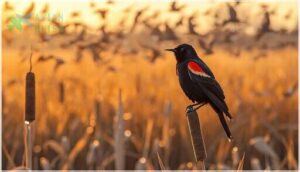
Here’s something that might surprise you: the Red-winged Blackbird isn’t invasive at all. Its native classification is firmly rooted in North America, from Alaska down through Central America.
So where does the confusion come from? Mostly from their sheer numbers and crop damage. These birds flock in the millions during winter roosting habits, and those roosting impacts on agriculture are real. USDA estimates put blackbird losses in ripening corn at $15–25 million annually, with sunflower growers in the Dakotas losing another $4–7 million each year.
Management tactics focus on frightening devices and crop timing — not eradication. Their legal status protects them as native wildlife.
Understanding that distinction matters. You’re watching a native bird managing a tough world, not an invader taking over.
Frequently Asked Questions (FAQs)
What are orange and black birds?
Orange and black birds are species with plumage patterns combining bold orange and deep black tones.
Melanin genetics drive the black, while a carotenoid diet shapes the orange — orioles and redstarts are classic examples.
Do blackbirds have orange wings?
Not every blackbird wears plain black. The red-winged blackbird has bold red-orange epaulets — bright shoulder patches, not full wings — that blaze against its glossy black body during territorial displays.
Do blackbirds have orange breasts?
True blackbirds don’t have orange breasts. Male Red-winged Blackbirds show red-and-yellow shoulder patches, not orange chests.
If you spot an orange breast on a black bird, you’re most likely looking at an oriole.
Are there black and orange birds in North America?
Yes, North America is home to several striking black and orange birds. You’ll spot Baltimore Orioles, American Redstarts, and Red-winged Blackbirds across forests, wetlands, and backyard feeders throughout the continent.
What birds are black and orange?
Think of black and orange birds as nature’s warning signs made beautiful. The Baltimore Oriole, American Redstart, and Bullock’s Oriole are the most striking examples you’ll spot across North America.
What do Oreos eat?
Oreos don’t eat — they’re cookies.
A serving of 3 has 160 calories, cocoa content for flavor, a high sugar level, and wheat and soy as allergen ingredients.
Best enjoyed with a milk pairing.
How rare is a golden oriole?
The golden oriole isn’t globally rare — population estimates sit between 17 and 32 million individuals. But in Britain, breeding scarcity is real. The last confirmed UK nest was
What is the world of Orange and black birds?
Like a painter’s boldest stroke, nature layers carotenoid diet pigments over melanin genetics to create birds that stop you cold.
Orioles, tanagers, and blackbirds all share this vivid palette across wildly different habitat preferences.
What is the significance of the orange and black coloration of these birds?
The orange and black color combination does more than look striking. It’s a biological statement.
Orange signals diet quality through dietary carotenoids, while melanin production in black feathers adds durability and camouflage contrast that enhances survival.
What is the difference between a Baltimore oriole and a Bullock’s oriole?
At first glance, these two birds look like two peas in a pod — but look closer.
Baltimore Oriole males wear a full black hood. Bullock’s Oriole males show an orange face instead.
Conclusion
Like nature’s paintbrush dipped in sunset hues, orange and black birds reveal survival stories in every feather.
Carotenoids fuel their brilliance; melanin fortifies their flight. From orioles stitching nests to redwings defending marshes, these colors signal health, territory, and resilience.
Knowing their needs—nectar, insects, safe spaces—turns your yard into a sanctuary. Watch closely: their flashes of orange against black aren’t just beautiful.
They’re living maps to migration mysteries, ecological balance, and the quiet persistence of wild things. The next flash could rewrite what you know.