This site is supported by our readers. We may earn a commission, at no cost to you, if you purchase through links.
Walk through any open field at dawn and you might catch a flash of color that stops you mid-step—a deep cobalt blue against green grass, gone before your brain fully registers it.
North America hosts more than a dozen bird species wearing shades of blue, and telling them apart takes more than a quick glance.
A Mountain Bluebird and an Indigo Bunting can share the same meadow yet belong to entirely different families, with different songs, nesting habits, and habitat needs.
Knowing which blue bird you’re actually looking at opens up a richer understanding of the birds visiting your yard, trail, or favorite birding spot.
Table Of Contents
- Key Takeaways
- True Bluebird Species
- Other Common Blue Bird Types
- Blue Bird Identification Tips
- Blue Bird Habitats and Behavior
- Attracting and Protecting Blue Birds
- Frequently Asked Questions (FAQs)
- What bird is blue but not a bluebird?
- Are there different varieties of bluebirds?
- What does it mean when you see a lot of bluebirds in your yard?
- What are some blue bird names?
- What are the three types of bluebirds?
- What kind of bird is Royal blue?
- What is a small solid blue bird?
- Are blue birds naturally aggressive toward other birds?
- How long do blue birds typically live?
- Can blue birds be kept as pets legally?
- Conclusion
Key Takeaways
- North America has over a dozen bluebird species across very different families, so a quick glance won’t cut it — you need to check breast color, crest, wing bars, and size together.
- The three true bluebirds (Eastern, Western, Mountain) share the same genus but split by elevation, chest pattern, and range, making location your first real ID clue.
- Blue plumage isn’t pigment — it’s physics, built from feather nanostructures that shift with light angle, which is why the same bird can look sky-blue one moment and almost gray the next.
- Nest boxes, native berry shrubs, and shallow water sources are the three most effective steps you can take to attract and support bluebirds in your yard.
True Bluebird Species
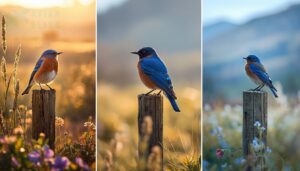
When most people think of bluebirds, they’re picturing one of three specific species — all belonging to the genus Sialia. Each one has its own look, range, and personality worth knowing.
Your location plays a big role in which species you’ll see, so it helps to know which bluebirds live in your region and how to attract them to your yard.
Here’s a closer look at what sets them apart.
Eastern Bluebird
Eastern Bluebird is your go-to starting point in any identification guide to blue bird species. Males wear a royal blue back with a brick-red chest — hard to miss.
Breeding timing runs spring through summer, with females laying three to seven eggs per clutch. They rely on habitat connectivity and nest boxes for survival, foraging on berries and insects through winter.
Effective conservation uses nest boxes with 1.5‑inch entrance to support their breeding.
Western Bluebird
Western Bluebird is another standout in any identification guide to blue bird species. Males show bright sky blue upperparts with a rusty orange breast, measuring roughly 15–18 cm.
They favor semi-open woodlands — a key habitat preference of blue birds.
Cooperative breeding, nest boxes for blue bird conservation, and winter range shifts tied to climate change impacts all shape this species’ survival.
Mountain Bluebird
Meet the Mountain Bluebird — the sky‑made feathers. Males glow cerulean blue from head to tail, while females wear soft gray‑blue tones. This high‑altitude habitat specialist breeds up to 12,500 feet across western North America.
Key facts for your birdwatching guide:
- Breeding Phenology: nests late spring through mid-summer
- Egg Clutch Size: usually 4–6 eggs per nest
- Winter Diet: shifts from insects to fruits and berries
- Lifespan Range: 2–6 years in the wild
Habitat preferences of blue birds like this one favor open meadows and sagebrush flats. Feeding habits and diet of blue birds here center on aerial insect‑catching. Nest boxes for blue bird conservation directly boost nesting success.
Key Differences Between True Bluebirds
All three true bluebirds share structural coloration and blue plumage in birds, yet each tells its own story.
The Eastern Bluebird sports a rusty-orange breast; the Western Bluebird shows a blue throat with warm orange chest; the Mountain Bluebird glows sky-blue with no rust at all.
Elevation habitat, vocalization differences, and seasonal diet change set them apart too.
Male Vs Female Bluebird Coloration
Male bluebirds win the display game — their structural blue intensity and chestnut pigment contrast make them easy to spot from across a field. Females lean into camouflage vs display, trading vivid color for subtle blue-gray tones that blend into branches during nesting.
Eye ring definition and breeding season brightness both peak in males, a classic example of sexual dimorphism in bluebird species.
Other Common Blue Bird Types
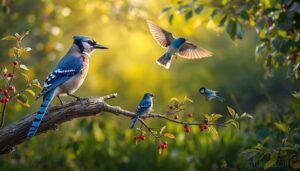
North America is home to far more blue birds than just the three true bluebirds. From bold, crested jays to tiny aerial insect-catchers, the variety is honestly impressive.
Here are some of the most common blue birds you’re likely to spot across different habitats.
Blue Jay
The Blue Jay is hard to miss — cobalt blue wings, bold black collar, and that sharp, signature crest. Crest Display Behavior signals everything from alarm to curiosity.
Blue Jay Identification of blue bird species gets easier once you spot those white wing patches.
They master Hawk Call Mimicry to scatter competitors, practice Food Caching Strategies across thousands of autumn hiding spots, and thrive through Urban Adaptation Patterns in backyards and parks.
Steller’s Jay
Steller’s Jay stands apart in the identification of blue bird species — dark blue body, bold crest, and no white underparts.
It thrives across western forests, with a clear elevation preference from 1,000 to 9,000 feet.
Watch for predator vigilance calls, food caching in bark and soil, fledgling development near nest sites, and mating displays that make this bird fascinating for any birdwatching enthusiast.
California Scrub-Jay
The California Scrub-Jay is hard to miss — bright blue head, wings, and tail set against a gray-brown back, with a bold white throat. You’ll spot it in coastal oak woodlands from Baja to Oregon, often raiding your feeder without hesitation.
- Acorn Dependence and Cache Retrieval: It stores hundreds of acorns seasonally, remembering exact locations with impressive precision.
- Cooperative Breeding: Some pairs rely on helper birds to raise chicks successfully.
- Urban Adaptation: It thrives in suburban yards wherever oaks or dense shrubs exist.
Its harsh, rattling calls make California Scrub-Jay birdwatching genuinely rewarding.
Indigo Bunting
Few birds stop you in your tracks like the Indigo Bunting (Passerina cyanea). During breeding season timing, the male courtship display is unmistakable — pure indigo from head to tail, roughly 12–13 cm long.
| Feature | Male | Female |
|---|---|---|
| Plumage | Rich indigo blue | Brown, faint blue tinge |
| Song frequency range | High, rapid phrases | Soft contact calls |
| Habitat preferences | Brushy field edges | Dense low shrubs |
Predation threats and habitat loss affect population trend analysis, but bird identification remains straightforward for birdwatching tips for attracting blue birds.
Lazuli Bunting
Lazuli Bunting (Passerina amoena) is the West’s answer to the Indigo Bunting. Males wear lapis-blue on the head and back with a warm orange breast — easy bird identification once you know what to look for.
Geographic distribution of specific blue bird species, like this one, spans British Columbia down to California. Molt timing dulls winter plumage noticeably.
Their habitat preferences favor brushy hillsides near streams, and courtship displays involve persistent singing from low perches.
Blue Grosbeak
Move west to east, and you’ll find the Blue Grosbeak — a chunky songbird whose bill morphology sets it apart instantly. That thick, conical bill isn’t decorative; it’s built for serious seed preference, cracking tough weed seeds with ease.
Males glow cobalt blue with bold rusty wingbars.
Range expansion has pushed this species northward into the Midwest, where brushy field edges suit its breeding phenology perfectly.
Cerulean Warbler
The Cerulean Warbler takes blue to another level — sky-blue on top, white below, with sharp flank streaks. Males breed high in mature hardwood canopies, sometimes up to 30 meters.
Long-term population studies show steady declines tied to forest fragmentation and climate change impacts on migration timing. Citizen science mapping projects have been essential in tracking this vulnerable species across its shrinking range.
Blue-gray Gnatcatcher
Smaller than you’d expect, the Bluegray Gnatcatcher packs a lot of personality into 4.5 inches. That Eye Ring Contrast — bright white against blue-gray — makes it easy to spot.
Watch for its signature Tail Flicking Behavior, which flushes hidden insects from foliage. It shows strong Microhabitat Preference for forest edges.
Key field marks include:
- Slim body with white outer tail feathers
- Pale underparts with darker wing markings
- Breeding males show a subtle dark eye line
Tree Swallow
Unlike the gnatcatcher’s forest-edge preference, the Tree Swallow thrives over open water and wetlands. This water-associated blue bird species flashes glossy blue-green upperparts against crisp white below — easy to spot mid‑flight.
| Field Mark | Detail |
|---|---|
| Upperparts | Glossy blue-green |
| Underparts | White |
| Breeding Season Timing | May–September |
| Nest Material Selection | Cavity with feather lining |
Aerial insect capture drives their entire foraging strategy. Colony formation happens outside nesting season. Nest boxes for blue bird conservation have genuinely helped stabilize Population Trends across North America.
Barn Swallow
The Barn Swallow takes aerial insect hunting to another level. Its steel-blue upperparts and deeply forked tail make it one of the most recognizable birds in any blue bird species identification guide.
Watch for these four quick field notes:
- Mud Nest Construction on barns and bridges.
- Insect Prey Types include flies, beetles, and moths.
- Urban Adaptation boosts strong Population Trends.
- Predation Risks increase near open nesting sites.
Purple Martin
The Purple Martin is the largest swallow in North America, and the males’ glossy blue-violet plumage makes them a standout in any blue bird species identification guide.
Their Flight Speed Adaptations let them chase insects high overhead.
Colonies depend heavily on nest boxes, making Breeding Pair Coordination and Population Monitoring Methods essential for backyard feeding enthusiasts and birdwatching tips communities supporting their recovery.
Blue Bird Identification Tips
Telling blue birds apart takes more than a quick glance — the details matter. A few key features can point you in the right direction fast.
Here’s what to look for when you’re out in the field.
Plumage Shades and Color Patterns
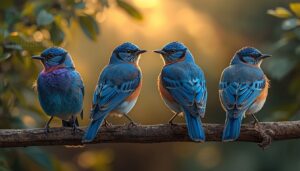
Blue bird plumage variation isn’t random — it’s physics, pigment, and diet working together. Structural iridescence from nanostructure variation makes the blue you see shift with the light angle, not paint. Melanin bar patterns add contrast, while carotenoid highlights brighten undertails and wingbars through diet quality. UV reflective patches signal health to other birds invisibly.
Blue plumage isn’t paint — it’s physics, pigment, and diet bending light into living color
- Structural coloration — feather iridescence from keratin nanostructures
- Melanin bar patterns — eumelanin blacks, pheomelanin rufous tones
- Carotenoid highlights — diet-driven yellows and oranges
- UV reflective patches — invisible coloration mechanisms in blue plumage
Crest, Wingbar, and Breast Markings
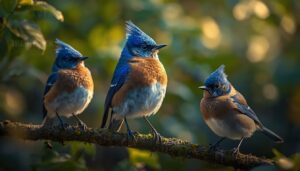
Three markings enable fast ID in the field: crest, wingbar, and breast patch. Crest Morphology varies from flat to raised, signaling mood or species. Wingbar Patterns cut through motion — their width and color differ by sex. Breast Markings reveal Sexual Dimorphism clearly, with males showing bolder patches.
Age-Related Changes soften all three features in juveniles.
| Marking | Male | Female |
|---|---|---|
| Crest | Raised, vivid contrast | Smaller, muted |
| Wingbar | Bold white or buff | Narrower, paler |
| Breast patch | Deep blue or orange | Faint or absent |
| Visibility | High in direct sun | Reduced in shade |
| Seasonal change | Brightest during breeding | Subtle year-round |
Size and Body Shape
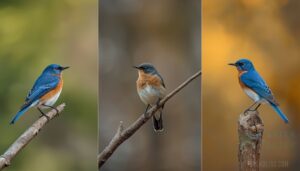
Size tells a story before color ever does.
Eastern bluebirds run 6.3–7.5 inches, with a Wing Length Ratio built for quick, fluttery bursts. Western bluebirds show notable Chest Depth Differences — slightly deeper and sturdier. Mountain bluebirds display the most interesting Tail Proportion and wing morphology, leaning long and tapered.
Body Mass Variation between sexes is real but small — useful field recognition when birdwatching tips matter most.
Tail Shape and Flight Style
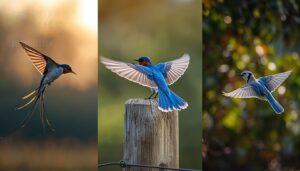
A bird’s tail is basically its steering wheel. Watch how it moves and you’ll reveal a fast ID clue.
- Barn swallows use Tail Streamer Agility — those long forked tips improve yaw control mid-chase
- Bluebirds show Broad Tail Braking during landing, fanning wide to slow descent near perches
- Jays rely on Pygostyle Control for tight woodland turns, with Habitat Tail Morphology shaping every species differently
Songs, Calls, and Vocal Clues
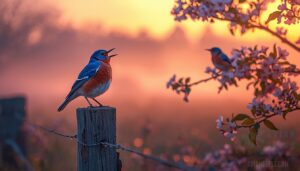
Sound is just as useful as sight when you’re tracking blue birds in the field. Dawn Chorus Patterns peak right at sunrise — that’s your best window to catch Territorial Song Structure in action, as males loop complex phrases to claim space. Environmental Noise Effects matter too; open fields carry notes farther than dense woods.
| Vocal Clue | What It Tells You |
|---|---|
| Dawn chorus repetition | Resident bluebird nearby |
| Short sharp alarm call | Predator approaching |
| Complex Age-Related Repertoire | Older, experienced male |
Seasonal Vocal Variation shifts song complexity throughout the year.
Seasonal Plumage Changes
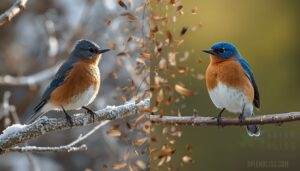
Plumage isn’t fixed — it shifts with the seasons. Molt Timing drives this change, with most species replacing worn feathers in late winter. That’s when Feather Microstructure refreshes, restoring the vivid Seasonal Hue you see during courtship.
Breeding blue deepens as a Mating Signal, while Camouflage Shifts mute tones in winter. Blue bird plumage variation follows environmental cues like daylight and temperature.
Juvenile Vs Adult Appearance
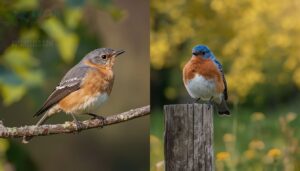
Age tells its own story in feathers. Juveniles wear a softer, less saturated blue—brownish tones mixing into the back, faint Underpart Buffing visible across the breast.
Wing Bar Development lags behind adults, and Head Proportion runs slightly larger relative to the body.
- Beak Coloration stays duller, with paler Leg Hue through early months.
- Blue bird plumage variation between age classes reflects structural coloration and plumage perception differences.
- Sexual dimorphism in blue bird species becomes clearer only after the first full molt.
Blue Bird Habitats and Behavior
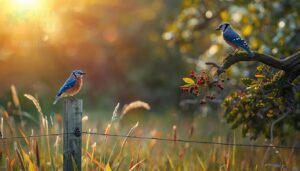
Blue birds show up in some surprising places, and where they live shapes almost everything about how they act. Each species has carved out its own niche, from open grasslands to your backyard fence.
Here’s a closer look at the habitats and behaviors that define these birds.
Open Fields and Meadows
Open fields and meadows are prime territory for species like the Eastern Bluebird, Western Bluebird, and Lazuli Bunting. These grassland and open habitat bluebirds thrive where native wildflowers support pollinator diversity and soil moisture stays consistent.
Smart mowing regimes and grazing management keep vegetation at ideal heights. You can boost visits by placing mealworms near field edges where they naturally hunt.
Forest Edges and Woodlands
Forest edges are where the action is. The edge microclimate—warmer, windier, and sunlit—drives insect prey abundance in the shrub layer, drawing Blue Jays, Eastern Bluebirds, and Indigo Buntings to forage.
Shrub layer diversity provides nesting and cover, while wind-driven seed dispersal keeps vegetation regenerating.
Habitat connectivity between woodland patches matters too, letting species move freely.
Watch these transitional zones—they’re consistently productive for birdwatching.
Wetlands and Riparian Areas
Wetlands and riparian zones punch above their weight for blue birds. Water level fluctuations create vibrant invertebrate food webs that Tree Swallows and Barn Swallows exploit heavily. Sediment trapping and nutrient cycling keep riparian vegetation layers dense and productive. These are prime stops for water-associated blue bird species year-round.
Watch for these blue birds near water:
- Tree Swallows skimming low over ponds
- Barn Swallows nesting under bridges
- Purple Martins foraging over open marshes
- Blue-gray Gnatcatchers threading through streamside shrubs
- Eastern Bluebirds hunting insects along wet meadow edges
Backyards and Suburban Spaces
Your backyard can quietly become a hotspot for blue birds. Shade structures, patio lighting, and pollinator gardens all make outdoor spaces more inviting for species like Eastern Bluebirds.
Use of nest boxes for blue bird conservation is straightforward here. Low‑maintenance planting with native shrubs, rainwater harvesting setups, and bird baths give visiting blue birds exactly what they need to stick around.
Feeding Habits and Diet
Blue birds are nature’s pest controllers—and their diet tells the whole story.
Their insectivorous diet shifts with the calendar. Seasonal Insect Shifts drive most of their foraging decisions.
- Perch Hunting Strategies let them strike beetles and caterpillars fast
- Berry Consumption Timing peaks in autumn, favoring dogwood and juniper
- Cache Use Behavior stores insects for poor-weather days
- Energy Demands Breeding push adults toward protein-rich mealworms
Nesting Sites and Cavity Use
Think of a nest cavity as prime real estate—location and size matter everything.
True bluebirds rely on natural tree decay or artificial boxes, where Cavity Entrance Size (1–2 inches) filters out larger predators, lowering Predation Risk Management.
Seasonal Box Cleaning between broods cuts parasite loads substantially.
Microhabitat Moisture and Tree Decay Selection shape which sites birds actually choose.
| Cavity Feature | Why It Matters |
|---|---|
| Entrance Size | Controls species access |
| Tree Decay | Softer wood, easier nesting |
| Box Cleaning | Reduces parasites |
| Moisture Control | Protects eggs and chicks |
| Entrance Height | Limits predator reach |
Migratory Vs Year-Round Species
Some blue birds stay close to home all year, while others log serious miles each season. Migratory routes of blue birds like the Indigo Bunting stretch from North America into Central America.
Before departure, fat accumulation fuels those long flights. Seasonal movements of blue birds depend heavily on stopover habitat quality, climate sensitivity, and home range size.
Seasonal molting often aligns with these journeys.
Social and Territorial Behavior
Territory size shifts with the seasons and available resources — more insects means a bigger defended patch. Male bluebirds lean on vocal communication and aggressive displays to hold their ground, while mate guarding keeps rivals at bay near the nest.
Watch for these territorial behaviors:
- Sharp calls signal ownership
- Wing flicks warn off intruders
- Pairs patrol cavity entrances together
- Intensity peaks during egg-laying
Attracting and Protecting Blue Birds
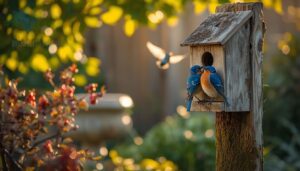
Getting blue birds to visit—and stick around—comes down to a few simple things you can set up in your own backyard. It’s less complicated than most people think, and even small changes can make a real difference.
Here’s what actually works.
Best Feeders and Foods
Feeding blue birds well comes down to matching the right food to the right feeder. Tube feeder benefits include easy access for smaller species and simpler cleaning.
Offer suet for winter energy when insects disappear. Nyjer seed preference draws finches reliably. Mealworms work best for attracting insectivores like bluebirds. Add fruit seasonal treats during migration.
Feeder hygiene practices—cleaning every two weeks—keep your visitors healthy.
Using Nest Boxes for Bluebirds
A nest box can do more than a feeder ever could.
Mount it at the right Box Placement Height—five to six feet off the ground—using cedar or untreated wood as your Material Choice.
Keep the Entrance Hole Size at 1½ inches. Add a Predator Guard Design around the pole.
Stick to your Annual Cleaning Routine after each brood fledges.
Bird Baths and Water Sources
Water matters just as much as a nest box. Keep Water Depth at one to two inches—shallow enough for small species like bluebirds and Tree Swallows to wade safely.
Smart Bath Placement means open ground, ten feet from dense shrubs. Add Water Movement with a dripper.
Stick to a Cleaning Routine every week, and make Seasonal Adjustments, like a heater in winter.
Native Plants for Shelter and Food
Plants do more than look pretty — they feed and shelter bluebirds year-round.
Berry shrubs like serviceberry and chokecherry supply seasonal fruit. Evergreen conifers offer winter refuge from harsh winds. Native grasses produce seeds that sustain songbirds through fall.
Riparian plantings shade water sources and attract insects. Seasonal flowering perennials draw the bugs that nestlings depend on during breeding.
Reducing Habitat Loss
Habitat loss quietly chips away at the ranges where blue birds thrive.
Protected Area Expansion creates breathing room across key corridors, while Habitat Corridor Planning links fragmented patches so species can move freely.
Sustainable Land Use keeps critical nesting grounds intact.
Community Stewardship Programs and Restoration Funding Incentives turn good intentions into real action — because conservation concerns for blue birds grow heavier every year without them.
Supporting Vulnerable Blue Species
Some blue species are genuinely struggling. Florida Scrub-Jay is threatened, and the Cerulean Warbler carries a vulnerable status — conservation concerns for blue birds like these are real and growing.
You can help through smart Nest Box Design with Predator Guarding, restoring Insect Habitat near nesting areas, and protecting Climate Refugia.
Population trends improve when everyday people take action.
Birdwatching and Citizen Science Tips
Every sighting you log becomes part of something bigger. Good citizen science starts with Standardized Data Sheets — note date, location, count, and behavior every time.
Use Audio Recording Techniques at dawn to capture songs for Community Data Sharing platforms. Follow Ethical Observation Practices near nests, and plan around Seasonal Survey Planning windows.
- Record vocalizations at dawn
- Log precise coordinates and weather
- Submit data within 24 hours
- Stay on trails near nesting sites
- Share photos to verify identifications
Frequently Asked Questions (FAQs)
What bird is blue but not a bluebird?
Many birds wear blue without being true bluebirds.
Blue Jays, Indigo Buntings, Lazuli Buntings, Blue Grosbeaks, Blue Kingfishers, Blue Terns, Blue Pigeons, Blue Swifts, Blue Parrots, and the Bluebird of Paradise all qualify.
Are there different varieties of bluebirds?
Yes — there are three varieties: the Eastern, Western, and Mountain Bluebird.
Each shows distinct geographic color variation and habitat-driven divergence, making them rewarding targets in any birdwatching guide for blue birds.
What does it mean when you see a lot of bluebirds in your yard?
Seeing a lot of bluebirds in your yard is a strong insect abundance indicator and a habitat health gauge.
It often signals nesting success and a seasonal population surge in your area.
What are some blue bird names?
Blue bird names span Scientific Nomenclature to Regional Vernacular Names.
You’ll find Eastern Bluebird, Mountain Bluebird, Indigo Bunting, Blue Jay, and Steller’s Jay among the most recognized, each reflecting Color-Based Taxonomy traditions.
What are the three types of bluebirds?
North America’s three true bluebirds—Eastern Bluebird, Sialia mexicana (Western), and Mountain Bluebird—each claims distinct geographic ranges, morphological traits, and habitat preferences, united by their reliance on nest boxes during breeding season.
What kind of bird is Royal blue?
Several birds show royal blue plumage. Eastern and Western Bluebirds are top examples. Indigo Buntings and Blue Jays also display rich royal blue tones through structural coloration, not pigment.
What is a small solid blue bird?
The Indigo Bunting is a small solid blue bird.
Breeding males show rich, all-over indigo blue — a striking look created by structural coloration in their feather microstructure, not true blue pigment.
Are blue birds naturally aggressive toward other birds?
Yes, bluebirds do show territorial behavior, especially during nesting. Males use chase flights and wing flicks to defend cavities. Aggression peaks in spring, when competition for nest boxes runs high.
How long do blue birds typically live?
Bluebirds don’t exactly "live long and prosper," but they make their years count. Most wild Eastern Bluebirds survive one to six years, with top individuals hitting nine or ten.
Can blue birds be kept as pets legally?
No, keeping most blue birds as pets isn’t legal without permits.
Wildlife laws protect native species, and captive breeding rules, import restrictions, and enforcement penalties make casual ownership nearly impossible in the U.S. and EU.
Conclusion
Think of your yard as a canvas—blue birds are the brushstrokes that make it come alive. A birder once spent a full morning convinced she’d spotted three different species, only to realize the shifting light had fooled her each time.
Learning the types of blue birds trains your eye to see past the trick. Once you can tell a bluebird’s rust chest from a bunting’s solid cobalt, every walk outside becomes a little more rewarding.