This site is supported by our readers. We may earn a commission, at no cost to you, if you purchase through links.
 When your bird suffers a wing injury, you need an avian vet wing injury specialist who understands the unique anatomy that makes flight possible. Birds’ hollow bones and complex feather structures require precise diagnostic tools like avian-specific X-rays and hands-on physical exams that reveal fractures, dislocations, or soft tissue damage invisible to the untrained eye.
Whether your parrot collided with a window or your canary tangled with a household pet, specialized treatment—from splinting and bandaging to surgical pinning—can restore function that general practitioners might miss.
Recovery isn’t just about healing bones; it’s about rebuilding the intricate mechanics of flight through controlled rehabilitation exercises and gradual retraining that respect your bird’s natural biology and behavioral needs.
Table Of Contents
Key Takeaways
- Birds’ hollow bones and complex wing anatomy demand specialized avian veterinarians who use species-specific diagnostic tools like avian X-rays and understand the unique mechanics of flight that general practitioners often miss. – Conservative treatment for wing fractures succeeds in 75% of cases overall and 97% for raptors, significantly outperforming surgical options, which carry a 43% complication rate, making treatment choice critical to recovery outcomes. – Wing injury recovery extends far beyond initial treatment, requiring controlled rehabilitation exercises, optimized nutrition for bone and feather regrowth, and gradual flight retraining that can span weeks to months. – Early intervention with board-certified avian specialists (ABVP or ACPV credentials) maximizes healing success, with diagnostic costs ranging $165–$500 and surgical repairs starting around $1,200, though pet insurance now covers up to 90% of eligible avian emergency care.
What Makes Birds Unique Animals?
Birds aren’t just animals with wings—they’re a distinct class of vertebrates shaped by millions of years of evolution.
Their unique anatomy means injuries that might be minor in other animals can turn life-threatening fast. That’s why specialized veterinary care isn’t optional—it’s essential.
Key Avian Characteristics and Adaptations
Birds possess a suite of outstanding adaptations—from hollow bones and air sacs to feathers and high-metabolism hearts—that set them apart as some of nature’s most specialized creatures. Their skeletal adaptations reduce weight without sacrificing strength, while their unique respiratory system allows continuous oxygen flow during both inhalation and exhalation.
Feather structure provides insulation and facilitates flight mechanics that let birds navigate diverse environments.
You’ll also notice their avian senses—especially vision—are exceptionally sharp, helping them hunt, forage, and avoid danger with remarkable precision.
Differences Between Birds and Other Animals
While those adaptations make birds remarkable flyers, what really separates them from mammals, reptiles, and other vertebrates comes down to a handful of defining traits you won’t find anywhere else in the animal kingdom. Feathers remain exclusive to avian physiology—no mammal or reptile grows them. Birds also have a four-chambered heart and an elevated metabolic rate that keeps their body temperature high. Their respiratory system uses air sacs for continuous oxygen exchange, unlike the simple lungs in other animals.
That’s why avian veterinarians need different training and tools than regular vets—birds require specialized care that accounts for their unique physiology and health concerns.
Evolutionary Importance of Avian Classification
Avian classification lets scientists trace how birds split from their reptilian ancestors and track millions of years of adaptation across every continent.
By studying avian phylogeny and the fossil record, researchers pinpoint speciation events and adaptive radiation patterns that explain today’s striking diversity.
This taxonomy reveals evolutionary relationships between animals, showing how trait evolution shaped flight, metabolism, and behavior—insights that guide your avian vet’s approach to bird anatomy and health.
Examples of Avian Species and Their Habitats
From emperor penguins enduring Antarctic ice sheets to hummingbirds hovering in rainforest canopies, the class Aves has colonized virtually every habitat on Earth—a clear indication of the evolutionary flexibility you’ve just explored.
This habitat diversity means your avian veterinarian must understand species-specific adaptations—whether treating migratory patterns in wild regional avifauna or providing specialized veterinary care for pet birds adapted to desert, wetland, or tropical environments, all critical for species conservation.
Common Causes and Types of Wing Injuries
Wing injuries happen more often than you might think, and understanding what causes them helps you protect your bird.
Let’s look at the most common accidents, injury patterns you’ll see in different bird populations, and how these injuries affect your feathered companion’s daily life.
Frequent Accidents Leading to Wing Trauma

Ceiling fans pose one of the most frequently reported hazards for companion birds, turning an ordinary room into a danger zone where a moment’s inattention can result in serious wing fractures. Understanding domestic hazards helps you protect your pet birds through preventative measures suited to their species vulnerability.
Common causes of wing trauma include:
- Window collisions when birds mistake reflections for flight paths
- Attacks by household pets like cats or dogs during unsupervised interaction
- Cooking accidents involving hot oil or steam burns
- Door closures trapping wings between frames
- Seasonal impacts from outdoor predators during supervised time outside
Implementing flight restrictions indoors and consulting your avian veterinarian about environmental safety can prevent injuries requiring specialized medical care in avian medicine.
Wing Injury Patterns in Pet and Wild Birds
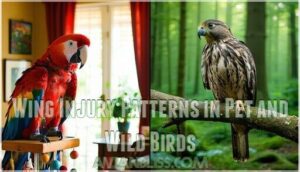
Wing injury patterns differ markedly between pet birds and wild bird populations, informing how your avian veterinarian approaches medical care for birds. Wild birds experienced a 9.0% fracture incidence following collisions, with release rates hovering at 18.2%. Habitat influence matters—51.1% of species in forested areas displayed injury-related behaviors.
Pet birds face clipping trauma and behavioral risks: blood feather breaks dominate clipped populations, while 67.4% undergo wing trimming. Severe clipping increases crashes, demanding expert avian medical care, and can also lead to significant muscle atrophy.
Impact of Injuries on Bird Health and Mobility
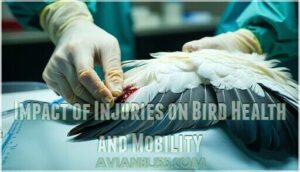
A broken wing isn’t just about one damaged bone—it messes with a bird’s ability to fly, find food, and keep its place in the flock.
Your avian vet looks at several health factors:
- Flight Impairment disrupts escape responses and territorial defense
- Pain Management requires specialized avian medicine protocols
- Infection Risk escalates without prompt medical care
- Behavioral Changes include depression and reduced vocalization
- Rehabilitation Success depends on early intervention and bird health monitoring
How Avian Vets Diagnose and Treat Wing Injuries
When your bird injures a wing, an avian vet will use specific diagnostic tools and treatment approaches to help your feathered friend heal.
Here’s how avian specialists check for wing injuries and help birds get back to flying again.
Diagnostic Tools: X-rays and Physical Exams
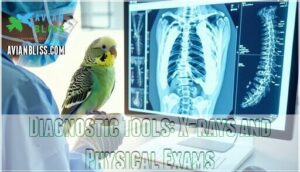
Your avian veterinarian relies on two essential diagnostic tools—a thorough physical examination and radiographic imaging—to accurately assess the extent of your bird’s wing injury. During the exam, your vet uses careful palpation methods to feel for fractures, swelling, or abnormal movement while your bird is gently restrained. X-ray interpretation then reveals hidden damage invisible to touch.
Understanding avian anatomy is key—bird bones are pneumatic (hollow), making fracture identification different from other veterinary practice. These exam techniques in avian medicine provide the foundation for effective medical care and restoring your bird’s health.
| Diagnostic Method | What It Reveals |
|---|---|
| Physical Examination | Swelling, pain response, joint mobility |
| Palpation Techniques | Bone displacement, crepitus (grinding sensation) |
| Radiographic Imaging | Fracture identification, bone alignment |
| Anatomical Assessment | Specific injury location in avian anatomy |
Surgical Vs. Conservative Treatment Options
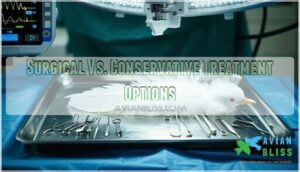
Deciding between surgery and a more hands-off approach isn’t simple—your bird vet takes a lot into account before making a recommendation.
Conservative success rates for closed coracoid fractures reach 75% overall, with raptors achieving 97%, significantly outperforming surgical outcomes at 34% (P < .001). However, surgical complications occurred in 43% of cases, with 30% life-threatening.
Preparation is key before any procedure, including avian general anaesthesia. Healing rates, post-op risks, and economic factors all influence treatment decisions in avian medicine, helping your bird receive the best veterinary care designed for its specific injury and prognosis.
Rehabilitation and Recovery for Birds
Taking off the splint marks a milestone, but your bird’s healing process stretches weeks or months beyond that point. Your avian vet will map out post-op care in stages:
- Controlled movement exercises to rebuild wing strength without risking re-injury
- Diet optimization with calcium and protein to aid bone healing and feather regrowth
- Gradual flight training in safe, enclosed spaces before considering release criteria for wild birds
Avian medicine emphasizes patience—rushing rehabilitation compromises long-term bird health and wellness.
Choosing an Avian Wing Injury Specialist
When your bird has a wing injury, finding the right specialist can make all the difference in their recovery.
Here’s what you need to know about selecting a qualified avian veterinarian and accessing emergency care when time matters most.
Qualifications and Board Certifications to Look For
Not everyone calling themselves an avian specialist has the credentials to back it up. You’ll want to look for board certification through the American Board of Veterinary Practitioners (ABVP) or American College of Poultry Veterinarians (ACPV).
These designations require at least six years of clinical practice, a two-year residency in avian medicine, and passing rigorous exams. Board-certified avian veterinarians also complete continuing education annually to maintain their expertise recognition, helping them stay current with the latest advances in avian medicine.
Finding Emergency Avian Care in Your Area
Even with the right credentials in hand, knowing where to turn when your bird suffers a sudden wing injury can feel overwhelming, especially outside regular business hours. Start by identifying animal hospitals offering after-hours avian clinics before an emergency strikes:
- Search online directories for board-certified avian veterinarians with emergency care availability
- Contact your regular avian medicine provider for their emergency protocols and backup referrals
- In rural areas, call exotic animal specialists who may handle avian emergency care when dedicated bird vets aren’t accessible
Keep transport carriers ready—transporting injured birds safely matters as much as finding affordable emergency options quickly.
Costs and Ongoing Care for Injured Birds
Treating a wing injury costs money and time—you need to know both upfront if you’re serious about helping your bird recover.
Here’s what you’ll actually pay and what kind of care you’re signing up for.
Typical Expenses for Diagnosis and Surgery
Regarding caring for an injured bird, understanding the financial commitment helps you prepare for quality animal health services. Diagnostic exam costs at an avian veterinarian usually range from $90 to $250, with X-rays adding another $75 to $250. Surgical procedure fees for wing repairs start around $1,200 and can reach $1,800 or more for complex cases. Lab testing prices vary from $35 for bloodwork to $75 for specialized infection screens. Hospitalization expenses after surgery may run $600 to $1,700 per night.
Insurance plan coverage for avian medicine now reimburses up to 90 percent of eligible avian emergency care costs, making treatment more accessible.
| Service Type | Typical Cost Range |
|---|---|
| Diagnostic Exam & X-rays | $165–$500 |
| Wing Surgery | $1,200–$1,800+ |
| Hospitalization (per night) | $600–$1,700 |
Importance of Follow-Up Visits and Wellness Checks
Paying for surgery is just the beginning—what happens after your bird leaves the operating table matters just as much for a full recovery. Your avian veterinarian schedules follow-up visits to monitor recovery progress and catch complications early. These checkups guarantee bones heal properly and prevent relapse.
Regular wellness exams promote enhanced wellbeing through preventative care and early detection of health issues, strengthening avian welfare and overall animal health throughout your bird’s life.
Supporting Long-Term Avian Health and Welfare
When your bird is on the mend, it’s time to focus on lifelong healthy routines that help them stay happy and strong for years to come.
Your avian vet will work with you to build a plan that covers nutrition, a stimulating environment, and all the little behaviors that keep your bird thriving.
Preventative Healthcare through Avian Medicine protects animal welfare by:
- Catching silent diseases before they ground your feathered companion
- Tailoring diet and habitat to your bird’s species-specific requirements
- Monitoring subtle changes that signal declining avian health
This thorough approach to avian welfare ensures your bird thrives, not just survives.
Frequently Asked Questions (FAQs)
Can birds recover from permanent wing damage?
When permanent wing damage eliminates flight, many birds can still thrive with Adaptive Strategies that bolster their Quality of Life. Some birds adapt to Flight Alternatives like ground mobility, while others face Euthanasia Decisions when animal welfare and avian health are compromised.
Recovery Factors depend on injury severity, species, and your avian veterinarian’s assessment.
What percentage of wing injuries require amputation?
Most wing injuries don’t require amputation. Studies show that among hundreds of raptors treated for wing trauma, the vast majority received conservative or surgical repair rather than amputation.
Alternative treatments like splinting often succeed, especially when you consult an avian veterinarian promptly for injury severity assessment.
How long does avian wing surgery usually take?
A simple fracture might take 30 minutes under anesthesia, but complex procedures involving multiple bones or soft tissue repair can extend beyond two hours.
Procedure complexity, species variation, and your avian veterinarian’s approach all influence surgery time factors and anesthesia duration, which directly affects recovery implications in avian medicine.
Are wing injuries more common in certain species?
Yes, wing injuries vary considerably by avian species. Species-specific anatomy and flight style impact vulnerability—wild birds in high-activity habitats face more predation influence and habitat-related risks.
Captivity risks, like ceiling fans, disproportionately affect companion species. Consult an avian veterinarian familiar with avian medicine for species-appropriate care.
Can birds fly again after wing fracture repair?
Recovery depends on fracture severity, your bird’s species, and age.
With proper rehabilitation from an avian veterinarian skilled in avian medicine, many birds regain flight, though outcomes vary by individual case and post-op care quality.
Conclusion
If a wing injury keeps your bird grounded, turning to an avian vet who specializes in wing care means their bones, feathers, and muscles get the expert attention they deserve.
From pinpointing fractures through specialized imaging to guiding rehabilitation that respects natural flight mechanics, you’re investing in more than recovery—you’re restoring your companion’s freedom.
Don’t wait until damage worsens; early intervention with certified professionals maximizes healing and gives your bird the best chance at returning to the skies.
- https://cdnsciencepub.com/doi/10.1139/cjas-2019-0204
- https://pubmed.ncbi.nlm.nih.gov/35526160/
- https://nottingham-repository.worktribe.com/OutputFile/918142
- https://www.veterinarypaper.com/pdf/2023/vol8issue6/PartD/8-6-20-883.pdf
- https://magazine.vetmed.ucdavis.edu/spring-2022-news-articles/wing-and-prey-er