This site is supported by our readers. We may earn a commission, at no cost to you, if you purchase through links.
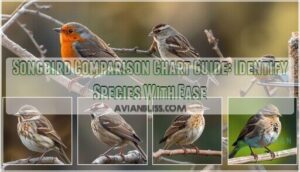
 Mastering basic bird identification characteristics doesn’t require expert knowledge—just focus on five essential features.
Start by comparing size to familiar birds like sparrows, robins, and crows, remembering that distance can make cardinals appear hawk-sized. Next, examine shape details like bill structure, which reveals feeding habits—conical beaks crack seeds while needle-like bills sip nectar.
Color patterns serve as nature’s ID cards, though behavior often proves more reliable than plumage. Watch feeding styles: ground-hopping sparrows versus aerial-hunting flycatchers tell different stories.
Table Of Contents
- Key Takeaways
- Bird Size Matters
- Shape and Color Patterns
- Bird Behavior Clues
- Habitat and Range Factors
- Key Identification Features
- Frequently Asked Questions (FAQs)
- What are the basic characteristics of birds?
- What are the 4 keys to bird ID?
- How do bird sounds help with identification?
- What time of day are birds most active?
- How do weather conditions affect bird behavior?
- What equipment do I need for birdwatching?
- How can I attract specific birds to observe?
- How do seasonal molting patterns affect identification?
- When are birds most active for viewing?
- What weather conditions improve bird identification success?
- Conclusion
Key Takeaways
- Compare size to familiar reference birds – You will master bird identification by comparing unknown species to sparrows, robins, and crows, remembering that distance tricks your perception and can make a cardinal appear hawk-sized.
- Focus on bill structure for feeding clues – You will identify species quickly by examining their beaks, since conical bills crack seeds while needle-like bills sip nectar, revealing their diet and lifestyle.
- Watch behavior over color patterns – You will get more reliable identification from observing how birds move, feed, and perch rather than relying solely on plumage, which changes seasonally.
- Use habitat to narrow your options – You will eliminate confusion by knowing where birds prefer to live, since wetlands attract herons and ducks while forests host woodpeckers and warblers.
Bird Size Matters
You’ll find that judging a bird’s true size becomes much easier when you compare it to familiar reference birds like sparrows, robins, or crows.
Distance can trick your eye into making a cardinal look hawk-sized or a distant hawk appear robin-sized, so always consider how far away the bird actually is.
Relative Size Comparison
When identifying birds, you’ll compare them to three reference birds you already know.
Think sparrow-sized birds for tiny species, robin comparisons for medium birds, and crow proportions for larger ones.
This sparrow vs. finch approach helps gauge actual size since distance creates size perception tricks.
Consider relative sparrow dimensions when making these comparisons.
Bird silhouettes become clearer when you use these physical characteristics benchmarks for accurate bird identification.
Measuring Size and Shape
You’ll master bird identification characteristics by comparing body proportions to familiar reference birds.
Understanding relative dimensions helps distinguish between similar species through careful observation of their physical characteristics.
- Sparrow-sized birds fit in your palm—think chickadees and finches
- Robin-sized birds match a softball—cardinals and jays fall here
- Crow-sized birds span your forearm—from woodpeckers to small hawks
- Eagle-sized birds dwarf everything else—true giants of the sky
Focus on silhouette recognition and shape variety.
A bird’s overall body proportions—stocky versus slender, long-necked versus compact—provide instant identification clues that work even in poor lighting conditions.
Size categories help narrow down species, and judging bird size can be easier than you think.
Size Deception Due to Distance
Distance plays tricks on your eyes when sizing up birds.
That tiny dot circling overhead? It might just be a massive eagle fooling your distance perception
That soaring hawk might just be a nearby sparrow playing tricks on your perspective.
A hawk soaring high appears robin-sized, while a close sparrow looks enormous.
Atmospheric effects blur details, making distant raptors seem smaller than nearby songbirds.
Bird height changes perceived size dramatically—that "small" dot could be a massive eagle.
Angle impact affects proportions too.
These bird identification challenges require you to take into account distance estimation before judging actual bird size and shape, considering the impact of atmospheric effects.
Shape and Color Patterns

When you’re identifying birds, their shape and color patterns work together like a fingerprint—no two species share the exact same combination.
You’ll find that a bird’s bill tells the story of what it eats, while its feathers display nature’s most reliable ID cards through distinctive markings and seasonal color changes, which can be seen as nature’s most unique identifiers.
Bill Structure and Function
Beyond mere aesthetics, a bird’s bill reveals its lifestyle like a business card.
Bill morphology directly reflects feeding adaptations—seed-cracking finches sport robust, conical beaks while nectar-sipping hummingbirds possess slender, tubular ones.
Specialized bills evolved over millions of years, creating perfect tools for specific diets. Crossbills’ twisted mandibles extract conifer seeds, while spoonbills sweep mudflats.
Understanding bird beak anatomy transforms identification from guesswork into detective work. To further explore avian diversity, consider researching various bill shapes, and discover the unique characteristics of each bird’s bill morphology.
Plumage and Feather Patterns
Beyond the beak lies another identification goldmine: plumage and feather patterns.
Bird plumage features four main patterns—mottled, scaled, barred, and spotted—that serve as nature’s fingerprints.
Seasonal molting changes these bird color patterns throughout the year, while hybrid plumage and color mutations create unique variations.
Understanding feather types helps you decode bird field marks with confidence.
Birds like the woodcock use camouflage patterns to blend into their environment.
Color Variations and Markings
Look for specific plumage terminology and bird color patterns that help with bird identification.
Seasonal changes affect bird markings throughout the year, while light patterns create distinctive field marks.
Even hybrid plumage occurs occasionally, but consistent characteristics remain your best identification guides.
Focus on wing bars, eye rings, and breast markings for reliable bird identification guides.
Bird Behavior Clues

You’ll discover that bird behavior often provides the most reliable clues for identification, especially when color and size aren’t clear.
Watching how a bird moves, feeds, and perches can instantly distinguish between similar-looking species that might otherwise confuse you, based on its unique behavior.
Feeding Habits and Styles
Watching how birds feed reveals their identity faster than you’d think.
Each species has developed unique foraging techniques that match their physical traits and dietary needs.
You’ll spot these feeding patterns once you know what to look for.
- Ground foragers like sparrows hop and scratch through leaf litter for seeds
- Aerial hunters such as flycatchers dart from perches to catch insects mid-flight
- Probe feeders including woodpeckers use specialized beaks to extract insects from bark
- Filter feeders like ducks strain food particles through bill structures while swimming
- Nectar specialists such as hummingbirds hover at flowers with needle-like bills
Diet specialization drives these distinct feeding behaviors.
Predatory behavior varies from hawks swooping on prey to nuthatches creeping headfirst down tree trunks.
Seasonal changes shift food sources, making winter suet feeders attract different species than summer’s insect abundance supports.
Flight Patterns and Movement
Movement patterns reveal key bird identification clues. You’ll spot differences in how species navigate the sky—some soar effortlessly while others flap constantly.
Observing these aerial displays helps distinguish between similar-looking birds and reveals their unique characteristics. Understanding avian languages is essential for interpreting these displays.
| Flight Pattern | Description | Common Examples |
|---|---|---|
| Soaring vs. Flapping | Thermal riding without wingbeats vs. continuous wing movement | Hawks/vultures vs. ducks/geese |
| Gliding Techniques | Extended wings with minimal flapping between bursts | Woodpeckers, goldfinches |
| Hovering Abilities | Stationary flight with rapid wingbeats (50-80 beats/second) | Hummingbirds, some raptors |
| Migration Strategies | High-speed, direct flight with pointed wings | Sandpipers, swallows |
| Aerial Displays | Species-specific maneuvers like undulating or V-shaped flight | Northern harriers, swifts |
Posture and Perching Behavior
Posture reveals a bird’s identity like a fingerprint.
You’ll notice how woodpeckers grip vertically with stiff tail support, while chickadees perch horizontally with relaxed body angles.
Observe leg position, tail position, and alertness cues—hawks sit bolt upright scanning for prey, whereas sparrows crouch low when feeding.
These bird behavior patterns make bird identification easier than memorizing field marks alone, using complete concepts and understanding bird behavior patterns.
Habitat and Range Factors

Where you find birds depends heavily on what they eat and where they feel safe.
Understanding a bird’s preferred habitat—whether it’s dense forest, open grassland, or suburban backyards—instantly narrows down your identification options and helps you predict which species you’re likely to encounter.
Preferred Environments and Ecosystems
Finding the right habitat serves as your best shortcut to bird identification.
Different ecosystems support distinct bird communities, making location your first clue.
Key habitats to recognize:
- Wetlands – Herons, ducks, and shorebirds thrive here
- Forests – Woodpeckers, warblers, and owls call these home
- Grasslands – Sparrows, hawks, and meadowlarks prefer open spaces
- Urban habitats – Cardinals, robins, and house sparrows adapt well
- Coastal areas – Gulls, terns, and pelicans dominate shorelines
Habitat diversity directly impacts ecosystem health and bird species distribution, while habitat destruction poses a significant threat.
Habitat diversity directly impacts ecosystem health and bird species distribution, while conservation efforts help maintain these critical environments despite climate impact.
Geographical Distribution and Migration
Beyond specific habitats, bird geographical distribution and Migration Patterns shape identification opportunities.
Nearly 40% of bird species migrate annually, creating Seasonal Abundance variations you’ll encounter.
Climate Change shifts traditional ranges, causing Range Expansion into new territories.
Understanding bird migration helps predict when species appear in your area, while Habitat Loss forces distribution changes that affect bird identification timing and locations.
| Migration Type | Distance | Examples |
|---|---|---|
| Long-distance | 1,000+ miles | Warblers, Arctic Terns |
| Short-distance | Regional shifts | Some robins, finches |
| Nomadic | Irregular wandering | Crossbills, irruptive species |
Habitat Specialization and Adaptation
Birds adapt to specific niches through resource availability and environmental pressures.
You’ll notice how adaptive radiation creates distinct bird characteristics based on their chosen habitats.
Different species showcase remarkable habitat specialization that aids bird identification.
- Shorebirds develop long legs for wetland wading
- Woodpeckers evolve strong bills for tree drilling
- Seed-eaters possess thick beaks for cracking
- Nectar-feeders feature thin, curved bills
Understanding these conservation implications helps you predict which birds you’ll find in specific bird habitats.
Key Identification Features
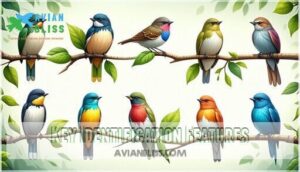
You’ll master bird identification faster when you know which features matter most.
Focus on field marks like wing bars, eye rings, and tail patterns—these distinctive characteristics separate similar species when size and color aren’t enough, and knowing them is key to successful identification.
Field Marks and Distinctive Characteristics
Key field marks act like a bird’s fingerprint—you’ll spot eye rings, wing bars, and tail patterns that clinch identification.
Look for plumage details like spotted breasts or crown stripes that distinguish similar species.
Seasonal changes affect bird characteristics, while regional variations create subtle differences.
Understanding avian identification features is essential for accurate birding. Even hybrid plumage occasionally appears, blending traits from different species, which can be identified by avian identification features.
Wing and Tail Features and Shapes
Wing-shape analysis reveals essential bird identification secrets you can’t miss.
Pointed wings indicate fast fliers like falcons, while rounded wings suggest woodland species.
Tail markings provide instant species recognition—look for bands, patches, or distinctive patterns.
Flight feathers show wear patterns that help determine age and molt cycles.
Your wingspan guide compares relative sizes against familiar birds.
Feather wear indicates seasonal changes affecting bird identification accuracy.
Beak Shape and Size and Its Importance
Four main bill types reveal feeding habits instantly.
Seed-crackers sport thick, conical beaks for crushing tough shells. Insect-hunters display thin, pointed bills perfect for precise picking.
Nectar-feeders feature long, curved beaks reaching deep into flowers. Fish-catchers show sharp, spear-like bills for underwater hunting.
These beak morphology patterns make species identification straightforward once you recognize the evolutionary significance behind each bill variation, which is key to understanding the feeding habits.
Frequently Asked Questions (FAQs)
What are the basic characteristics of birds?
Like pieces of a puzzle, you’ll identify birds by observing their size, shape, color patterns, behavior, and habitat.
Compare size to familiar birds like sparrows or robins for quick reference points.
What are the 4 keys to bird ID?
You’ll master bird identification by focusing on size, shape, color patterns, and behavior.
Compare birds to familiar species like sparrows or robins, note distinctive markings and bill types, then observe their movements and habitat preferences.
How do bird sounds help with identification?
Ever wonder how birds communicate their identity before you see them?
Bird sounds provide essential identification clues through unique calls, songs, and flight sounds that distinguish species, especially when birds remain hidden or difficult to observe visually.
They are crucial for species recognition.
What time of day are birds most active?
You’ll spot birds most actively during dawn and dusk when they’re feeding. Early mornings offer peak activity as birds search for food after fasting overnight, making identification easier.
How do weather conditions affect bird behavior?
Storm clouds gather as birds sense dropping pressure—you’ll notice they feed frantically before weather hits, then seek shelter during storms, becoming more active afterward when conditions stabilize.
What equipment do I need for birdwatching?
You’ll need binoculars (8×42 recommended), a field guide or bird ID app like Merlin, notebook for observations, and comfortable walking shoes for different terrains.
How can I attract specific birds to observe?
Setting up the right food sources will reliably draw target species to your yard.
Research shows native plants producing seeds, berries, and insects work best.
Install species-specific feeders with appropriate food—sunflower seeds for cardinals, suet for woodpeckers, nectar for hummingbirds.
How do seasonal molting patterns affect identification?
Seasonal molting creates identification challenges as birds shed old feathers for fresh plumage.
You’ll notice color changes, patchy appearances, and altered patterns that can temporarily disguise familiar species until molt completion, which involves complete concepts of feather replacement.
When are birds most active for viewing?
You’ll catch birds at their busiest during dawn and dusk when they’re actively feeding. Early morning offers peak activity, while late afternoon provides a second window of opportunity.
What weather conditions improve bird identification success?
Clear skies and calm winds create ideal viewing conditions—like nature’s spotlight illuminating each feather detail.
You’ll spot distinctive markings, colors, and behaviors more easily when weather cooperates with your identification efforts, especially under conditions that resemble a spotlight.
Conclusion
Mastering these five elements is like assembling a birding toolkit—each technique becomes sharper with practice.
You’ll discover that this basic bird identification characteristics guide transforms confusing species into recognizable neighbors.
Size comparisons anchor your observations, while shape details reveal feeding strategies.
Color patterns catch your eye, but behavioral cues provide the most reliable identification markers.
Habitat knowledge narrows your possibilities substantially.
Start with common backyard species, then gradually expand your range.
Remember, every expert birder began exactly where you’re standing now—notebook in hand, curious about that mysterious visitor at the feeder, and they all had to learn about bird identification and understand the importance of practice and observation.