This site is supported by our readers. We may earn a commission, at no cost to you, if you purchase through links.
Every spring and fall, billions of birds funnel through North America’s skies in waves so massive they show up on weather radar, yet most people miss the spectacle entirely because they’re looking at the wrong time. Timing matters because a difference of just a few days can mean the contrast between witnessing thousands of warblers in a single morning or walking through empty woodlands.
The best time bird migration unfolds in distinct pulses shaped by species, geography, and rapidly shifting climate patterns—spring migration peaks between late April and mid-May across most regions, while fall brings a longer, more gradual movement from August through October. Understanding these patterns transforms casual observation into strategic birding, putting you in the right place when migration intensity reaches its crescendo and the air hums with travelers racing toward ancient destinations.
Table Of Contents
- Key Takeaways
- Bird Migration Patterns
- Best Time for Migration
- Geographic Influences
- Migration Tracking Tools
- Conservation Efforts
- Frequently Asked Questions (FAQs)
- What month do most birds migrate?
- What is the best time of day to see birds migrating?
- What is the BIRDIST rule 10?
- What is the best month for bird watching?
- How does weather affect daily migration timing?
- What equipment helps beginners spot migrating birds?
- Do urban areas disrupt natural migration routes?
- Which months offer easiest migration photography opportunities?
- How long do individual migration journeys typically last?
- How does climate change affect future migration timing?
- Conclusion
Key Takeaways
- Spring migration peaks between late April and mid-May across most of North America, while fall migration stretches longer from August through October, with timing varying by several weeks depending on whether you’re in western states (earlier) or northeastern regions (later).
- Modern tracking tools like BirdCast use 143 weather radar stations to provide real-time migration updates every 10 minutes and three-day forecasts, transforming bird watching from guesswork into precise planning based on actual overhead bird density.
- Over one billion birds die annually from building collisions in the U.S., with the deadliest threat occurring during migration when glass reflections and light pollution between 11 p.m. and 6 a.m. disorient nocturnal travelers—making simple interventions like turning off lights dramatically effective.
- Climate change has accelerated spring migration timing by 1-2 days per decade since the 1970s and extended fall migration by roughly 17 days, creating mismatches between when birds arrive and when their food sources peak.
Bird Migration Patterns
Bird migration isn’t a one-size-fits-all phenomenon—it’s a complex puzzle shaped by geography, timing, and the birds themselves. Understanding these patterns helps you predict when and where you’ll witness the spectacle of millions of birds on the move.
Let’s break down the three key factors that determine migration patterns in your area.
Regional Variations
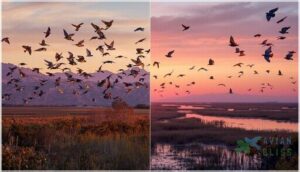
Across the continent, regional bird migration patterns are shaped by a fascinating mix of latitudinal differences and longitudinal contrasts. In the West, migration windows open earlier—late April to early May—while the Northeast lags by several weeks, thanks to geographic influences on migration. Along the Gulf, western routes host more long-distance travelers, creating intense migration peaks, whereas the Southeast sees earlier arrivals from short-distance migrants. California’s Central Valley, almost like an island, blends both types, with climate-driven shifts and continental changes making each spring’s migration routes a new chapter in nature’s ongoing story.
BirdCast analyzes migration using weather radar and machine learning to predict these patterns.
Seasonal Changes

Weather patterns and shifting temperatures dictate when migratory birds take flight, creating distinct migration windows you can predict. Spring advancement has accelerated by 1–2 days per decade since the 1970s, revealing strong climate sensitivity in these seasonal patterns. Meanwhile, autumn extension now stretches roughly 17 days longer than decades ago.
This phenological mismatch—between migration patterns and food availability—challenges birds confronting increasingly unpredictable seasonal changes. These shifts highlight the impact of climate change impacts on migratory patterns.
Species Composition

While timing tells you when birds migrate, species composition reveals who’s traveling. Passerine dominance defines nocturnal flights—warblers, thrushes, and sparrows make up the vast majority overhead.
Flyway assemblages shift dramatically by region: western Gulf routes host long-distance Neotropical songbirds, while southeastern paths favor short-distance migrants. Raptor influence peaks during autumn, when falcons concentrate along coastal corridors tracking shorebird movements.
Regional differences matter too—California’s Central Valley mixes overwintering species with passage migrants, and marine migrants like albatrosses follow entirely separate oceanic routes. Understanding these patterns helps you anticipate which bird species will appear in your area during peak migration periods.
Best Time for Migration

Timing is everything for bird migration, and knowing when to look up can make the difference between spotting a few stragglers and witnessing thousands of birds on the move.
The best migration periods aren’t random—they’re driven by seasonal rhythms that repeat year after year, creating windows of peak activity you won’t want to miss.
Let’s break down when these major movements happen and what makes each season special.
Spring Migration
Spring migration unfolds like clockwork between mid-March and early June, with most nocturnal flights launching 30–45 minutes after sunset. You’ll catch peak migration intensity from mid-April through mid-May, when weather patterns trigger nightly flights and hundreds of millions of birds pass overhead. Understanding migration phenology and regional timing helps you predict these volume movements perfectly.
- Early arrivals appear in late February with waterfowl and blackbirds
- Peak intensity occurs late April to mid-May across most U.S. cities
- Weather triggers determine daily departure times and stopover choices
Fall Migration
From late July through mid-November, you’ll witness fall migration patterns as birds depart breeding grounds. Flycatchers and vireos dominate September, while raptors like Broad-winged Hawks push through mid-month. Nocturnal behavior kicks in 30–45 minutes post-sunset, with species turnover creating waves of different migrants weekly.
Climatic influences now stretch the season two weeks longer than decades past, but collision risk spikes when buildings stay lit. Light management during peak nights—turning off nonessential illumination—cuts mortality by 60%, protecting travelers following migration routes under cover of darkness along ancient flyways.
| Migration Timing | Dominant Species | Key Behaviors |
|---|---|---|
| Late July–August | Flycatchers, Terns | Early departures, daylight movement |
| September–October | Vireos, Warblers, Hawks | Nocturnal flights, species turnover |
| Late October–November | Blackbirds, Sparrows | Extended season, weather-dependent |
| Peak Nights | 400M–1.2B birds aloft | Collision risk, light sensitivity |
Peak Migration Periods
Between mid-April and mid-May, you’ll encounter the continent’s most impressive migration intensity—millions of nocturnal flights passing overhead nightly. Regional peaks shift across the landscape: western states peak in late April, while northeastern hotspots explode weeks later. Climate impacts now push species timing earlier by 3–5 days in warming corridors, reshaping migration patterns you’ve known for years.
Why these peak migration periods matter:
- April 22–May 12 delivers your best odds for witnessing mass warbler movements during spring migration timing
- September concentrates 50% of annual bird traffic, creating unrivaled fall viewing opportunities along major flyways
- Weather-driven waves produce predictable peak migration seasons when monitoring tools show 400M+ birds aloft simultaneously
Geographic Influences

Where you live shapes everything about the bird migration you’ll witness—timing, species, and sheer numbers all shift depending on your spot on the map. Geography isn’t just a backdrop; it’s the main driver behind when those warblers arrive at your feeders and which routes they follow overhead.
Let’s break down how location, from north to south and low elevation to high, changes the migration game in your backyard.
Northern Regions
If you’re watching the skies for migrating birds, northern regions offer something remarkable—massive waves of species moving through high latitudes where migratory richness peaks. In places like Greenland, Northern Russia, and Northern Canada, roughly 89% of breeding birds are on the move seasonally.
Spring migration unfolds between mid-March and early June, driven by photoperiod influence that triggers those internal clocks birds rely on. You’ll see waterfowl and shorebirds arrive first, followed by waves of warblers and vireos making intra-continental movements from southern wintering grounds.
Fall migration kicks off late August through early October, creating dramatic seasonal turnover as breeding populations depart. Arctic migrants like plovers time their arrival with insect emergence on thawed tundra, while boreal flyways guide raptors southward each September.
Weather patterns can shift migration timing by days, so monitoring conditions helps you catch peak activity along these important northern routes.
Southern Regions
You’ll catch the action early in southern areas—by mid-March, Gulf migration routes funnel millions through Texas and Florida. Species diversity peaks between April 20 and May 12, when warblers and orioles flood coastal corridors.
Climatic influences like tropical rainfall shape these migration patterns, while recent migration events have surpassed 1 billion birds in a single night. Shifting distributions due to weather patterns mean you’re witnessing geography in motion.
Elevation Effects
Elevation changes throw a powerful punch in shaping bird migration—temperature gradients orchestrate habitat zones that pull species upward or downward with the seasons. You’re watching a vertical journey that rivals horizontal travel, driven by oxygen limitation and terrain routing that force birds to climb ridges and maintain higher flight paths. Altitude adaptations like enhanced lung capacity let some hummingbirds thrive above 3,000 meters. Here’s how elevation influences migration patterns:
- Stopover hotspots cluster along elevated landforms like the Appalachians
- High-altitude layers form when favorable weather patterns align with migration directions
- Birds adjust flight altitude nightly, dropping lower in headwinds
- Temperature gradients create distinct resource zones along mountain slopes
Migration Tracking Tools

You don’t have to guess when birds will pass through your area anymore. Modern tracking technology has transformed migration watching from guesswork into a science, giving you real-time data on millions of birds moving overhead.
Let’s look at three powerful tools that help you plan your birding adventures with precision.
BirdCast Technology
BirdCast transforms how you monitor migrating birds by harnessing 143 weather radar stations across the country. You’ll see real-time tracking updates every 10 minutes, revealing bird density patterns overhead. The system crunches over 20 years of radar data to deliver migration forecasts three times daily, so you know exactly when to head outside. When activity peaks, Lights Out alerts notify communities to dim nonessential lighting.
Here’s what BirdCast’s radar systems and forecasting tools deliver:
| Feature | Update Frequency | Coverage |
|---|---|---|
| Live migration map | Every 10 minutes | Continental U.S. |
| Migration forecasts | Every 6 hours | 3-day predictions |
| Bird density estimates | Continuous | Local to regional |
| Lights Out alerts | As needed | City-level |
BirdFlow Model
The BirdFlow model takes bird migration forecasting to the next level by fusing eBird’s millions of community-science records with satellite-tracking data. You’ll get weekly movement predictions that map entire populations across the continent, not just individual birds. Its predictive performance outshines older methods, accurately identifying stopover hotspots and migration timing without physical tags.
Conservation applications are already transforming how we protect critical habitats, linking breeding grounds to wintering areas through data integration that reveals seasonal patterns with striking model accuracy.
Radar Systems
Weather radar systems track realtime bird migration by measuring aerial bird density every ten minutes across the NEXRAD network. You’ll see radar reflectivity converted into density estimates, though weather interference and radar limitations mean you can’t identify individual species or always separate birds from insects.
BirdCast uses this radar data alongside machine learning for accurate forecasts. Future applications promise sharper reflectivity analysis and expanded coverage, transforming how researchers monitor continental movements.
Conservation Efforts

Now that you can track migration patterns with precision, it’s worth knowing how to keep those travelers safe as they pass through.
Every year, millions of birds face deadly obstacles during their journeys, but a few simple changes can make a real difference.
Here’s what you can do to protect migrating birds in your area.
Bird Safety Measures
You can protect millions of migrating birds through simple bird safety measures at home and in your community. Start by installing bird-friendly film on windows to prevent collision risks during migration, then join Lights Out programs by switching off nonessential lights between 11 p.m. and 6 a.m.
Support habitat restoration projects and spread awareness about bird collision prevention through thoughtful design practices that safeguard these notable travelers.
Collision Risks
While bird safety measures offer protection, understanding collision risks during migration helps you target your efforts where they matter most. Over one billion birds die annually from striking buildings across the U.S., with glass collisions creating the deadliest threat to travelers during spring and fall passages.
Over one billion birds die annually from building collisions in the U.S., making glass the deadliest threat during migration
Urban structures increase danger through window reflections that mirror natural habitats, fooling even experienced fliers, while light pollution disorients nocturnal migrants streaming overhead. Species vulnerability varies dramatically—Varied Thrushes collide nearly 77 times more frequently than expected, whereas gulls show moderate risk.
Fall migration brings peak collision rates, though winter concentrations around feeders create localized hazards requiring year-round mitigation strategies.
Lighting Recommendations
During peak migration, your lighting choices make the difference between safe passage and deadly disorientation. Install shielded fixtures that direct light downward, cutting light pollution and urban skyglow that confuse nocturnal travelers.
Choose warm, bird-friendly bulbs under 3,000 Kelvin with spectral control—avoiding blue wavelengths that disorient migrants.
Support Lights Out programs through interior management: dim from 11 p.m. to 6 a.m., especially during forecasted heavy flights. Targeted dimming during high-risk nights saves millions of lives annually.
Frequently Asked Questions (FAQs)
What month do most birds migrate?
May stands as the champion month for spring migration—particularly in North America—when warblers, thrushes, and countless songbirds stream northward in staggering numbers, creating birdwatching opportunities you simply can’t replicate any other time.
What is the best time of day to see birds migrating?
You’ll catch the most migration activity during early mornings—roughly one to three hours after sunrise—when nocturnal migrants land to forage, and late afternoons when diurnal species and soaring raptors ride thermal currents skyward.
What is the BIRDIST rule 10?
Think of it as a conservation lifeline: BIRDIST Rule 10 recommends turning off non-essential lights from 11:00 p.m. to 6:00 a.m. during migration seasons, drastically cutting collision mortality reduction and protecting millions of nocturnal travelers.
What is the best month for bird watching?
If you’re chasing the richest diversity, late April through mid-May stands out as prime spring migration timing across most of North America. Weather patterns funnel millions of songbirds northward through your local hotspots.
How does weather affect daily migration timing?
Weather patterns dictate daily migration timing through wind direction, temperature influence, and pressure changes. You’ll notice birds depart on clear nights with tailwinds, while precipitation effects and headwinds delay flights until conditions improve considerably.
What equipment helps beginners spot migrating birds?
You’ll want 8×42 binoculars for steady viewing, plus the free Merlin or eBird app on your phone.
Comfortable shoes matter more than you’d think—those dawn walks add up quickly during peak migration season.
Do urban areas disrupt natural migration routes?
Urban light pollution draws migrating birds off course, making cities deceptive beacons that concentrate flocks in areas where collision mortality rates spike.
These areas rarely offer stopover habitat quality that matches what natural route corridors provide.
Which months offer easiest migration photography opportunities?
Spring migration from April through May offers prime opportunities when millions of warblers and thrushes pass through, creating concentrated hotspots.
You’ll find birds more visible against sparse foliage before summer canopies develop.
How long do individual migration journeys typically last?
Journey duration factors vary dramatically among migrants. Bar-tailed godwits fly nonstop for over a week, while songbirds stretch their migration journey duration across weeks or months, depending on stopover impact and individual migration speed between refueling sites.
How does climate change affect future migration timing?
Climate change is pushing bird migration earlier each spring—roughly 2 days per decade—creating phenological mismatch when migratory birds arrive before or after peak food availability.
This mismatch threatens population stability and requires adaptive conservation strategies.
Conclusion
Think of migration as nature’s most punctual performance—miss the curtain call, and you’ll wonder where all the birds went. Armed with radar forecasts, BirdCast alerts, and knowledge of peak windows, you’re no longer guessing when waves arrive.
The best time bird migration happens isn’t random; it’s predictable, trackable, and waiting for observers who show up prepared. Step outside during those critical weeks, and you’ll finally see what weather radar has been revealing all along.
- https://birdcast.info/migration-tools/migration-dashboard/
- https://vt.audubon.org/news/shifting-timelines-warming-world-changing-how-birds-migrate
- https://warnercnr.source.colostate.edu/bird-migration-timing-skewed-by-climate-new-research-finds/
- https://www.hcn.org/articles/climate-change-is-happening-too-fast-for-migrating-birds/
- https://news.cornell.edu/stories/2018/09/more-4-billion-birds-stream-overhead-during-fall-migration