This site is supported by our readers. We may earn a commission, at no cost to you, if you purchase through links.

Most people grab the first pair of binoculars they see and wonder why distant objects look like blurry disappointments. The culprit isn’t your eyes—it’s choosing optics without understanding what actually matters.
Magnification numbers seduce beginners into thinking bigger is better, but a 20x model that shakes with every heartbeat won’t show you anything except your own trembling hands.
What you need are binoculars for beginners that balance optical performance with real-world usability, models that deliver bright, steady images whether you’re tracking a hawk’s flight or scanning a distant ridgeline. The right pair transforms outdoor adventures from squinting frustration into crystal-clear discovery, and you don’t need a trust fund to find them.
Table Of Contents
- Key Takeaways
- Key Features to Look for in Beginner Binoculars
- Top 10 Binoculars for Beginners
- 1. Nikon Prostaff Binoculars
- 2. Vortex Diamondback Binoculars
- 3. Celestron Nature Binoculars
- 4. Bushnell Waterproof Binoculars
- 5. Celestron Outland Binoculars
- 6. Nikon Aculon Binoculars
- 7. Pentax Compact Binoculars
- 8. Steiner Predator Hunting Binoculars
- 9. Vanguard Endeavor Ed Binoculars
- 10. Carson Waterproof High Definition Binoculars
- Choosing Binoculars for Birdwatching
- Binoculars for Stargazing and Astronomy
- Tips for Using and Caring for Your Binoculars
- Budget and Value Considerations for Beginners
- Frequently Asked Questions (FAQs)
- Conclusion
Key Takeaways
- The 8×42 configuration strikes the ideal balance for beginners because it delivers bright, steady views without magnifying hand shake or requiring tripod support, making it easier to track moving targets across landscapes.
- Optical quality depends more on lens coatings and prism construction than magnification numbers—fully multi-coated lenses with quality prisms reveal true colors and sharp details that cheap high-power models can’t match.
- Field of view and eye relief matter as much as magnification since wide angles help you spot and follow birds faster, while 15mm+ eye relief prevents blackouts for eyeglass wearers during extended viewing sessions.
- Budget-friendly models from Nikon, Vortex, and Celestron deliver professional-grade features like waterproof construction and multi-coated optics in the $100-250 range, proving you don’t need premium prices for reliable field performance.
Key Features to Look for in Beginner Binoculars
Choosing your first pair of binoculars can feel overwhelming when you’re staring at rows of nearly identical models covered in technical specs. The good news is that you don’t need to decode every optical formula to find a great pair—just focus on a handful of features that actually matter in the field.
Let’s break down the key specifications that separate a frustrating experience from one that opens up the natural world around you.
Magnification and Objective Lens Size
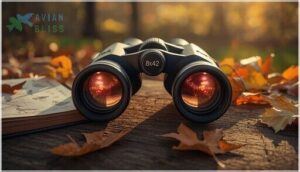
Your first binocular choice hinges on two numbers stamped on every pair: magnification and lens diameter. Most beginners thrive with 8×42 or 10×42 models, where 8x or 10x magnification balances detail with image stability, and the 42 mm objective lens delivers solid optical quality without excessive weight. Higher magnification levels reduce field coverage and magnify hand shake, making targets harder to track.
That’s why 8×42 strikes the sweet spot for beginners—bright, steady views that don’t demand a tripod. When writing about binoculars, it’s vital to keep in mind the importance of clear science writing.
Field of View and Eye Relief

Field of View—measured in feet at 1,000 yards—determines how much landscape you capture in one glance. Wide angles let you spot birds faster and track them across branches without losing sight.
Eye Relief, the distance from eyepiece to your eye, matters if you wear glasses; 15 mm or more prevents blackouts.
Low Magnification widens your Exit Pupil, brightening images in dim conditions.
Understanding research methodology is essential for evaluating optical instruments.
Clarity, Brightness, and Color Rendition

Optical clarity separates mediocre glass from the gear that reveals feather detail at fifty yards. Lens coatings—fully multi-coated options boost light transmission—deliver image sharpness across the entire view, while quality prisms guarantee color accuracy that doesn’t wash out reds or muddy greens.
Optical clarity depends on fully multi-coated lenses and quality prisms that reveal feather detail while preserving true color accuracy
When you’re comparing binoculars for beginners through binocular reviews, test optical quality and performance by viewing neutral targets; true color rendition won’t exaggerate or fade natural tones.
Weight and Portability
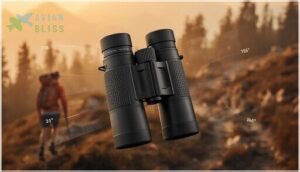
Sharp images mean nothing if your binoculars for beginners become a burden on the trail. Compact designs balanced with lightweight materials—models between 10 and 15 ounces—let you scan horizons without fatigue, while an ergonomic grip ensures steady viewing during extended outdoor activities for beginners:
- Weight usually spans 10–22 ounces depending on features
- Compact models fold to 3.5–5.5 inches for storage options
- Weather sealing adds 2–6 ounces but boosts durability
- Balanced weight distribution beats raw lightness for travel ease
Waterproof and Durability Considerations

Rain and rough handling define outdoor gear longevity, so your binoculars for beginners should carry at least an IPX4 water resistance rating for rain protection, plus O-ring seal integrity at hinge points. Rubber armor delivers impact absorption against drops, while nitrogen purging ensures fog proofing in temperature swings.
Durability tests prove sealed construction outlasts basic models, making waterproof binoculars a smart investment for any outdoor gear collection.
Top 10 Binoculars for Beginners
Now that you know what features matter most, let’s look at the binoculars that actually deliver for beginners. We’ve narrowed down dozens of models to ten solid options that balance performance, ease of use, and value.
Each one brings something different to the table, whether you’re watching birds at dawn or scanning mountain ridges on a weekend hike.
1. Nikon Prostaff Binoculars
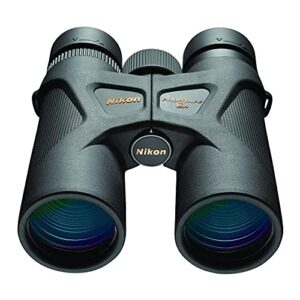
When you’re ready to step up your wildlife game, Nikon Prostaff binoculars deliver serious bang for your buck. The Nikon Prostaff P3 8×42 model sits right in that beginner sweet spot—8x magnification and a 42mm objective lens gather enough light for crisp, bright images without the weight penalty of bigger glass.
Multi-coated optics boost clarity, while nitrogen-filled chambers keep fog at bay when temperatures shift. You’ll appreciate the rubber armor that survives bumps and the waterproof construction that laughs off sudden showers, backed by Nikon’s solid warranty coverage.
| Best For | Beginners and casual outdoor enthusiasts who want reliable, affordable binoculars for bird watching, hiking, and general wildlife viewing without breaking the bank. |
|---|---|
| Magnification | 8x |
| Objective Lens | 42mm |
| Waterproof | Yes |
| Prism Type | Roof |
| Weight | 4.8 oz |
| Field of View | Not specified |
| Additional Features |
|
- Multi-coated lenses and 42mm objectives deliver bright, clear images with good contrast even in moderate low-light conditions
- Nitrogen-filled waterproof and fogproof construction holds up in changing weather, backed by Nikon’s multi-year warranty
- Lightweight at under 5 ounces with rubber armor that handles bumps and provides a secure grip during extended use
- Not as bright as premium models when light gets really dim, so nighttime stargazing or dawn/dusk viewing has limits
- Lens caps can feel cheaply made or awkward to use compared to the quality of the optics themselves
- The 8×42 configuration trades some detail capture for a wider field of view—serious birders might prefer the 10×42 version
2. Vortex Diamondback Binoculars
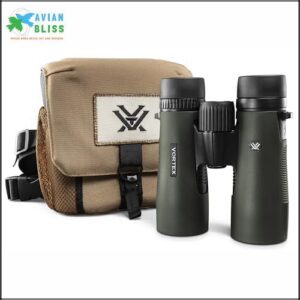
Optical quality meets budget-friendly pricing in the Vortex Diamondback HD 8×42, making these binoculars a standout choice for beginners.
Multi-layered lens coatings and a dielectric prism design deliver bright, color-accurate views across the 393-foot field. The ergonomic grip, wrapped in rubber armor, ensures durability in the field.
You’ll pull focus smoothly with the center wheel, while argon purging keeps moisture out in harsh conditions. Vortex backs your investment with an unconditional lifetime warranty—no questions asked if something goes wrong.
| Best For | Beginners and budget-conscious outdoor enthusiasts who want sharp optics and long-term durability without breaking the bank. |
|---|---|
| Magnification | 8x |
| Objective Lens | 42mm |
| Waterproof | Yes |
| Prism Type | Roof |
| Weight | 8 oz |
| Field of View | 393 ft/1000 yds |
| Additional Features |
|
- Bright, color-accurate images thanks to HD glass and dielectric prism coatings
- Rugged, waterproof build with argon purging to handle rain, fog, and rough conditions
- Unconditional lifetime warranty covers nearly everything except loss or theft
- Barrel hinge can feel stiff when adjusting the width between eyepieces
- At 8 ounces, it’s not the lightest option for long hikes or all-day carry
- Some users report glare or edge distortion in bright sunlight or low-light settings
3. Celestron Nature Binoculars
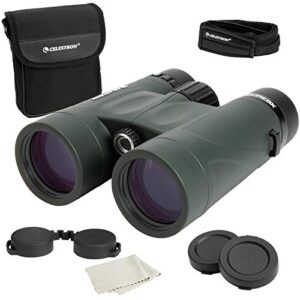
When you’re ready to explore the wild without emptying your wallet, Celestron Nature binoculars deliver solid optical quality at entry-level prices. The Nature DX ED 8×42 features multi-coated lenses and a roof prism design, offering dependable performance for nature viewing and birdwatching.
You’ll appreciate the nitrogen-purged waterproof construction during unpredictable weather, though lighter models sacrifice some durability.
For beginners balancing budget with essential outdoor optics, these binoculars provide a practical stepping stone—whether you’re tracking warblers at dawn or testing the waters for stargazing adventures ahead.
| Best For | Budget-conscious nature enthusiasts and beginners who want reliable waterproof optics for birdwatching and hiking without spending a fortune. |
|---|---|
| Magnification | 8x |
| Objective Lens | 42mm |
| Waterproof | Yes |
| Prism Type | BaK-4 |
| Weight | Not specified |
| Field of View | 7.4° |
| Additional Features |
|
- Nitrogen-purged waterproof construction keeps moisture out during unpredictable weather
- Multi-coated lenses and roof prism design deliver solid optical quality for the price
- Lightweight and portable enough for extended field use and hiking trips
- Lighter models sacrifice some durability compared to premium options
- May not perform as well in low-light conditions as more expensive binoculars
- Entry-level positioning means you’ll miss out on advanced features found in higher-end models
4. Bushnell Waterproof Binoculars
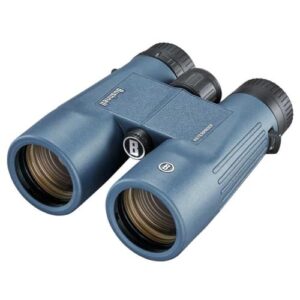
When storms roll in without warning, you’ll want gear that won’t quit on you. Bushnell waterproof binoculars feature O-ring sealed optical systems with IP67 ratings, protecting your investment during boating trips and rainy hikes.
Their 8x42mm roof prism design balances portability with light-gathering power, while fully multi-coated optics deliver sharp images across varied conditions.
Though some users note the weight during extended use, these affordable binoculars prove their durability through real-world outdoor activities—from birdwatching in morning mist to beginner astronomy sessions under dewy skies.
| Best For | Outdoor enthusiasts who need reliable, budget-friendly binoculars for birdwatching, hiking, and boating in unpredictable weather conditions. |
|---|---|
| Magnification | 8x |
| Objective Lens | 42mm |
| Waterproof | Yes |
| Prism Type | Roof |
| Weight | Not specified |
| Field of View | Not specified |
| Additional Features |
|
- O-ring sealed IP67 waterproof protection keeps optics safe during rainy hikes and water activities
- Fully multi-coated 8x42mm lenses deliver clear, bright images in different lighting conditions
- Durable aluminum construction with non-slip rubber grip stands up to rough outdoor use
- Heavier than expected for extended viewing sessions, which can strain hands and arms
- Flimsy included carrying case doesn’t offer much protection for transport
- Lens caps aren’t tethered and fall off easily, risking loss in the field
5. Celestron Outland Binoculars
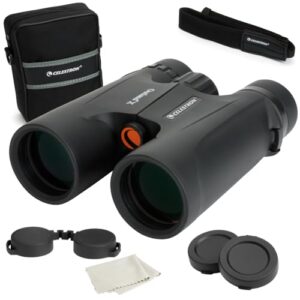
You won’t break the bank with Celestron Outland binoculars, which deliver solid optical quality through their 8x to 10x magnification and 42mm objective lenses—perfect for outdoor activities from trail hiking to beginner astronomy.
These entry-level binoculars feature nitrogen-purged waterproof construction and rubber-armored housings that withstand real field conditions. The roof prism design keeps them compact while providing comfortable eye relief during extended viewing sessions.
With built-in diopter adjustment and a central focus wheel, Celestron models in the Outland line offer affordable binoculars that don’t compromise on essential features for outdoor use.
| Best For | Budget-conscious outdoor enthusiasts who want reliable binoculars for birdwatching, hiking, and casual stargazing without spending a fortune. |
|---|---|
| Magnification | 8x |
| Objective Lens | 42mm |
| Waterproof | Yes |
| Prism Type | BaK-4 |
| Weight | 22 oz |
| Field of View | 356 ft/1000 yds |
| Additional Features |
|
- Waterproof and fogproof construction holds up in rain and humidity, so you’re covered in rough weather
- 8x magnification with 42mm lenses strikes a nice balance between portability and light-gathering power
- Rubber armor gives you a solid grip and protects against drops and bumps on the trail
- Eye focus adjustment can be finicky and frustrating to dial in properly
- Included strap and carrying case feel cheap and may need replacing
- Not powerful enough for serious deep sky astronomy—better suited for terrestrial viewing
6. Nikon Aculon Binoculars
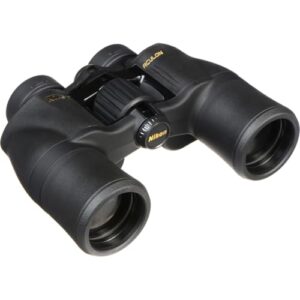
Nikon Aculon binoculars pack impressive optical quality into lightweight designs that won’t slow you down on the trail. The Nikon 10×50 Aculon A211 offers bright, sharp views through multi-coated lenses, while 8x variants deliver steadier handheld images—ideal entry-level binoculars for birding or nature walks.
These Aculon models feature waterproof construction, rubber armor for grip, and eyeglass-friendly eye relief. With binocular durability backed by Nikon’s warranty, this binoculars guide recommends Aculon as a no-nonsense starter choice.
You’ll appreciate how Nikon balances affordability with features that actually matter in the field.
| Best For | Beginners and casual outdoor enthusiasts looking for reliable, lightweight binoculars for birdwatching, nature observation, and general outdoor use without breaking the bank. |
|---|---|
| Magnification | 8x |
| Objective Lens | 42mm |
| Waterproof | No |
| Prism Type | Roof |
| Weight | 755g (26.6 oz) |
| Field of View | 140m/1000m |
| Additional Features |
|
- Multi-coated optics deliver bright, sharp images with natural color rendition across various Aculon models
- Waterproof and fogproof construction with rubber armor provides durability and all-weather reliability
- Eyeglass-friendly eye relief and ergonomic design make them comfortable for extended viewing sessions
- Diopter adjustment can be stiff or difficult to turn on some units
- Occasional reports of debris or imperfections inside the lens that can’t be cleaned
- Some users with larger hands find the eye cups interfere with diopter adjustments
7. Pentax Compact Binoculars

Pentax models like the AD 8×25 WP prove that compact designs don’t sacrifice optical quality. At 9.6 ounces, these entry-level binoculars slip into your daypack without notice, while multi-layer coatings and roof prisms deliver crisp images for birdwatching or quick sky checks.
Portability features include waterproof construction and fiber-reinforced housings that pass durability tests in the field. You’ll find them ideal for outdoor events and casual hiking, though modest 25mm objectives limit performance in low light.
For beginner astronomy tips or general nature observation, Pentax offers solid optical instruments at wallet-friendly prices.
| Best For | Hikers and casual birdwatchers who want lightweight, durable binoculars that won’t weigh down their pack on day trips. |
|---|---|
| Magnification | 8x |
| Objective Lens | 25mm |
| Waterproof | Yes |
| Prism Type | Roof/Porro |
| Weight | 9.6 oz |
| Field of View | Not specified |
| Additional Features |
|
- Waterproof and fog-proof construction handles rain and humidity without missing a beat
- Multi-layer coatings deliver bright, true-to-life images even in tricky lighting
- Weighs under 10 ounces so you can carry them all day without feeling it
- The 25mm lenses struggle in low light compared to larger binoculars, limiting dawn and dusk viewing
- Included case is reportedly too small, making it awkward to pack the binoculars away quickly
- No front lens caps included, leaving the objectives exposed when stored
8. Steiner Predator Hunting Binoculars
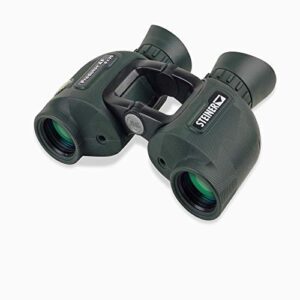
While compact models work for casual outings, serious wildlife viewing demands hunting optics built for dawn and dusk. Steiner Predator binoculars deliver optical clarity through their Auto Focus system and Color Adjusted Transmission technology, cutting through foliage to reveal game you’d otherwise miss. The 8×30 configuration balances magnification with a wide field of view, while Steiner quality shows in waterproof construction and lifetime warranties.
You’ll appreciate how these birdwatching binoculars shift seamlessly from predator focus to beginner astronomy tips during outdoor activities—proof that wildlife observation gear can serve multiple purposes without compromise.
| Best For | Hunters and wildlife watchers who need reliable optics for low-light conditions and heavy cover, especially during dawn and dusk when game is most active. |
|---|---|
| Magnification | 8x |
| Objective Lens | 30mm |
| Waterproof | Yes |
| Prism Type | Porro |
| Weight | 16 oz |
| Field of View | Not specified |
| Additional Features |
|
- Color Adjusted Transmission (CAT) technology cuts through foliage and shade better than standard optics, making it easier to spot game in dense cover
- Auto Focus system lets you quickly lock onto targets without fiddling with a focus wheel in critical moments
- Waterproof and fog-proof construction with a lifetime warranty means these binoculars can handle rough field conditions for years
- Porro prism design makes them bulkier than modern roof prism binoculars, which some users find less convenient to carry
- The auto-focus system takes adjustment time if you’re used to traditional center-focus wheels
- Mixed user reports on long-term durability suggest quality control may be inconsistent
9. Vanguard Endeavor Ed Binoculars
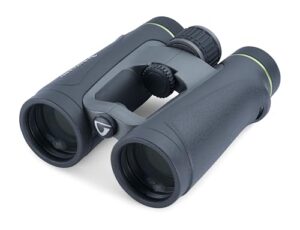
When optical quality matters more than brand hype, Vanguard Endeavor ED binoculars earn their place through extra-low dispersion glass that eliminates color fringing during dawn birdwatching sessions.
The 8×42 configuration balances magnification with a 377-foot field of view, while phase-coated roof prisms and sophisticated lens coatings boost light transmission when you’re tracking warblers through dense canopy.
You’ll notice the ergonomic design during extended field trips—twisted eyecups accommodate eyeglass wearers, and nitrogen purging prevents internal fogging.
These entry-level binoculars deliver mid-range performance without breaking your budget.
| Best For | Birders and outdoor enthusiasts who want ED glass quality and solid optical performance without paying premium brand prices. |
|---|---|
| Magnification | 8x |
| Objective Lens | 42mm |
| Waterproof | Yes |
| Prism Type | SK-15 |
| Weight | 27.7 oz |
| Field of View | 377 ft/1000 yds |
| Additional Features |
|
- Extra-low dispersion glass delivers sharp, color-accurate images with minimal chromatic aberration
- Wide 377-foot field of view at 8×42 makes it easy to track fast-moving birds and wildlife
- Fully waterproof and fogproof with nitrogen purging, built to handle tough field conditions
- Mixed feedback on build quality suggests inconsistent manufacturing standards
- Some users report diopter adjustment issues and difficulty with the snug case design
- At 27.7 ounces, the weight may cause fatigue during long viewing sessions
10. Carson Waterproof High Definition Binoculars
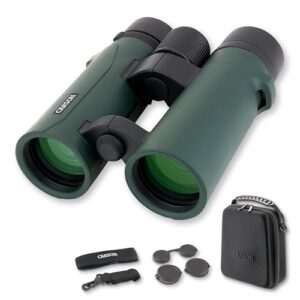
Budget-conscious stargazers get more than bare-bones specs with Carson’s waterproof high definition binoculars—you’re looking at fully multi-coated optics and BAK-4 prisms that punch above their weight class.
The 8×42 configuration delivers 372 feet of field of view at 1,000 yards, while nitrogen-filled, O-ring sealed housing keeps internal elements dry during surprise rainstorms.
An ergonomic grip and twist-down eyecups make these entry-level binoculars surprisingly comfortable for extended viewing sessions, though the included case won’t win durability awards.
| Best For | Budget-conscious outdoor enthusiasts who want reliable waterproof optics for bird watching, hiking, and sporting events without spending a fortune. |
|---|---|
| Magnification | 8x |
| Objective Lens | 42mm |
| Waterproof | Yes |
| Prism Type | BAK-4 |
| Weight | 1.4 lbs (22.4 oz) |
| Field of View | 372 ft/1000 yds |
| Additional Features |
|
- Fully multi-coated optics and BAK-4 prisms deliver surprisingly sharp, bright images for the price point
- Nitrogen-filled waterproof and fogproof construction handles rain and temperature changes without internal fogging
- Lightweight open-bridge design (1.4 lbs) and twist-down eyecups make them comfortable for extended use, even with glasses
- Eye relief focus mechanism moves too easily and lacks proper adjustment controls
- Included carrying case and neck strap feel cheap and may need replacement for serious outdoor use
- Minor edge distortions and chromatic aberration appear in some viewing conditions, though center sharpness remains good
Choosing Binoculars for Birdwatching
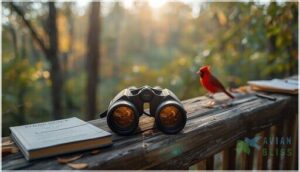
Birdwatching opens up a whole new world when you’ve got the right pair of binoculars in your hands. The specs that matter most—like magnification, field of view, and brightness—can make the difference between spotting a fleeting warbler and missing it entirely.
Let’s break down what birders actually need and which models deliver without breaking the bank.
Ideal Binocular Specs for Birders
When you’re ready to break into birding, the sweet spot for binoculars for birdwatching lies in these proven specs:
- 8x or 10x magnification keeps your view steady without image shake
- 42 mm objective lenses balance brightness and portability perfectly
- Quality lens coatings deliver sharp, true-color bird identification
- 15–18 mm eye relief accommodates glasses without vignetting
- Close focus under 3 meters captures perched songbirds up close
These optics for birding transform fleeting glimpses into confident sightings.
Importance of Field of View and Brightness
Field visibility determines whether you’ll catch that warbler before it vanishes into the canopy. A wide field of view lets you track fast-moving birds without constant panning, while brightness—driven by optical quality and larger objective lenses—ensures image clarity in dense forest shade or dawn patrols.
Together, these factors define viewing comfort during those pivotal low-light moments when magnification alone won’t cut it, and proper eye relief keeps binoculars usable through extended sessions.
Best Practices for Spotting Birds
You’ll spot more birds when you anchor your stance wide, sweep slowly across habitats with your binoculars for birdwatching, and scan perches systematically. Birders who master these spotting techniques improve bird identification rates markedly:
- Use neutral backgrounds like open sky to boost contrast for bird behavior observation
- Record objective notes on habitat selection, plumage, and timing for later verification
- Practice at feeders with known species to build optical quality recognition patterns
Start with 8x magnification and patience—bird watching equipment works best when you do.
Recommended Models for Birdwatching Beginners
When you’re ready to invest in your first pair of binoculars for birdwatching, these proven birding essentials deliver optical quality that won’t disappoint. Below you’ll find entry-level binoculars that balance nature observation needs with outdoor gear reliability, covering the best bird watching equipment for new birders across binocular sizes.
| Model | Key Birdwatching Advantage |
|---|---|
| Nikon Monarch 5 8×42 | Bright images in medium light with excellent color fidelity |
| Vortex Diamondback 8×42 | Wide field of view with durable rubber armor for field use |
| Celestron Nature 8×42 | Budget-friendly fully multi-coated optics in lightweight form |
| Nikon Aculon A211 8×42 | Comfortable eye relief for eyeglass wearers with wide field |
| Bushnell Legend Ultra HD 8×42 | High-contrast optics with moisture-sealing for wet conditions |
Binoculars for Stargazing and Astronomy

Stargazing opens up a whole different world for your binoculars, where gathering light becomes just as important as magnification. The night sky demands specific optical characteristics that differ from daytime birdwatching or general observation.
Let’s break down what makes a binocular work well for astronomy and which models will get you started without breaking the bank.
Magnification and Aperture for Night Sky Viewing
You’ll want magnification between 7x and 10x for astronomy and stargazing—higher power shakes too much in your hands. Aperture size matters more for night sky viewing than you’d think, since larger lens diameter (42–50 mm) gathers essential light for star magnification without needing a tripod.
- Exit pupil of 4–5 mm matches your dark-adapted pupils for ideal brightness
- Multi-layer optical coatings boost light transmission and contrast in faint star fields
- Lens quality beyond 50 mm demands tripod support but reveals fainter celestial objects
Binoculars for stargazing balance portability with night vision capabilities.
Porro Prism Vs. Roof Prism for Astronomy
Porro prism binoculars often deliver brighter images and enhanced light transmission at lower price points, making them ideal for astronomy when you’re scanning faint star fields. Their offset optical alignment enhances image contrast, though they’re bulkier than roof prism designs.
Roof prisms create compact, lightweight binoculars that are easier to hand-hold during extended stargazing sessions, but require premium phase coatings to match porro performance for astronomical viewing.
Best Binocular Models for Stargazing Beginners
The Nikon Prostaff 3S 7×50 binoculars deliver rugged optics and a wide exit pupil that captures more starlight for astronomy beginners. If you’re chasing higher magnification for detailed lunar craters, the Celestron SkyMaster 15×70 offers telescope alternatives without the setup hassle.
Vortex Diamondback 8×42 and Bushnell Powerview 10×50 models balance portability with night vision performance, giving you solid best binoculars for stargazing without breaking your budget.
Tips for Using and Caring for Your Binoculars

Getting the most out of your binoculars means knowing how to handle them properly and keep them in top shape. Whether you’re bracing for a steady view or adjusting the focus to match your eyes, these techniques make all the difference between frustration and crystal-clear observations.
Let’s walk through the essential skills and maintenance habits that’ll keep your optics performing like new for years to come.
Proper Holding and Focusing Techniques
Mastering your binoculars starts with a stable grip—hold them with both hands while tucking your elbows against your chest to minimize shake during handheld viewing. Bring the optics up to your eyes in one smooth motion, keeping your shoulders relaxed.
Use the center focus wheel to sharpen the image, then fine-tune as you scan. This technique transforms wildlife observation into crisp, steady views every time.
Adjusting Diopter and Eye Relief
Once you’ve nailed the center focus, lock in your diopter settings on the right eyepiece to balance both eyes—close your left eye, twist the diopter ring until the image sharpens, then open both eyes to confirm optical alignment.
Eye relief matters too, especially if you wear glasses: look for at least 15 mm to avoid vignetting and eyestrain during extended use with Nikon optics or any quality binoculars.
Cleaning and Storage Guidelines
Keep your glass clear by wiping lenses with a microfiber cloth—never household solvents that strip coatings—and only when dust or oils demand it.
Store binoculars in a padded case with silica gel packs to combat moisture, maintaining 40–60% humidity to prevent mold.
Let optics acclimate between indoor and outdoor temps before viewing, and always cap lenses between sessions for lasting durability and weather resistance.
Using Binoculars With Accessories (Tripods, Straps)
A sturdy tripod tames hand shake at higher magnifications, letting you pan smoothly for wildlife observation and stargazing with precise binocular alignment. Harness-style straps shift weight across both shoulders, cutting neck fatigue during long birdwatching sessions.
Before mounting, set your diopter and verify interpupillary distance.
Clean lenses first, check tripod leg locks regularly, and store all outdoor gear in padded bags for lasting accessory care.
Budget and Value Considerations for Beginners
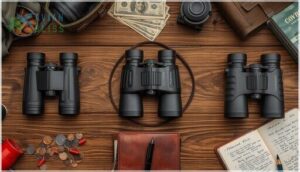
You don’t need to break the bank to get binoculars that actually work well in the field. The key is knowing which features matter most at different price points so you’re not paying for bells and whistles you’ll never use.
Let’s look at what you can realistically expect in various budget ranges and where to find the best value for your money.
Price Ranges and What to Expect
Budget options for binoculars break into clear tiers that reveal what your dollar buys. Entry-level models from brands like Nikon start around $50 to $100, covering basic optical performance and rugged builds, while midrange beginner binoculars for outdoor activities stretch from $100 to $250 with brighter views and better glass. Here’s what to expect in each price band:
- $50–$100: Basic coatings, simple eye relief, limited warranties (1–2 years), suitable for casual nature walks.
- $100–$250: Improved brightness, moisture resistance, better focus wheels, warranties extending 2–5 years.
- $250–$400: Fully multi-coated lenses, edge-to-edge clarity, durable chassis, enhanced low-light performance.
- Under $50: Budget bundles sacrifice optical quality and durability—expect tradeoffs in brightness and long-term reliability.
Price comparison across brands shows cost factors like coating quality, warranty length, and build materials directly impact your viewing experience and value analysis over time.
Balancing Cost With Essential Features
You’ll boost value when you match your baseline price range to how often you’ll actually grab those entry-level binoculars for wildlife watching.
Feature prioritization means focusing on core optics—magnification, lens diameter, and solid eye relief—rather than premium coatings when budget analysis points toward tighter spending.
Cost optimization favors durable housings with basic waterproofing, while value assessment considers included accessories and warranty length for nature watching adventures.
Where to Buy Quality Binoculars for Beginners
You won’t master outdoor gear reviews without exploring where reputable sources meet hands-on trial runs. Smart shoppers check multiple channels before committing to entry-level binoculars:
- Online Retailers filter optics by magnification and price while displaying real customer feedback.
- Brand Dealers provide warranty support and genuine telescope buying guide expertise.
- Specialty Shops offer demonstrations and post-purchase advice.
- Local Clubs enable hands-on trials before purchase.
Frequently Asked Questions (FAQs)
Can I use binoculars with glasses or contacts?
Yes, you can! Modern optics offer adjustable eye relief—look for models with 16–20 mm for glasses. Nikon and others provide twist-up eyecups that preserve your field of view without sacrificing clarity.
What does the center focus wheel actually do?
The center focus wheel adjusts focal distance for both barrels simultaneously, bringing your target into sharp focus.
It manages distance-based focusing while the diopter setting compensates for differences between your eyes.
How far can binoculars actually see clearly?
Like trying to read a book through fog, binoculars don’t have a fixed distance limit—clarity depends on magnification power, optical limits, atmospheric conditions, and target contrast.
Under ideal circumstances, 8x-10x binoculars reveal sharp details at several hundred meters.
Are expensive binoculars always better than cheap ones?
Price point doesn’t guarantee premium optical quality for every user. High-end binoculars deliver sharper images, yet budget options often exceed entry-level needs.
Match magnification, durability, and user needs to your activities rather than chasing brand reputation alone.
Do binoculars need batteries or special power sources?
Standard binoculars are as battery-free as an old compass—they rely purely on optics.
However, models with image stabilization, night vision, digital zoom, or electronic focus need power sources like AA batteries or recharge options.
Conclusion
The best binoculars for beginners aren’t the most expensive—they’re the ones you’ll actually carry into the field. Armed with magnification specs that stabilize rather than sabotage, optics that reveal detail without draining your wallet, and durability that survives real adventures, you’re now equipped to choose wisely.
Stop squinting at fuzzy horizons. Grab a pair that transforms distance into clarity, and discover what you’ve been missing all along.
- https://academichelpexpress.blog/2024/08/please-use-the-bulleted-points-and-the-rubric-below-to-guide-your-work-your-pa/
- https://www.writingclearscience.com.au/category/writing-guides/writing-research-papers/page/2/
- https://www.sciencedirect.com/science/article/pii/S0749208123000268
- https://pmc.ncbi.nlm.nih.gov/articles/instance/9553038/bin/pone.0275964.s005.docx
- https://x.com/godofprompt/status/1990526288063324577