
This site is supported by our readers. We may earn a commission, at no cost to you, if you purchase through links.
Most hunters lose an animal not because they missed the shot, but because they spotted it too late—or worse, misjudged the distance and the animal’s size entirely. A quality pair of binoculars for hunting changes that equation before you ever touch your rifle.
The difference between an 8x and a 10x, between BaK-4 and BaK-7 prisms, between 90% and 99% light transmission—these aren’t spec-sheet abstractions. They’re the difference between glassing a mature buck in the last ten minutes of shooting light and driving home empty-handed. What follows cuts through the marketing noise with field-tested picks, terrain-matched recommendations, and the optical specs that actually matter.
Table Of Contents
- Key Takeaways
- Top 10 Binoculars for Hunting
- 1. Vortex Triumph HD 10×42 Binoculars
- 2. Zeiss SFL Lightweight Compact Binoculars
- 3. Frontier ED X Binoculars 8×42 Green
- 4. Nikon Monarch M7 Binoculars
- 5. Swarovski NL Pure Binoculars
- 6. Meopta MeoPro Air HD Binoculars
- 7. Vortex Razor UHD Binoculars Harness
- 8. GPO Passion HD Binoculars
- 9. Maven B1.2 Elite Binoculars
- 10. Leupold BX-5 Santiam HD Binoculars
- Key Hunting Optics Features
- Match Binoculars to Hunting Terrain
- Durability for Field Conditions
- How We Compare Hunting Binoculars
- Frequently Asked Questions (FAQs)
- Can I use hunting binoculars for birdwatching?
- How do I properly focus binoculars?
- What does the diopter adjustment actually do?
- Are roof prism or porro prism better?
- How often should binoculars be professionally serviced?
- How do I clean binocular lenses in the field?
- Can binoculars damage your eyes with extended use?
- What warranty coverage should hunting binoculars include?
- Are binoculars allowed in all hunting zones?
- How long do quality hunting binoculars typically last?
- Conclusion
Key Takeaways
- Match magnification and lens size to your terrain: 8×42 works best in dense woods for wider field of view and better low-light gathering, while 10×42 suits open-country glassing where extra reach matters more.
- Exit pupil size (objective lens diameter divided by magnification) determines how much light reaches your eye at dawn or dusk, with 8×42’s 5.25mm exit pupil closely matching your eye’s dark-adapted pupil.
- Build quality features like ED glass, BaK-4 prisms, phase-correction and dielectric coatings, and 90%+ light transmission directly translate to sharper, brighter, truer-color images when it counts most.
- Durability factors—IPX7 waterproof rating, nitrogen or argon gas purging, magnesium chassis for weight savings, and at least 16mm of eye relief for glasses wearers—decide whether your optics hold up through rough field conditions over years of use.
Top 10 Binoculars for Hunting
Finding the right binoculars can make or break a season, whether you’re glassing open ridges at dawn or tracking deer through thick timber.
Whether you’re a weekend birder or a seasoned hunter, this guide to best binoculars for hiking and bird watching breaks down exactly what to look for before you head out.
This list covers ten field-tested options across a wide range of budgets, from sub-$100 workhorses to premium glass that redefines what you thought was possible. Here’s what made the cut.
1. Vortex Triumph HD 10×42 Binoculars

The Vortex Triumph HD 10×42 is the rare budget binocular that doesn’t make you feel like you’re compromising. At under $100, you get fully multi-coated BaK-4 roof prisms, nitrogen-purged waterproofing, and 17mm of eye relief — solid specs for eyeglass wearers. It weighs 22.9 ounces and covers 334 feet at 1,000 yards.
The included GlassPak carrier and lifetime VIP warranty sweeten the deal considerably. The diopter runs tight, but for the price, that’s a minor gripe.
| Best For | Bird watchers, hunters, and sports fans who want solid optics without spending a fortune. |
|---|---|
| Magnification | 10x |
| Objective Lens | 42mm |
| Waterproof Fogproof | Yes |
| Chassis Material | Polycarbonate |
| Lens Coating | Fully multi-coated |
| Primary Use | Hunting birding sports |
| Additional Features |
|
- Fully multi-coated lenses and nitrogen-purged construction give you clear, fog-free views in rough conditions
- Comes with a GlassPak harness, neck strap, and a lifetime VIP warranty — real value for the price
- Shockproof rubber armor makes it tough enough to throw in a bag and not worry about
- The right eye diopter adjustment runs tight, which can be frustrating to dial in
- 10x magnification can get shaky hand-held — you may want a tripod for serious use
- Warranty doesn’t cover loss, theft, or intentional damage, so don’t leave it on a park bench
2. Zeiss SFL Lightweight Compact Binoculars
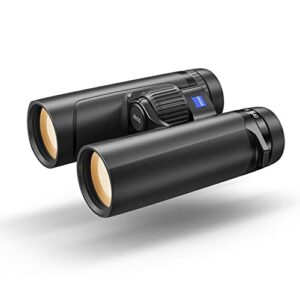
If budget gets you the Triumph HD, stepping up to the Zeiss SFL 10×40 is where serious hunters land. At 22.6 ounces with magnesium housing, it earns its Best Overall score of 93.5 without feeling punishing on a long pack-out.
ZEISS T multicoating delivers 90% light transmission, keeping images sharp and color-true at dawn. The LotuTec lens coating sheds rain and mud cleanly.
One real gripe: the focus knob sits awkwardly low, and the rubber eyecaps don’t inspire confidence.
| Best For | Serious hunters and wildlife observers who want top-tier optical performance in low light and don’t mind paying a premium for it. |
|---|---|
| Magnification | 10x |
| Objective Lens | Not specified |
| Waterproof Fogproof | Yes |
| Chassis Material | Magnesium |
| Lens Coating | ZEISS T coating |
| Primary Use | Birding hunting wildlife |
| Additional Features |
|
- 90% light transmission keeps images crisp and color-accurate from dawn to dusk
- LotuTec coating sheds rain and mud without fuss — great for harsh field conditions
- Magnesium housing keeps it tough without adding unnecessary bulk
- The price tag puts it out of reach for casual users
- Focus knob sits awkwardly low, which gets annoying fast in the field
- Rubber eyecaps feel flimsy and have a habit of popping off
3. Frontier ED X Binoculars 8×42 Green
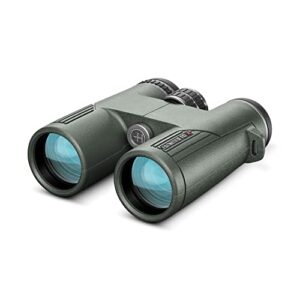
Not everyone needs the optical firepower of a Zeiss. The Hawke Frontier ED X 8×42 makes a compelling case for the middle ground — ED glass, phase-corrected BAK-4 prisms, and fully multi-coated dielectric optics at a fraction of premium prices.
The 8x magnification keeps images steady without a tripod, while the 18mm eye relief is genuinely useful for hunters who wear glasses.
At 692g, it’s not ultralight, but the magnesium chassis and nitrogen purging handle field conditions without complaint.
| Best For | Hunters, birders, and outdoor enthusiasts who want sharp, reliable glass without spending premium scope money. |
|---|---|
| Magnification | 10x |
| Objective Lens | Not specified |
| Waterproof Fogproof | Yes |
| Chassis Material | Magnesium alloy |
| Lens Coating | Multi-coated |
| Primary Use | Hunting hiking outdoor |
| Additional Features |
|
- ED glass with dielectric multi-coated prisms gives you genuinely crisp, color-accurate images
- Magnesium alloy body is tough enough for real field use without feeling like a toy
- 8x magnification hits the sweet spot — stable handheld, wide enough to track moving targets
- At 3.4 lbs, it’ll notice itself after a long day on your neck
- Edge sharpness drops off a bit, which some users will pick up on
- Can flare against bright skies, so mid-day glassing has its limits
4. Nikon Monarch M7 Binoculars

Step down from the Hawke’s mid-range value, and the Nikon Monarch M7 10×42 earns its reputation as the best value at $500. ED glass reduces chromatic aberration noticeably, while phase-correction-coated roof prisms push clarity well above its price bracket.
The 10×42 delivers a 362-foot field of view at 1,000 yards and a 4.2mm exit pupil — solid for dawn glassing. Nitrogen-sealed and waterproof to one meter, it withstands wet mornings without fuss.
| Best For | Birders, hunters, and outdoor enthusiasts who want premium glass without pushing past a $500 budget. |
|---|---|
| Magnification | 10x |
| Objective Lens | 42mm |
| Waterproof Fogproof | Yes |
| Chassis Material | Rubber-armored |
| Lens Coating | Dielectric coated |
| Primary Use | Hunting birding astronomy |
| Additional Features |
|
- ED glass noticeably cuts chromatic aberration, giving you sharp, clean images even in tricky light
- Nitrogen-sealed and waterproof construction handles wet, foggy mornings without missing a beat
- Dielectric coatings push brightness and clarity well above what you’d expect at this price
- 10x magnification can get shaky on long sessions — a monopod helps
- Tracking fast-moving birds or animals is trickier with the shallower depth of field
- Attaching the neck strap is more of a hassle than it should be
5. Swarovski NL Pure Binoculars
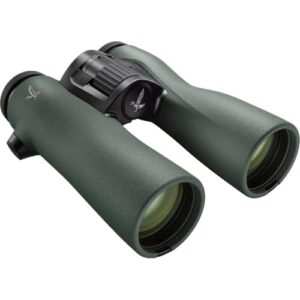
At $3,449, the Swarovski NL Pure 10×42 isn’t a casual purchase — it’s a commitment to the best glass available.
When you’re spending this much on glass, it helps to sharpen your eye too — understanding bird field marks and visual identification techniques ensures those stunning optics are working as hard as you are.
SWAROVISION technology with field-flattener lenses delivers a 399-foot field of view at 1,000 yards, with sharp, color-accurate images almost to the edges. The magnesium chassis keeps weight at 30 oz.
If you’re glassing open country from first light, nothing in this list matches it for brightness, clarity, and immersive detail.
| Best For | Serious birders and wildlife enthusiasts who want the absolute best optics and aren’t afraid to pay for them. |
|---|---|
| Magnification | 10x |
| Objective Lens | 42mm |
| Waterproof Fogproof | Yes |
| Chassis Material | Magnesium |
| Lens Coating | SWAROVISION coating |
| Primary Use | Birding nature viewing |
| Additional Features |
|
- SWAROVISION technology delivers stunning clarity and true-to-life color, even in low light
- Wide field of view with sharp edges makes tracking birds and wildlife way easier
- Lightweight magnesium build means you can glass all day without your arms giving out
- At $3,449, it’s a tough pill to swallow for anyone but a dedicated hobbyist or pro
- Lens cover straps can be fiddly — covers have a habit of popping open on flat surfaces
- The rubber grip can loosen up in humid, tropical conditions, which is frustrating in the field
6. Meopta MeoPro Air HD Binoculars
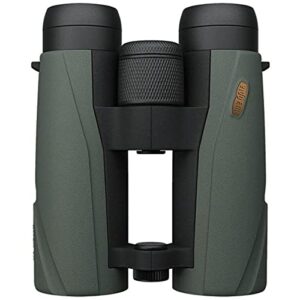
Meopta doesn’t get the fanfare of Swarovski or Zeiss, but it deserves a serious look. The MeoPro Air HD 10×42 uses fluoride ED glass with MeoBright multicoatings, delivering sharp, color-accurate images and a 4.2mm exit pupil — solid for low-light glassing.
At 33.3 ounces with a magnesium alloy chassis and open-bridge design, it’s built for long days in the field. The 18mm eye relief and large center focus wheel work well with gloves. A non-locking diopter is the one real drawback.
| Best For | Hunters, shooters, and birdwatchers who want premium European glass without the Swarovski price tag. |
|---|---|
| Magnification | 10x |
| Objective Lens | 42mm |
| Waterproof Fogproof | Yes |
| Chassis Material | Magnesium alloy |
| Lens Coating | Fluoride HD glass |
| Primary Use | Hunting shooting birding |
| Additional Features |
|
- Fluoride HD glass delivers sharp, color-accurate images even in low light
- Magnesium alloy chassis and open-bridge design keep it tough but comfortable for long days out
- Nitrogen-purged build handles rain, dust, and temperature swings without skipping a beat
- Non-locking diopter can drift during transport or when using heavy gloves
- Lacks the brand recognition of Zeiss or Swarovski, which may affect resale value
- Minimum focusing distance of 2.3m may feel limiting for close-range wildlife observation
7. Vortex Razor UHD Binoculars Harness

The Vortex Razor UHD 10×50 is a serious tool for serious hunters. Its Abbe Koenig prism design, index-matched lenses, and argon purging deliver impressive clarity and low-light performance — exactly what you need at dawn or dusk. The magnesium chassis keeps it durable without unnecessary bulk.
What sets it apart is the GlassPak Pro system: quiet microfiber interior, one-handed access, and modular attachment points for your rangefinder pouch. At 32 ounces, it’s a full-day carry you won’t regret.
| Best For | Hunters and bird watchers who want top-tier optics and don’t mind the weight. |
|---|---|
| Magnification | 10x |
| Objective Lens | 50mm |
| Waterproof Fogproof | Yes |
| Chassis Material | Magnesium |
| Lens Coating | Anti-reflective coating |
| Primary Use | Hunting birding dusk |
| Additional Features |
|
- Abbe Koenig prism and index-matched lenses give you seriously sharp, bright images even in low light
- The GlassPak Pro harness makes all-day carry comfortable and keeps your gear within easy reach
- Built tough — magnesium chassis, argon-purged, waterproof, and fogproof with a lifetime warranty to back it up
- At 32 ounces, your neck and shoulders will feel it on long hikes
- The slow focus wheel can be frustrating when you need to lock onto something fast
- The price tag is steep compared to most binoculars on the market
8. GPO Passion HD Binoculars
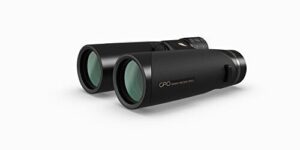
GPO doesn’t get the attention it deserves, but the Passion HD 8×42 makes a strong case for itself. Its 99.7% light transmission and 5.25mm exit pupil give you a noticeably bright view at dawn and dusk. ED glass keeps color fringing in check, and the GPObright fully multi-coated lenses add real pop to contrast.
The magnesium micro-bridge chassis stays rigid and comfortable in hand. At 29 ounces, it’s not featherlight, but the 19.5mm eye relief makes it a genuine choice for eyeglass wearers.
| Best For | Bird watchers, hunters, and eyeglass wearers who want top-tier optical clarity and don’t mind carrying a little extra weight. |
|---|---|
| Magnification | 10x |
| Objective Lens | 42mm |
| Waterproof Fogproof | Yes |
| Chassis Material | Magnesium |
| Lens Coating | GPObright coating |
| Primary Use | Hunting birding clarity |
| Additional Features |
|
- 99.7% light transmission gives you a genuinely bright, crisp view—especially useful at dawn or dusk
- Magnesium micro-bridge body feels solid and holds up well in rough outdoor conditions
- Waterproof and fogproof build with hydrophobic lens coating means weather won’t slow you down
- At 1.82kg, it’s noticeably heavier than most 10×42 binoculars on the market
- The locking diopter needs careful setup upfront—get it wrong and you’ll notice
- GPO is still a lesser-known brand, so finding hands-on demos or local support can be tricky
9. Maven B1.2 Elite Binoculars

Maven built the B1.2 around a straightforward idea: deliver premium glass without the premium markup. The 10×42 configuration pulls in 94.50% light transmission — a number that outpaces several binoculars costing twice as much. ED glass, dielectric Schmidt-Pechan prisms, and phase correction coatings combine to produce sharp, high-contrast images with honest color rendition.
At 26.8 ounces in a magnesium frame, it operates well in the field. 17.8mm eye relief and a lifetime warranty round out a package that’s genuinely hard to argue with.
| Best For | Hunters, birders, and wildlife watchers who want high-end glass without paying a flagship price. |
|---|---|
| Magnification | 10x |
| Objective Lens | 42mm |
| Waterproof Fogproof | Yes |
| Chassis Material | Not specified |
| Lens Coating | High transmission coating |
| Primary Use | Hunting birding wildlife |
| Additional Features |
|
- Exceptional light transmission at 94.50% — impressive even against binoculars that cost significantly more
- Sharp, true-color images thanks to ED glass, dielectric prisms, and phase correction coatings
- Backed by a lifetime warranty, so you’re covered for the long haul
- The diopter has no locking mechanism, so it can drift if you bump it
- Eye relief click stops feel a little soft and lack confidence
- Eyecups can shift out of position during extended use
10. Leupold BX-5 Santiam HD Binoculars
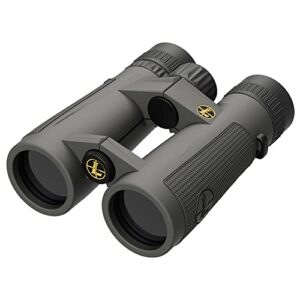
Leupold’s BX-5 Santiam HD earns its spot through dependable performance rather than hype. The 10×42 configuration delivers a 341-foot field of view at 1,000 yards, backed by the Twilight Max HD Light Management System for solid low-light clarity.
At 24.3 ounces with an open-bridge design, it carries comfortably all day. Guard-ion lens coatings shed water and resist fingerprints, and Leupold backs every unit with a lifetime guarantee — real confidence in a hunting optic.
| Best For | Hunters and wildlife watchers who need a reliable, high-clarity optic that holds up in tough conditions all day long. |
|---|---|
| Magnification | 10x |
| Objective Lens | 42mm |
| Waterproof Fogproof | Yes |
| Chassis Material | Aluminum |
| Lens Coating | Guard-ion coating |
| Primary Use | Hunting shooting glassing |
| Additional Features |
|
- Guard-ion coating sheds water and fingerprints fast, so you’re not constantly wiping your lenses in the field
- Open-bridge design keeps it comfortable during long glassing sessions without wearing you out
- Leupold’s lifetime guarantee means you’re covered — no asterisks, no fine print
- At over 24 ounces, you’ll want a tripod or monopod for extended glassing
- The neck strap setup isn’t ideal for all-day carries — a shoulder harness helps but costs extra
- The price is a real commitment compared to budget-friendly options
Key Hunting Optics Features
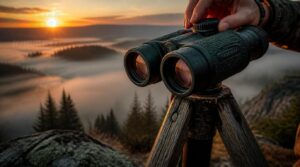
Not all binoculars are created equal, and the gap between a good pair and the right pair comes down to a handful of spec-level decisions. Before you spend a dollar, you need to understand what actually separates crisp, reliable glass from something that’ll let you down at first light.
Here are the five features that matter most for hunting optics.
Magnification and Field View
Magnification is the first number on the label — 8x or 10x power tells you how much closer the image appears. Higher magnification means more detail on that distant elk, but your real field of view shrinks and hand shake gets harder to ignore.
Most hunters stick to 8×42 for dense cover and 10×42 for open-country field glassing. Additionally, 8×42 models offer improved low-light performance due to a larger exit pupil.
Objective Lens Size
The second number — 42, 50, 52 — is the objective lens diameter in millimeters. Bigger means more light collected, which directly improves low-light performance at dawn or dusk.
A 42mm lens balances brightness and portability well. Go larger, like 50mm or 52mm, and you gain serious light-gathering power but add noticeable weight to carry all day.
Exit Pupil Brightness
Exit pupil is simply your objective lens diameter divided by magnification — Exit Pupil Calculation in action. A 10×42 gives you 4.2mm; an 8×42 delivers 5.25mm.
That difference matters at dawn. Your eye pupil opens to roughly 4–5mm in twilight, so Eye Pupil Match determines how much of that light actually reaches your retina and improves low-light performance.
ED Glass Clarity
That extra millimeter of exit pupil gets you into the cover before shooting light — but raw brightness only tells part of the story.
ED glass, or extra-low dispersion glass, controls how different light wavelengths converge, eliminating the color fringing that muddies edges on antlers, branches, or distant ridgelines. The result is sharper, truer color exactly when and where it counts.
Prism and Coating Quality
Think of prism and coating quality as the difference between clean signal and static. BaK-4 roof prism glass eliminates internal light scatter that cheaper BK-7 prisms allow.
Phase-correction coatings preserve contrast and color fidelity across reflective surfaces, while fully multi-coated lenses push light transmission to 92–93%. Dielectric layers on premium glass can exceed 99% reflectance — every photon counts at shooting light.
Match Binoculars to Hunting Terrain
The binoculars that work great in open fields can feel completely wrong the moment you step into tight timber. Terrain dictates everything—magnification, field of view, how much light you actually need. Here’s how the right pair breaks down across five common hunting situations.
Dense Woods and Whitetails
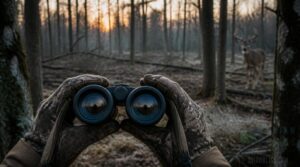
Whitetail hunting in dense timber is a game of patience and short windows.
8×42 binoculars are the smart call here — the wider field of view lets you track movement between blowdowns and hinge-cut bedding cover without losing the deer in the glass. Low-light performance matters too, since most buck movement happens at dawn.
Open Country Glassing
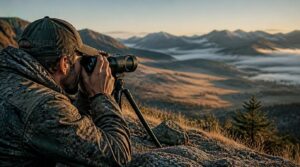
Open country is where binoculars truly earn their keep.
10×42 binoculars are the standard choice — they deliver the reach you need across basins and ridges without shaking apart in your hands. Pair them with a tripod for long glassing sessions, and fatigue drops considerably.
- Grid search left to right, top to bottom, overlapping each pass
- Vantage selection from knobs or opposing ridgelines exposes more country at once
- Morning light at your back reveals feeding animals; shaded afternoon slopes show bedded ones
Once you spot something, stalk planning begins from the glass — study terrain folds and low spots before you ever leave your position.
Mountain Hunting Stability
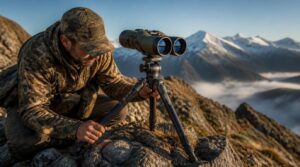
Mountain terrain punishes bad gear choices fast. High magnification (10x to 12x+) gives you the reach to read a hillside, but without a tripod, even the sharpest optics turn into a blur.
A steady tripod mount isn’t optional up high — it’s how you actually see. Adjusting tripod legs on uneven ground keeps your glass planted, not wobbling.
Low-light Dawn Visibility
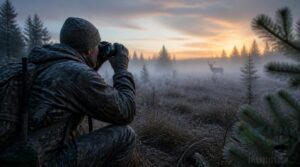
Dawn doesn’t wait. The window between first light and legal shooting light is narrow, and your binoculars either deliver or they don’t.
Exit pupil size is the starting point — an 8×42 produces a 5.25mm exit pupil, closely matching a dark-adapted human eye. A 10×42 drops to 4.2mm, slightly dimmer but still capable. Fully multi-coated lenses and quality prism coatings above 99% reflectivity close that gap meaningfully.
Bird and Wildlife Scanning

Spotting a grouse flush or tracking a flock across a meadow edge comes down to field of view and speed.
Wider views — around 400 feet at 1,000 yards — let you stay locked on fast-moving birds without constant repositioning. Lower magnification like 8x helps here, keeping your hands steady and your scan broad.
Durability for Field Conditions
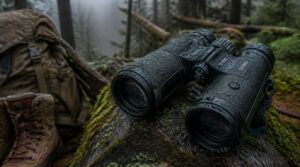
A binocular that can’t handle the field isn’t worth carrying. Rain, fog, drops, and long days in rough country will expose every weak point in a poorly built optic fast. Here’s what to look for when durability actually matters.
Waterproof and Fogproof Ratings
Waterproof and fogproof ratings aren’t just marketing checkboxes — they’re the difference between clear glass and a fogged-out view at the worst possible moment.
IP rating standards tell you exactly what you’re buying. A binocular labeled IPX7 can handle temporary submersion, while IPX4 only covers rain splash. "Water-resistant" without an IP code is fundamentally meaningless.
Gas purge process — commonly nitrogen or argon — removes internal moisture before sealing. Without it, a waterproofed body can still fog internally when temperatures swing hard at dawn.
Key specs worth verifying:
- IPX7 or IPX8 provides real field immersion protection
- Nitrogen and argon purging both prevent internal condensation effectively
- Sealed O-rings around focus mechanisms matter as much as barrel seals
- Fogproof performance degrades if seals crack or wear over time
- Waterproof and fogproof are separate systems solving separate problems
Rubber Armor Protection
Waterproofing keeps moisture out, but rubber armor is what keeps the glass in one piece when things get rough.
Full-coverage rubber armor absorbs impact by deforming on contact, cushioning the hard shell underneath. It also gives you a tackier, more secure grip in wet or gloved hands — critical when you’re pulling binoculars fast from a chest rig in cold weather.
Lightweight Chassis Materials
Rubber armor protects the shell, but what’s inside that shell determines how much weight you’re hauling up the mountain all day.
Magnesium chassis binoculars are roughly 33 percent lighter than aluminum equivalents, making them the go-to for backcountry hunters. Here’s what separates the top chassis materials:
- Magnesium framing cuts component mass by up to 70 percent versus steel
- Aluminum alloy balances low mass with corrosion resistance at a lower cost
- Multi-material design places each material where its weight and stiffness profile fits best
For compact binoculars built around portability, magnesium weight savings add up fast over a long glassing session.
Eyecups and Eye Relief
Weight savings from the chassis matter, but eyecup setup is what actually determines whether you see a clean image or a shadowed tunnel. Twist-up eyecups let you dial in eye relief on the fly — critical if you’re switching between bare eyes at dawn and glasses later.
Glasses wearers need at least 16mm of eye relief to preserve a full, edge-to-edge field of view.
Harness and Carrying Comfort
A neck strap sounds simple until mile six. Binocular harnesses shift that load to your shoulders and upper torso, keeping optics centered against your chest where they won’t swing or bounce.
Look for dual shoulder straps, adjustable fit points, and breathable mesh padding — especially if you’re layering up. Stable chest carry means faster access and less fatigue, full stop.
How We Compare Hunting Binoculars
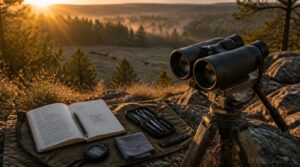
Every score in this guide comes from a structured testing process, not a spec sheet. We put each binocular through five evaluation categories that reflect what actually matters in the field. Here’s exactly how we broke it down.
Optical Resolution Testing
Resolution testing starts with the USAF 1951 Target — a standardized chart of progressively finer bar patterns that reveals exactly where an optic’s clarity falls apart. You’re measuring line pair resolution, spatial frequency response, and MTF curves across three critical dimensions:
- Center sharpness — how cleanly the optic resolves fine detail straight ahead
- Edge sharpness — whether image clarity holds toward the field’s outer limits
- Field sharpness consistency — how evenly optical precision distributes across the full view
Low-light Performance Checks
When legal shooting light is slipping away, your binoculars either hold the image or they don’t.
We evaluate low-light performance at 300 yards during actual dawn and dusk conditions, tracking twilight factor, texture retention, color fidelity, and contrast stability simultaneously. Noise reduction and optical coatings directly shape how long image brightness stays useful — because the last five minutes of light are often the only ones that matter.
Handling and Ergonomics
A binocular that feels awkward in your hands will cost you the moment it matters most.
Weight distribution shapes everything — optics that balance near your grip stay steady far longer than nose-heavy designs that torque your wrists.
Grip design, focus wheel feel, eyecup adjustment, and strap fit all feed directly into how confident and fatigue-free your glassing sessions become.
Weather-resistance Scoring
Weather resistance isn’t just a checkbox — it’s what keeps your optics alive when the hunt gets ugly.
Every model we tested was evaluated across five criteria:
- O-ring seal integrity across joints, eyecups, and the hinge
- IPX7 waterproof rating, handling submersion up to 1 meter for 30 minutes
- Nitrogen or argon gas purging to prevent internal fogging during temperature swings
- Dust and debris defense on windy ridgelines and dry trails
- Temperature tolerance, with top performers rated from -43°C to +55°C
Scores weighted fogproof performance and seal consistency most heavily, since internal condensation and moisture intrusion are the failures that end hunts.
Price Versus Field Value
Price doesn’t equal field value — and that gap matters more than most hunters realize.
Price and field value are not the same thing, and that gap matters more than most hunters realize
The Vortex Triumph HD 10×42 at under $100 covers real hunting needs for occasional users. The Swarovski NL Pure, at roughly 3,020 euros, buys refinement, not a different outcome.
Match the glass to your terrain, your time behind it, and your budget first.
Frequently Asked Questions (FAQs)
Can I use hunting binoculars for birdwatching?
Yes, absolutely. 8×42 models work especially well — their wider field of view helps you track fast-moving birds, and the rugged, waterproof build withstands any weather birding throws at you.
How do I properly focus binoculars?
Start with eyecup positioning — extend fully without glasses, retract with them. Set interpupillary distance until you see one clean circle. Use the center focus wheel, then fine-tune with the diopter for each eye.
What does the diopter adjustment actually do?
The diopter fine-tunes one eyepiece to match your weaker eye, compensating for the natural difference between left and right vision so both eyes see the same sharp image simultaneously.
Are roof prism or porro prism better?
Roof prism wins on portability and field durability. Porro prism delivers better image brightness per dollar. For all-day carries, go roof. For fixed glassing, porro’s three-dimensional view and raw optical value are hard to beat.
How often should binoculars be professionally serviced?
Most binoculars don’t need scheduled servicing. Service when problems appear — blurry focus, misalignment, or moisture inside. After a drop or roughly 10–15 years of regular use, a professional check is worth it.
How do I clean binocular lenses in the field?
Hold lens-down first, then use a soft lens brush to lift dust before touching glass. Follow with a microfiber cloth — never paper towels — using gentle circular strokes to protect anti-reflective coatings.
Can binoculars damage your eyes with extended use?
Extended use won’t damage healthy eyes — but poor setup will wear them out fast. Adjust your diopter, match interpupillary distance, and never point binoculars at the sun. That’s where real risk lives.
What warranty coverage should hunting binoculars include?
A solid warranty covers defects in materials and workmanship, offers lifetime protection, and clearly excludes accidental damage. Check transferability and claim steps — you’ll want to know exactly how repairs get handled before you need it.
Are binoculars allowed in all hunting zones?
Standard daytime binoculars are legal in most hunting zones, but night-vision and thermal optics face strict regional rules. Always verify local laws before heading out.
How long do quality hunting binoculars typically last?
Quality optics often last 10 to 20 years with normal use. Premium models backed by lifetime warranties can serve you even longer — provided you avoid drops and store them properly between seasons.
Conclusion
Picture a hunter glassing a steep alpine basin at last light—elk moving through scattered timber 400 yards out. The right binoculars for hunting don’t just help you see them; they help you read them—body posture, antler width, whether it’s even worth the stalk.
Every pick in this guide earned its rank in exactly those moments. Choose the glass that best matches your terrain, trust the specs, and the field will reward the preparation.
- https://stealthbirding.co.uk/blogs/birding/ed-glass-vs-hd-glass-in-binoculars
- https://www.vanguardworld.com/blogs/hunting/the-best-types-of-binoculars-for-hunting-a-hunter-s-essential-guide
- https://argalioutdoors.com/blogs/advice/how-to-pick-the-best-size-binoculars-for-big-game-hunting-part-1
- https://www.knivesandtools.com/en/ct/binoculars-glossary-types-of-glass.htm
- https://www.nzhuntingandshooting.co.nz/f15/ed-glass-scopes-binos-80029