This site is supported by our readers. We may earn a commission, at no cost to you, if you purchase through links.

Your well-intentioned bird bath might be functioning as a predator’s dinner plate. When birds bathe, they become temporarily vulnerable—their feathers get waterlogged, their vision is compromised by splashing, and their attention focuses inward rather than scanning for threats.
Domestic cats alone kill billions of birds annually, and poorly positioned water features create perfect hunting grounds where stalking predators can approach undetected. The difference between a safe haven and a danger zone often comes down to just a few feet of strategic placement.
By understanding how predators exploit cover and how birds detect danger, you can transform your bird bath from a liability into a genuinely protective resource that benefits your feathered visitors without putting them at unnecessary risk.
Table Of Contents
- Key Takeaways
- Why Bird Bath Placement Affects Bird Safety
- Choosing Safe Distances From Vegetation
- Avoiding Ambush Zones for Predators
- Maximizing Visibility and Escape Routes
- Managing Proximity to Feeders and Windows
- Considering Sunlight and Shade for Safety
- Elevation: Ground-Level Vs Raised Baths
- Selecting The Best Materials for Safety
- Ensuring Accessibility for Cleaning and Maintenance
- Seasonal and Environmental Placement Considerations
- Frequently Asked Questions (FAQs)
- Conclusion
Key Takeaways
- Position your bird bath 10-15 feet from dense shrubs, hedges, and ground cover to prevent cats and other predators from using vegetation as concealed stalking zones while birds are vulnerable during bathing.
- Elevate baths at least three feet on pedestals or poles to limit ground predator access, improve birds’ sightlines for threat detection, and provide better escape opportunities compared to ground-level placement.
- Place baths in open spaces with clear 360-degree visibility rather than near feeders, fences, or building edges where predators travel regularly and birds become concentrated targets with obstructed escape routes.
- Keep baths either within 3 feet of windows or farther than 10 feet away to minimize fatal collision risks, while ensuring partial shade to prevent overheating that compromises birds’ ability to detect and flee from approaching threats.
Why Bird Bath Placement Affects Bird Safety
When you fill a bird bath, you’re offering more than water—you’re creating a moment of risk. Wet feathers slow escape, bathing birds lose vigilance, and predators know it.
Understanding how placement shapes safety helps you turn a vulnerable moment into a reliable refuge that birds will trust and return to.
Birds’ Vulnerability During Bathing
When birds bathe, they face a stark time trade-off: reduced vigilance leaves them exposed while wet feathers compromise escape performance. Research shows bathing birds scan less frequently for threats, creating behavioral vulnerability that predators exploit.
This ambush risk is real—your backyard becomes a hunting ground if you ignore bird safety from predators. Smart bird bath placement strategies and predator avoidance measures minimize bird vulnerability, especially around cat ambush zones.
Birdbaths can also attract non-seed eaters to your yard.
Predation Risks in Residential Yards
Your yard harbors serious predator protection challenges. Cat predation kills an estimated 1.3 to 4.0 billion birds annually in the United States, with unowned cats responsible for roughly 69% of these deaths. Window strikes claim another 599 million birds each year. Add raptor threats and ground predators exploiting cat ambush zones, and you’ll see why habitat fragmentation and human impact make residential landscapes particularly dangerous for bathing birds.
Residential yards are predator hotspots where cats kill billions of birds annually and windows claim millions more
Addressing feral cat impact is vital for bird conservation.
Choosing Safe Distances From Vegetation
Dense vegetation around your bird bath acts like a predator’s blind, giving cats and other hunters the perfect cover to stalk unsuspecting birds. The distance between your bath and these hiding spots can mean the difference between a safe watering hole and a danger zone.
Here’s what you need to know about spacing your bird bath away from vegetation.
Risks of Dense Shrubs and Ground Cover

When vegetation wraps too closely around your bird bath, you’re basically setting a trap. Dense shrubbery and ground cover provide ideal predator concealment, allowing cats to stalk within striking distance while birds bathe with reduced vigilance. This configuration blocks escape routes and dramatically increases hunting efficiency, contributing to substantial bird deaths annually.
Why Dense Vegetation Near Baths Creates Danger:
- Obstructed sightlines prevent birds from spotting approaching threats until it’s too late to flee
- Multiple approach paths give predators numerous concealed routes to reach bathing birds
- Compromised escape routes mean wet, heavy feathers meet blocked flight paths during critical seconds
- Enhanced ambush success occurs when cats exploit the sit-and-wait strategy from vegetative cover
- Concentrated predation pressure develops as hunters learn that dense plantings near water yield consistent kills
Avoiding cat ambush zones requires understanding this interaction—a protective buffer zone between your bath and ground cover isn’t optional, it’s essential for bird survival.
Recommended Distance From Hiding Spots

Research-backed spacing guidelines offer concrete targets for yard integration. Position your bird bath 10–15 feet from dense shrubbery and ground cover—this setback balances open lawn visibility with accessible refuge.
Here’s the best setback framework:
| Bath Type | Minimum Distance | Preferred Zone |
|---|---|---|
| Ground-level | 10–15 feet | Open lawn with clear sightlines |
| Elevated baths | 10+ feet | Moderate clearing from cover proximity |
| Pedestal (3 ft) | 10–20 feet | Between scattered trees and hedges |
| Integrated yards | 10+ feet | Separated from feeders and thickets |
This spacing disrupts predator stalking patterns while maintaining bird access to protective cover.
Avoiding Ambush Zones for Predators

Predators don’t just appear randomly in your yard—they follow patterns, using certain spots as hunting corridors and staging areas. Understanding where cats and other predators are most likely to stalk birds helps you position your bath strategically, keeping it out of high-risk zones.
Let’s look at the key behaviors and placement strategies that minimize ambush opportunities.
Cat Behavior and Bird Bath Placement
Domestic cats are patient hunters, often using sit-and-wait tactics near water sources to ambush unwary birds. Understanding these predator safety risks helps you choose deterrent placement strategies that protect your feathered visitors. Both feral cat populations and owned cats pose temporal predation risks throughout the day and night, so consider these ambush cover removal principles:
- Avoid placing baths directly beside fences, hedges, or solid structures that shorten a predator’s final attack distance.
- Position baths where cats must cross exposed ground, giving birds vital seconds to detect danger.
- Remove nearby hiding spots within 6–10 feet to eliminate spatial activity patterns that favor stalking.
- Raise baths about 3 feet on pedestals, making cat hunting tactics less effective.
Placement Away From Common Predator Paths
Because predators exploit predictable corridors along fences, building edges, and hedgerows, route mapping helps you disrupt travel paths that threaten bathing birds. Fence proximity increases ambush risk, so practice edge avoidance by placing your bath 10–15 feet from these linear features.
Habitat connectivity guides predator movement, so creating safe bird habitats means positioning water sources away from these high-traffic zones, minimizing bird vulnerability throughout your yard.
Maximizing Visibility and Escape Routes
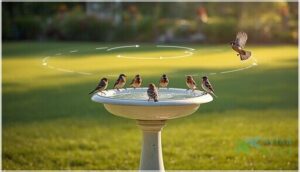
When predators can see a bird bath from a distance, birds lose their tactical advantage—they need the opposite scenario. Your goal is to position the bath so visiting birds have unobstructed views in all directions, giving them precious seconds to detect threats and take flight.
The two most critical factors in maximizing both visibility and escape routes come down to spatial design and environmental awareness.
Open Spaces for Predator Detection
When you place your bird bath in an open area, you give birds the gift of time—the important seconds they need to spot danger before it’s too late. Open spaces create safe distances that reduce ambush opportunities and heighten predator sightlines, directly supporting avian safety.
Here’s what makes openness so effective for bird bath placement:
- 360-degree visibility lets birds monitor all directions while bathing
- Earlier predator detection occurs when hiding spots are farther away
- Reduced ambush success happens in uniformly open configurations
- Multiple escape routes become available without obstructing vegetation
- Lower multi-predator risk results from fewer concealed approach angles
Studies confirm that maintaining at least 10–15 feet between your bath and dense shrubs allows birds to detect stalking cats or other predators in time to escape. Suburban yard research shows that open lawn placement away from hedges and fences reduces intersections with regular predator travel paths.
Clear Sightlines for Safe Takeoff
When birds bathe, their vigilance behavior depends on detection distance—the unobstructed space where they can spot threats early. Strategic bird bath placement with clear sightlines gives your visitors the visibility they need to flee before danger closes in.
You’ll want to remove obstructions within the escape trajectory, creating ideal angles for takeoff in any direction. This setup directly improves bird safety by supporting faster predator recognition.
Managing Proximity to Feeders and Windows
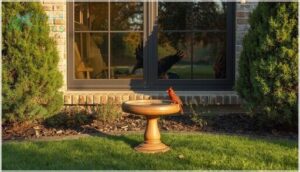
Your bird bath’s location relative to feeders and windows can create unexpected hazards, even in spots that seem perfectly safe from ground predators. While feeders draw birds into concentrated areas where they’re easier targets, nearby windows pose a different threat entirely—one that kills roughly 599 million birds each year in the United States alone.
Understanding these spatial relationships helps you position your bath to minimize both predation risk and collision danger.
Dangers of Placing Baths Near Feeders
Clustering your bird bath right next to bird feeders might seem convenient, but this setup creates a predator magnet that puts birds at serious risk. When food and water share the same tight zone, you’re concentrating vulnerable birds in a single hunting ground.
- Predator concentration: Both avian predators like hawks and ground predators such as cats learn to stake out these high-traffic zones, where prey is predictable and plentiful.
- Reduced vigilance: Birds bathing near busy feeders are distracted by constant movement, making predator detection much harder during their most vulnerable moments.
- Disease transmission: Seed debris and droppings contaminate water quickly, fostering bacterial growth and waterborne pathogens that spread through concentrated bird populations.
- Ambush facilitation: Cats exploit the narrow space between feeders and baths, using nearby vegetation as cover to launch surprise attacks on birds moving between resources.
Expert guidance consistently recommends keeping baths at least 10 to 15 feet from bird feeders—a distance that balances accessibility with safety. This separation reduces contamination, spreads bird activity across your yard instead of creating a single danger zone, and gives bathing birds the clear sightlines they need to spot approaching threats.
Despite conflicting guidance in casual birding circles suggesting closer placement for convenience, the evidence confirms meaningful separation to protect the birds you’re trying to help.
Reducing Window Collision Risks
Window collisions kill hundreds of millions of birds annually in the U.S., and your bird bath placement directly influences this risk. If you position baths farther than 3 feet from windows, startled birds gain enough speed to sustain fatal impacts—research shows 67% of collisions at 10 meters proved lethal.
Place baths within 0.9 meters of glass, add collision deterrents like densely-spaced window decals, and minimize window reflectivity near vegetation to create safer escape routes.
Considering Sunlight and Shade for Safety

While predator avoidance often dominates placement decisions, sunlight and shade play a surprisingly important role in bird bath safety as well.
Birds bathing in full sun face increased stress from overheating, which can compromise their ability to detect threats and escape quickly.
Understanding how to balance light exposure protects both the birds’ physical comfort and their vigilance against danger.
Benefits of Partial Shade
When you provide partial shade around your bird bath, you’ll immediately cut heat stress and lower evaporation rates during scorching afternoons. Cooler water attracts more birds, while algae reduction becomes easier, since intense sunlight exposure for bird baths fuels rapid algae blooms.
Shade provision also offers refuge use near the bath—giving birds quick cover from predators without creating ambush zones. Strategic bird bath placement under dappled canopy balances safety with comfort beautifully.
Avoiding Overexposure and Overheating
While partial shade prevents algae growth and keeps water cooler, full sun exposure on hot summer days creates a dehydration risk that can be just as dangerous as predators. Small birds overheat quickly in sunny locations—their body temperatures can spike above safe thresholds within minutes.
You’ll notice reduced bathing frequency when water gets too warm, so shade provision isn’t optional in summer; it’s survival insurance.
Elevation: Ground-Level Vs Raised Baths

The height at which you position your bird bath directly influences how safe your feathered visitors will be from predators, particularly ground-based hunters like cats.
Ground-level baths offer certain advantages, but they also come with distinct vulnerabilities that elevated options can help mitigate.
Understanding the trade-offs between these two approaches will help you make the best choice for your yard’s specific conditions and the birds you’re hoping to attract.
Vulnerabilities of Ground-Level Placement
Ground-level bird baths put your backyard visitors at serious risk. When birds bathe at ground level, they face increased terrestrial predator access—cats, in particular, can launch ambush attacks from nearby cover with almost no warning. Limited escape time means a drinking or bathing bird often can’t react fast enough.
Here’s how different factors stack up:
| Risk Factor | Ground-Level Impact |
|---|---|
| Cat predation risk | Cats kill 1.3–4.0 billion birds annually, many near ground features |
| Ambush site proximity | Dense shrubs provide perfect stalking cover within feet |
| Escape time | Wet feathers slow flight; attacks happen in seconds |
| Visibility | Low sightlines prevent early predator detection |
| Vulnerability during use | Bathing birds show reduced vigilance, making surprise attacks easier |
Creating safe bird habitats means understanding these ground-level bird bath vulnerabilities and taking action.
Advantages of Elevated Bird Baths
Raising your bird bath at least three feet instantly changes the safety equation. Elevated placement limits predator access—cats generally jump five to six feet, but smooth poles above three feet deny them the stability to strike effectively. You’re also boosting predator detection: birds gain clearer sightlines and extra escape opportunities from a higher launch point. Add a baffle for deterrent compatibility, and contamination reduction follows naturally as mammals can’t reach the water.
| Feature | Ground Bath | Elevated Bath |
|---|---|---|
| Predator access reduction | Cats ambush easily | Difficult climbing target |
| Escape opportunities | Wet birds struggle | Vertical advantage aids flight |
| Predator detection | Low visibility | 360-degree sightlines |
| Contamination reduction | Fecal/scent deposits | Less mammal contact |
Selecting The Best Materials for Safety

The material you choose for your bird bath directly affects how safely birds can use it, especially when they’re wet and vulnerable. Slippery surfaces increase the risk of falls and failed takeoffs, while porous or difficult-to-clean materials can harbor bacteria that weaken birds and make them easier targets.
Let’s look at the key material considerations that balance safety with practical maintenance.
Non-Slip Surfaces for Birds
A slippery bird bath becomes a death trap when wet feathers meet polished surfaces. Surface texture matters enormously—concrete, unglazed terracotta, and rough stone provide the grip birds need for safe bathing in your chosen location.
If you’re working with smooth materials, add-ins like pea gravel or flat stones transform treacherous basins into safe environments.
Edge design also counts: gently sloping rims with textured finishes let birds enter confidently, supporting avian wellbeing while minimizing vulnerability to predators during this essential activity.
Easy-to-Clean and Hygienic Materials
Nonporous surfaces like glazed ceramic, glass, and smooth metal make maintenance straightforward—you’ll scrub away biofilm and debris with minimal effort, keeping water cleanliness at safe levels.
Porous concrete or unsealed stone trap organic matter in microscopic crevices, requiring harsher cleaning agents and more frequent attention.
Choose bird bath materials that rinse completely, reducing chemical residues and disease risks while you maintain a safe location free from predators.
Ensuring Accessibility for Cleaning and Maintenance
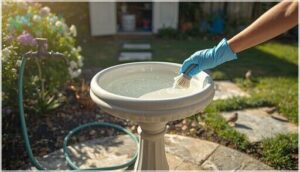
A bird bath that’s difficult to reach or maintain won’t stay clean for long, and dirty water can spread disease just as effectively as predators can harm vulnerable birds. You need to think about accessibility from day one, not as an afterthought when algae has already taken over.
The two most important considerations are how often you can realistically clean the bath and how conveniently you can access fresh water to refill it.
Regular Cleaning to Prevent Disease
You can’t afford to neglect water cleanliness when pathogens like Trichomonas gallinae survive up to 48 hours in contaminated baths. Empty and scrub every 2–3 days during warm weather—daily if temperatures soar—to prevent avian disease transmission.
Use a 10% bleach solution or vinegar dilution for disinfection methods, then rinse thoroughly. Frequent cleaning and maintenance controls bacteria growth, reduces pathogen risks, and protects water quality for your visiting birds.
Placement Near Water Sources for Convenience
Positioning your bath within 10–15 feet of a spigot or downspout cuts refill time to under five minutes, encouraging the frequent maintenance frequency birds depend on. Hose accessibility matters—especially in summer, when daily water changes prevent mosquito breeding.
Consider Irrigation Integration or Rainwater Harvesting for automated top-offs, but remember plumbing considerations: Balancing Safety means avoiding dense vegetation near that convenient water source, so predators can’t exploit your hoses as cover.
Seasonal and Environmental Placement Considerations

Your bird bath’s location needs to shift with the seasons, since temperature extremes and weather patterns directly affect both water quality and bird safety. Summer heat accelerates algae growth and evaporation, while winter freezing can render a bath useless or even dangerous if birds can’t access liquid water.
Beyond seasonal shifts, you’ll also want to think about your yard’s drainage patterns and moisture levels to prevent creating hazards like mosquito breeding grounds or flood zones that increase predation risk.
Adapting Placement for Winter and Summer
Your bird bath placement needs seasonal adjustments to balance protection from predators with thermal comfort. Consider these key adaptations:
- Winter Sun: Position heated baths in sunny spots to reduce energy use and maintain ice-free water longer.
- Summer Shade: Move baths to partial shade, preventing overheating and slowing bacterial growth.
- Distance to Cover: Place baths closer to evergreen shelter in winter (about 6 feet), slightly farther in summer (10–15 feet).
- Seasonal Elevation: Keep pedestal baths raised year-round to limit ground predator access.
- Maintenance Access: Make certain you can reach the bath easily for daily cleaning, regardless of snow or heat.
Avoiding Flood-Prone or Mosquito Breeding Areas
Standing water in flood-prone yards becomes a magnet for mosquito breeding, with larvae reaching adulthood in just 7–10 days under warm conditions. Place your bird bath away from low-lying areas, drainage swales, and spots that hold water after storms.
Adding a fountain or bubbler creates water movement that disrupts the mosquito lifecycle, while weekly cleaning prevents disease transmission and water contamination in your bath.
Frequently Asked Questions (FAQs)
How do hawks hunt birds at baths?
A sudden blur over the fence—that’s how hawks strike. Their visual acuity advantage lets them spot bathing birds from rooftops away, then they use speed attack strategies and landscape feature usage to ambush vulnerable, wet-feathered targets.
Should baths face specific compass directions?
Compass direction doesn’t really matter for protection from predators. Instead, focus on sun exposure, seasonal changes, and your yard layout—shade patterns and local climate trump directional myths when avoiding bird predators through smart shelter placement strategies.
Can mirrors or reflective objects deter predators?
Flashes of light can briefly startle cats and other predators, yet mirror predator confusion and reflection visibility range aren’t foolproof deterrents.
Habituation risk mitigation requires rotation, and predator-specific responses vary widely among species.
Do motion-activated sprinklers protect bathing birds?
Motion-activated sprinklers can help protect bathing birds by creating a deterrent zone that discourages predators, especially cats.
Their effectiveness depends on species behavior limitations, proper placement, and integration with broader bird protection strategies for a safe haven.
What sounds alert birds to approaching danger?
Birds respond rapidly to alarm call types from their own and other species through heterospecific eavesdropping. Urgency coding and predator encoding trigger escape routes to a safe haven.
This behavior shapes avian health and bird behavior via social learning.
Conclusion
Think of your yard as a chessboard where every move matters. A warbler hesitates at a bath surrounded by dense hostas, instinctively recognizing the trap.
Your strategic bird bath placement to avoid predators transforms that hesitation into confidence—birds bathing freely while maintaining clear escape routes and unobstructed sightlines.
The ten feet you position your bath from shrubs, the elevation you choose, and the open space you preserve aren’t just guidelines—they’re the difference between sanctuary and ambush.
- https://pubmed.ncbi.nlm.nih.gov/23360987/
- https://www.allaboutbirds.org/news/faq-outdoor-cats-and-their-effects-on-birds/
- https://www.redding.com/story/life/home-garden/2016/01/29/birdwords-feral-cats-drive-songbird-decline/93436176/
- https://abcbirds.org/wp-content/uploads/2015/07/Lepczyk_et_al_2003-Landowners_and_cat_predations_across_rural-urban_landscapes.pdf
- https://extension.psu.edu/water-for-wildlife-bird-baths-and-backyard-ponds