This site is supported by our readers. We may earn a commission, at no cost to you, if you purchase through links.
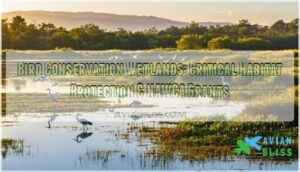 You’ll discover that bird conservation wetlands serve as nature’s pit stops for over 600 migratory bird species across North America.
These watery havens aren’t just scenic—they’re survival stations where birds refuel, nest, and raise their young during epic cross-continental journeys.
Wetlands filter pollutants, prevent floods, and support one-third of endangered species despite covering just 5% of the landscape.
Programs like NAWCA provide essential funding to protect these irreplaceable habitats, turning conservation dreams into reality through strategic partnerships and matching grants that stretch every conservation dollar further than you might expect.
Table Of Contents
- Key Takeaways
- Wetland Conservation Benefits
- Bird Habitat Preservation
- NAWCA Grant Programs
- Ecological Importance Wetlands
- International Bird Conservation
- Frequently Asked Questions (FAQs)
- How do wetlands support birds?
- How do ducks unlimited conserve wetlands?
- What are bird conservation regions?
- What is the conservation of wetlands?
- What species benefit most from wetland restoration?
- How do wetlands affect local climate patterns?
- What are the main wetland restoration techniques?
- How do invasive species threaten bird habitats?
- What role do volunteers play in conservation?
- Conclusion
Key Takeaways
- You’ll discover that wetlands serve as critical pit stops for over 600 migratory bird species, providing essential nesting sites, food sources, and refueling stations during their epic cross-continental journeys.
- You’re investing in nature’s infrastructure when you support wetland conservation—these ecosystems filter pollutants at $1 per pound versus $40 for treatment plants while providing $237 billion in annual flood protection.
- You can leverage NAWCA grants to maximize your conservation impact through matching contributions that stretch every dollar further, with streamlined application cycles and flexible funding requirements for wetland restoration projects.
- You’ll find that wetlands generate over $150 billion annually through wildlife recreation while supporting one-third of endangered species despite covering just 5% of the landscape, making them biodiversity hotspots that rival rainforests in productivity.
Wetland Conservation Benefits
Wetland conservation delivers measurable benefits that protect both wildlife and human communities from environmental threats.
You’ll find these ecosystems act as natural infrastructure, filtering water pollutants while reducing flood damage and coastal erosion that costs billions annually.
Improved Water Quality
You’ll discover that wetlands act as nature’s water purification systems, transforming polluted runoff into clean water through natural filtration processes.
These aquatic habitats remove harmful chemicals and sediments that threaten ecosystem balance. Effective bird migration habitat conservation relies on preserving such ecosystems to support biodiversity.
Wetlands filter pollution naturally while protecting communities from floods—nature’s most cost-effective infrastructure investment.
- Nitrogen removal: Wetlands filter farm chemicals at $1 per pound versus $40 for treatment plants
- Sediment trapping: Natural filters catch soil particles before they reach streams and rivers
- Bacterial breakdown: Beneficial microbes in wetland soils decompose organic pollutants naturally
- Chemical absorption: Wetland plants absorb heavy metals and toxic substances from contaminated water
- Groundwater protection: Clean water recharges underground supplies that 44% of Americans drink daily
Reduced Flooding
You’ll find wetlands act like natural sponges, absorbing excess rainwater during storms and releasing it slowly over time.
This flood control saves communities millions annually—inland wetlands provide $237 billion in water management benefits.
When you restore these habitats for waterfowl management, you’re also protecting your property from costly flood damage naturally, which is a significant benefit of preserving these ecosystems for flood control.
Coastal Erosion Mitigation
Protecting coastlines from nature’s relentless waves requires wetland buffers that act as living shields.
Coastal wetlands absorb wave energy and trap sediments, creating natural barriers against storm surge and erosion damage.
- Shoreline Protection: Coastal restoration projects use native vegetation to stabilize soil and reduce wave impact
- Ocean Barriers: Wetland buffers create multiple defense layers between open water and inland communities
- Erosion Control: Salt marshes and mangroves trap sediments while their root systems bind coastal soils together
- Storm Surge Mitigation: During hurricanes, coastal wetlands can reduce wave heights by up to 90 percent
- Flood Risk Reduction: These natural systems absorb excess water during storms, protecting property and infrastructure
Enhanced Ecosystems
While wetland conservation shields your coastline from erosion, it also builds thriving ecosystems that support countless species.
You’re creating biodiversity hotspots where wildlife flourishes through habitat enhancement and ecosystem restoration.
Wetland ecosystems provide ecosystem services worth billions annually, from water filtration to carbon storage, making biodiversity protection a smart investment.
| Ecosystem Benefit | Annual Value |
|---|---|
| Water Quality Improvement | $1.5 billion saved |
| Flood Control Services | $237 billion protection |
| Wildlife Recreation | $150 billion economy |
| Commercial Fish Support | $1.2 trillion industry |
| Carbon Storage Capacity | $23 billion equivalent |
Bird Habitat Preservation
You’ll discover how strategic wetland conservation creates essential stopover points and breeding grounds that sustain millions of migratory birds across North America.
These protected habitats don’t just support individual species—they maintain the intricate food webs and nesting sites that keep entire bird populations thriving during their incredible seasonal journeys, which is crucial for migratory birds.
Migratory Bird Species
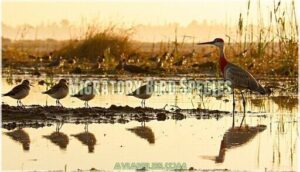
Across North America’s vast landscapes, over 600 migratory bird species depend on wetlands as essential stopover sites during their epic journeys.
Wetlands serve as nature’s roadside diners for millions of migrating birds crossing continents.
These aquatic havens support everything from tiny warblers to massive cranes, creating biodiversity hotspots that fuel conservation efforts and avian research.
The protection of these areas is essential for maintaining stopover site habitats.
Critical species relying on wetland conservation:
- Western Sandpipers – 31% of the global population depends on single wetland sites
- Black-tailed Godwits – face 42% population declines from habitat loss
- Canvasback ducks – require connected prairie potholes for successful waterfowl management
- Sandhill Cranes – utilize flooded agricultural lands as essential migratory bird conservation areas
Critical Habitat Conservation
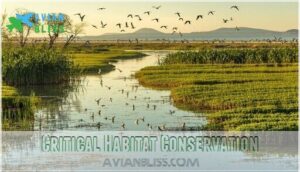
Critical habitat conservation requires strategic planning to protect essential breeding, feeding, and roosting areas that migratory birds depend on throughout their lifecycles.
You’ll find that effective conservation strategies focus on preserving large, connected wetland systems rather than isolated patches.
These wildlife refuges serve as stepping stones along migration routes, maintaining ecosystem balance through biodiversity protection.
Successful wetland preservation combines habitat restoration with long-term monitoring to guarantee migratory birds have reliable sanctuaries.
Conservation efforts often rely on wetland conservation tools to manage and protect these critical habitats.
Upland Habitat Restoration
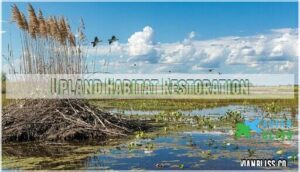
You can’t restore bird habitat without fixing the ground beneath their feet.
Native grasses anchor soil, preventing erosion while creating wildlife corridors that combat habitat fragmentation.
These uplands provide ecosystem services beyond wetlands, offering nesting sites and food sources.
Strategic habitat restoration connects fragmented landscapes, supporting thorough bird conservation and strengthening wetland conservation efforts.
Wetland Ecosystem Services
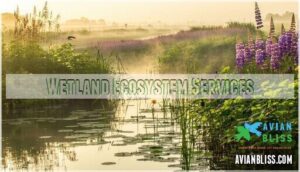
Beyond upland restoration, wetland ecosystem services power nature’s most efficient environmental solutions.
These natural systems work as biological powerhouses, delivering carbon sequestration while maintaining ecological balance through wetland conservation efforts that support biodiversity conservation and habitat conservation simultaneously.
- Water filtration magic – Wetland ecosystems remove pollutants at $1 per pound versus $7-40 for treatment plants
- Flood control champions – Wetland restoration provides $237 billion annually in natural flood protection nationwide
- Carbon storage heroes – Ecosystem services include sequestering carbon at rates surpassing most terrestrial habitats
- Wildlife highways – Ecosystem resilience depends on wetland preservation connecting fragmented bird migration routes
NAWCA Grant Programs
You’ll find NAWCA grants offer the most extensive federal funding for wetland conservation projects across North America.
The program’s streamlined application cycles and flexible matching requirements make it easier than ever to secure support for your bird habitat restoration efforts.
U.S. Standard Grant Application
You’ll navigate through NAWCA’s competitive U.S. Standard Grant Application process, where partnerships make all the difference.
This matching grant program requires minimum $250,001 requests with 1:1 non-federal contributions for wetland conservation projects.
The program aims to support long-term habitat protection for wetland ecosystems.
| Application Component | Requirement |
|---|---|
| Grant Eligibility | State agencies, nonprofits, private landowners |
| Award Criteria | Habitat conservation for migratory birds |
| Project Evaluation | Partnership strength, conservation impact |
| Application Process | Grants.gov submission with SF-424 forms |
| Grant Administration | Performance reports, GIS mapping required |
Funding Cycles and Deadlines
NAWCA’s grant cycles align with federal funding availability to streamline your application process.
You’ll work within two annual cycles for fiscal year 2026: Cycle 1 applications are due July 10, 2025, while Cycle 2 deadlines fall on February 26, 2026.
This dual-cycle approach reduces waiting time between application submission and grant awards, helping you plan your project timeline more effectively.
Understanding bird conservation efforts is essential for maximizing the impact of these grants, and is a key part of bird conservation and overall project planning.
Matching Contributions Requirements
Understanding matching contributions is like learning the rules of a financial partnership.
You’ll need to provide dollar-for-dollar matching funds for Federal Grants, though NAWCA partners often exceed this Match Ratio.
For FY26, you can use contributions from three years prior to your application—a one-time extension of traditional Contribution Rules.
This flexibility helps conservation organizations better align their Funding Cycles with available resources for wetland conservation efforts.
Grant Administration Standards
Following your matching contributions, you’ll navigate specific Grant Guidelines that govern NAWCA funding.
The US Standard Grant Application Process requires strict adherence to Funding Rules and Award Criteria.
These guidelines guarantee your conservation funding aligns with program objectives. You must meet Match Requirements exactly as outlined, or your grants won’t receive approval for wetland restoration projects.
Ecological Importance Wetlands
You’ll find wetlands rank among nature’s most productive ecosystems, supporting nearly half of all bird species.
They generate over $150 billion annually through wildlife recreation, and these natural systems filter pollutants, prevent flooding.
They also provide critical stopover sites for billions of migrating birds across North America, making them a vital part of the ecosystem, with significant economic benefits through recreation.
Biodiversity Hotspots
Beyond NAWCA’s funding mechanisms lies wetland conservation’s true power: protecting biological diversity hotspots.
You’re witnessing ecosystems that rival rainforests in productivity, where species preservation meets ecosystem balance. These habitats support nearly half of America’s bird species despite covering minimal land area.
- Wetlands support 75% of commercially harvested fish and shellfish species
- Habitat fragmentation threatens 64% of global wetland ecosystems since 1900
- Conservation efforts focus on maintaining corridors between fragmented bird habitats
- Biological diversity peaks where water meets land, creating unique ecological niches, which is crucial for ecosystem balance and supports a wide range of species, including those that rely on wetland conservation.
Wildlife-Associated Recreation
You’ll discover that wetlands fuel America’s massive wildlife recreation economy, generating over $150 billion annually through birdwatching and waterfowl hunting.
These outdoor adventures create jobs while supporting conservation efforts. Effective birdwatching requires proper bird watching gear.
| Recreation Type | Annual Participants | Economic Impact |
|---|---|---|
| Bird Watching | 45 million | $80 billion |
| Waterfowl Hunting | 1.5 million | $3.5 billion |
| Eco Tourism | 76 million | $87 billion |
| Wildlife Photography | 13 million | $15 billion |
Recreation management guarantees sustainable outdoor recreation opportunities.
Economic Benefits of Wetlands
Wetland investments deliver impressive fiscal benefits, generating $3,273 per acre annually through ecosystem services.
You’ll find these natural systems create substantial job creation opportunities in construction and eco tourism sectors.
Water savings from wetland conservation provide economic impact through reduced treatment costs, while environmental economics shows restoration projects yield 7:1 benefit-cost ratios for communities nationwide.
Understanding wetland habitat conservation is essential for maintaining these economic benefits and supporting biodiversity through wetland conservation.
Water Quality Improvement
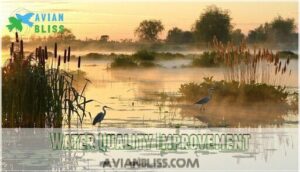
You’ll find that wetlands act as nature’s water filters, removing harmful pollutants and sediments from runoff before they reach rivers and lakes.
Through wetland restoration projects, you can improve water quality while supporting aquatic management goals.
These natural systems provide pollution control that’s nine times more cost-effective than traditional treatment methods, making wetland conservation essential for ecosystem health.
International Bird Conservation
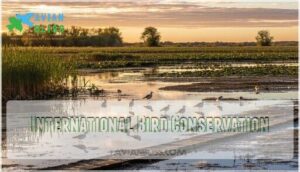
You’ll find that international bird conservation efforts span multiple continents and involve complex partnerships between governments, organizations, and citizens.
These collaborative initiatives protect critical wetland habitats that serve as essential stopover points for millions of migratory birds traveling thousands of miles each year.
North American Waterfowl Management
You’ll see conservation partnerships in action through the North American Waterfowl Management Plan, where three countries unite for bird conservation success.
Since 1986, this international collaboration has transformed wetland restoration across borders, creating a blueprint for effective wildlife management through shared resources and expertise.
- Joint ventures coordinate waterfowl habitat projects across Canada, the U.S., and Mexico using science-based approaches
- Conservation funding leverages $4.3 billion in matching contributions through NAWCA grants for migratory bird conservation efforts
- Waterfowl management strategies target specific flyways to maximize bird migration corridor protection and habitat connectivity
Migratory Bird Treaty Act
You’ll find the Migratory Bird Treaty Act serves as the backbone of Bird Protection in North America.
Since 1918, this Conservation Laws framework has guided Treaty Enforcement across international borders.
The act protects over 1,000 migratory birds species, making it illegal to hunt, capture, or harm protected birds without permits.
This thorough Species Preservation legislation supports bird conservation efforts by regulating human activities that disrupt Migratory Patterns during critical seasons.
Joint Ventures and Partnerships
Collaboration forms the backbone of successful bird conservation, transforming isolated efforts into powerful conservation partnerships.
You’ll find that joint ventures unite federal agencies, state governments, nonprofits, and private landowners under shared goals.
These partnership models pool resources through joint funding mechanisms, combining NAWCA grants with matching contributions, and publicprivate partnerships leverage community engagement.
Collaborative research guides wetland conservation strategies across North America’s migratory corridors.
Global Wetland Conservation Efforts
Global partnerships amplify wetland restoration efforts beyond North America’s borders.
The Ramsar Convention unites nearly 90% of UN nations, protecting 2.6 million km² through 2,531 designated sites.
You’ll find ecosystem services worth $8-39 trillion annually supporting global economies.
Conservation strategies now target mega-nations hosting over 50% of priority sites, while sustainable management requires $275-550 billion in annual financing to reverse global wetland loss trends.
Frequently Asked Questions (FAQs)
How do wetlands support birds?
Wetlands provide essential nesting sites, food sources, and stopover habitat for migrating birds. You’ll find diverse invertebrates, fish, and seeds that fuel their journeys and breeding cycles.
How do ducks unlimited conserve wetlands?
You’ll use science-based approaches to protect, enhance, and restore wetland habitats.
Ducks Unlimited’s conservation methods are science-driven and focused on improving landscapes for waterfowl, using partnerships and geographic information systems to identify priority restoration areas.
They are using these methods to make a positive impact on the environment.
What are bird conservation regions?
Since 1986, scientists divided North America into 67 Bird Conservation Regions—distinct areas where you’ll find similar bird species, habitats, and conservation challenges, helping coordinate targeted protection efforts.
What is the conservation of wetlands?
Protecting and restoring wetland ecosystems involves strategic habitat management that supports wildlife diversity while providing flood control and water filtration services for your community’s environmental health.
What species benefit most from wetland restoration?
Migratory birds get the biggest boost from wetland restoration. You’ll see waterfowl populations soar, while shorebirds and neotropical species also thrive in these restored habitats.
How do wetlands affect local climate patterns?
Prairie potholes in Minnesota show how wetlands cool surrounding areas by 2-5°F through evaporation.
You’ll find wetlands act like natural air conditioners, releasing moisture that cools air and moderates temperature swings nearby.
What are the main wetland restoration techniques?
You’ll restore wetlands using hydrology manipulation, soil amendments, native plant seeding, invasive species removal, and strategic placement of water control structures to recreate natural flooding cycles and habitat conditions.
How do invasive species threaten bird habitats?
Invasive species outcompete native plants you’d find in healthy wetlands, reducing food sources and nesting sites.
They alter water chemistry, disrupt breeding cycles, and create monocultures that can’t support diverse bird communities effectively.
What role do volunteers play in conservation?
You’re the backbone of conservation efforts. Volunteers monitor bird populations, restore habitats, remove invasive species, and educate communities. Your dedication multiplies professional efforts, making large-scale conservation possible through collective action.
Conclusion
Absolutely transforming landscapes across continents, bird conservation wetlands represent North America’s most critical defense against habitat loss.
These ecosystems support over 600 migratory species while delivering essential services like flood control and water purification.
NAWCA grants provide the financial backbone for wetland protection, leveraging matching contributions to maximize conservation impact.
You’ll find that supporting bird conservation wetlands through strategic funding guarantees these vital habitats continue protecting wildlife for future generations, and by doing so, safeguard these habitats for the benefit of wildlife in the years to come, making them indispensable.
NAWCA grants are crucial for the protection of these ecosystems, and the financial backbone they provide is essential for the conservation of bird conservation wetlands.
- https://www.tmparksfoundation.org/single-post/why-birds-need-wetlands
- https://www.wetlands.org/blog/wetlands-migratory-birds/
- https://gl.audubon.org/news/wetlands-are-answer-better-birding-habitat
- https://www.bto.org/get-involved/volunteer/projects/wetland-bird-survey
- https://archive.epa.gov/water/archive/web/html/birds.html