This site is supported by our readers. We may earn a commission, at no cost to you, if you purchase through links.
Stand in a Florida marsh at dawn and you’ll hear it before you see it: a chorus that sounds nothing like your backyard feeder. Roseate Spoonbills wade past on stilted legs, their bills swinging side to side like metal detectors. A Snail Kite hovers overhead, scanning for apple snails with predatory focus.
This state hosts one of the richest concentrations of avian diversity in North America, from a scrub-jay found nowhere else on Earth to raptors that stoop at highway speeds. Habitat loss threatens some of these species, while others thrive in your own backyard.
Grab your binoculars. Florida’s skies, shorelines, and swamps are about to reveal themselves in astonishing detail.
Table Of Contents
- Key Takeaways
- Native Birds in Florida
- Wetland and Water Birds in Florida
- Coastal and Shoreline Birds in Florida
- Florida Raptors and Birds of Prey
- Common Backyard Birds in Florida
- Frequently Asked Questions (FAQs)
- What type of birds do they have in Florida?
- How do I identify a bird I found?
- What is the most aggressive bird in Florida?
- How many types of birds are there in Florida?
- When is the best time for birdwatching?
- What threats face Floridas endangered bird species?
- How do hurricanes affect Florida bird populations?
- Which Florida birds are best for photography?
- What permits are needed for bird research?
- What are the rarest birds in Florida?
- Conclusion
Key Takeaways
- Florida hosts roughly 545 documented bird species across scrub, wetland, coastal, and backyard habitats, making it one of North America’s richest regions for avian diversity.
- The Florida Scrub-Jay, the state’s only endemic bird, has declined over 90% due to vanishing fire-dependent scrub habitat, highlighting how habitat loss threatens native species survival.
- Specialized adaptations—like the Snail Kite’s hooked bill for extracting apple snails and the Osprey’s reversible toes for gripping fish—show how Florida’s birds have evolved precise tools for hunting.
- Conservation efforts, including DDT recovery programs and protected nesting zones, have helped species like the Peregrine Falcon and Brown Pelican rebound, proving that dedicated habitat protection directly supports population recovery.
Native Birds in Florida
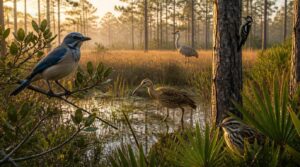
Florida’s native birds tell a story found nowhere else on the map, shaped by scrub, swamp, and old-growth pine that once covered the peninsula. You’ll meet species that evolved right here, adapting to conditions as particular as the land itself.
Among these homegrown natives, the flamboyant pink birds found in Florida add an unmistakable splash of color to the state’s wetlands and coastlines.
Here are five that show just how distinct Florida’s original bird life really is.
Florida Scrub-Jay
The Florida Scrub-Jay (Aphelocoma coerulescens), Florida’s only endemic bird species, has declined over 90% as scrub habitat vanishes. These jays live in cooperative family groups, with helpers feeding chicks alongside breeders. Their signature acorn caching behavior stores food across territories. Since scrub requires prescribed fire benefits to stay open, and habitat fragmentation impacts isolate populations, scrub habitat management remains essential to this special native bird species’ survival.
Florida’s only endemic bird, the scrub-jay, has declined over 90 percent as fire-dependent scrub habitat disappears
As a key seed disperser role, they help maintain oak regeneration in their habitat.
Wood Stork
Wood Stork (Mycteria americana), the only stork species breeding in the U.S., wades through Florida’s shallow marshes on dark legs, its bald gray head unmistakable among native bird species.
Wood storks rely on tactile foraging, snapping their bills shut on fish sensed rather than seen—a survival skill tied directly to wetland habitat health and successful stork nesting colonies each breeding season.
Florida Mottled Duck
Mottled Duck (Anas fulvigula fulvigula), Florida’s only non-migratory dabbling duck, wears buffy brown plumage with an olive-to-yellow bill marked by a telltale black gape spot.
Nesting in dense marsh grasses, it forages by tipping into shallow water for seeds and invertebrates.
Sadly, hybridization with Mallards threatens its genetic identity, making this duck a key indicator of wetland health.
Anhinga
Anhinga (Anhinga anhinga), often called the "snakebird" for its serpentine underwater hunting style, spears fish with a dagger-like bill while swimming nearly submerged.
Lacking waterproof feathers, it perches with wings spread wide, drying glassy, silvered plumage in the sun.
Nesting near still wetland waters, this striking native reveals just how ingeniously Florida’s birds adapt to aquatic life.
Red-cockaded Woodpecker
Red-cockaded Woodpecker (Picoides borealis) is a cavity excavation specialist, chiseling nests into living longleaf pines and defending them with sticky resin well defense against snakes.
- Family groups with helpers raise young cooperatively
- Fire-maintained pine ecology sustains foraging grounds
- Cavities take years to complete
This endangered species depends entirely on old-growth longleaf pine ecology and active fire regime management—proof that healthy forests mean healthy birds.
Wetland and Water Birds in Florida
Florida’s marshes, sloughs, and cypress swamps hold some of the state’s most striking bird life, each species shaped by the shallow water it calls home.
Among these wetland residents, the osprey’s remarkable comeback from near-extinction stands out as a testament to decades of dedicated conservation work.
You’ll find bills built for probing, filtering, and cracking snails, along with feathers adapted for everything from soaring to sunbathing. Here are five wetland and water birds worth knowing before your next trip out to the swamp.
White Ibis
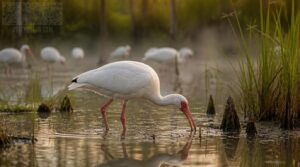
Picture a marsh full of snow-white bodies dipping curved pink bills into the mud—that’s the White Ibis at work. This wading bird sports black wingtips, a red face, and red legs, foraging socially in flocks. Juveniles start brown, gaining white plumage over two years.
Colonial nesters in dense trees, they’ve adapted well to urban wetlands, making them useful indicators of environmental health.
Roseate Spoonbill
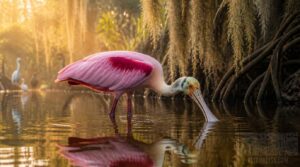
Roseate Spoonbill (Platalea ajaja) turns any mangrove lagoon into a flash of color, its spatulate bill sweeping side to side to detect prey by touch.
- Pink body, crimson shoulders
- Bare greenish-yellow head
- Colony nester over water
- Estuarine, mangrove habitat
Juveniles dull pink, brightening with age—proof that wetland foraging tactics shape one of Florida’s most photogenic wetland ecosystems residents.
Purple Gallinule
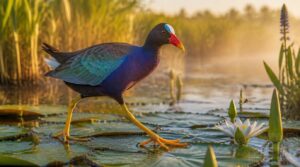
Purple Gallinule (Porphyrio martinica) strides across lily pads like it owns the place, thanks to elongated yellow toes built for distributing weight on floating vegetation.
Its vivid purple plumage, blue wings, and red-and-yellow bill make identification simple, while cackling calls announce territory in dense marsh vegetation.
You’ll spot it nesting low over water, anchored among reeds—a true wetland specialist.
Wood Duck
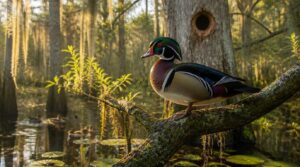
Wood Duck (Aix sponsa) ranks among North America’s most stunning waterfowl, males flaunting iridescent green and purple crests against chestnut breasts.
Nesting cavities up to 60 feet high, lined with debris for concealment, protect clutches of 6-14 eggs. Ducklings leap fearlessly to reach water below.
Wooded swamps and slow streams sustain them, with acorns and aquatic plants rounding out seasonal diets.
Snail Kite
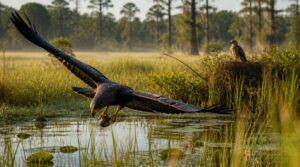
Snail Kite (Rostrhamus sociabilis) showcases extreme dietary specialization, its deeply hooked bill built solely for extracting apple snails from their shells without ever touching the meat inside.
Slate-gray males and streaked brown females patrol Florida’s sawgrass marshes on broad, gliding wings, nesting communally in low shrubs where cooperative care raises one to five eggs per clutch—true wetland species mastery.
Coastal and Shoreline Birds in Florida
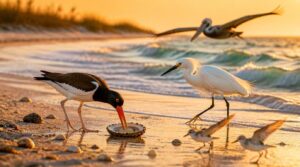
Florida’s coastline stretches over a thousand miles, and where the sand meets the surf, you’ll find some of the state’s most fascinating birds at work. These species have adapted in astonishing ways, from specialized bills to daring feeding techniques, letting them thrive along beaches and tidal flats.
Here are five coastal and shoreline birds worth knowing on your next trip to the water’s edge.
Brown Pelican
A plunge-diving spectacle, Pelecanus occidentalis drops from 60 feet, striking fish with its 9-inch bill before its throat pouch drains water on the surface.
You’ll spot adults by their white-headed, brown-bodied frame and 6-foot-7 wingspan along Florida’s estuaries. Juveniles wear mottled brown until maturing.
Watch closely: these coastal specialists forage cooperatively, herding schooling fish in coordinated groups near nesting colonies.
American White Pelican
American White Pelican (Pelecanus erythrorhynchos) trades the Brown Pelican’s dramatic dives for cooperative fishing tactics, herding fish into shallows using its massive throat pouch and 9.5-foot wingspan.
Juvenile plumage changes from grayish to bright white with age. Wintering habitat needs draw flocks to Florida’s lakes and estuaries, where breeding island protection safeguards nesting colonies from disturbance—essential for this astonishing species’ survival.
Black Skimmer
Black Skimmer (Rynchops niger) showcases evolution’s ingenuity: its elongated lower mandible slices through water while flying low, snapping shut the instant it senses fish.
Feeding peaks at dawn and dusk along tidal lagoons. Colonial nesting on sparse, sandy beaches leaves chicks vulnerable to human disturbance and predators—making protected coastal zones essential for these strikingly patterned shorebirds’ survival across Florida’s estuaries.
American Oystercatcher
American Oystercatcher (Haematopus palliatus) trades the skimmer’s aerial slicing for brute mechanics, using its bright orange bill to pry or hammer open oysters, clams, and mussels along tidal flats.
Ground nests on open beaches make chicks vulnerable, though they’re precocial and mobile within hours. Protecting undisturbed shoreline habitat remains essential for these boldly patterned shorebirds’ continued success across Florida’s coasts.
Sanderling
Sanderling (Calidris alba) epitomizes wave chasing behavior, sprinting the tideline on stout black legs to probe wet sand for crustaceans.
- Pale nonbreeding plumage
- Bold white wing stripe
- Rapid leg cycling
- Reddish breeding-season head
Breeding across Arctic tundra, these migratory shorebirds complete astonishing long-distance journeys, making them essential subjects for any serious bird identification guide.
Florida Raptors and Birds of Prey
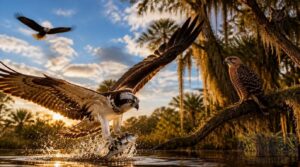
Look skyward in Florida and you’ll likely catch a raptor at work, wings set for hunting rather than wading. These birds command their territory through sheer skill, whether that means a talon-first plunge or a silent glide through the trees.
Here are five of the state’s most impressive hunters, each with its own hard-earned reputation.
Bald Eagle
Bald Eagle (Haliaeetus leucocephalus), our national symbol, sports a white head and tail against a dark brown body—unmistakable among Florida’s avian predators.
Adults construct massive nests, reused and enlarged yearly, in tall trees near water. Juveniles show mottled brown plumage until age four or five.
Beyond hunting fish with powerful talons, these impressive raptors practice kleptoparasitism, stealing prey outright from other predatory birds.
Osprey
Osprey (Pandion haliaetus), an impressive raptor found on every continent except Antarctica, hunts through wonderful feet-first plunges into fish-rich waters.
Reversible outer toes and barbed talon spicules grip slippery prey, while closing nostrils prevent water inhalation mid-dive.
Consider their hunting toolkit:
- Binocular vision for precise distance judgment
- Hovering flight before the plunge
- Nest reuse atop dead trees or platforms
- Site fidelity across breeding seasons
Peregrine Falcon
Peregrine Falcon (Falco peregrinus), among the fastest predatory birds on Earth, executes high-speed stoops exceeding 200 mph to strike prey mid-flight.
Astonishing hunting vision and specialized facial feathers aid pursuit, while reverse dimorphism gives females greater size than males.
Once devastated by DDT, this impressive raptor now thrives through DDT recovery and increasing urban nesting—rewarding patient wildlife observation and sharp bird identification skills.
Red-shouldered Hawk
Red-shouldered Hawk (Buteo lineatus) haunts wooded swamps and bottomlands, its sharp kee-ah call announcing territory long before you spot those rust-colored shoulders.
Perched motionless along wetland edges, it launches sudden strikes on frogs, snakes, and small mammals—a hunting style rewarding patient wildlife observation.
Nesting high in mature canopy near water, these striking raptors rank among Florida’s most reliably vocal predatory birds, their banded tails flashing through forest gaps.
Eastern Screech-Owl
Eastern Screech-Owl (Megascops asio) proves that mastering nocturnal vocalization patterns—that eerie whinnying trill—matters more than size when hunting Florida’s dusk.
- Gray vs red morphs melt into bark and foliage
- Nest cavities include old woodpecker holes, boxes, even porch columns
- Perched hunters ambush insects, crayfish, and small vertebrates seasonally
Watch any wooded backyard at dusk; you’re likely sharing space with this remarkably adaptable predator.
Common Backyard Birds in Florida
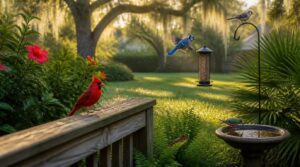
You don’t need a wetland or a coastline to spot something special in Florida—your own backyard will do just fine. From your porch or patio, you can watch five species that bring color, song, and personality right to your doorstep. Here’s what to look and listen for.
Northern Mockingbird
Northern Mockingbird (Mimus polyglottos), Florida’s official state bird, reveals its vocal mimicry abilities through 39 distinct songs and 50 call notes, often performed nocturnally. Juvenile song learning continues weeks post-fledging, as young birds absorb neighborhood melodies from attentive adults.
This slender gray species thrives via urban habitat adaptation, nesting in dense suburban shrubs. Omnivorous diet habits sustain year-round residency, while nesting defense strategies turn territorial parents fiercely protective.
Northern Cardinal
Cardinal (Cardinalis cardinalis) males flaunt carotenoid-derived red plumage, offset by black facial skin, while raising a signaling crest that broadcasts alertness to nearby birds.
Their thick, conical bills excel at seed crushing—sunflower seeds especially—making backyard foraging habits easy to spot near feeders.
Listen for territorial song patterns: clear, whistled phrases persisting year-round across Florida’s thickets, hedgerows, and residential edges.
Blue Jay
Jay (Cyanocitta cristata) swaps the cardinal’s fiery plumage for structural blue—no pigment involved, just light-scattering feather architecture.
This corvid’s impressive intelligence shines through hawk-call mimicry, scaring off rivals, and diligent seed caching, where spatial memory guides retrieval of hidden nuts.
Watch for bold black necklace markings and an omnivorous diet spanning insects, acorns, and the occasional egg.
Painted Bunting
Painted Bunting (Passerina ciris) trades the jay’s structural blue for genuine pigment-based riot: males flaunt blue heads, red underparts, and green backs in true rainbow fashion.
- Territorial males defend several acres via song and aerial displays
- Females nest low in dense shrubs, 3–9 feet up
- Diet shifts seasonally—millet in winter, insects come breeding season
- Eastern and western populations migrate along distinct routes to Central America
Carolina Wren
Rounding out our woodland songsters is the Carolina Wren (Thryothorus ludovicianus), whose cinnamon plumage and bold white eyebrow stripe make it a rewarding entry in any bird identification guide.
Its rollicking teakettle song patterns ring from brush piles, while relentless insectivore foraging habits and careful nesting site selection in dense shrubs prove this bird’s impressive backyard habitat suitability—one of Florida’s most endearing avian residents.
Frequently Asked Questions (FAQs)
What type of birds do they have in Florida?
Florida’s skies are a living kaleidoscope, stitching wetlands to shoreline to backyard. You’ll find avian habitat diversity spanning scrub-jays, storks, pelicans, and raptors—each species shaped by unique beak adaptations and seasonal migration patterns across the peninsula’s varied ecosystems.
How do I identify a bird I found?
Start by checking the bill shape and overall silhouette, then note plumage colors and behavior. Snap photos, record calls, and run them through Merlin Bird ID—matching feather patterns and wing shape against Florida’s resident species narrows things down fast.
What is the most aggressive bird in Florida?
Meet the Florida Scrub-Jay (Aphelocoma coerulescens), your fiercest territorial nester—dive-bombing intruders near breeding sites.
Ospreys and Bald Eagles shriek and strike defensively too, showcasing predator aggression levels rooted in protecting nests, not innate hostility toward you.
How many types of birds are there in Florida?
Boasting a bounty of biodiversity, the state’s documented avian species reach roughly 545, spanning resident and migrant populations.
This species diversity reflects thriving Florida ecosystems—from scrub to shoreline—supporting native wildlife across dramatically varied regional habitats and migratory corridors.
When is the best time for birdwatching?
Timing is everything: dawn chorus hours and spring migration (late March–mid-May) deliver peak activity, as cool mornings and warbler waves through Florida’s flyways create astonishing viewing windows for dedicated birding enthusiasts.
What threats face Floridas endangered bird species?
Like Icarus flying too close to the sun, Florida’s endangered birds face mounting peril: habitat loss claims 90% of native scrub, while climate change, sea-level rise, water pollution, and human disturbance squeeze survival across increasingly fragmented wetland ecosystems.
How do hurricanes affect Florida bird populations?
Storm surges destroy nesting sites and flood wetlands, displacing wading birds. Habitat loss impacts disrupt migratory patterns, while food source shifts follow saltwater intrusion.
Recovery hinges on population recovery trends, vegetation regrowth, and ongoing wildlife conservation efforts supporting Florida’s fragile environmental diversity.
Which Florida birds are best for photography?
The camera never lies, yet Florida’s birds practically pose for it.
Roseate Spoonbills flash vibrant pink plumage, Wood Storks silhouette against dawn wetlands, and Anhingas spread wings for dramatic light—rewarding patient photographers chasing that perfect color contrast shot.
What permits are needed for bird research?
Consider it your passport into Florida’s avian world: you’ll need FWC state agency authorization plus federal permits under migratory bird laws, with additional endangered species permits and animal welfare protocols required for banding, handling, or studying threatened populations.
What are the rarest birds in Florida?
Picture a dry prairie at dawn, silent but for a single sparrow’s buzzy trill—one of fewer than 50 left. The Florida Grasshopper Sparrow, Snail Kite, and Florida Scrub-Jay rank among the rarest, each clinging to vanishing habitat.
Conclusion
Scrub-jays scratching palmetto scrub, spoonbills sweeping tidal flats, falcons stooping through coastal wind—each species writes its own chapter in Florida’s ecological story.
You’ve now walked through 25 types of birds in Florida spanning wetland, shoreline, backyard, and sky. That knowledge is a compass, not a checklist. Carry your binoculars into any marsh at dusk, and you’ll recognize silhouettes that once seemed like strangers. Florida’s birds aren’t just scenery; they’re teachers, if you’re willing to watch closely and listen.