This site is supported by our readers. We may earn a commission, at no cost to you, if you purchase through links.
Bluebirds won’t nest in just any cavity you mount on a pole. These selective cavity-nesters require specific interior dimensions, precise entry hole sizes, and construction details that match their behavioral needs. A poorly designed house might sit empty year after year while bluebirds choose natural cavities or even inappropriate nest sites nearby.
Understanding proven bird house plans for bluebirds transforms your backyard into prime nesting habitat, giving these stunning birds exactly what they need to raise healthy broods. The difference between a decorative lawn ornament and a functional bluebird home comes down to measurements, materials, and strategic design choices that accommodate their unique nesting behaviors.
Table Of Contents
- Key Takeaways
- Essential Bluebird House Design Requirements
- Choosing The Best Materials for Bluebird Houses
- Step-by-Step Bluebird House Building Guide
- Bluebird House Placement and Installation Tips
- Maintaining and Monitoring Bluebird Houses
- Top Bluebird House Products for Easy Setup
- Frequently Asked Questions (FAQs)
- What kind of birdhouse do bluebirds prefer?
- How big should a birdhouse be for a bluebird?
- What is the best design for a bluebird house?
- How do you make a simple bluebird house?
- What color should I paint my bluebird house?
- When is bluebird nesting season timing?
- How often should I clean bluebird houses?
- Can other birds use bluebird houses?
- What attracts bluebirds to my yard?
- What colors should I paint my bluebird house?
- Conclusion
Key Takeaways
- Precise interior dimensions, entry hole size, and construction details are essential for creating a bluebird house that attracts and supports successful nesting.
- Use weather-resistant lumber like cedar or pine, corrosion-proof hardware, and bird-safe sealants to ensure the house lasts multiple seasons and keeps occupants safe.
- Proper placement—at 5 to 6 feet high on a smooth metal pole with predator guards in open, grassy areas facing north or east—increases the likelihood bluebirds will use your nest box.
- Ongoing maintenance, including regular cleaning, structural inspections, and monitoring during nesting season, is crucial for the continued health and safety of bluebird families.
Essential Bluebird House Design Requirements
Building a successful bluebird house starts with getting the fundamentals right, and that means precision in your measurements and materials. Eastern Bluebirds won’t settle for just any box—they need specific dimensions, proper ventilation, and thoughtfully placed entry holes to feel safe and raise their young.
Start with a solid design template, and you can explore unique bird houses for bluebirds that meet both their instinctive needs and your backyard’s aesthetic.
Eastern Bluebirds demand precision-built houses with exact dimensions, proper ventilation, and carefully positioned entry holes to nest successfully
Let’s break down the essential design requirements that will turn your backyard into prime bluebird real estate.
Optimal Dimensions for Bluebird Houses
You’ll want your bluebird nest box to follow proven birdhouse plans that reflect species-specific needs. Proper birdhouse design ensures successful nesting depth and adequate floor space for broods to thrive.
- Interior floor space: 4 by 4 inches minimum, with 12-inch vertical height from floor to roof
- Nesting depth: 4 to 5 inches provides comfortable brood-rearing conditions
- Roof angle: Sloped design with 1 to 2-inch overhang sheds rain and protects the entry hole
For guidance on ideal materials, roof pitch, and ventilation, see these bluebird house design tips.
Entry Hole Size and Placement
After establishing proper interior dimensions, your hole diameter determines which species you’ll attract. Cut a 1⅛ to 1¼ inch circular opening to accommodate bluebirds while excluding larger competitors.
Position this entry 6 to 10 inches above the floor—ideally at the two-thirds mark—to balance nest access with predator guard protection. Center the hole on your front panel for stable flight paths and bird safety.
Roof and Floor Construction Details
Once you’ve placed the entry hole, focus on roof pitch and floor drainage to keep your bluebird house plans functional year-round. A 10 to 15 degree slope ensures proper water shedding without compromising structural integrity during birdhouse construction.
Secure your roof with corrosion-resistant fasteners that won’t obstruct cleaning access. Add four to five drainage holes in the floor—³/8 to ½ inch diameter—so moisture doesn’t accumulate and threaten nesting success.
Importance of Rough Interior Surfaces
Right alongside drainage holes, your birdhouse construction must include a textured interior that lets fledglings climb out safely. Surface texture anchors nesting materials, reduces moisture buildup, and stabilizes the cavity microclimate.
Consider these interior durability benefits when building birdhouses:
- Coarse walls improve bird grip for nest cup formation
- Irregular surfaces dry faster after rain
- Textured panels discourage slick mold growth
Rough panels turn your nest box into a functional bluebird house plans success.
Choosing The Best Materials for Bluebird Houses

The materials you choose for your bluebird house directly impact its durability, safety, and effectiveness in attracting nesting birds. Weather-resistant lumber provides the foundation, but you’ll also need to select appropriate fasteners and protective finishes that won’t harm your feathered residents.
Understanding these material choices ensures you build a nest box that benefits bluebirds for multiple breeding seasons while maintaining a safe, comfortable environment.
Recommended Wood Types and Their Benefits
Your bluebird nest box requires lumber that balances wood durability with workability. Pine uses include affordable construction with medium density surfaces, while cedar benefits extend to natural decay resistance and insect protection with minimal upkeep. Softwood options like spruce, fir, and hemlock deliver dimensional stability and structural strength for birdhouse materials.
When choosing your lumber, consider how proper birdhouse placement can maximize the lifespan of naturally rot-resistant woods like cedar in outdoor environments.
Choose sustainable lumber with low toxicity to guarantee safe, long-lasting DIY birdhouse plans. For more guidance on selecting the best wood, it’s useful to review.
Safe Hardware and Fasteners
When building bluebird houses, you need fastener materials that won’t fail when moisture strikes. Your best choices include stainless steel or galvanized exterior screws in #8 gauge, 1 to 1.5 inches long, offering exceptional corrosion resistance over multiple nesting seasons.
For lasting DIY birdhouse plans:
- Select stainless or galvanized fasteners with weatherproof coatings
- Pre-drill pilot holes to prevent splitting around entry holes
- Apply thread locking compounds to resist wind vibration
- Use proper screw sizing to avoid overdriving thin panels
Weatherproofing and Sealants
For lasting weather resistance, you’ll want silicone or polyurethane sealants on roof and bottom drainage areas of your nest box construction. These sealant types maintain elastic recovery through wood expansion, preventing moisture control failures at critical joint sealing points.
Apply continuous beads along ventilation and front wall edges in your birdhouse plans, ensuring bird house designs stay dry without blocking essential airflow for healthy broods.
Step-by-Step Bluebird House Building Guide
Building a bluebird house requires careful attention to measurements, proper assembly techniques, and functional design elements that support nesting success. You’ll need to follow precise cutting specifications, create adequate ventilation and drainage systems, and verify all components fit together securely to withstand seasonal weather conditions.
The following steps will guide you through the construction process, from preparing your lumber panels to completing the final safety inspections that make your nest box ready for occupancy.
Cutting and Assembling The Panels
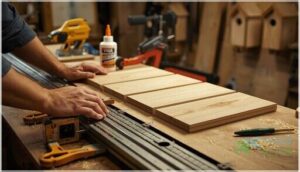
When precision matters most, your bluebird house plans start with cutting panels square within plus or minus 1/16 inch to guarantee tight, weather-resistant joints. Use a sharp crosscut saw or track saw to prevent tearout on softer wood species like cedar or cypress. Before glue up, mill edge boards flat and align wood grain direction to minimize warping in your nest box panels.
- Draw layout lines on panels to optimize yield and reduce waste during cutting
- Apply thin, even PVA glue layers to faces, wiping excess within 5 minutes
- Use clamping cauls during panel pressing to maintain flat, uniform surfaces
- Verify edge jointing accuracy with a combination square before final assembly
Creating Ventilation and Drainage
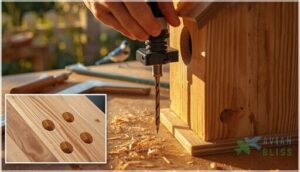
Without proper airflow management, your nest box becomes a heat trap that jeopardizes egg incubation and chick survival. Drill four 6 to 8 mm ventilation holes near the top of each side wall to promote cross ventilation while keeping drafts above nest height.
On the bottom floor, create four drainage systems using 3/8 inch holes positioned near the corners to prevent moisture control issues without disturbing nesting material.
Securing The Roof and Front Panel
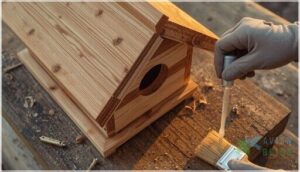
Your roof overhang should extend at least 1 inch beyond the front wall to shed rain away from the entrance—critical birdhouse design principles that protect nesting bluebirds.
Secure the roof and bottom drainage panels using corrosion-resistant screws in a staggered pattern for structural reinforcement, then apply weatherproofing sealant along all joints.
Install hinges on your nest box roof for maintenance access without compromising ventilation and front wall integrity.
Finishing Touches and Safety Checks
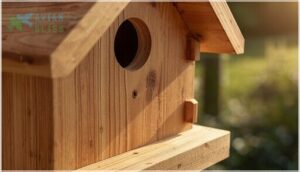
Before you mount your nest box, confirm your ventilation systems include slots 2 inches below the roof line and drainage solutions with evenly spaced 1/8-inch floor holes.
Apply bird-safe, water-based sealant around joints while keeping it away from the entrance hole—this weatherproofing step protects against moisture without compromising safety features that support successful bluebird house plans and predator control.
Bluebird House Placement and Installation Tips
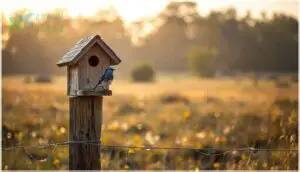
You’ve built a bluebird house that meets every specification, but your success hinges entirely on where and how you mount it. Proper placement transforms a well-constructed nest box from a backyard decoration into a functional breeding territory that bluebirds will actually use.
Let’s examine the critical installation factors that will boost your chances of attracting these cavity-nesting songbirds to your property.
Ideal Mounting Height and Pole Selection
You’ll want to position your bluebird house plans at 5 to 6 feet above ground to balance predator control with accessibility for annual maintenance. When selecting pole material and ensuring stability features, consider these critical elements:
- Use 1-inch smooth metal conduit, 7 to 9 feet long, for enhanced wind resistance and climbing deterrence
- Install predator guards or baffles above the mounting height to block raccoons and cats
- Anchor poles 2 feet deep with concrete footings sized to local frost depth
- Choose weather-resistant materials with corrosion protection for coastal installations
Best Locations for Bluebird Attraction
Once your pole stands firm, focus on site selection that mirrors bluebird natural preferences. Open ground with scattered trees, field edges along meadows, and farmland orchards create ideal foraging zones within 100 to 300 meters of your nest box placement.
Keep predator zones clear by avoiding dense brush within 100 feet, and position water proximity features like birdbaths 20 to 40 feet away to support backyard birding tips and bird-friendly landscaping that consistently attracts bluebirds.
Facing Direction and Sun Exposure
After establishing your nest box placement in open habitat, orient your bluebird house plans toward the north or northeast to minimize harsh afternoon heat during nesting box installation. This seasonal orientation balances morning warmth with thermal management, preventing sun exposure effects that raise interior temps and stress fledglings.
In cooler climates, a gentle east-facing angle aids bluebird nestbox construction by capturing early light without overheating your mounting and placement strategy.
Predator Deterrence Strategies
Beyond proper placement, you’ll need layered defenses against intrusion. Start with these proven predator control for bluebirds tactics:
- Install a stovepipe predator baffle below the box to block climbing mammals and snake deterrents
- Add nest box predator guards with 1.5-inch entrance holes
- Apply reflective tape around mounting poles as visual barriers
- Clear ground cover for better nest camouflage visibility
- Monitor weekly to adjust house sparrow control measures
Maintaining and Monitoring Bluebird Houses
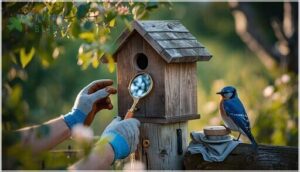
Your bluebird house won’t succeed without proper upkeep, which means you’ll need to establish a maintenance routine that protects both the structure and its occupants.
Regular monitoring allows you to track nesting progress, identify potential problems before they escalate, and make certain each breeding season ends successfully.
The following practices will help you maintain most favorable conditions for bluebirds while preventing common issues that compromise nest box integrity.
Annual Cleaning and Inspection
Once your bluebird house plans become a finished nest box, cleaning schedules should be set for late summer through February, timing nest removal after broods fledge but before spring nesting begins.
During annual inspections, follow safety precautions by wearing gloves when handling old material, then apply disinfection methods using a 1:10 bleach solution.
Your inspection checklists must confirm structural integrity, drainage hole function, and ventilation opening clarity across all nesting boxes.
Preventing Moisture and Pest Issues
Moisture control in your nest box begins with keeping interior humidity below 50 percent, slowing mold growth and deterring pests through proper ventilation systems and drainage solutions.
When building bluebird houses, apply non-toxic water-repellent sealants to exterior surfaces and include drainage holes at the base.
Wood treatment using rot-resistant cedar resists fungal growth, while pest management through copper mesh around openings maintains pest deterrence without blocking airflow in nesting boxes.
Monitoring Bluebird Nesting Activity
You’ll want to check your nest box once weekly during nesting season, tracking bluebird behavior and recording egg counts, hatch dates, and fledgling success for bluebird conservation. Proper nest box management means monitoring bluebird nest boxes in calm weather while documenting nesting patterns:
- Record adult presence and feeding activity during each visit
- Track key dates from first egg to fledging for accurate nesting behavior data
- Note predator control needs or territorial interactions affecting bluebird nesting behavior
Top Bluebird House Products for Easy Setup
If you’d rather skip the sawdust and head straight to a ready-made solution, several commercially available bluebird houses meet the essential design specifications outlined in this guide.
These pre-built options incorporate proper dimensions, ventilation, drainage, and construction materials that support successful bluebird nesting.
Each product listed below has been selected for its adherence to proven bluebird housing standards and ease of installation.
1. Woodlink Bluebird House Natural Wood
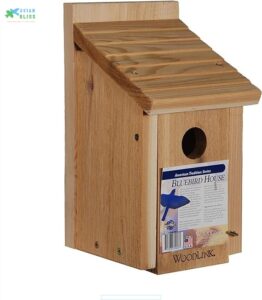
If you’re ready to skip the construction phase, the Woodlink Bluebird House offers a well-designed alternative built from kiln-dried inland red cedar. This model features the critical 1.5-inch entrance hole positioned at the proper height, paired with ventilation slits at the rear corners to regulate interior temperatures during warm periods.
The front panel lifts for seasonal nest removal, secured by a simple latch mechanism, while the pitched roof efficiently channels rainfall away from the cavity. At 7.13 x 6.25 x 11.75 inches, it provides adequate interior space for successful bluebird nesting.
| Best For | Backyard birders who want a ready-to-hang bluebird house with proper dimensions and easy maintenance access. |
|---|---|
| Material | Inland Red Cedar |
| Construction | Kiln Dried Wood |
| Target Species | Eastern Bluebirds |
| Cleaning Access | Easy Open Front |
| Ventilation | Air Gap and Drain Hole |
| Weight | 16 ounces |
| Additional Features |
|
- Features the correct 1.5-inch entrance hole and proper ventilation to attract eastern bluebirds
- Front panel opens easily for seasonal cleaning and nest monitoring
- Made from durable kiln-dried red cedar that weathers well outdoors
- Door latch may leave gaps that could allow drafts or predator access
- Lacks a predator guard, so larger birds or animals might intrude without modifications
- Priced higher than some comparable models without including a landing perch
2. Stovall Western Bluebird House
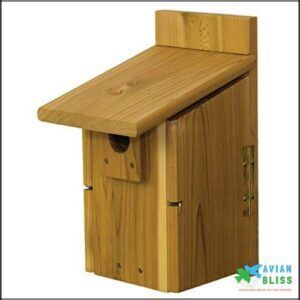
For Western and Mountain bluebirds, the Stovall Western Bluebird House provides specialized cavity dimensions, featuring a 15-inch depth and a 1.5625-inch entrance hole.
Its all-cedar construction includes dual side access doors with twist-pin mechanisms, enabling you to monitor nesting progress through the right viewing panel while cleaning through the left panel without disturbing active broods.
The design incorporates hand-sanded edges to eliminate snag hazards, while corrosion-resistant fasteners ensure structural integrity across multiple seasons in exposed conditions.
| Best For | Birdwatchers who want to attract Western or Mountain bluebirds and need a durable, easy-to-maintain nesting box with viewing access. |
|---|---|
| Material | Cedar Wood |
| Construction | Hand Assembled with Stainless Steel Screws |
| Target Species | Mountain and Western Bluebirds |
| Cleaning Access | Both Sides Open |
| Ventilation | Standard Ventilation |
| Weight | 5 Pounds |
| Additional Features |
|
- Dual-access design lets you check on nests through the viewing window without disturbing birds during cleaning
- Hand-sanded cedar construction with rust-proof screws holds up well through multiple nesting seasons
- Sized specifically for Western and Mountain bluebirds with the right entrance hole diameter to keep larger birds out
- No built-in hanging system means you’ll need to buy a separate pole or mounting hardware
- Pricey at around $85 compared to basic bluebird houses
- Ships without assembly instructions, so you’ll need to figure out installation on your own
3. Stovall Bluebird Wood House
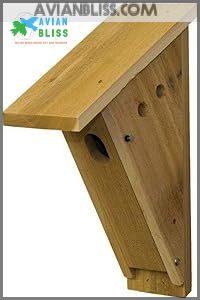
The Stovall Bluebird Wood House balances accessibility with species-appropriate cavity dimensions, incorporating a 1 9/16-inch entrance hole that accommodates Eastern Bluebirds while reducing competitive pressure from European Starlings.
You’ll find the hinged side door simplifies nest checks and seasonal cleaning, while vertical air vents along both sides maintain cross-ventilation to prevent humidity buildup during incubation.
The slanted overhang roof sheds precipitation effectively, and the integrated viewing window lets you monitor brooding activity without opening the main cavity, minimizing disturbance to nesting pairs.
| Best For | Backyard birders who want a durable, well-ventilated bluebird house with easy monitoring features and don’t mind making minor modifications for optimal predator protection. |
|---|---|
| Material | Western Red Cedar |
| Construction | Hand-Sanded with Stainless Steel Hardware |
| Target Species | Bluebirds |
| Cleaning Access | Standard Access |
| Ventilation | Standard Ventilation |
| Weight | 5 Pounds |
| Additional Features |
|
- Hand-crafted from western red cedar with rust-resistant hardware for long-lasting outdoor durability
- Hinged side door and viewing window make nest monitoring and seasonal cleaning simple without disturbing birds
- Slanted roof and cross-ventilation design keep nests dry and prevent dangerous humidity buildup
- Entrance hole may be too large for Eastern Bluebirds and could require a predator guard or reducer ring
- Some users report quality control issues like misaligned drilling or loose panels
- Doesn’t fully prevent sparrows or other predators from attempting to nest or attack
Frequently Asked Questions (FAQs)
What kind of birdhouse do bluebirds prefer?
Bluebirds prefer a snug, cavity-style nest box measuring 5 by 5 inches at the floor with a 5-inch entrance hole positioned 6 to 7 inches above the base, ensuring proper protection and ventilation.
How big should a birdhouse be for a bluebird?
You’ll want an interior floor space of at least 4 inches by 4 inches with a height of around 12 inches inside the box to accommodate nesting while limiting access to larger species.
What is the best design for a bluebird house?
What makes a bluebird house truly effective? You’ll need a 5-inch entry hole positioned 6-10 inches from the floor, a sloped roof with ventilation gaps, drainage holes, and rough interior surfaces for climbing fledglings.
How do you make a simple bluebird house?
You can build a simple bluebird house by cutting cedar panels to create a 4×4-inch floor, 12-inch height, adding a 5-inch entrance hole, then assembling with corrosion-resistant screws.
What color should I paint my bluebird house?
The secret weapon in your bluebird sanctuary? Light blue, white, or soft earth tones that reflect sunlight and keep interiors cool.
These colors also blend seamlessly into your habitat while deterring predators from spotting vulnerable nests.
When is bluebird nesting season timing?
Bluebirds usually begin nesting in spring, with southern populations starting in February and northern areas in March or April.
Most birds complete their first clutch between March and May, often raising two broods annually.
How often should I clean bluebird houses?
You should clean bluebird houses at least twice per year: once after the brood fledges in late summer and again in early spring before nesting begins, removing old material and reducing parasite buildup.
Can other birds use bluebird houses?
Yes, chickadees, tree swallows, tufted titmice, and house wrens often use bluebird houses. The 5-inch entrance hole excludes starlings but admits these smaller native species, though house sparrows can aggressively compete for the same cavities.
What attracts bluebirds to my yard?
You’ll draw these vibrant songbirds by offering open grassy areas with scattered perches, fresh shallow water for bathing, native berry shrubs, and properly positioned nest boxes that provide safe shelter from predators.
What colors should I paint my bluebird house?
Light colors work best—think white, pale blue, or soft gray. These tones reflect heat during summer, keeping nestlings cooler while blending naturally into the landscape without attracting predators.
Conclusion
Think of your backyard as a theater where you’ve just built the perfect stage. The bird house plans for bluebirds you’ve followed create more than shelter—they establish a foundation where generations will thrive.
Your precision with measurements, material choices, and placement transforms raw lumber into essential habitat.
Now monitor your installation regularly, maintain it diligently, and watch as bluebirds claim the space you’ve carefully prepared, validating every measurement and decision you made.