This site is supported by our readers. We may earn a commission, at no cost to you, if you purchase through links.
Bluebirds nested in a box with a hole a quarter-inch too wide will lose their eggs to starlings—every single time. That one measurement separates a thriving nest from a failed one, and most store-bought houses get it wrong.
Building your own gives you complete control over every dimension that matters. Good birdhouse plans for bluebirds account for species-specific entrance sizes, floor depth, ventilation, and predator resistance—details that work together like a system, not a checklist.
Get them right, and you’ll have bluebirds returning season after season.
Table Of Contents
- Key Takeaways
- Choose The Right Bluebird Plan
- Bluebird House Dimensions That Work
- Best Materials and Hardware
- Build a Bluebird House Step-by-Step
- Place and Maintain Bluebird Houses
- Top 3 Bluebird House Products
- Frequently Asked Questions (FAQs)
- How big should a birdhouse be for a bluebird?
- What kind of birdhouse do bluebirds prefer?
- What is the best design for a bluebird house?
- How do you make a simple bluebird house?
- What color should I paint my bluebird house?
- When is bluebird nesting season timing?
- How often should I clean bluebird houses?
- Can other birds use bluebird houses?
- What attracts bluebirds to my yard?
- What colors should I paint my bluebird house?
- Conclusion
Key Takeaways
- A quarter-inch difference in your entrance hole—1½ inches for Eastern Bluebirds—is the single detail that keeps starlings out and bluebirds coming back season after season.
- Untreated cedar is your best building material because it naturally resists rot, buffers summer heat inside the box, and stays safe for nestlings without any chemical coatings.
- Mounting your box 4–6 feet high, facing east or southeast, with a stovepipe baffle on the pole gives bluebirds the predator protection they need to actually raise a brood successfully.
- Clean the box after each brood fledges, check the nests every four to five days during the season, and you’ll turn a one-time visitor into a bird that returns to your yard every spring.
Choose The Right Bluebird Plan
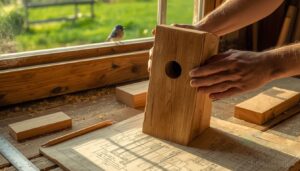
Not all birdhouses are built the same, and bluebirds are particular about where they raise their young. The plan you choose matters more than you might think — from the size of the entry hole to the type of wood.
Getting those details right starts with knowing the exact specs, so a solid reference like this guide to bluebird house dimensions can save you a lot of guesswork.
Here’s what to look at before you pick up a saw.
What Makes a Bluebird House Different
Unlike a bluebird house is built around one bird’s specific needs. Species-specific entrance dimensions — between 1½ and 1 9/16 inches — block starlings while welcoming bluebirds.
Predator-proof nesting strategies, birdhouse ventilation, cooling features, color temperature impact considerations, and bluebird house design guidelines all work together. Even proper mounting height for birdhouses and eco-friendly finishes matter more than most builders expect.
Boxes should follow the minimum 300 ft spacing guideline to reduce competition and improve nesting success.
One-board Plans Vs PVC Designs
Once you know what bluebirds need, the next question is what to build from. A one-board box cut from a single cedar picket is your fastest, most affordable option — an afternoon build with basic tools.
PVC birdhouse designs last longer without rot, but fitting pipe sections takes more steps.
For thermal regulation, wood wins: it buffers heat better than plastic in summer sun.
Eastern, Western, and Mountain Bluebird Needs
Each bluebird species has its own preferences. Eastern Bluebirds thrive in open meadows and require a 1.5-inch entrance hole. Western Bluebirds favor oak woodlands and do better with 1 9/16-inch openings.
Mountain Bluebirds—fully migratory with a strong insect diet—inhabit high alpine terrain and accept the same larger hole as their Western counterparts.
Species-specific entrance dimensions and floor size directly shape your bluebird nest box design and construction choices.
Features That Support Nesting Success
Once you’ve matched the entrance hole size to your species, the rest of the box must pull its weight as well. A deep nest cup keeps eggs safely below the opening, while smooth entry edges protect adult feathers, and a removable roof simplifies cleaning.
Good birdhouse ventilation and cooling, a moisture-wicking floor, and solid predator protection strategies ensure every nesting attempt remains secure and stable.
Bluebird House Dimensions That Work
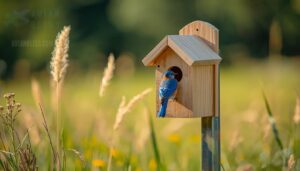
Getting the dimensions right is what separates a house bluebirds actually use from one they ignore. Every measurement has a purpose, from floor space to the height of the entry hole.
Here’s what you need to know before you cut a single board.
Ideal Floor Space and Interior Height
Getting birdhouse dimensions right is what separates a house birds actually use from one they ignore. For eastern bluebirds, a 5×5-inch floor space hits the sweet spot — enough clutch capacity to handle 4–6 eggs without crowding. Pair that with 9 inches of interior height, and you’ve nailed the space ratio.
Key nest box dimensions to remember:
- Floor area: 5×5 inches minimum
- Total height: 9–12 inches interior
- Crowding prevention: never go below 4×4 inches
Correct Entrance Hole Size by Species
Each species has its own entrance hole sweet spot, and getting it wrong invites the wrong tenants. The table below outlines species-specific entrance dimensions:
| Species | Entrance Hole Size |
|---|---|
| Eastern Bluebird | 1½" round or 1⅜"×2¼" oval |
| Western Bluebird | 1 9⁄16" round |
| Mountain Bluebird | 1 9⁄16" round |
| All Species | Smooth edges, no rough wood |
Round vs. oval holes both work—what matters is adhering to species-specific entrance dimensions. For example, a 1½" hole size blocks starlings from eastern bluebird boxes, preventing unwanted intrusion naturally.
Watch for hole wear over time. Adjusting hole wear with a reducer restores the proper fit, ensuring the right tenants move in.
Proper Entrance Height Above The Floor
From floor to hole, that distance matters more than most builders expect. Place the entrance 6–10 inches above the floor — 6–7 inches suits eastern bluebirds best. This predator buffer zone keeps raccoons and snakes from reaching nestlings, while fledgling clearance lets young birds exit cleanly.
Species height standards stay consistent: deeper boxes, mimicking natural cavities, improve nesting success noticeably.
Roof Slope and Front Overhang
A well-sloped roof is your first line of defense against rain, heat, and predators. Aim for a 15–20 degree slope angle with 2–4 inches of overhang length over the entrance — this combination maximizes water shedding while boosting predator prevention by blocking straight-down access.
Steeper pitches (25–30°) manage heavy rain better without sacrificing structural stability. Double roof birdhouse designs add an insulating air gap for heat management in bird nest boxes. Front overhangs of 3–4 inches shade the hole and suit most design variations for bluebird nest boxes.
- A steeper pitch (25–30°) manages heavy rain better without sacrificing structural stability
- Double roof birdhouse designs add an insulating air gap for heat management in bird nest boxes
- Front overhangs of 3–4 inches shade the hole and suit most design variations for bluebird nest boxes
Ventilation and Drainage Details
Fresh air and dry floors aren’t just comfort features — they’re survival features. Drill upper side vents near the roofline so heat escapes where it collects first. Small floor air gaps prevent nesting material from staying damp, ensuring critical airflow without drafts.
Add corner drainage holes to let rainwater out fast, while drip kerfs under the roof edge redirect runoff away from the structure. These features work together to eliminate standing water, a key threat to nest health.
Proper vent-drain balance ensures the box remains breathable without chilling the nest, maintaining a stable microclimate through all weather conditions.
Best Materials and Hardware

The wood and hardware you choose will make or break how long your bluebird house holds up. Cheap materials might save you a few dollars now, but they won’t survive a few seasons of rain, heat, and cold.
Here’s what actually works.
Why Cedar is a Top Choice
Cedar is hard to beat for building a bluebird house. Its natural durability comes from built-in oils that resist moisture and decay — no chemical treatment needed.
Easy handling makes cutting and assembly straightforward.
Dimensional stability keeps joints tight through rain and heat.
Cedar’s thermal insulation buffers temperature swings inside the box, while its warm, natural appearance ensures genuine aesthetic appeal for any wildlife structure.
Other Rot-resistant Wood Options
If cedar is not available, you’ve got solid alternatives. Black Locust is one of the toughest North American woods — it resists decay naturally and needs no chemical help. Bald Cypress heartwood is a longtime favorite for outdoor builds.
White Oak features a dense grain that sheds moisture well.
Accoya Wood, Heat-Treated Timber, white cedar, and hemlock all hold up nicely too.
Safe Fasteners, Hinges, and Latches
The hardware holding your box together matters more than most builders realize. Use galvanized finish nails and 1½" galvanized wood screws — they won’t rust and lose their grip after a few seasons. Stainless fasteners are even better in wet climates.
For the door hinge and locking screw, concealed hinges add tamper-proof reliability, while vibration-resistant latches and weather-seal latches keep everything snug through wind and rain.
Why to Avoid Pressure-treated Wood
Pressure-treated wood might seem durable, but it’s the wrong call for a bluebird house.
Modern treatments use copper compounds that cause chemical leaching in wet conditions — and nestling toxicity is a real risk when young birds spend weeks absorbing those chemicals through skin and air.
Copper compounds in pressure-treated wood leach chemicals that nestlings absorb through skin and air, making toxicity a real risk
Corroding fasteners, wood warping, and environmental contamination round out the reasons to skip it entirely.
Weatherproofing Without Harming Birds
Once you’ve ditched pressure-treated wood, protecting your box from rain and heat is simple — just keep it outside-only. Seal exterior surfaces with low-VOC sealants or pure tung oil, and let everything cure fully before mounting.
A rain-shedding roof with a front overhang, high vent placement, and floor drainage holes handle the rest.
The inside stays bare, safe, and ready for nesting.
Build a Bluebird House Step-by-Step
Now comes the fun part — actually building it.
The steps below walk you through everything from cutting your panels to doing a final safety check before the birds move in.
Grab your tools and let’s get started.
Cut List for Panels and Roof
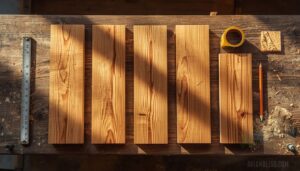
Before you pick up a saw, a solid cut list saves both time and wood. Most DIY bluebird house plans use a single 1×6-inch cedar fence board — and smart sheet layout means almost zero waste.
- Back panel: 5.5 × 16 inches
- Side panels (×2): 5.5 × 10.75 inches
- Front panel: 5.5 × 9.25 inches
- Roof panel: 5.5 × 11 inches
- Floor: 4 × 4 inches
This cutting efficiency and material yield approach gives you every piece from one 6-foot board.
Marking Pilot Holes and Entry Placement
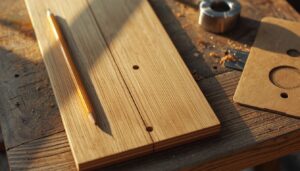
Marking your panels before drilling keeps everything true. Find the centerline of the front panel, then mark the entrance hole center 5½ to 6 inches above the bottom — that’s your placement guideline for eastern bluebirds.
Use a 1½-inch hole saw for a clean cut. A cardboard template speeds up pilot-hole spacing and alignment checks across multiple boxes, ensuring consistent results.
Assembling The Sides, Base, and Back
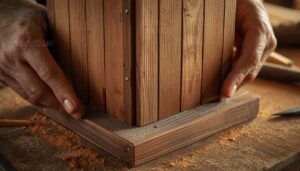
Start by attaching the floor to both side panels using galvanized finish nails—set the floor about ¼ inch above the bottom edges so water drains freely. Good base alignment methods matter here. Pre-drill pilot holes to avoid splitting your western red cedar.
- Hold sides at 90° using square joint techniques
- Drive two nails per side for fastener placement strategy
- Apply exterior glue for back panel securing
- Clamp corners briefly—clamping for squareness prevents racking
Adding The Front Door and Lock
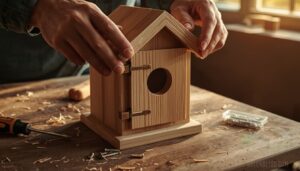
The front door is your access point for every nest check, so get it right. Position hinge screws about 1 inch below the front corners — solid Hinge Positioning keeps the door from wobbling.
Angle the top edge slightly for a Rain-Deflect Angle that sheds water naturally. Leave a Door Seal Gap of roughly ⅛ inch to ensure it swings freely.
Drive your locking screw up through the base for a secure One-Hand Latch — door opening for cleaning takes seconds.
Installing The Roof, Vents, and Drip Kerfs
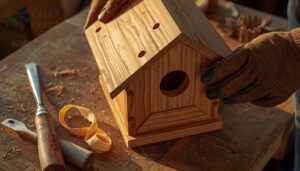
The roof does more than keep rain out — it’s your first line of defense against overheating and moisture damage. Get these four details right before you nail it down:
- Cut a drip kerf depth of about ⅛ inch along the underside edge for proper drip kerf depth that breaks water runoff
- Drill ventilation holes near the top for ridge vent alignment and heat management in bird nest boxes
- Keep vent clearance spacing open so airgap construction lets hot air escape freely
- Confirm removable roof fit allows seasonal access without gaps that compromise proper ventilation
Slope the roof toward the front and let it overhang at least one inch. That simple angle manages soffit intake sizing naturally, moving cool air in while warm air exits — no sparrow or summer heat spike stands a chance.
Final Safety and Durability Checks
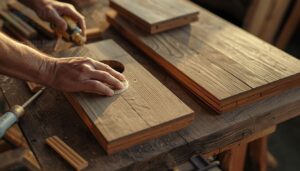
Before you hang the box, run your hands over every surface. Sand any rough edges around the entrance hole—bluebirds shouldn’t get scratched on the way in. Tighten every fastener, check weather sealing along the roof joints, and confirm ventilation integrity at each vent hole.
Reject any boards showing soft spots or warping. Good wood condition now means less maintenance later.
Tighten every fastener and ensure all structural elements are secure. Verify weather sealing and ventilation to protect against elements and ensure habitat safety.
Place and Maintain Bluebird Houses
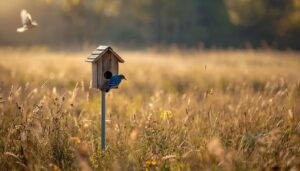
Building the box is only half the job — where you put it and how you care for it makes all the difference.
A well-placed, well-maintained house gives bluebirds a real shot at raising healthy chicks season after season.
Here’s what you need to know to get it right.
Proper Mounting Height and Pole Options
Getting the mounting height right makes a real difference. Most guidelines recommend a height between 4 and 6 feet for nest boxes, with 5 feet being the ideal standard for easy monitoring.
Your mounting pole or post options include:
- Metal pole: A galvanized conduit is durable, smooth, and ideal.
- PVC pole: Lightweight and affordable, but requires a ground anchor for stability.
- Wooden post: Works well with a metal baffle added below the box.
- Gilbertson pole system: A popular, purpose-built mounting system among serious bluebird trail managers.
- Pole baffle: Essential on any pole to prevent climbing predators.
Which Direction The Entrance Should Face
Once your pole is set, point the entrance hole east or southeast. This positioning ensures the box is gently warmed by the morning sun while avoiding the intense afternoon heat from the west. It also shields against prevailing winds and rain, preventing them from blowing directly inside.
For microclimate optimization, predator sightlines also matter. Face the opening toward open ground, allowing bluebirds to spot danger before landing and enhancing their safety.
Best Habitats for Bluebird Occupancy
Bluebirds thrive in open grasslands with short vegetation, scattered perches like fence posts or isolated trees, and high seasonal insect abundance.
They avoid dense brush where house sparrows and wrens take over. Minimal competition and a solid nest cavity supply make all the difference.
Place your box where the habitat stays open and food-rich year-round.
Box Spacing and Bluebird Trail Planning
Once your habitat is right, spacing makes or breaks a trail.
Territory Distances matter — Eastern and Western Bluebirds need about 100 yards between boxes, while Mountain Bluebirds require 200–300 yards. For creating bluebird trails for habitat enhancement, start with 5–6 boxes before expanding.
Smart Paired Box Placement means:
- Space pairs 5–15 feet apart for Bluebirds and Swallows to share
- Keep pair-to-pair distance 100–300 yards depending on species
- Follow a consistent Monitoring Schedule — weekly checks from March through August
- Use GPS Spacing Verification to map the best spacing and density of bluebird houses accurately
Predator Guards and Sparrow Deterrence
Even the best-placed box fails without solid protection in place.
| Guard Type | How It Works | Best For |
|---|---|---|
| Stovepipe Baffle | 8-inch wobbling pipe blocks climbing | Raccoons, snakes, cats |
| Noel Guard | Hardware cloth tube jabs reaching paws | Raccoons, cats |
| Sparrow Spooker | Monofilament lines alarm sparrows | House sparrow exclusion |
| Metal Hole Guard | Aluminum plate stops chewing/enlarging | Squirrels, woodpeckers, starlings |
| Entrance Depth Collar | Deep hole deters quick sparrow invasions | Sparrow prevention |
Combine a stovepipe baffle with a sparrow spooker for strong predator deterrent design and sparrow exclusion together.
Seasonal Cleaning and Nest Monitoring
Once nesting season wraps up, your fall cleaning schedule starts in late September: scrape out old nests with a putty knife, wear gloves and an N95 mask, then wipe the interior with a 10% bleach solution.
Come February, conduct spring prep checks before bluebirds return.
During the active season, monitoring frequency rules require checks every four to five days to maintain nest health and simplify fledging confirmation steps, ensuring a simple process.
Heat Management for Summer Nesting
Summer heat can turn a bluebird box into an oven, spiking temperatures past 107°F—a critical threat to eggs and nestlings. Thermal mass matters: use ¾- to 1-inch cedar for natural insulation.
To combat overheating, add reflective paint, a double roof or sun shield for shade, and side vents for airflow. These measures help regulate internal temperatures.
Top 3 Bluebird House Products
Not every builder has time to start from scratch, and that’s perfectly okay. If you’d rather skip the sawdust and go straight to hanging a box, ready-made options are worth your attention.
Here are three solid picks that meet bluebird nesting standards and hold up through the seasons.
1. Woodlink Natural Cedar Bluebird House
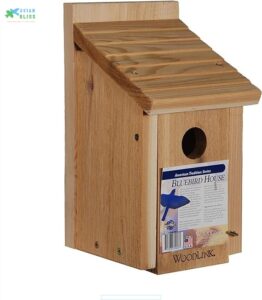
The Woodlink BB1 is a solid choice for a ready-made bluebird house designed with Eastern bluebirds in mind. Its construction from kiln-dried inland red cedar ensures natural resistance to rot, insects, and warping, eliminating the need for paint or chemicals.
The 1.5-inch entrance hole is optimally sized for Eastern bluebirds, while the slide-down front panel enables quick, tool-free cleaning.
At approximately $37, it delivers reliable construction without demanding a weekend building commitment, offering immediate, hassle-free use.
| Best For | Backyard birders who want a ready-made, low-maintenance home for Eastern, Western, or Mountain bluebirds without the hassle of building one from scratch. |
|---|---|
| Material | Kiln-dried inland red cedar |
| Hardware | Zinc-chromate screws |
| Entrance Hole | 1.5 inches |
| Target Species | Eastern, Western, Mountain bluebirds |
| Finish | Natural wood finish |
| Price | $36.77 |
| Additional Features |
|
- Built from kiln-dried inland red cedar, so it naturally resists rot, insects, and warping — no paint or chemicals needed.
- The 1.5-inch entrance hole is sized just right for bluebirds, and the slide-down front panel makes seasonal cleaning quick and tool-free.
- Rust-resistant screws (no nails) keep the box dimensionally stable over time, so it holds up season after season.
- The 1.5-inch hole can be a tight fit for some birds, and a few users have reported sparrows getting stuck trying to enter.
- Mounting can be tricky — the internal screw placement doesn’t always play nice with thin posts, so you may need extra hardware.
- A handful of buyers have noticed some rain getting in around the back panel, which means a little extra sealing might be needed for long-term weatherproofing.
2. Stovall Western Bluebird Nesting Box
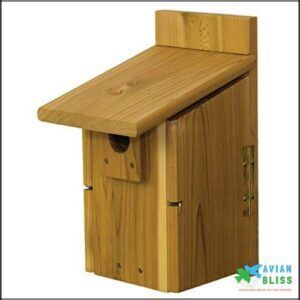
If you’re looking after Western or Mountain bluebirds, the Stovall SP2HUW is worth a close look. It’s built from hand-sanded cedar with stainless-steel and dichromate-plated screws that won’t rust through a wet season.
The 1 9/16-inch entrance hole fits the species perfectly, and the dual hinged doors make nest checks and seasonal cleanouts genuinely easy.
At 5 by 5.5 inches, the floor gives nestlings enough room to grow without crowding.
The main catch — no pre-drilled mounting holes, so you’ll need to plan your post setup ahead of time.
| Best For | Backyard birders and conservationists focused on Western or Mountain bluebird nesting success. |
|---|---|
| Material | Hand-sanded cedar |
| Hardware | Stainless-steel dichromate screws |
| Entrance Hole | 1.5 inches |
| Target Species | Mountain and Western bluebirds |
| Finish | Green painted finish |
| Price | Not listed |
| Additional Features |
|
- Hand-sanded cedar with stainless-steel hardware holds up well through wet, rough seasons
- Dual hinged doors and a viewing window make nest checks quick and easy without disturbing the birds
- Spacious 5 × 5.5 in floor gives nestlings plenty of room to develop without crowding
- No pre-drilled mounting holes means you’ll need to sort out your own hardware before installation
- Heavier and bulkier than basic boxes, so setup can be a bit of a workout
- Higher price tag, and some buyers have run into slower-than-expected shipping
3. Stovall Cedar Bluebird House
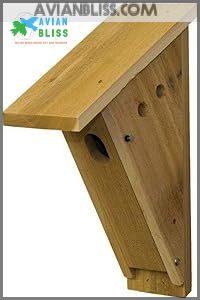
The Stovall Cedar Bluebird House is built for Eastern bluebirds and doesn’t cut corners. It’s hand-sanded in Michigan from 7/8-inch western red cedar — thick enough to insulate the nest cavity and resist rot season after season.
The 1.5-inch entrance hole is sized right for Eastern bluebirds, and the side door swings open fully for easy cleaning.
Stainless-steel and dichromate-plated hardware keeps joints tight and rust-free.
At $65.60, it’s a solid, ready-to-mount option if you want quality without building from scratch.
| Best For | Backyard birders who want a ready-made, durable bluebird house without the hassle of building one from scratch. |
|---|---|
| Material | Western red cedar |
| Hardware | Stainless-steel dichromate hardware |
| Entrance Hole | Oversized (guard recommended) |
| Target Species | Eastern bluebirds |
| Finish | Natural wood finish |
| Price | $65.60 |
| Additional Features |
|
- Hand-sanded western red cedar looks great and holds up well through rain, heat, and cold
- Stainless-steel and dichromate-plated hardware means no rust and a sturdy mount
- Side door swings open fully, so cleaning between nesting seasons is quick and easy
- The front panel doesn’t always latch securely — many owners add a hook-and-eye fastener to fix it
- The entry hole runs a bit large for bluebirds, so a predator guard or reducer plate is often worth adding
- Nothing stops sparrows or starlings from moving in without extra modifications like mesh or a predator baffle
Frequently Asked Questions (FAQs)
How big should a birdhouse be for a bluebird?
A bluebird house works best with a 4×4 to 5×5 inch floor, 8–12 inches of interior height, and a 5-inch entrance hole — snug enough to keep starlings out.
What kind of birdhouse do bluebirds prefer?
These birds prefer a simple wooden box with a 5-inch entrance hole, 4×4-inch floor, and good ventilation.
Cedar or cypress works best — its durable, natural, and stays cooler in summer heat.
What is the best design for a bluebird house?
The best design keeps things simple: a 5×5 inch floor, a 1½-inch entrance hole, good ventilation near the top, and untreated cedar wood.
Add a sloped roof with an overhang, and you’re set.
How do you make a simple bluebird house?
Roll up your sleeves — a simple bluebird house starts with one 6-foot cedar board, basic cuts for five panels, a 1½-inch entrance hole, and galvanized screws holding it all together.
What color should I paint my bluebird house?
Light colors are your best bet. White, pale blue, or light tan keep interior temperatures safe for eggs and nestlings.
Dark shades can push heat past 107°F — enough to cause serious harm.
When is bluebird nesting season timing?
Bluebirds start scouting nest sites as early as late February. By April, females are actively building.
Most pairs raise two to three broods, nesting well into August in the right conditions.
How often should I clean bluebird houses?
Think of it like changing bed sheets — the fresher, the better.
Clean your bluebird house at least once a year, ideally after each brood fledges, to keep parasites out and birds coming back.
Can other birds use bluebird houses?
Other birds can and will use bluebird houses. Tree swallows, chickadees, wrens, and even house sparrows may move in.
Regular monitoring helps guarantee bluebirds — not unwanted guests — get first dibs.
What attracts bluebirds to my yard?
Open space, short grass, and a clean water source go a long way.
Add mealworms near your yard and native berry shrubs like dogwood or elderberry, and you’ll have their attention fast.
What colors should I paint my bluebird house?
Paint your bluebird house white or light gray. Light colors reflect heat, keeping the interior cooler on hot days.
Avoid dark shades — they trap heat and can harm eggs and chicks.
Conclusion
The proof is in the pudding—and for bluebirds, that pudding is a nest full of healthy fledglings. Every detail in these bird house plans for bluebirds, from the 1½-inch entry hole to the predator baffle below, works together to make that happen.
Build it right, place it well, and clean it each season. Do those three things consistently, and you won’t just attract bluebirds once. You’ll earn their return every spring.
- https://www.flockingaround.com/post/how-to-build-a-bluebird-house
- https://www.semanticscholar.org/paper/3758dc5ff2e72b1102fac76d0e40973b392a5db8
- https://michiganbluebirds.org/nest-boxes/nestbox-basics
- https://nesthollow.com/bluebird-nest-boxes-10-critical-features/
- https://fanningsparks.com/diy-bluebird-approved-birdhouse-tutorial/