This site is supported by our readers. We may earn a commission, at no cost to you, if you purchase through links.

A barn swallow that winters in Argentina and breeds in Canada burns through nearly half its annual energy reserves on migration alone—a biological investment that makes protecting stopover sites as critical as safeguarding breeding grounds. Yet habitat fragmentation continues to sever the ecological corridors these species depend on, while climate shifts push spring arrivals earlier by 1-3 days each decade, creating mismatches with peak food availability.
You’re witnessing a conservation challenge that spans continents, requiring coordinated protection across multiple jurisdictions and ecosystems. Effective bird migration habitat conservation integrates flyway-scale planning with local habitat restoration, addressing both the connectivity migratory species need and the specific threats—from light pollution to pesticide exposure—that compromise their survival at each stage of their journey.
Table Of Contents
- Key Takeaways
- Bird Migration Patterns and Routes
- Importance of Habitats for Migratory Birds
- Major Threats to Migration and Habitats
- Conservation Strategies and Best Practices
- Research, Technology, and Citizen Science
- Frequently Asked Questions (FAQs)
- What is the migratory bird habitat conservation plan?
- What is the migratory bird habitat conservation Act?
- How does bird migration affect an ecosystem?
- How can we help birds migrate safely?
- How can individuals support bird habitat conservation?
- What are key threats specific to urban bird habitats?
- How do invasive species impact migratory bird habitats?
- What role do native plants play in habitat quality?
- How does noise pollution affect migratory patterns?
- How do migratory birds find enough food during flight?
- Conclusion
Key Takeaways
- Migratory birds expend nearly half their annual energy reserves on migration alone, making the protection of stopover sites—where they refuel for 3-7 days—as critical as safeguarding breeding grounds for population survival.
- Habitat fragmentation has eliminated 50-80% of essential stopover sites since 1970, while climate change advances spring arrivals by 1-3 days per decade, creating dangerous mismatches between bird arrival and peak insect availability.
- Conservation strategies like “lights-out” programs reduce urban bird mortality by 30-60%, while restored wetlands boost stopover capacity by 18-25%, demonstrating that targeted interventions can measurably improve migration success.
- Effective habitat conservation requires coordinated international partnerships across all four North American flyways, combining satellite tracking data, citizen science contributions (which provide 20-35% of regional records), and adaptive management that responds to rapidly changing climate conditions.
Bird Migration Patterns and Routes
Understanding how birds move across the continent is the first step in protecting them. Migration isn’t a single journey—it’s a spectrum of strategies shaped by distance, timing, and extraordinary navigational abilities.
Let’s explore the patterns that define these epic seasonal movements.
Short- Vs. Long-Distance Migration

You’ll encounter two main migratory species categories: short-distance migrants, comprising 60–80% of temperate passerines that travel within continents, and long-distance migrants like shorebirds covering over 2,000 km per cycle. Energy costs tell the story—long-distance flight behaviors demand 40–60% of annual energy budgets, making stopover ecology vital.
Understanding these bird migration patterns helps you protect the habitats migratory species need for successful distance navigation and habitat conservation. Effective conservation strategies require a thorough literature review process to inform decision-making.
Key North American Flyways

North American migration routes follow four major flyways—Atlantic, Mississippi, Central, and Pacific—that guide billions of birds across the continent each year. These avian corridors provide critical ecological connectivity, linking coastal wetlands, riparian zones, and breeding grounds.
Understanding these migration patterns helps identify priority areas where flyway conservation and habitat protection yield the greatest impact for migratory species survival. Effective conservation strategies often rely on research network collaborations to inform decision-making and policy development.
Seasonal Timing and Triggers

Migration timing relies on photoperiod cues—daylight changes that trigger hormonal shifts preparing birds for departure. You’ll see spring arrivals advance by 1–2 days per decade as climate shifts alter these triggers.
Stopover ecology depends on habitat quality: many migrants refuel for 3–7 days, but phenology mismatches now threaten energy intake when insects emerge before peak bird arrival, disrupting centuries-old migration patterns and conservation priorities.
Navigational Skills and Adaptations

Once daylight cues set departure, birds rely on remarkable navigation systems to complete their journeys. You’re watching organisms that integrate celestial navigation with magnetic sensing—detecting sun angles, star locations, and Earth’s magnetic field simultaneously. Here’s how their adaptations work:
- Flight morphology determines maneuverability and energy efficiency across diverse migration patterns
- Neural processing facilitates real-time route adjustments during storms or wind shear
- Olfactory cues guide species back to familiar breeding grounds
These sensory tools shape habitat conservation priorities and reveal ecological consequences of migration disruption across bird species.
Importance of Habitats for Migratory Birds
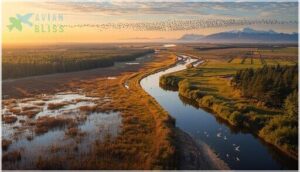
Migratory birds depend on a network of habitats throughout their annual journeys, from breeding grounds to wintering areas and everywhere in between. These landscapes aren’t just scenic stopovers—they’re biological lifelines that determine whether populations thrive or decline.
Understanding what makes these habitats essential helps you see why their protection matters so much for conservation success.
Critical Stopover and Breeding Sites
Think of stopover habitats as essential fueling stations along your favorite migratory species’ journeys. About 60–70% of North American passerines depend on these critical sites, where habitat fragmentation threatens their survival.
Protected breeding grounds with intact forest stands support nest success rates of 40–60%, while degraded sites show sharp declines. Conservation efforts targeting these essential areas directly improve migration survival by 15–25% through strategic habitat restoration and protection.
Habitat Connectivity and Corridors
Across vast landscapes, habitat connectivity acts as the lifeline for migratory birds. With sturdy corridor design, you can counter habitat fragmentation and keep migration routes viable. For effective conservation planning, focus on:
- Linking stepping-stone habitats within 1–3 km of flyways
- Maintaining 60–80% native vegetation cover
- Reducing barriers to landscape connectivity through targeted habitat restoration
Ecological sustainability depends on these connections.
Ecological Benefits of Healthy Habitats
Resilience lies at the heart of healthy habitats—they don’t just shelter birds, they fuel survival. When you protect stopover sites, you’re supporting daily fat gain of 0.5–1.5 grams, which is critical for long-distance journeys. Habitat restoration drives ecosystem services and biodiversity conservation, while environmental sustainability strengthens ecological balance.
Consider these wildlife ecology benefits:
| Habitat Feature | Ecological Benefit |
|---|---|
| Wetland complexes | 12–28% higher arrival survival |
| Forested riparian corridors | 6–14% improved body condition |
| Native vegetation restoration | 18–34% increased insect abundance |
| Protected stopover networks | 20–35% higher refueling rates |
| Habitat heterogeneity | 10–22% greater species richness |
Through habitat conservation and management, conservation efforts enhance migratory success and safeguard the habitats that sustain millions of travelers.
Impact of Habitat Loss and Fragmentation
Habitat loss has carved up migration corridors—since 1970, 50–80% of essential stopover sites across major flyways have vanished or degraded. Habitat degradation and fragmentation effects ripple through stopover ecology, reducing your migratory birds’ refueling success by 10–20%.
Corridor conservation demands action:
- Restore landscape connectivity where habitat fragmentation has isolated patches
- Protect remaining stopover networks through habitat conservation and management
- Implement landscape restoration to recover lost foraging and roosting resources
Conservation efforts must address these systemic threats.
Major Threats to Migration and Habitats

Migratory birds face an escalating array of challenges throughout their annual journeys, from breeding grounds to wintering areas and back again. These threats don’t operate in isolation—they compound across seasons and landscapes, making survival increasingly difficult for many species.
Understanding the primary dangers helps you recognize where conservation efforts can make the most meaningful difference.
Climate Change Effects on Migration
Climate change is rewriting migration patterns you’ve long relied on to observe seasonal bird arrivals. Warming temperatures shift spring arrival dates by 1–3 days per decade, creating phenology changes that disrupt food availability for hatchlings. Weather extremes—heatwaves, storms, altered precipitation—compound ecosystem disruption across flyways. Conservation efforts must address these climate shifts to protect birds traversing increasingly unpredictable conditions during their epic journeys.
Climate change is rewriting migration patterns, shifting bird arrivals 1–3 days earlier per decade and disrupting food availability across flyways
| Climate Impact | Observed Effect on Migration |
|---|---|
| Arrival timing shifts | 1–3 days earlier per decade |
| Insect peak changes | 1–3 weeks earlier in some regions |
| Population declines | Climate-mediated losses across flyways |
Urbanization and Light Pollution
You’ve likely noticed cities glowing brighter each year—but artificial lighting disrupts migration patterns for up to 500 million birds annually in North America. Urban planning that ignores light pollution causes bird disorientation, increasing fatal collisions by 1–2% in urban centers.
Conservation efforts implementing “lights-out” programs reduce nighttime mortality by 30–60%, proving habitat conservation strategies can coexist with city lighting when thoughtfully designed.
Pesticides and Pollution Risks
Beyond disorienting lights, chemical runoff poses severe threats to migratory species. Pesticide exposure in agricultural stopover zones reduces your birds’ return rates by 15–40%, while neonicotinoids cut fat reserves by 9–14%—energy they desperately need. Pollution effects accumulate in sediments for years, causing ecological damage that ripples through wetland habitats.
- Heavy metals in stopover wetlands exceed safe levels by 2–5 times
- Pesticide regulation with buffer zones cuts toxin loads by 28–47%
- Insectivorous migrants show 1.5–3.5% annual population declines in affected flyways
- Conservation efforts using satellite tracking identify exposure hotspots for habitat preservation
Human Activities and Land Use Change
Land use change drives the most pervasive threats you’ll encounter in habitat conservation. Agricultural impacts and urban sprawl fragment corridors, reducing functional connectivity by 12–20% across North American flyways.
Ecosystem disruption from land degradation removes 15–25% of stopover sites in key regions, while human footprint expansion threatens another 0.5–1.2 million hectares.
Habitat preservation depends on reversing these patterns through targeted conservation efforts.
Conservation Strategies and Best Practices

Protecting migratory birds requires coordinated action across their entire journey, from breeding grounds to wintering areas and every stopover in between. Effective conservation combines on-the-ground habitat work with broader strategies that address emerging threats like climate shifts and human-caused hazards.
The approaches below represent tested methods that conservation organizations and land managers are using to safeguard these extraordinary travelers.
Habitat Protection and Restoration
Habitat conservation forms the backbone of effective bird migration support, and you can see its impact through strategic protection and restoration. Currently, only 12% of priority migratory habitats hold formal protection status in North America, while restored wetlands have boosted stopover capacity by 18–25% in pilot regions.
- Wildlife corridors linking fragmented landscapes increase juvenile survival by 40% during migration
- Habitat restoration projects achieve 11–14% habitat quality gains within five years through ecological monitoring
- Conservation planning that integrates multiple land uses enhances corridor viability by 15–25% across flyways
Adaptive Management for Climate Change
Climate change demands conservation strategies that can shift as conditions evolve. Adaptive management frameworks now incorporate active modeling to predict habitat changes, allowing you to adjust protection priorities in real time.
These flexible approaches recognize that migration patterns won’t stay static—species tracking temperature shifts need conservation planning that accounts for future ecosystem services and builds climate resilience across evolving landscapes.
Reducing Migration Hazards
You can dramatically improve migration safety by implementing bird-friendly designs that reduce collision hazards at urban peaks by 20–35%.
Strategic stopover management—restoring riparian buffers, managing predators, and reducing nighttime lighting—raises completion rates by 9–14% and boosts refueling events by 15%.
These hazard mitigation efforts, paired with ecological restoration along flyways, improve habitat conservation while cutting habitat loss below 0.5% annually.
Sustainable Conservation Partnerships
Across borders, you’ll find that conservation partnerships succeed when stakeholder analysis brings together local landowners, indigenous communities, and international NGOs. Collaborative governance models deliver measurable results:
- Regional programs see 72% higher effectiveness with community engagement
- Cross-border networks boost corridor restoration success by 34%
- Partnership models cut project cycles by 28%
- Data-sharing agreements expand tracking coverage by 45%
- Community-led stewardship raises habitat conditions 22%
These sustainable conservation practices strengthen ecological sustainability and biodiversity while securing conservation funding for habitat conservation and conservation of migratory species.
Research, Technology, and Citizen Science

Understanding where birds go and what they need requires tools that can track their journeys across continents and oceans. Modern technology, from satellite tags to machine learning algorithms, has revolutionized how you can monitor migration patterns and identify critical habitats.
When you combine these advances with the dedicated eyes of citizen scientists and international data networks, conservation efforts become more precise and far-reaching than ever before.
Bird Tracking and Migration Mapping
You’re witnessing a revolution in migration science—over a million location records now reveal flight routes once hidden from view. Bird tracking technology paired with habitat mapping transforms raw data into conservation action, revealing that 12–25% of avian migration patterns cross international borders.
High-resolution mapping updates stopover site quality daily, while citizen science contributes 20–35% of passerine movement records, strengthening our understanding of these extraordinary journeys.
| Technology | Conservation Application | Data Impact |
|---|---|---|
| Satellite tracking | Identifies critical flyways | 5+ million location records |
| Radar mapping | Monitors real-time movements | Daily habitat suitability scores |
| Citizen science | Expands species coverage | 20–35% of regional data |
Machine Learning in Habitat Conservation
Machine learning now powers habitat modeling that pinpoints where your conservation efforts matter most. Algorithms analyze vast datasets—from satellite imagery to tracking records—achieving predictive accuracy around 0.80–0.95, transforming how you protect migration patterns.
Three ways ML advances habitat conservation:
- Species classification identifies critical stopover sites 15–25% more effectively
- Migration forecasting predicts arrival windows within 5 days
- Data integration facilitates conservation planning across borders, increasing coverage by 40%
Role of Citizen Science Initiatives
Your observations matter more than you might think. Citizen science now backs 42% of North American migratory bird projects, with volunteer data contributing up to 60% of regional occurrence records.
When you receive standardized training, data quality improves by 15–25%, directly influencing conservation decisions—at least 12 international actions over the past decade relied on community research, making citizen engagement essential for protecting migration habitats.
International Cooperation and Data Sharing
You can’t protect birds that cross continents without sharing what you know. By 2023, global networks standardized data protocols across five major migratory systems, enabling cross-border research collaboration through open access platforms.
International cooperation for conservation now connects governments, NGOs, and researchers—conservation partnerships fueling ecological sustainability and biodiversity. This is achieved through real-time habitat data exchange and coordinated migratory bird conservation efforts across jurisdictions.
Frequently Asked Questions (FAQs)
What is the migratory bird habitat conservation plan?
A migratory bird habitat conservation plan guides protection, restoration, and management of critical sites across breeding grounds, stopover corridors, and wintering areas.
Through coordinated strategies, monitoring protocols, and adaptive management frameworks, these efforts ensure the preservation of vital habitats for migratory birds.
What is the migratory bird habitat conservation Act?
You won’t find a standalone federal law by that exact name. The Migratory Bird Treaty Act anchors habitat conservation programs, weaving federal protections and conservation efforts through partnerships that safeguard migratory species across critical landscapes.
How does bird migration affect an ecosystem?
When you picture migrating flocks, you’re witnessing mobile nutrient pipelines. These seasonal travelers disperse seeds across ecosystems, boost biodiversity, and drive nutrient cycling—stabilizing ecological balance while delivering measurable ecosystem services that strengthen habitat conservation efforts.
How can we help birds migrate safely?
You can support safe passage by reducing light pollution, installing bird-friendly glass, preserving habitat corridors along migration routes, and participating in conservation efforts that protect critical stopover sites for migratory species.
How can individuals support bird habitat conservation?
You can make a real difference by planting native vegetation, participating in citizen science bird counts, supporting local conservation funding, and helping restore habitats—actions that directly strengthen wildlife preservation and migration success.
What are key threats specific to urban bird habitats?
Urban bird habitats face compounding threats. Artificial light pollution disorients migrants by 15–40%, while habitat fragmentation disrupts connectivity by 25–40%.
Pesticide exposure impairs navigation, and human disturbance reduces foraging efficiency.
Climate-driven timing mismatches further challenge survival.
How do invasive species impact migratory bird habitats?
Invasive species disrupt native ecosystems by reducing food availability up to 60%, increasing predation risks by 40%, and degrading stopover habitat quality by 32%.
These impacts threaten biodiversity loss and migratory species survival across critical bird migration corridors, demanding urgent conservation efforts.
What role do native plants play in habitat quality?
You’ll find that regional flora create nature’s safety net—native plant diversity drives ecosystem services by boosting insect prey availability 30–50%, strengthening food webs that sustain bird migration.
Through restored plant community networks, these ecosystems become critical for habitat conservation.
How does noise pollution affect migratory patterns?
Acoustic disruption alters migratory species’ timing and navigation, with traffic noise advancing arrival by 3–5 days while reducing fat reserves.
Stopover habitats experiencing sonic pollution see 20–35% declines in quality, compromising conservation efforts against climate change impacts.
How do migratory birds find enough food during flight?
Many migratory species rely on stopover ecology, exploiting habitats where food sources concentrate energy-rich prey.
You’ll find they refine fueling strategies by tracking nutrient acquisition opportunities along migration corridors—timing arrivals when invertebrates peak.
Conclusion
Like telegraph operators once coordinating messages across vast distances, you’re now part of a network connecting fragmented landscapes for species that can’t afford broken links. Bird migration habitat conservation demands your attention to both hemispheric flyways and backyard choices—from advocating for dark-sky ordinances to supporting pesticide-free corridors.
Each protected stopover site, each restored wetland, becomes another essential node in a system where migratory survival hinges on uninterrupted passage and abundant resources at every stage.