This site is supported by our readers. We may earn a commission, at no cost to you, if you purchase through links.
 You’ll discover that bird nest building facts reveal incredible engineering skills across species.
Birds use everything from spider silk and mud to human-made materials like yarn and plastic. Some create cup-shaped structures while others weave hanging pouches or excavate underground tunnels.
Timing matters too – most birds build during specific seasons when materials are abundant and weather conditions are favorable. Construction techniques vary dramatically, with some species completing nests in days while others take weeks.
Notably, not all birds build traditional nests; some simply scrape ground depressions or commandeer existing structures. The architectural complexity ranges from simple grass platforms to intricate multi-chambered designs that regulate temperature and humidity.
What’s truly fascinating is how these feathered architects solve structural challenges that would stump human engineers, using incredible engineering skills to create intricate and complex nests.
Table Of Contents
- Key Takeaways
- Bird Nesting Materials
- Nest Building Techniques
- Bird Nest Locations
- Nesting Behavior Patterns
- Nest Construction Adaptations
- Frequently Asked Questions (FAQs)
- What is a fun fact about a bird’s nest?
- How does a bird know how to build a nest?
- How long will it take a bird to build a nest?
- Does the male or female build the nest?
- How long does nest construction typically take?
- Do birds reuse nests from previous seasons?
- Which bird species builds the largest nests?
- How do baby birds leave the nest?
- What happens to abandoned bird nests?
- Conclusion
Key Takeaways
- You’ll find birds use surprisingly diverse materials – from spider silk and mud to human-made items like yarn and plastic, showing incredible resourcefulness in construction
- Construction techniques vary dramatically across species – some birds complete cup-shaped nests in days, while others spend weeks on complex, multi-chambered designs that regulate temperature
- Nest locations are strategically chosen for survival – birds select tree cavities, cliff faces, or ground sites based on safety from predators, weather protection, and accessibility to food sources
- Birds demonstrate remarkable engineering adaptations – they incorporate camouflage, predator deterrents, weatherproofing, and insulation methods that rival human architectural solutions
Bird Nesting Materials
You’ll discover that birds transform everyday materials into architectural marvels using twigs, grasses, mud, and even their own feathers.
From simple twigs to perfect homes — birds are nature’s master architects, crafting cozy sanctuaries with whatever they find.
These resourceful creatures select specific materials based on their nesting needs, weather conditions, and available resources in their environment, which makes them resourceful and able to build using architectural marvels.
Twigs and Branches
You’ll find that most bird species rely on twigs and branches as their primary nest construction framework.
Twig selection involves choosing sturdy, flexible pieces that provide structural integrity for the nest frame. Birds carefully evaluate branch strength before incorporating materials into their stick arrangement.
Tree limbs serve as both foundation anchors and material sources for bird nest building. This systematic nest construction approach guarantees durability throughout the nesting season.
Understanding the role of twig gatherers is vital in appreciating the complexity of bird nest building, which involves complete concepts and primary nest construction.
Grasses and Leaves
While sturdy twigs create the framework, you’ll find that grasses and leaves form the nest’s flexible foundation.
These materials offer birds remarkable versatility in nest construction, adapting to countless architectural needs.
Bird nest building relies heavily on careful material selection:
- Grass Types – Long prairie grasses provide structural support, while fine fescue creates soft interior lining
- Leaf Selection – Broad leaves offer weather protection, narrow leaves allow precise weaving techniques
- Stem Strength – Flexible stems bend without breaking, maintaining nest integrity during storms
Different bird nesting habits determine specific grass types and blade length preferences, ensuring ideal nest materials for each species’ unique requirements.
The choice of materials often depends on available nest building supplies.
Mud and Clay
You’ll discover mud and clay serve as nature’s cement in bird nest construction.
These materials create incredibly strong, waterproof structures when mixed with organic matter.
| Clay Types & Uses | Mud Usage Benefits |
|---|---|
| Red clay for strength | Waterproof barrier creation |
| Sandy clay for flexibility | Temperature regulation |
| Fine clay for smoothness | Predator deterrence |
| Heavy clay for durability | Structural reinforcement |
| Mixed clay for balance | Weather resistance |
Nest stability increases dramatically when birds combine these materials with precise water content ratios for ideal building consistency.
Feathers and Hair
You’ll discover that bird feathers and hair create remarkably insulated nest linings that regulate temperature for developing chicks.
Many species collect these soft materials from their own molt patterns or gather them from other animals, creating cozy nurseries that protect against harsh weather conditions.
The use of natural fibers for nesting is essential, as they provide a safe and healthy environment, utilizing safe material options for successful breeding.
- Feather structure provides natural insulation through trapped air pockets that maintain ideal nest temperatures
- Plumage types vary in insulation quality, with down feathers offering superior warmth compared to contour feathers
- Feather care includes regular replacement during molting seasons, ensuring fresh, clean materials for successful bird nesting
Nest Building Techniques
You’ll discover four distinct nest construction methods that birds have perfected over millions of years of evolution.
Each technique serves specific purposes, from protection against predators to adapting to different environments and weather conditions, which is crucial for their survival.
Cup-Shaped Nests

You’ll recognize cup-shaped nests as nature’s most ingenious architectural feat – these rounded bowls cradle eggs with remarkable precision.
Over 1,200 bird species worldwide master this nest building technique, creating structures that balance durability with comfort through careful nest architecture.
| Feature | Measurement | Function |
|---|---|---|
| Cup Size | 7-15cm diameter | Species-specific egg accommodation |
| Nest Depth | 1-2cm wall thickness | Ideal egg retention and insulation |
| Nest Linings | 60% use spider silk | Enhanced comfort and nest stability |
Platform Nests
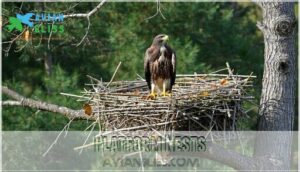
Platform nests showcase nature’s engineering prowess through their simple yet effective design.
You’ll spot these flat, sturdy structures built by raptors like hawks and eagles who prioritize accessibility over elaborate architecture.
Their elevated nests use minimal materials – mostly sticks and twigs arranged in loose layers, allowing for easy takeoffs for large birds.
The open platform design provides excellent visibility of surrounding territory for hunting and predator detection.
Burrow Nests
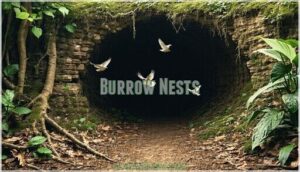
You’ll encounter burrow nests when birds excavate underground tunnels for protection.
These sophisticated structures showcase impressive burrow architecture, with tunnel safety mechanisms like multiple escape routes.
Bird nesting experts use specialized burrowing tools to dig into soil stability-tested locations.
Nest tunnel systems extend several feet deep, lined with feathers and grass for insulation, demonstrating advanced nesting habits adapted to challenging nesting sites.
The construction of these nests is influenced by nest building techniques that guarantee survival and protection.
Pendulous Nests
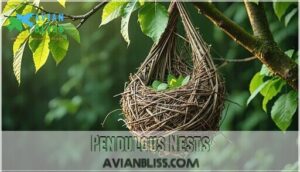
Throughout the branches above you, pendulous designs showcase nature’s most sophisticated hanging nests that swing like tree swings in the wind.
These remarkable structures demonstrate advanced weaving techniques that secure nesting sites against gravity’s pull.
- Orioles create intricate sock-like pouches using plant fibers and string
- Nest suspension requires precise attachment points on flexible branch tips
- Hanging nests protect eggs from ground predators and climbing threats
- Weaving techniques involve thousands of individual fiber crossings for strength
- These nesting habits inspire modern bird nesting boxes with similar protective features
The use of nest building materials is essential in creating sturdy and cozy nests for various bird species, utilizing advanced weaving techniques and providing protection against ground predators and climbing threats.
Bird Nest Locations
You’ll discover that birds choose nesting locations based on safety, accessibility, and environmental protection for their eggs and chicks.
Each species has evolved specific preferences that match their unique survival needs and physical capabilities, leading to a natural selection of nesting sites that ensure the protection of their eggs and chicks.
Tree Cavities

Tree nesting requires strategic cavity selection based on tree species and decay process considerations.
You’ll find over 85 North American species prefer natural hollows ranging 1.5-15 meters high.
Branch stability and nest placement affect success rates, while decay creates accessible excavation sites.
Proper nest insulation develops naturally within cavities.
Bird nesting boxes supplement natural options during nesting season when competition intensifies.
Rock Creices

Rocky outcrops offer secure nesting sites where birds exploit natural rock formation cracks for protection.
You’ll find species wedging nests into crevice depth variations, using nest anchors like twigs to secure their structures.
During nesting season, these locations provide excellent nest insulation from wind and predators.
Bird nesting behaviors adapt to utilize cliff erosion patterns, creating safe havens for bird breeding success.
Cliff Faces

Sharp cliff faces challenge birds to master vertical walls where nest anchors determine survival success.
Rock faces offer protective overhang sites that shield bird nests from predators and harsh weather. However, cliff erosion constantly threatens these precarious locations, forcing bird breeding pairs to carefully select stable surfaces.
Smart bird nesting behaviors include testing rock stability and choosing ledges with natural windbreaks for superior bird habitat conservation.
The selection of nesting sites often involves considering factors related to cliff swallow habitats to guarantee the best chance of survival, which is crucial for bird breeding pairs and overall survival success.
Ground Nests
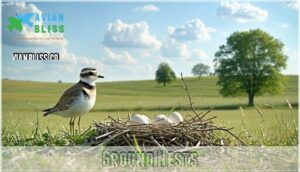
Ground nesting birds choose the earth’s surface strategically for bird nesting success.
These species excavate shallow depressions or utilize natural soil formations, creating nests with impressive nest camo techniques. Burrow depth varies substantially based on species requirements and environmental factors.
Hidden entrances protect vulnerable eggs from nest predators, while careful soil usage guarantees structural integrity throughout the breeding season.
- Killdeer perform "broken wing" displays – leading predators away from their ground-level treasures
- Prairie chickens create scrapes in grasslands – where chicks can immediately forage after hatching
- Plovers nest on beaches and mudflats – timing reproduction with tide cycles for maximum nesting success
Nesting Behavior Patterns
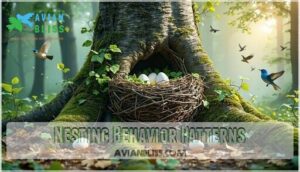
You’ll discover that bird mating systems directly influence how and where they build their nests, from devoted pairs constructing elaborate structures together to single parents handling everything alone.
These behavioral patterns reveal fascinating strategies that have evolved to maximize reproductive success across different species and environments, and this is a key aspect of understanding bird behavior in terms of reproductive success.
Monogamous Nesting
When you observe bird behavior observations, you’ll discover that monogamous pairs demonstrate remarkable fidelity patterns.
These devoted partners share nest sharing responsibilities and return to the same bird nesting sites annually.
Their pair bonding strengthens through synchronized breeding habits, with mate selection occurring before establishing territories.
Understanding nesting site selection is vital for conservation efforts.
| Species | Bond Duration | Nest Responsibilities |
|---|---|---|
| Albatross | Lifelong | Both incubate eggs |
| Swan | Multiple seasons | Male guards territory |
| Eagle | 5-10 years | Female builds primarily |
This commitment guarantees bird species conservation through consistent bird breeding patterns and enhanced offspring survival rates.
Polygamous Nesting
Many bird species practice complex mating systems where males maintain territories with multiple females.
Polygynous species like Red-winged Blackbirds showcase intricate harem dynamics, with dominant males defending prime bird nesting sites while attracting numerous mates.
These breeding patterns involve strategic nest sharing arrangements and frequent mate switching throughout seasons, creating fascinating bird courtship displays that maximize reproductive success through diverse breeding habits, including complex mating systems.
Cooperative Breeding
Unlike single-pair strategies, cooperative breeding involves bird behavior where helpers assist with nest building and chick care.
You’ll find this bird breeding behavior creates stronger group defense systems and shared responsibilities that boost survival rates substantially.
- Social Learning accelerates nest construction skills through observation of experienced builders
- Breeding Roles divide tasks with some birds incubating while others gather materials
- Nest Sharing allows multiple pairs to utilize communal structures for enhanced protection
- Cooperative Care enables round-the-clock feeding schedules that maximize chick growth rates
Solitary Nesting
Solitary birds take nest defense seriously, transforming into fierce guardians when protecting their territory.
These lone nesters, including many bird species like hawks and owls, rely on aggressive displays and strategic nest placement for protection.
Single parenting demands constant vigilance, as bird isolation means no backup when predators threaten.
Bird behavior shifts dramatically during breeding season, with solitary nesters choosing remote bird habitats to minimize threats and guarantee successful reproduction.
The need for constant vigilance and strategic nesting highlights the challenges faced by solitary birds, making their survival and reproductive success a testament to their adaptability and resilience in the face of aggressive displays.
Nest Construction Adaptations
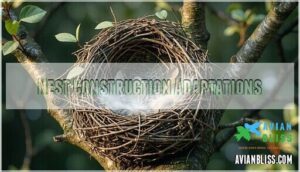
You’ll find that bird nest construction involves sophisticated adaptations that guarantee survival in challenging environments.
These architectural marvels incorporate camouflage techniques, predator defense systems, weatherproofing strategies, and insulation methods that rival human engineering solutions.
Camouflage Strategies
Mastering nest disguise requires understanding how birds blend seamlessly into their surroundings. Color patterns in bird nests match surrounding vegetation, creating nearly invisible sanctuaries.
Birds employ sophisticated bark mimicry and feather camouflage techniques.
- Tree blending – Nests mirror bark textures and moss growth patterns
- Natural materials – Twigs, lichen, and spider silk create perfect disguises
- Strategic placement – Hidden among branches where shadows break up nest outlines
These bird adaptations showcase nature’s incredible camouflage solutions for nest protection.
Predator Deterrents
Birds deploy sophisticated defense strategies to protect their nests from predators.
Weaverbirds construct entrance tunnels up to 30cm long, blocking snake access.
Penduline tits create false chambers that mislead intruders, while orioles build swinging nests that deter climbing mammals.
Alarm calls intensify threefold when threats approach.
Cooperative breeders like pied babblers coordinate group attacks against nest raiders, dramatically improving survival rates.
Weather Resistance
Nature’s toughest challenge isn’t predators—it’s surviving Mother Nature’s tantrums.
Smart architects know that Rain Protection starts with strategic roof design and proper drainage systems.
Weather-resistant nest features include:
- Wind Resistance through flexible branch placement and aerodynamic positioning
- Nest Anchoring using multiple attachment points and reinforced structural elements
- Moisture Control via waterproof materials and elevated construction sites
Storm Damage prevention requires understanding local weather patterns.
Bird conservation efforts increasingly focus on how urban environments affect traditional bird habitat preservation strategies and bird adaptation to urban environments, supporting essential bird survival strategies.
Nest Insulation Methods
Smart architects know that thermal insulation separates survival from catastrophe in bird nesting.
You’ll find nest linings crafted from downy feathers, animal hair, and moss create essential heat retention barriers.
These insulating materials boost energy efficiency by maintaining stable temperatures, allowing parents to focus on feeding rather than constant warming.
Bird anatomy perfectly adapts to select materials that maximize nest protection and support successful bird conservation through improved habitat preservation strategies.
The use of effective nest insulation materials is vital for maintaining a stable nest environment.
Frequently Asked Questions (FAQs)
What is a fun fact about a bird’s nest?
You’d never guess that some birds construct their nests using spider silk as nature’s ultimate building material. These feathered architects weave intricate webs stronger than steel into their homes.
How does a bird know how to build a nest?
Instinct guides most nest construction through inherited genetic programming. You’ll find birds automatically know their species’ specific building techniques, materials, and locations without learning from parents or practice.
How long will it take a bird to build a nest?
Building time varies substantially depending on the species you’re observing.
Smaller songbirds like robins typically complete their nests in just three to six days, while larger birds such as eagles might spend several weeks constructing their elaborate homes, which is a notable difference in building time.
Does the male or female build the nest?
Like a master architect choosing blueprints, nature assigns nest construction duties differently across species.
You’ll find that in most bird species, females take the lead role in building nests, though males often assist by gathering materials or providing protection during construction.
How long does nest construction typically take?
Nest construction timing varies dramatically across species. You’ll find some birds completing their homes in just a few days, while others take several weeks to craft their architectural masterpieces.
Do birds reuse nests from previous seasons?
Old habits die hard – many species won’t reuse last year’s nests.
Most birds construct fresh nests each breeding season since old structures deteriorate, harbor parasites, or attract predators.
Though some raptors do renovate existing homes, this behavior is not common among most bird species, as old nests are often associated with parasites.
Which bird species builds the largest nests?
You’ll recognize several champions in nest construction.
Bald eagles claim the record with nests reaching 10 feet wide and over 4,400 pounds, while sociable weavers build communal structures weighing 2,000 pounds.
These impressive structures showcase the art of bird nest building techniques used by various species, demonstrating complete concepts of bird nest building and communal structures with a focus on impressive structures.
How do baby birds leave the nest?
Fledgling flight unfolds when you’re ready!
Baby birds either hop branch-to-branch developing flight muscles, or take bold leaps from nest edges.
Parents guide this gradual progression through persistent calling and food rewards.
What happens to abandoned bird nests?
When you discover abandoned nests, they’ll naturally decompose over time.
Birds rarely reuse old nests due to parasites and structural decay.
These structures become shelter for insects and small mammals while contributing valuable nesting materials back to the ecosystem through weathering processes.
Conclusion
Knowledge is power, and understanding these bird nest building facts transforms you into a more observant nature enthusiast.
You’ve discovered how birds demonstrate remarkable engineering skills, utilizing diverse materials from spider silk to modern plastics.
Their construction techniques range from simple scrapes to complex multi-chambered designs that regulate temperature and humidity.
These architectural marvels showcase millions of years of evolutionary refinement, where each species has developed specialized methods to protect their offspring while adapting to environmental challenges and predator threats, highlighting the remarkable ability of birds to adapt and the diverse materials they use.