This site is supported by our readers. We may earn a commission, at no cost to you, if you purchase through links.
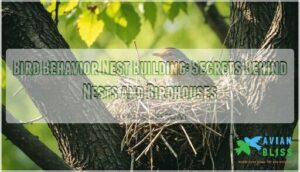
A robin can build a nest strong enough to hold four eggs and withstand a week of rain using nothing but what it finds on the ground. No tools, no instruction manual—just an instinct refined over millions of years and a surprisingly deliberate selection of materials.
Watch one long enough and you’ll notice it rejects certain twigs, skips over others, and makes a second trip for something softer. selectivity isn’t random.
The materials birds choose directly affect nest temperature, structural integrity, and whether chicks survive their first cold night. Knowing what helps that process—and what quietly undermines it—makes all the difference.
Table Of Contents
- Key Takeaways
- Natural Nesting Materials
- Safe Material Options
- Unsuitable Nesting Materials
- Providing Nest Materials
- Bird-Friendly Yard Practices
- Frequently Asked Questions (FAQs)
- What’s the best material for a birdhouse?
- What is the best material for a bird’s nest?
- What materials are used to build birds nests?
- What materials are used to build a Robin’s nest?
- What material is used for bird box nesting?
- What is the best material for bird nests?
- What materials are used to build a bird’s nest?
- What is the raw material for bird nest?
- What do birds use them to build their nest?
- How do birds choose their nesting location?
- Conclusion
Key Takeaways
- Birds are surprisingly picky builders — they reject twigs, double back for softer fibers, and layer materials with purpose, because nest temperature and structural integrity directly affect whether chicks survive their first cold night.
- Your best offerings are dry grass, moss, raw cotton, feathers, and bark strips — natural materials that handle warmth, moisture, and structure without the risks that synthetic alternatives quietly introduce.
- Some seemingly harmless donations — dryer lint, human hair, yarn, and chemically treated pet fur — can entangle, poison, or collapse a nest entirely, often before the chicks ever hatch.
- How you offer materials matters as much as what you offer — scattered ground piles, mesh bags, or suet cages placed before February give birds reliable access right when nesting instincts kick in.
Natural Nesting Materials
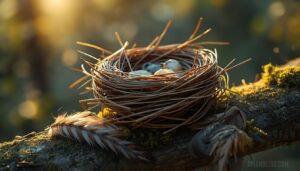
Birds are remarkably selective about what goes into a nest — and for good reason. The materials they choose affect warmth, structural strength, and ultimately how well their chicks survive.
From grass and mud to feathers and moss, every choice serves a purpose — as explored in this deep dive into bird nest-building behavior and material selection.
Here’s a look at the natural building blocks they rely on most.
Dead Twigs and Leaves
Dead twigs and dead leaves are where every nest begins — and they do more than you might expect. Twigs ranging from 1 to 10 millimeters thick interlock to create structural rigidity that holds the cup against wind and rain.
Leaves handle insulation layering, trapping air between their surfaces to buffer temperature swings on cool nights. Both materials also provide impressive camouflage benefits, blending the nest into surrounding bark and ground debris. Seasonal availability is generous — storms and autumn drops keep supply steady. Retaining leaf litter creates a winter wildlife safe haven for insects and birds.
- Collect dry twigs under 6 inches for easier weaving
- Choose intact, dry leaves that won’t crumble immediately
- Discard anything soggy after rain to prevent mold
- Skip chemically treated yard waste — it’s among the most hazardous nesting materials you’ll encounter
Dry Grass and Feathers
Where twigs and leaves set the frame, dry grass and feathers finish the comfort. Grass stems flex without snapping — their hollow structure traps air pockets that deliver real thermal retention on cold nights.
Feathers handle moisture regulation naturally, channeling capillary action away from eggs while adding buoyant insulation.
Together, their weight distribution matters: grass scaffolds the outer cup, feathers line the inner bowl. That structural flexibility and insulation balance is what makes this pairing central to natural nest construction.
| Material | Function | Key Benefit |
|---|---|---|
| Dry grass (outer layer) | Structural framework | Insulation balance, wind resistance |
| Feathers (inner lining) | Thermal insulation | Moisture regulation, warmth |
| Combined layering | Weight distribution | Structural flexibility, nest stability |
Moss and Bark Strips
grass and feathers handle the inner comfort, moss and bark strips take care of durability. Moss insulation works quietly — regulating seasonal moisture and holding warmth without adding weight. Bark strip size matters too; strips between 10 and 40 centimeters give birds enough flexibility for secure weaving. The texture grip of rough elm or oak bark keeps materials locked in place naturally.
- Moss coverage ratio of 40–70% over bark strips balances camouflage with airflow — a bird-friendly combination that facilitates safe environment nesting through natural nest construction.
Pine Needles and Plant Fluff
Pine needles bring something bark strips can’t — a resinous needle coating from natural oils that resists decay and deters pathogens, making them surprisingly durable nest lining. Their allelopathic effects even suppress competing plants beneath pines, keeping nest sites cleaner.
Plant fluff from cattails and milkweed delivers serious fluff insulation benefits, trapping warmth around eggs efficiently.
| Material | Key Benefit |
|---|---|
| Pine needles | Antimicrobial resin coating |
| Cattail down | Lightweight thermal insulation |
| Milkweed fluff | Soft egg-cushioning layer |
| Cottonwood fibers | Moisture-wicking natural padding |
| Fallen needle litter | Nutrient-rich litter base layer |
Seasonal needle availability makes these organic options reliable — collect only what’s already fallen.
Pine needles pair beautifully with soft naturals like coconut fiber, as explored in this guide to comfortable bird cage bedding options that support instinctive nesting behaviors.
Safe Material Options
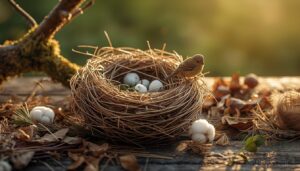
Not every material you put out will do birds a favor — some are genuinely useful, and others cause more harm than good.
The good news is that safe options are usually simple, inexpensive, and easy to source. Here’s what’s worth offering.
Untreated Grass Clippings
Untreated grass clippings are one of the most underrated organic options in your yard. Dry them first — fresh clippings carry 70–80% moisture, and that’s a mold risk that no nest needs.
Once dried, they become bird-friendly building blocks with real benefits:
- Thermal insulation: fine fibers trap air, keeping eggs warm on cool mornings
- Predator camouflage: their yellow-brown tones blend naturally into surroundings
- Nutrient recycling: decomposition rate is fast, returning organic matter without lasting residue
Robins and bluebirds both favor them.
Native Plants and Straw
Native plants are some of the most practical nesting resources you can offer — and straw from local grasses takes that a step further.
Seasonal straw availability aligns naturally with breeding cycles, so birds find what they need when they need it.
Small pieces of straw offer camouflage color matching that blends into hedgerows and grassland edges.
There’s also carbon footprint reduction when you skip imported materials.
Benefits worth noting:
- Straw moisture retention keeps nest cups stable through weather shifts
- Soil nutrient release helps the microhabitat long after nesting ends
- Native vegetation for birds supplies fibers that match local insulation needs
- Organic nesting options like milkweed and sedge reduce chemical exposure
- Natural materials decompose cleanly, leaving no synthetic residue behind
Raw Cotton and Hemp
Raw cotton and hemp are two of the quieter stars in the bird-friendly nesting world — both biodegradable, both genuinely useful.
Cotton fiber softness makes it ideal for lining nest cups, and its natural cotton moisture resistance helps insulation hold up through spring rain.
Hemp brings something different: hemp tensile strength means structural fibers that don’t fall apart mid-construction. Hemp environmental impact is also considerably lower than conventional alternatives.
Offer small, loose bundles of chemical-free materials — a cotton‑hemp blend works particularly well — and keep everything untreated.
Natural Fibers and Feathers
Feathers and natural fibers are genuinely underrated — and birds have known this far longer than we have.
Here’s what to offer:
- Untreated wool or rabbit fur for high-quality thermal insulation and soft egg cushioning
- Clean poultry feathers, whose keratin toughness and mechanical interlocking improve nest stability
- Moss and bark strips for reliable moisture management inside the cup
- Chemical-free plant fluff for lightweight, biodegradable nesting that enhances avian nest safety
All bird-friendly, all natural nest building at its best.
Unsuitable Nesting Materials
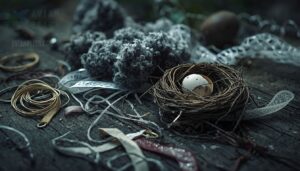
Not everything you find around the house is safe to leave out for birds, even if it looks harmless. Some materials can injure, poison, or even kill nestlings before they ever leave the nest.
Here’s what to keep away from your yard entirely.
Plastic Strips and Tinsel
Plastic strips and tinsel might look festive in a craft bin, but they’re genuinely dangerous near a nest. Birds weave what they find — and shiny synthetic strands are irresistible to them.
| Risk | Real-World Impact |
|---|---|
| Microplastic Pollution | Fragments contaminate soil and waterways for centuries |
| Fire Hazard Potential | PVC strands near heat sources can melt or ignite |
| Pet Ingestion Danger | Causes intestinal blockage in curious animals |
Static electricity risks make loose strands cling to feathers and nestlings’ legs, while entanglement prevention becomes nearly impossible once strips are woven into a nest. Skip the tinsel entirely — eco-friendly sparkle alternatives like biodegradable paper garlands deliver the shimmer without the harm.
Human Hair and Yarn
It seems like a generous gesture—leaving out a clump of hair from your brush or a ball of yarn for nesting birds. Don’t do it.
Human hair and yarn or string create serious entanglement hazards, from human hair and yarn that can cost a nestling its foot, wing, or life. Hair’s natural fiber tensile strength works against small birds once it loops and tightens. Yarn compounds the problem—its synthetic fibers resist biodegradation and retain moisture against delicate skin.
Three specific reasons to avoid both:
- Dye absorption in treated hair and yarn introduces chemical residues into the nest
- Spinning challenges leave loose fibers that tangle unpredictably around legs and necks
- Ethical sourcing concerns aside, even "natural" hair lacks biodegradable yarn’s safety profile
Choose nontoxic choices like plant down instead.
Dryer Lint and Synthetic Materials
Dryer lint looks soft and inviting — exactly the kind of material you’d think birds would love. They won’t, and here’s why you shouldn’t offer it.
Lint from synthetic fabrics is loaded with chemical additives, dyes, and residual flame retardants that become microplastic contamination in bird nests once fibers break down. It also crumbles when wet, collapsing the nest structure entirely.
Beyond the nest, dryer lint is a fire hazard tied to poor vent maintenance and releases airborne irritants into your home.
Synthetic materials carry the same problems — microplastic pollution, hazardous chemical components, and entanglement risks. Stick with natural alternatives; the difference genuinely matters.
Chemically Treated Pet Fur
Pet fur might seem like a cozy, natural option — but that depends entirely on what’s in it. If your dog or cat receives flea and tick treatments, the shed fur carries those chemical residues directly into any nest a bird builds with it. We’re talking insecticides and repellents that persist for months, affecting multiple breeding cycles. Chemical residue toxicity isn’t a minor concern here; birds are metabolically far more sensitive to these compounds than mammals are.
Treated pet fur carries insecticides into bird nests, poisoning chicks for multiple breeding cycles
There’s also a microbial alteration problem — chemical finishes shift the nest’s natural bacterial communities — and odor deterrence is real, with some treated fur actually repelling birds from otherwise good nesting sites. Certain chemical breakdown products even carry pest attraction risks, drawing parasites toward the nest.
Instead, offer:
- Milkweed fluff or cattail down — soft, chemical-free, and locally available
- Untreated natural cotton or wool fibers
- Moss and lichen from pesticide-free areas
- Feathers from organic, untreated poultry sources
- Fur only from pets with zero chemical treatment history
Avoiding chemically treated pet fur in nests is straightforward once you understand the stakes. Safe materials and natural materials are genuinely easy to source — and the birds will find them.
Providing Nest Materials
Once you’ve gathered the right materials, the next step is figuring out how to offer them so birds can actually find and use them. method matters — birds won’t forage from just anything, and some setups work far better than others.
Here are four simple ways to put those materials within easy reach.
Piles on The Ground
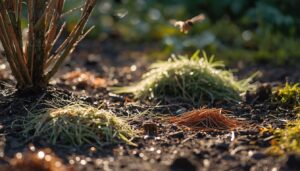
One of the simplest things you can do is create ground-level material stations — small, scattered piles that mimic what birds naturally encounter while foraging. Dead twigs, grass clippings, moss, and pine needles placed directly on well-drained soil give ground-nesting species exactly what they need without any extra effort on your part. Keep soil compaction in mind: hard, compacted ground discourages birds from probing for materials. Aim for loose, accessible spots near shrubs or mud sources.
| Material | Pile Size | Placement Tip |
|---|---|---|
| Dead twigs | 6–8 inch cluster | Near shrub bases |
| Grass clippings | 8–10 inch mound | Open, sunny patches |
| Pine needles | 10–12 inch circle | Close to mud sources |
Pile spacing and drainage management matter too — soggy piles lose material durability quickly, so refresh them weekly.
Wire-Mesh Suet Cages
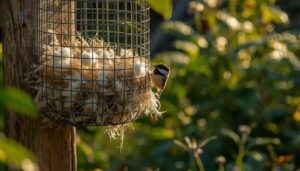
Wire-mesh suet cages work surprisingly well as nest material stations when you swap the suet for natural materials — cotton, feathers, or plant down.
Mesh size optimization matters here: openings wide enough for a chickadee to tug a fiber free, but not so large that the whole bundle falls out at once.
Look for cages with UV coatings to prevent rust and plastic degradation in the sun, an easy refill design so you’re not wrestling with the feeder weekly, proper mounting hardware for stable placement, and a squirrel guard to keep raiders from emptying your stock overnight.
Mesh Bags and Tree Crevices
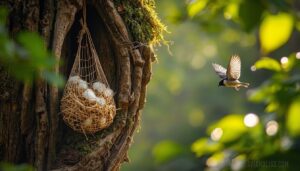
Mesh bags and tree crevices give you a tidy, targeted way to offer natural materials without scattering debris across your yard. Fine-mesh bags — roughly 20 to 40 threads per inch — strike the right Ventilation Moisture Balance, letting air circulate while keeping fibers from spilling out.
Mesh Material Durability matters too; look for UV-stabilized nylon that holds up across multiple seasons. For Bag Placement Timing, hang them in early February before nesting begins.
Here’s what works best:
- Hang mesh bags 4–6 feet high for Predator Access Prevention
- Choose tree cavities 2–4 inches deep for secure storage
- Prioritize Crevice Size Selection — openings birds can navigate without stress
- Skip synthetic fibers; fill only with natural materials
Open-Topped Berry Baskets
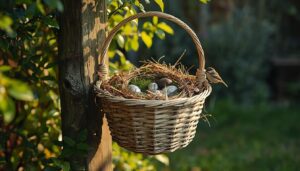
Open-topped berry baskets are one of those surprisingly practical tools that do double duty in your yard. Their slatted sides and wide mouths — generally 5 to 7 inches across — provide excellent Ventilation Design, keeping materials dry and accessible.
Hang one 4 to 6 feet up near shrubs, fill it with natural nesting material options for backyard birds like dry grass, moss, or feathers, and you’re done.
Choose Compostable Materials versions over plastic when possible. Check weekly and swap out anything damp.
Bird-Friendly Yard Practices
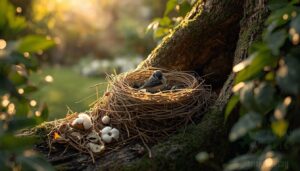
manage your yard matters more than most people realize — small choices add up to big differences for nesting birds. The good news is that few consistent habits can turn even a modest backyard into a reliable haven.
focus on.
Maintaining Natural Debris
Your yard’s fallen leaves and dead twigs aren’t yard waste—they’re a bird’s lumber yard. Smart Debris Sourcing means leaving leaf litter under shrubs, stacking pruned branches into small brush piles, and keeping dry grass, moss, and bark strips accessible year‑round.
Birds rely on Layering Techniques—coarser material at the base, softer fibers like cattail fluff on top—for both structural stability and Predator Camouflage. A Seasonal Refresh each spring keeps material pliable and facilitates Moisture Management naturally.
- Leave undisturbed leaf litter beneath trees and shrubs
- Stack pruned branches into small, accessible brush piles
- Allow moss to accumulate on shaded ground patches
- Keep dried grass clumps and bark strips within reach
- Refresh debris piles each spring with newly fallen material
Avoiding Chemical Use
Every pesticide you skip is a gift to your local nesting birds. Chemicals don’t stay where you spray them—they move into soil, runoff, and the insects that birds feed their chicks.
Swap synthetic pesticides for beneficial insect habitat, use chemical-free mulch from untreated wood chips, and try rainwater harvesting to avoid treated municipal water.
Organic soil amendments and non-toxic cleaning practices keep chemical exposure in nests effectively at zero.
Planting Native Vegetation
Native plants are the backbone of truly bird-friendly landscaping. When you choose regionally sourced native vegetation, you’re not just adding greenery — you’re building a living supply chain of chemical-free materials and food.
- Test soil pH and apply organic soil amendment before planting
- Use native seed sourcing with local provenance to preserve genetics
- Layer drought-tolerant species for microhabitat creation across seasons
- Sequence plantings for seasonal bloom sequencing and continuous resources
Supporting Local Wildlife
What happens in your backyard doesn’t stay there. The choices you make — planting native vegetation, skipping pesticides, offering natural materials — ripple outward into the broader ecosystem you share with local wildlife.
Birdfriendly landscaping, native vegetation for birds, and Recommendations for natural chemical‑free nesting resources aren’t separate projects — they’re one continuous commitment to the place you call home.
- Seasonal Food Planting and Pollinator Gardens keep insects thriving, which directly feed nestlings through their most critical weeks
- Water Source Creation and Habitat Connectivity let birds move, bathe, and breed with far less stress
- Predator Management through thoughtful fencing and reduced nighttime lighting protects species already squeezed by urban pressure
Frequently Asked Questions (FAQs)
What’s the best material for a birdhouse?
Cedar wood is your best bet for a birdhouse.
It naturally resists decay and insects, needs no synthetic coatings, and stays cool enough inside to keep nesting birds comfortable through warmer months.
What is the best material for a bird’s nest?
Natural materials are the ideal example — think twigs, dry grass, moss, and feathers. They offer structural flexibility, thermal insulation, and moisture regulation without synthetic risks or nest material toxicity concerns.
What materials are used to build birds nests?
Birds pull from whatever their habitat offers — dead twigs, dry grass, mud pellets, feathers, spider silk, seed fibers, water reed, pine resin, and moss — weaving them into surprisingly durable, precisely engineered homes.
What materials are used to build a Robin’s nest?
Robins are perhaps nature’s most methodical masons.
They weave dead twigs and willow twigs into a sedge stem framework, pack mud pellet binding between layers, then tuck in grass clippings and moss for a soft, warm finish.
What material is used for bird box nesting?
Inside nest boxes, you’ll usually find soft grasses, feathers, and moss doing most of the work — natural materials that handle thermal performance and moisture regulation without any synthetic shortcuts.
What is the best material for bird nests?
The best materials are small twigs, chemical-free grass clippings, moss, feathers, and plant fibers.
These natural materials support thermal insulation, moisture regulation, and healthy chick development — without the risks that synthetic materials introduce.
What materials are used to build a bird’s nest?
Thousands of species, one universal blueprint — gather what the land offers.
Dead twigs anchor the frame, feathers and cattail down insulation cushion the interior, while spider silk bindings and mud pellet construction hold everything together.
What is the raw material for bird nest?
Every nest starts with what’s nearby — dead twigs, dry grass, feathers, moss, bark strips, sedge stems, mud pellets, spider silk, lichen coating, and milkweed fluff — raw materials shaped by instinct into something remarkably precise.
What do birds use them to build their nest?
Birds build in layers — dead twigs form the structural framework, dry grass and feathers handle thermal insulation, while spider silk and mud serve as binding agents, and moss provides moisture regulation and camouflage protection.
How do birds choose their nesting location?
Choosing a nesting spot isn’t random — it’s a calculated decision driven by food proximity, predator shielding, microclimate comfort, and material abundance nearby.
Social cues from neighboring pairs often seal the deal.
Conclusion
What happens in those first hours after hatching often comes down to decisions made weeks earlier—specifically, what lined the nest. The bird nest building materials you leave out can quietly tip the odds in a chick’s favor, or against it.
Skip the synthetics, the treated fibers, the human hair. Offer dry grass, raw cotton, natural debris.
Birds do the rest with notable precision. Your yard either helps that process or complicates it.