This site is supported by our readers. We may earn a commission, at no cost to you, if you purchase through links.
 You’ll capture amazing backyard bird photography with just a few simple tools and techniques.
Start by setting up feeders where natural light hits best, then position nearby perches for birds to land before eating.
Morning and evening offer golden lighting when birds are most active.
You don’t need fancy equipment—a camera with decent zoom will work wonders.
Try using burst mode to capture those split-second wing flutters that transform ordinary shots into jaw-droppers.
Patience is your secret weapon; birds sense your presence, so move slowly and blend in.
The difference between good and great bird photos often happens in those quiet moments of waiting.
Table Of Contents
- Key Takeaways
- Essential Bird Photography Gear
- Creating Bird Friendly Environment
- Bird Behavior and Attraction
- Photography Techniques and Composition
- Advanced Strategies and Ethics
- Frequently Asked Questions (FAQs)
- Is backyard bird photography a good idea?
- What should I do if I’m a bird photographer?
- How can I improve my backyard bird photography?
- What is bird photography?
- How should I plan my backyard bird photography setup?
- What makes a good bird photo?
- What is the rule of birds photography?
- What happened to my backyard birds?
- What is the best setting for photographing birds?
- What is it called when you take pictures of birds?
- Conclusion
Key Takeaways
- You’ll capture the best backyard bird photos by setting up feeders and perches where natural light hits, creating an inviting environment with native plants and water features that attract diverse species.
- You don’t need expensive equipment—a camera with decent zoom, appropriate shutter speeds (1/500-1/2000), and burst mode will help you freeze those split-second moments that transform ordinary shots into stunning images.
- Your patience is crucial—birds sense your presence, so move slowly, learn their patterns through observation, and use field guides or apps to identify species and anticipate behaviors for better shooting opportunities.
- You should always prioritize bird wellbeing and ethics in your photography by maintaining a respectful distance, avoiding disturbances during breeding season, and contributing to conservation efforts that protect these feathered subjects.
Essential Bird Photography Gear
You don’t need a suitcase full of gear to photograph backyard birds, but having the right tools makes a big difference.
A good camera, a sharp lens, and a sturdy tripod are your best friends for capturing those feathered visitors in all their glory.
Camera Selection for Beginners
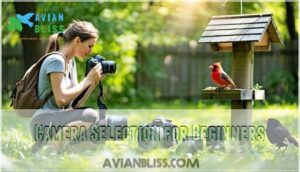
For backyard bird photography, beginner-friendly gear matters.
Comparing DSLR vs Mirrorless, start with what fits you best—DSLRs feel solid, but mirrorless cameras win with portability.
Consider sensor size and megapixel count; sharper photos need decent specs.
Ergonomics reign; a camera that’s comfy to hold keeps you snapping.
A telephoto lens offers varying levels of reach for capturing detailed shots.
Stick within your budget—great shots don’t require breaking the bank, and choosing the right gear is about finding the best balance between quality and affordability.
Lens Options for Better Reach
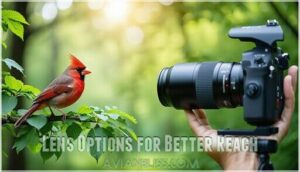
Choosing the right bird photography lens brings birds closer, even in your backyard.
Zooms offer flexibility, while primes shine for clarity.
Consider these bird photography lens choices:
- Telephoto lens: 400mm+ for reach.
- Budget lens: Third-party options save cash.
- Image stabilization: Cuts blur.
- Teleconverter benefits: Extend reach.
- Lens maintenance: Keep it clean—birds hate smudges!
Many photographers seek a specialized birding lens.
Tripods and Remote Shutter Releases
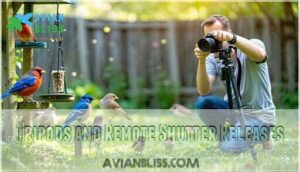
For bird photography, tripods and remote shutter releases are lifesavers.
A stable tripod minimizes shake, and gimbal heads guarantee swift movement for those unpredictable moments.
Use a remote to snap shots without touching the camera, keeping vibrations at bay.
Monopods are great for agility, too—perfect when chasing that elusive woodpecker in your yard.
For ideal stability, consider a specialized photography tripod.
| Feature | Benefits |
|---|---|
| Tripod Stability | Eliminates camera shake |
| Remote Advantages | Hands-free, vibration-free shooting |
| Gimbal Heads | Smooth adjustments for flight shots |
| Monopod Uses | Lightweight, mobile support |
| Vibration Reduction | Creates sharper images |
Memory Cards and Batteries
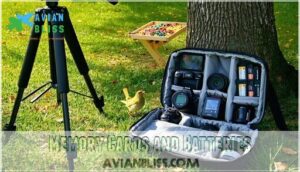
You’ve got the tripod, but don’t overlook memory cards and batteries.
Fast card speeds handle burst shots smoothly, while ample storage capacity keeps you snapping those backyard masterpieces.
Battery life is a lifesaver—stock up for long sessions.
Consider memory card speed for peak performance.
Backup strategies keep your bird photography tips alive when surprises strike.
Reliable power solutions guarantee your bird photography equipment never misses a moment.
Creating Bird Friendly Environment
If you want birds to visit your backyard, you’ve got to make it feel like home. Think food, water, and plants—basically a bird buffet with cozy, leafy seating.
Positioning Feeders and Perches
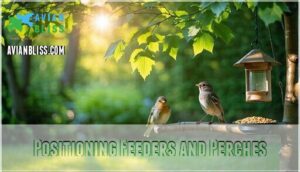
When setting up bird feeders and perches, think like a bird!
Position feeders in shaded, wind-protected spots for comfort, and place them at varying heights to attract different species.
Use natural perch materials, like branches, for a more authentic touch.
For the best bird photography setups, make certain a clean background and consider weather protection.
Happy snapping!
Planting Native Trees and Flowers

Native plants make your yard a bird magnet. They’re like the VIP buffet of bird-friendly landscaping!
Try these:
- Mulberries for summer snacks.
- Sunflowers for feathery foragers.
- Crabapples for winter treats.
- Serviceberries for springtime sweets.
- Dogwoods for year-round charm.
Local nurseries help you choose the best bird attractants for your area, supporting a thriving backyard ecosystem.
Water Features for Bird Attraction
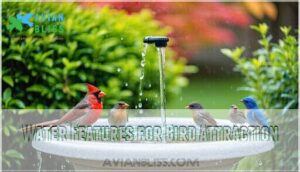
Add a birdbath or small fountain to your yard, and you’ll see thirsty birds flocking in no time.
Keep the water clean—stagnant water’s a no-go! Place your water source near shrubs but away from hiding predators.
Heated birdbaths are game-changers in winter, ensuring water access year-round.
These attract aquatic birds and enhance your backyard bird photography setup beautifully with year-round access.
Natural Landscaping for Diverse Species
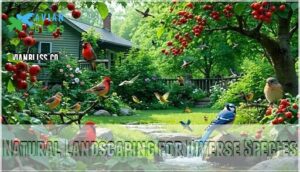
Think of your yard as a bird retreat. Incorporate native plantings to create a thriving backyard ecosystem.
Pair habitat variety with water sources to boost bird diversity. Seasonal diversity matters too, so mix plants that bloom or bear fruit year-round.
Natural landscaping attracts more birds by mimicking their preferred habitats, turning your space into a birdfriendly paradise. To further enhance the environment, consider planting native trees for shelter and food, creating a thriving backyard ecosystem.
Bird Behavior and Attraction
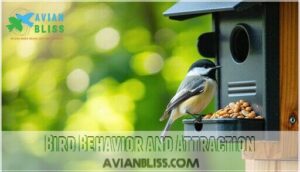
When you understand a bird’s behavior, you’re one step closer to capturing that perfect shot.
Watching their habits, like how a chickadee flits nervously or a cardinal boldly guards a feeder, makes your yard feel like a wildlife documentary waiting to happen.
Observing Bird Patterns and Habits
Watching birds is like uncovering secrets—they’re full of surprises!
Start by noting their habits:
- Observe feeding dynamics to find favorite foods and times.
- Track seasonal migrations—new species mean new photo ops.
- Look for behavioral cues like head tilts before take-off.
- Spot patterns to predict perching spots and flights.
Understanding flocking behaviors can also reveal social dynamics.
Patience reveals magic in backyard bird photography.
Using Field Guides and Apps
Field guides and apps serve as your birding detective tools, essential for accurate backyard bird identification before you pick up your camera.
Modern technology has transformed how we identify our feathered subjects.
| App Name | Key Features | Best For |
|---|---|---|
| Merlin | Photo & sound ID | Beginners |
| Audubon | 3,000+ photos, 8hrs audio | All levels |
| iBird Pro | Detailed illustrations | Advanced |
You’ll photograph more confidently when you know exactly who’s visiting your yard, using the right identification tools and techniques for accurate identification and becoming a skilled backyard bird observer.
Learning Bird Sounds and Calls
Your ears can be your secret weapon in backyard bird photography.
When you learn to recognize bird sounds and calls, you’ll anticipate behaviors before they happen.
Download bird apps like Merlin for sound identification or study vocal mimicry patterns of local species.
The distinct call variations of backyard birds often signal feeding, mating, or territory marking—giving you precious seconds to prepare for that perfect shot.
Journaling for Pattern Recognition
Keep track of your backyard visitors through bird journaling to reveal behavioral insights.
Note when specific species arrive, their feeding dynamics, and environmental factors that affect their presence.
You’ll soon spot patterns in seasonal variations – like how chickadees feed early while cardinals prefer dusk.
This recorded wisdom becomes your secret weapon for predicting perfect photo opportunities.
Bird photography patterns emerge once you’ve compiled enough observations!
Photography Techniques and Composition
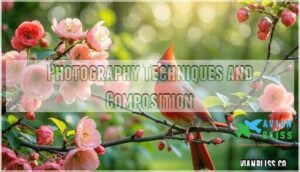
You’ll capture breathtaking backyard bird photos by mastering the right camera settings and composition techniques, which transform ordinary snapshots into gallery-worthy images.
Once you’ve got birds visiting your yard, it’s time to freeze those fleeting moments with the perfect combination of shutter speed, aperture, and focus—just like trying to photograph your energetic toddler, except these little subjects have wings! You are trying to capture a perfect combination.
Shutter Speed and Aperture Settings
The perfect shot of that cardinal at your feeder hinges on mastering your camera’s technical side.
Balancing shutter speed and aperture is like finding the sweet spot in a dance between freezing motion and creating depth.
Here’s how to nail your backyard bird photography settings:
- Use 1/2000 sec shutter speed for birds in flight
- Drop to 1/500 sec for perched birds
- Set aperture between f/5.6-f/8 for ideal sharpness
- Widen to f/4 in low light situations
- Remember: faster shutter speeds need wider apertures to achieve the best results
ISO Adjustments for Lighting Conditions
With your camera’s shutter speed and aperture set, let’s tackle ISO—your light sensitivity lifeline.
In backyard bird photography, lighting conditions change constantly.
Keep ISO low (100-400) in bright conditions for clean images.
When clouds roll in or during golden hour, don’t hesitate to bump it up to 800-3200.
Remember, a slightly grainy photo beats a blurry one every time in the exposure triangle balancing act.
Autofocus and Burst Mode Techniques
When photographing birds that dart about like feathered rockets, your autofocus settings become your best friend.
Set your camera to continuous autofocus with focus tracking to keep those chickadees pin-sharp, even during acrobatic feeder visits.
Enable burst mode at your highest burst speed to capture perfect action sequences without hitting your buffer capacity.
For backyard bird photography, sharpness priority settings guarantee you’ll never miss those split-second wing flaps again.
Advanced Strategies and Ethics

You’ll master backyard bird photography by balancing artistic vision with ethical responsibility, just as a bird watcher might balance on a branch for the perfect view.
When you’re chasing that award-winning shot, remember that your feathered subjects’ wellbeing always comes first, and they’ll reward your patience with natural behaviors that make truly memorable images.
Respecting Bird Wellbeing and Habitats
Birds deserve photographers who prioritize their welfare over the perfect shot.
When setting up your backyard studio, minimize stress by maintaining a respectful distance—your zoom lens exists for a reason!
Habitat preservation isn’t just good ethics; it guarantees future photo opportunities.
Consider ethical feeding practices and prevent window collisions with anti-reflection stickers.
Remember, disturbing nests can harm bird health and breeding success.
Your bird-friendly habitat creates a sanctuary where stunning natural behaviors can be captured without interference, promoting respectful photography practices.
Ethical Considerations for Photographers
While protecting bird wellbeing remains paramount, your role as a photographer carries ethical responsibilities too.
Always minimize disturbance by keeping your distance and using longer lenses. Avoid song playback which can stress birds during breeding season.
Consider habitat protection by staying on designated paths. Install anti-collision stickers on windows near your feeding stations.
Remember, capturing natural behavior trumps getting the "perfect shot" – responsible feeding and patience will reward you with authentic moments worth sharing.
Advanced Techniques for Challenging Shots
While respecting birds is paramount, mastering advanced techniques will take your backyard photography to the next level.
When facing challenging shots, try these approaches:
- Use Creative Blur with slow shutter speeds (1/15-1/60) to capture wing motion while keeping the body sharp
- Perfect Low-Light Mastery by pushing ISO higher than you’re comfortable with
- Practice Capturing Flight by pre-focusing on favorite perches
These bird photography techniques dramatically improve your action shots without stressing your feathered subjects.
Conservation Efforts and Bird Safety Measures
While capturing those perfect shots is thrilling, your backyard can be a lifeline for local birds facing habitat loss impact.
You’ll need to balance photography with bird conservation. Here’s how you can help:
| Conservation Actions | Safety Measures |
|---|---|
| Avoid toxic pesticides | Install window strike prevention decals |
| Keep cats indoors | Use responsible feeding practices |
| Plant birdfriendly landscaping | Clean feeders to prevent bird diseases |
| Submit citizen science data | Turn lights off at night |
| Buy bird-friendly coffee | Remove entanglement hazards |
Citizen scientists can contribute to monitoring bird populations, enhancing research and conservation efforts.
Frequently Asked Questions (FAQs)
Is backyard bird photography a good idea?
With over 900 bird species in North America alone, backyard bird photography is absolutely worthwhile.
You’ll enjoy capturing beautiful moments right from home while developing your photography skills and connecting with nature.
What should I do if I’m a bird photographer?
Set up bird-friendly feeders, master your camera settings, practice patience, and respect wildlife boundaries.
You’ll need a telephoto lens, steady tripod, and knowledge of local species to capture those perfect shots.
How can I improve my backyard bird photography?
Like an artist with a living canvas, you’ll capture stunning bird photos by using longer lenses (200mm+).
Setting up natural perches, providing varied food sources, and practicing patience with faster shutter speeds are essential for capturing stunning bird photos.
What is bird photography?
You’re engaging in the art of documenting birds through your camera lens, capturing their behaviors, colors, and movements while they’re in their natural habitat.
It’s both science and creativity rolled into one!
How should I plan my backyard bird photography setup?
Plan your setup with feeders away from predators, arrange natural perches, use a tripod-mounted camera with telephoto lens, and position yourself where sunlight illuminates birds.
You’ll need patience and quick reflexes!
What makes a good bird photo?
A good bird photo captures sharp details—especially the eye—with proper exposure, natural behavior, and clean backgrounds.
You’ll want dynamic composition, beautiful light, and that perfect moment when the bird’s personality shines through.
What is the rule of birds photography?
What secrets lie beyond the simple shutter click? You’ll prioritize the bird’s welfare, use fast shutter speeds to freeze motion, and always focus on the subject’s eye for compelling shots.
What happened to my backyard birds?
Your feathered friends might’ve vanished due to seasonal migration, predator presence, or changes in your feeding routine.
They’ll likely return when conditions improve—birds aren’t homebodies and follow food sources like tiny winged foodies!
What is the best setting for photographing birds?
For ideal bird photos, use a fast shutter speed (1/1000s+), aperture around f/6-f/8, and ISO 400-
Set up in good light, use a tripod, and focus on the bird’s eyes for sharp images.
What is it called when you take pictures of birds?
Taking pictures of birds is called "bird photography" or "avian photography.
You’re joining a passion that combines wildlife observation with creative expression, capturing feathered friends in their natural behaviors and environments.
Conclusion
Research shows that 67% of backyard bird photography enthusiasts report improved mental wellbeing from their hobby.
You’re now equipped to join their ranks! Remember, your journey with backyard birds doesn’t require perfection—just passion, patience, and practice.
As you apply these tips, you’ll develop your own signature style of bird photography.
Backyard birds offer endless opportunities for stunning shots right outside your door. So grab your camera, step outside, and let nature’s winged wonders inspire you!