This site is supported by our readers. We may earn a commission, at no cost to you, if you purchase through links.
 You’ll transform your bird photography during golden hour by shooting within that magical first and last hour of sunlight.
The warm, soft light enhances feather details and creates stunning natural colors without harsh shadows.
Set your camera to a wide aperture like f/5.6 for beautiful background blur, and use faster shutter speeds since you’re working with more available light.
Position yourself so birds are side-lit rather than backlit for ideal detail capture.
The key is timing – arrive early to scout locations and set up before the light peaks.
Master these fundamentals, and you’ll discover advanced techniques that separate amateur snapshots from gallery-worthy images.
Table Of Contents
- Key Takeaways
- Golden Hour Basics
- Benefits of Golden Hour
- Golden Hour Photography Tips
- Techniques for Golden Hour Shots
- Planning and Preparation
- Frequently Asked Questions (FAQs)
- What is the best time for bird photography?
- Is golden hour a good time to take pictures?
- What camera settings should I use during golden hour?
- What is the best time of day for wildlife photography?
- What camera equipment works best for golden hour?
- How does weather affect golden hour bird photography?
- Which bird species are most active during golden hour?
- What are common beginner mistakes in golden hour photography?
- How do you photograph birds in different golden hour seasons?
- Conclusion
Key Takeaways
- You’ll capture stunning bird photos by shooting during the first hour after sunrise and the last hour before sunset – this magical lighting window provides warm, soft illumination at 3,000 degrees Kelvin that enhances feather details and eliminates harsh shadows.
- Set your camera to wide apertures like f/2.8-f/5.6 and use faster shutter speeds of 1/800 as a minimum – the abundant golden hour light lets you freeze bird motion while creating beautiful background blur and maintaining a low ISO for clean images.
- Position yourself so birds are side-lit rather than backlit for optimal detail capture – this technique reveals intricate feather textures and patterns while the warm light wraps around your subjects naturally.
- Arrive at least 30 minutes early to scout locations and set up your equipment – you cannot afford to fumble with camera controls when perfect shots appear for mere seconds during this fleeting lighting window.
Golden Hour Basics

Golden hour occurs during the first hour after sunrise and the last hour before sunset, when the sun sits low on the horizon and creates soft, warm light at around 3,000 degrees Kelvin.
Golden hour transforms ordinary birds into luminous jewels, painting feathers with warm, ethereal light that no studio can replicate.
This magical lighting window transforms ordinary bird photos into stunning images because the gentle, diffused illumination enhances feather details and colors while eliminating harsh shadows that plague midday photography, creating a magical lighting effect with soft, warm light and gentle, diffused illumination.
Definition and Timing
Golden hour transforms ordinary bird photography into magical captures.
This prime shooting window occurs twice daily, creating perfect conditions for stunning wildlife shots.
Here’s when golden hour happens:
- Morning golden hour – First hour after sunrise
- Evening golden hour – Last hour before sunset
- Daily variation – Times shift based on your location
- Seasonal changes – Duration varies throughout the year
- Atmospheric effects – Weather impacts light quality and timing
Light Temperature and Quality
During golden hour, light temperature drops to around 3,000 Kelvin, creating that signature warmth you’ll notice in your bird photography.
Longer wavelengths produce softer diffusion quality compared to harsh midday sun, and this low-angle positioning extends shadow lengths naturally, giving your feathered subjects dimensional depth.
The wavelength effects enhance plumage colors while maintaining gentleness that flatters rather than overwhelms delicate bird features.
Ideal Lighting Conditions
This warm, 3,000-degree Kelvin light creates perfect bird photography lighting conditions.
You’ll find balanced exposure that’s neither too bright nor harsh, making it the best time for bird photography. Minimal shadows during this period further enhance the images.
Here’s what makes golden hour ideal:
- Soft illumination reduces harsh shadows on feathers
- Warm tones enhance natural colors beautifully
- Shadow play adds depth without overwhelming darkness
- Golden light flatters every species naturally
- Natural colors pop without heavy editing
Benefits of Golden Hour

You’ll discover that golden hour transforms your bird photography by enhancing natural colors and details while providing soft, warm light that can’t be replicated in post-processing.
This magical lighting window allows you to capture stunning images with higher shutter speeds, lower ISO settings, and beautiful deep blue sky backgrounds that make your feathered subjects truly shine, with soft, warm light.
Enhanced Bird Colors and Details
The magic happens when warm light kisses feathers at just the right angle.
Plumage illumination during golden hour transforms ordinary birds into masterpieces, revealing intricate feather detail you’d never notice in harsh midday sun.
Color saturation intensifies naturally—no filters needed.
Light direction from low angles creates ideal viewing conditions, making every texture pop with stunning clarity and depth.
The result is a visually stunning display of nature’s beauty, with each element working together in harmony to create a breathtaking scene, full of stunning clarity.
High Shutter Speeds and Low ISO
Better light means you can shoot faster and cleaner.
During golden hour, abundant soft light lets you achieve high shutter speeds around 1/2500 for freezing motion in bird photography while keeping ISO low for noise reduction.
This combination delivers ideal settings for image clarity and light sensitivity control, creating professional-quality shots with minimal effort, and your camera captures sharp feathers without grain.
Natural Deep Blue Sky Backgrounds
Sky colors pop when you shoot birds against that coveted natural deep blue sky during golden hour. The low sun angle creates perfect atmospheric conditions that make backgrounds rich and vibrant without needing polarization filters or extensive post-processing tweaks.
- Timing matters – shoot 30-45 minutes before sunset for deepest blues
- Clear skies work best – avoid heavy cloud cover that dulls background colors
- Position yourself strategically – keep the sun behind you for maximum sky saturation
- Use spot metering – meter on your bird subject to maintain proper sky exposure
- Ideal seasons vary – spring and fall often provide the clearest atmospheric conditions
Minimal Post-Processing Edits
Golden hour lighting delivers such pristine results that you’ll spend less time hunched over editing software.
The natural warmth and balanced exposure mean your shots look stunning straight from the camera, especially when shooting RAW format for maximum flexibility.
| Camera Setting | Golden Hour Advantage |
|---|---|
| White Balance | Natural warmth requires minimal adjustment |
| Exposure Accuracy | Balanced light reduces blown highlights |
| In-Camera Settings | Ideal conditions work with standard profiles |
| RAW vs JPEG | RAW captures full dynamic range effortlessly |
| Style Preferences | Natural light matches most artistic visions |
Golden Hour Photography Tips
You’ll capture your best bird photos when you master the technical aspects of golden hour lighting, from adjusting exposure compensation to prevent silhouetted subjects.
Using wide apertures for stunning bokeh effects is one of these proven techniques that transform ordinary bird encounters into extraordinary images.
These techniques showcase both the warm, soft light and intricate feather details that make golden hour photography so rewarding.
Utilizing Soft and Warm Light

Soft, warm light during golden hour transforms ordinary bird photos into masterpieces.
This natural light diffusion creates the perfect tone balance, reducing harsh shadows while enhancing your subject’s colors.
The golden glow wraps around feathers, revealing intricate details you’d miss in harsh midday sun.
- Position yourself to catch front-lit subjects for maximum color enhancement
- Use the warm light to highlight feather textures and patterns
- Let shadow reduction reveal details in darker plumage areas
- Embrace the golden hour lighting for natural, unforced brilliance
By following these tips, you can capture stunning bird photos that showcase the beauty of your subjects, with the warm light enhancing every detail.
Controlling Depth of Field
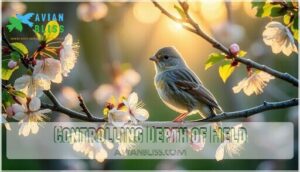
Wide apertures create stunning background blur, making your feathered subjects pop like gems against velvet.
Switch to Aperture Priority mode and dial in f/2.8 to f/4 for perfect subject isolation during golden hour sessions.
This technique transforms cluttered scenes into artistic masterpieces, with creamy bokeh that screams professional quality.
Your bird photography tips arsenal isn’t complete without mastering this fundamental sharpness control method.
Managing Exposure and Light
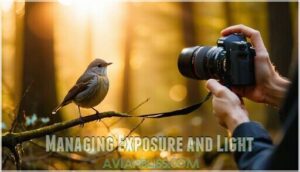
Managing exposure during golden hour requires precision since light changes rapidly within minutes.
Use spot metering to focus on your bird’s key features, avoiding blown highlights from bright backgrounds.
Exposure compensation helps balance tricky lighting situations, and bracket exposures to capture the full tonal range, and always shoot in RAW format for maximum editing flexibility.
The histogram becomes your best friend for perfect golden light exposure, and for precise light readings, consider dedicated spot meters.
Backlighting and Silhouette Techniques

Backlighting transforms ordinary bird shots into extraordinary art. Position yourself so the sun sits behind your subject, creating stunning rim lighting that outlines feathers with golden fire. This technique works magic during golden hour when the light’s warmth adds drama to your compositions.
Remember that proper exposure compensation is essential for backlighting.
- Underexpose by 2-3 stops to enhance rim lighting effects and create deeper shadows
- Focus on distinctive bird shapes for creative silhouettes that emphasize form over detail
- Shoot toward shadowed areas to make water droplets on feathers more visible and dramatic
- Use spot metering on the bird’s body to maintain proper exposure balance with backlighting
- Experiment with shadow emphasis to create high-contrast images that tell compelling visual stories
Techniques for Golden Hour Shots
You’ll transform your bird photography once you master these specific golden hour techniques that work with the warm, low-angle light.
These methods help you capture sharp flight shots, create dramatic silhouettes, and use wide apertures effectively during those fleeting moments when the sun sits perfectly on the horizon, utilizing the warm light to enhance your photographs.
Capturing Birds in Flight
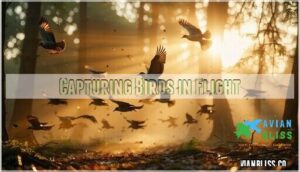
Flight shots become pure magic during golden hour when you master focus tracking modes and anticipate wing position impact.
Set your camera to continuous autofocus and follow the bird’s path smoothly.
Golden light direction from behind creates stunning rim lighting, while side lighting reveals intricate feather details.
Flight pose variety emerges as birds bank and turn, offering dynamic compositions with natural background blur techniques enhancing each frame, using continuous autofocus.
Using Wide Apertures and Fast Shutter Speeds
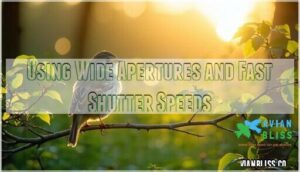
Your camera settings during golden hour require precise balance between aperture and shutter speed.
Start with f/2.8-4 for maximum light intake while maintaining sharp details.
Set shutter priority at 1/800 minimum to freeze wing motion and prevent motion blur.
These aperture effects create beautiful depth control, isolating birds against soft backgrounds.
Minimal shadows during this time enhance feather details.
Light sensitivity adjustments through ISO complete your bird photography triangle for stunning golden hour results.
Experimenting With Silhouettes and Backlighting
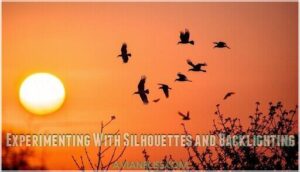
Dramatically transform your bird photography by positioning subjects between you and the sun.
Backlighting creates stunning rim lighting effects that outline feathers with golden halos, while underexposing by 2-3 stops produces striking silhouettes against vibrant skies.
Light metering becomes essential for balancing shadow detail with backlit subjects during golden hour sessions.
- Rim lighting technique: Position birds between camera and sun for glowing feather edges
- Silhouette shapes: Underexpose dramatically to emphasize distinctive bird profiles and forms
- Shadow detail balance: Use spot metering to maintain some detail while creating artistic contrast
Incorporating Foreground Elements

Foreground elements transform your bird photography golden hour shots from simple portraits into compelling stories.
Use rocks, branches, or flowers to create leading lines that guide viewers toward your subject.
This technique adds depth and provides scale reference, showing how magnificent that hawk really is, which enhances contextual storytelling and makes each frame more engaging and visually dynamic, highlighting the importance of creative composition.
Planning and Preparation

You’ll need to scout your location beforehand and use golden hour calculator apps to nail the precise timing, since this magical light window lasts only about an hour.
Arrive at least 30 minutes early to set up your gear and familiarize yourself with camera settings, because when that perfect golden light hits, you won’t have time to fumble with controls.
Scouting Locations and Timing
You’ll want to scout your chosen spots before golden hour arrives.
Walk the area during midday to identify the best vantage points and potential obstacles that could block your shots.
Check sunrise/sunset times for your location since these change throughout the year.
Peak bird activity coincides perfectly with golden hour, so you’ll catch subjects when they’re most active and lighting is ideal, during this peak bird activity.
Using Golden Hour Calculator Apps
Golden hour calculator apps take the guesswork out of photography timing. These digital tools predict exact sunrise and sunset times for your location, helping you arrive when lighting conditions peak.
Look for apps with offline functionality and intuitive user interface design. Feature comparison reveals some offer AR sun path visualization and customization options for different sun angle preferences, ensuring you’re positioned perfectly for ideal bird photography lighting.
Some photographers also explore related product options to enhance their golden hour shoots.
Familiarity With Camera Settings
Once you’ve nailed down timing with apps, mastering your camera settings becomes your secret weapon.
You can’t afford to fumble with controls when that perfect shot appears for mere seconds.
Here’s your golden hour camera checklist:
- Aperture Priority mode lets you control depth of field while maintaining proper exposure
- ISO 400-800 balances noise with adequate shutter speed for sharp bird photography
- Spot metering helps expose correctly for your feathered subject against bright backgrounds
- Auto White Balance handles the warm golden hour light naturally without constant adjustments.
To find related products, consider browsing online stores.
Arriving Early to Set Up and Avoid Crowds
Beat the rush by arriving an hour before sunrise advantages kick in.
Location scouting pays off when you’re not fighting other photographers for prime spots. Crowd avoidance means better wildlife behavior and cleaner compositions.
Remember to practice proper birding etiquette to minimize disturbance.
Use this quiet time for equipment readiness—check batteries, clean lenses, and plan your photography composition.
Early birds capture the magic while others hit snooze, allowing for better wildlife shots.
Frequently Asked Questions (FAQs)
What is the best time for bird photography?
You’ll capture your best bird shots during golden hour – that magical first hour after sunrise and last hour before sunset.
The warm, soft light enhances feather details while birds are most active.
Is golden hour a good time to take pictures?
Like striking photographic gold, you’ll find golden hour delivers exceptional results.
The warm, soft light flatters every subject beautifully.
You’ll capture richer colors, minimize harsh shadows, and create stunning images that’d be impossible during midday’s brutal brightness.
What camera settings should I use during golden hour?
Start with manual mode, lower your ISO to 100-400, use wider apertures like f/8-f/6 for shallow depth.
Adjust shutter speeds between 1/250-1/1000 depending on available light and subject movement.
What is the best time of day for wildlife photography?
Golden light paints wildlife in warm hues during sunrise and sunset’s magic hour.
You’ll find peak animal activity when shadows stretch long and temperatures cool, creating perfect conditions for stunning captures.
What camera equipment works best for golden hour?
You’ll need a fast telephoto lens with wide aperture, sturdy tripod for stability, and camera with good low-light performance.
Manual controls help adjust quickly as light changes rapidly during this magical hour.
How does weather affect golden hour bird photography?
Weather transforms your golden hour shots dramatically – cloudy skies can extend shooting time by 30 minutes while clear conditions create intense contrast.
You’ll need faster shutter speeds on bright days, slower settings when overcast diffuses light.
Which bird species are most active during golden hour?
You’ll find songbirds, raptors, and waterfowl are most active during these magical hours.
Early risers like robins, cardinals, and hawks hunt actively, while ducks and herons feed before temperatures rise and activity slows.
What are common beginner mistakes in golden hour photography?
Over 70% of golden hour shots fail due to poor planning.
You’re rushing setup, ignoring exposure compensation, shooting only auto mode, forgetting backup batteries, and not checking weather forecasts beforehand—simple oversights that’ll ruin your perfect lighting window.
How do you photograph birds in different golden hour seasons?
Adapt your settings seasonally: winter’s harsh light needs underexposure, spring’s soft warmth allows lower ISOs.
Summer requires early timing for cooler temperatures, while autumn’s rich colors shine with slight overexposure to capture vibrant plumage.
Conclusion
Through dedicated practice, you’ll discover that bird photography during golden hour truly transforms ordinary shots into extraordinary captures.
The theory that timing beats equipment proves accurate when you witness how natural light elevates your images beyond expensive gear upgrades.
Your patience during those early morning and evening sessions pays dividends in stunning feather details, vibrant colors, and professional-quality results.
Start implementing these techniques tomorrow morning, and you’ll immediately notice the dramatic improvement in your wildlife photography portfolio.