This site is supported by our readers. We may earn a commission, at no cost to you, if you purchase through links.

A single bird can carry more than 25,000 feathers, each one positioned with a precision that would humble most engineers. Experienced birders know this—and they use it.
The difference between a Pine Warbler and a Yellow-throated Vireo isn’t a gut feeling; it’s a specific combination of wing bars, eye rings, and undertail coverts that tells a clear story once you know how to read it.
Bird plumage identification features work like a field language, and fluency comes faster than most beginners expect.
Understanding what feathers do, how pigment works, and why patterns fall where they do transforms a confusing blur of color into a reliable system you can trust.
Table Of Contents
- Key Takeaways
- Key Features of Bird Plumage
- Interpreting Color Patterns and Markings
- Wing and Tail Identification Features
- Age, Sex, and Seasonal Plumage Variation
- Challenges in Plumage-Based Identification
- Tips for Accurate Plumage Observation
- Frequently Asked Questions (FAQs)
- What are the features of plumage?
- Can I take a picture of a feather and identify it?
- What are the 5 adaptive features of birds?
- How does habitat influence a birds plumage color?
- Can diet change the intensity of feather pigmentation?
- Which bird families share the most similar plumage?
- How do parasites and disease affect feather condition?
- Conclusion
Key Takeaways
- Feather type, color pigmentation, and arrangement patterns work together as a field language — once you learn to read them, most IDs become a matter of checking the right details in the right order.
- Color isn’t always what it seems: some hues come from diet, some from light-bending feather structure, and some only show up under UV — knowing the source helps you trust what you’re seeing.
- Age, sex, and season all rewrite a bird’s appearance, so the same species can look like three different birds depending on when and where you encounter it.
- Consistent, head-to-tail observation habits — paired with regional field guides and photo-ID apps — turn confusing sightings into confident identifications over time.
Key Features of Bird Plumage
Plumage is more than just a bird’s “outfit” — it’s a system built for survival, communication, and flight.
Each feather serves a purpose that goes well beyond looks, as explored in this deep dive into bird feather health and hygiene.
To read it well, you need to know what you’re actually looking at.
Three features will sharpen your eye more than anything else.
Feather Types and Functions
Birds rely on several feather types, each with a distinct job. Contour Feather Structure creates the smooth outer silhouette you see, while Remige Aerodynamics — powered by primary and secondary flight feathers — keeps birds airborne. Beneath the surface, Down Insulation traps warmth in fluffy air pockets.
Ornithologists study various types of bird feathers to understand bird biology and conservation.
Filoplume Sensory feathers detect subtle plumage shifts, and Bristle Protection guards the face.
Together, these feather types make identification — and survival — possible.
Coloration and Pigmentation
Feathers don’t just protect — they communicate. Coloration and pigmentation are your first real clues in the field.
- Melanin Pigment Types — eumelanin creates blacks and dark browns; pheomelanin produces rufous and buff tones
- Carotenoid Dietary Sources — yellows, oranges, and reds come entirely from food, not the bird itself
- Structural Iridescence Mechanisms — hummingbird throats shift color with viewing angle, no pigment required
- UV Fluorescence Detection — some markings only appear under ultraviolet light
- Combined Color Effects — green plumage often layers yellow pigment over structural blue
Albino and leucistic birds lack normal pigment entirely, proving how much coloration shapes identification. Cassowaries demonstrate a novel rachis-based structural color mechanism.
Feather Arrangement Patterns
Color tells you what — but arrangement tells you where.
Most birds grow feathers in organized tracts called pterylae, with bare patches called apteria hidden underneath.
This pterylae layout creates predictable wing patterns, head markings, tail features, and underparts patterns you can count on.
Coverts rowing across the wing and scapular overlap at the shoulder follow a tract molting sequence that stays consistent across healthy individuals.
Interpreting Color Patterns and Markings
Color patterns and markings are where bird ID really starts to click. Once you know what to look for, a few key details can separate a confusing sparrow from a clear-cut warbler.
Here are the main features worth training your eye on.
Streaks, Spots, and Bars
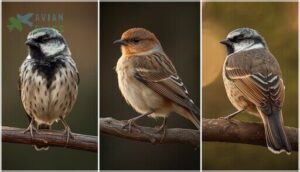
Three simple pattern types reveal a surprising number of identifications. Breast streak patterns, flank spot distribution, and barred tail significance each serve as reliable field marks once you know what to look for:
These patterns become even more meaningful when you understand how bird color identification and sexual dimorphism shape the visual differences between males and females in the field.
- Breast streaking separates many sparrow species at a glance
- Seasonal streak variation shifts with age and molt cycles
- Tail spots and wing bars narrow species groups quickly
- Sexual dimorphism bars often distinguish males from females
- Crisp versus blurry streaks reveal age differences
Trust the pattern.
Eye Rings, Crests, and Facial Markings
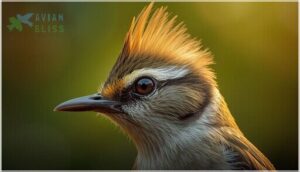
bird’s face tells a story the moment you lay eyes on it.
Eye Ring Contrast against surrounding feathers instantly separates tricky warblers and vireos.
Watch for Crest Display Behavior — raised feathers signal alarm or excitement.
Facial Stripe Patterns, including the supercilium variation above the eye, the eyeline through it, and Malar Stripe Significance below the cheek, combine with colored lores to build diagnostic features no other field marks can match.
Wing Bars and Patches

Wing bars and patches rank among the most reliable field marks you’ll use. A wing bar forms where pale feather tips line up across the coverts — giving you those clean horizontal stripes on a folded wing.
- Bar Placement on median vs. greater coverts separates look‑alike species
- Patch Shape — rounded or rectangular — refines your ID in flight
- Seasonal Bar Intensity fades as feathers wear through winter
- Sexual Dimorphism Bars show broader, brighter markings on adult males
- Field Guide Bar Codes treat bar number and color as core diagnostic features
Cross‑reference wing patterns with plumage patterns overall, and tricky IDs become much more manageable.
Wing and Tail Identification Features

Wings and tails are where a lot of the real identification work happens. Once you know what to look for, these features can tell you more than color alone ever could.
Here’s what to focus on.
Wing Shape and Pattern
bird’s wings tell a story before it even lands.
Elliptical Wing Morphology — short and rounded — gives robins and sparrows quick, agile flight through dense trees.
Passive Soaring Design, seen in eagles, uses slotted primaries to ride thermals effortlessly.
Primary Projection Variance helps separate similar warblers.
Watch for Speculum Coloration on ducks, Wing Edge Silhouette, wing bars, and feather patterns — these field marks make all the difference.
Tail Shape, Length, and Markings
The tail is one of the most underrated field marks in bird identification. Once you start reading it, you’ll wonder how you ever missed it. Three morphological characteristics to watch:
- Tail Shape Identification — forked tail dynamics (swallows), graduated tail patterns (wrens), or squared tips (goldfinches)
- Tail Color Contrast — tail spots on outer feathers flash white against dark centers
- Tail Streamer Sexuality — longer streamers often signal males
Knowing these clues sharpens every observation.
Flight Feather Characteristics
engineering marvels are hiding in plain sight. Primary asymmetry — that narrow leading vane versus the wider trailing vane — keeps each feather stable under pressure. Meanwhile, self-healing surface creates a surface thataling surface restores restores aerodynamic smoothness after wingbeat.
| Feature | What It Tells You |
|---|---|
| Secondary lift feathers | Inner wing; broad, shorter |
| Slotting tips | Soaring vs. fast-flapping style |
| Feather wear patterns | Age and migration intensity |
| Primary count | Species group identification |
Happy feather-watching!
Age, Sex, and Seasonal Plumage Variation

A bird’s plumage doesn’t stay the same throughout its life — and that’s actually great news for identification.
Knowing what drives those changes puts you a step ahead in the field.
Here are the three key variation types worth understanding.
Juvenile Vs Adult Plumage
Juvenile birds don’t look like miniature adults — they’re built for survival first. Age-specific markings like heavy streaking, duller feather coloration, and smudged patterns help them blend in.
Molt timing determines how quickly they develop adult plumage, with some species taking years. Watch for bare-part color clues too — pale gape flanges or dark irises signal youth just as clearly as feather wear does.
Breeding Vs Non-breeding Plumage
Age tells part of the story — but season rewrites it entirely.
A male American Goldfinch in winter looks nothing like his summer self: dull olive-brown replaces that electric yellow.
That’s a seasonal color shift at work.
Molting timing drives these changes, with iridescent breeding displays emerging through prealternate molts.
Watch for bill color change and skin hue variation too — field marks you can’t afford to miss.
Sexual Dimorphism in Plumage
Season rewrites appearance — and so does sex.
Sexual dimorphism in birds runs deep, driven by carotenoid brightness in reds and yellows, plus UV reflectance differences that your eyes may miss entirely.
Male tanagers, warblers, and finches wear bold breeding plumage, while females stay cryptic by design — an evolutionary trade-off between attraction and survival.
Male birds dazzle to attract; females hide to survive — evolution’s oldest trade-off written in feathers
Genetic Z‑linkage underlies much of this, making avian sexual dimorphism a reliable, built-in field mark.
Challenges in Plumage-Based Identification

Even with a solid grasp of plumage basics, identification doesn’t always go smoothly. Birds are messy, living creatures — and the field throws a few curveballs that can trip up even experienced observers.
Here are the main challenges worth knowing before you head out.
Molting and Transitional Feathers
Molt timing trips up even seasoned birders. During a partial molt, birds replace only select feathers — head, breast, some coverts — leaving older ones behind.
That boundary between worn and fresh feathers is called a molt limit.
Eccentric molt and adventitious feathers complicate things further, creating uneven wing patterns or isolated replacement feathers that mimic rare plumages.
Recognizing these avian molting processes transforms confusing sightings into confident IDs.
Lighting and Environmental Effects
Light is just as tricky as molt — and just as misleading.
Lighting conditions reshape what you see in real time:
- Sun-shadow gular stripes appear on bird throats when direct sunlight hits bill edges at certain angles
- Angle-dependent iridescence makes hummingbird gorgets flash ruby, then emerald, with a slight head tilt
- Diffuse light coloration under overcast skies flattens reds to brown and blues to gray
- Backlighting plumage highlights wing edges while hiding body markings entirely
Weather-driven camouflage is real too — humidity and rainfall genuinely influence melanin levels across populations, making environmental impacts on bird coloration far more variable than most beginners expect.
Variability Within Species
Even within a single species, variation runs deep. Geographic morphs mean a robin in the Pacific Northwest looks noticeably darker than one in the arid interior. Hybrid zones blur those lines further.
Age‑related patches, sexual dimorphism, health indicators like feather quality, seasonal color morphs, and molting all layer onto each other.
Understanding this species variation helps you stop second-guessing yourself — and start seeing the full picture.
Tips for Accurate Plumage Observation

Knowing what to look for is only half the battle — how you look matters just as much. A few practical habits can make a real difference in how quickly and accurately you identify birds in the field.
Here’s what works.
Systematic Observation Techniques
Good observation isn’t luck — it’s habit. Follow a consistent Body Part Sequence every time: crown to tail, no shortcuts.
- Start with a naked-eye size impression before raising binoculars — Binocular Timing matters.
- Work head to tail, capturing facial field marks first.
- Use Standardized Color Terms like “buff” or “streaked.”
- Practice Angle Shifting to reveal hidden field marks.
- Note Negative Plumage Evidence — “no wing bars” is still useful data.
Systematic observation of bird features turns visual clues into confident bird identification through plumage. You’ll get there.
Using Field Guides and Apps
Pairing the right tools makes field identification far less frustrating.
Regional guide selection matters — a guide built for your area shows only birds you’ll actually encounter.
Use digital filter customization in apps like Merlin Bird ID to narrow results by color and pattern quickly.
| Tool | Best Use | Limitation |
|---|---|---|
| Regional field guide | Offline field-guide tactics | Bulkier to carry |
| Merlin Bird ID | Photo-ID workflow | Needs connectivity |
| Broader national guide | Cross-checking app results | Less region-specific |
Always cross-reference. Happy birding.
Photographing Birds for Reference
A sharp photo beats a sketch every time. When you photograph birds for reference, use a fast shutter speed — around 1/1000 of a second — to freeze movement and preserve plumage detail.
Ideal lighting during golden hour keeps colors true.
Framing angles matter too: side profiles, head shots, and spread tails each reveal different field marks.
Follow ethical practices by keeping your distance.
Good reference composition enhances identification accuracy beyond the field.
Frequently Asked Questions (FAQs)
What are the features of plumage?
Plumage is built from feather types, overall coloration, field marks, and head markings.
Structural iridescence, habitat camouflage, sexual color contrast, flight feather aerodynamics, plumage wear patterns, and seasonal plumage all shape what you see in the field.
Can I take a picture of a feather and identify it?
Yes, you can. Apps like Feather Identifier and BirdSnap use AI to match your photo against vast feather databases instantly. Clear shots of the vane improve accuracy substantially.
What are the 5 adaptive features of birds?
Birds have five key adaptive features: pneumatic bones for lightweight strength, air sac system for efficient breathing, thermal insulation from plumage, beak diversity for varied feeding, and a magnetic compass for navigation.
How does habitat influence a birds plumage color?
Habitat shapes a bird’s color through camouflage matching, climate-driven darkness, urban melanin demands, carotenoid availability, and light contrast — each ecological niche quietly nudging avian coloration toward whatever helps that bird survive.
Can diet change the intensity of feather pigmentation?
Absolutely. Diet shapes feather color more than most people realize. Carotenoid-rich foods directly fuel the bright yellows, oranges, and reds you see. Without them, those colors fade noticeably during molt.
Which bird families share the most similar plumage?
Herons and egrets are classic family look-alikes — both show long necks, white plumage, and dark legs.
Convergent plumage across these groups makes distinguishing families tricky without checking bill shape and size.
How do parasites and disease affect feather condition?
Parasites and disease quietly wreck feather condition.
Feather lice damage vanes, mite dullness flattens sheen, and stress bar indicators signal past illness.
Disease feather loss and parasite color change make identification genuinely tricky.
Conclusion
What separates confident identification from a frustrating guess? It’s knowing exactly where to look.
Bird plumage identification features give you a repeatable system—one built on feather structure, color patterns, markings, and variation across age and season. Each field outing sharpens that system a little more. You won’t get every bird right away, and that’s fine. The more you observe with intention, the faster the language of plumage starts speaking clearly back to you.
- https://www.allaboutbirds.org/news/bird-id-skills-field-marks/
- https://blog.mybirdbuddy.com/post/how-to-identify-birds-plumage
- https://avianreport.com/age-and-identify-a-juvenile-and-sub-adult-bald-eagle/
- https://phys.org/news/2020-11-migration-molt-affect-birds.html
- https://www.basicsofbirding.com/blog/how-to-identify-birds-looking-for-key-field-marks