This site is supported by our readers. We may earn a commission, at no cost to you, if you purchase through links.
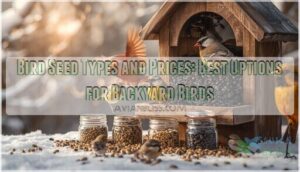
Last winter, a cardinal pair visited my feeder daily—until I switched to a cheaper seed blend. They vanished within a week, and I learned an expensive lesson about bargain bird seed.
The truth is, not all bird seed delivers the same value, and understanding the connection between seed types and their prices can transform your backyard into a thriving avian hub without draining your wallet. Different seeds attract specific species, and their costs vary wildly based on factors like oil content, regional availability, and seasonal demand.
Black oil sunflower seeds might cost twice as much as white millet, but they’ll bring in cardinals, chickadees, and nuthatches that cheaper blends won’t touch. Knowing which seeds offer the best return—in both bird visits and budget—means you’ll stop wasting money on filler ingredients that end up scattered on the ground.
Table Of Contents
- Key Takeaways
- Popular Bird Seed Types and Their Benefits
- Price Comparison of Common Bird Seeds
- Factors Influencing Bird Seed Prices
- Top 10 Bird Seeds for Backyard Birds
- 1. Wild Bird Food Variety Blend
- 2. Lyric Wild Bird Seed Mix
- 3. Black Oil Sunflower Bird Seed
- 4. Shafer Safflower Seed For Wild Birds
- 5. Wagner’s Nyjer Seed Bird Food
- 6. Shafer White Millet Bird Seed
- 7. Wagners Cracked Corn Wild Bird Food
- 8. Lyric Peanut Wild Bird Seed
- 9. Morning Song Wild Bird Seed Mix
- 10. Wild Bird Mealworm Food Supplement
- Tips for Buying and Storing Bird Seed
- Frequently Asked Questions (FAQs)
- What is the best inexpensive bird seed?
- What is the cheapest way to feed the birds?
- Why is bird seed suddenly so expensive?
- What is the best birdseed to attract the most birds?
- How do you store bird seed long-term?
- What bird seeds deter unwanted pests effectively?
- Can bird seed attract specific bird species?
- Are organic bird seeds worth the cost?
- How do you prevent mold in bird seed?
- How to attract specific bird species?
- Conclusion
Key Takeaways
- Black oil sunflower seeds deliver the best return on investment at $0.50–$0.90 per pound in bulk, attracting cardinals, chickadees, and nuthatches with their 40–50% fat content and thin shells that nearly every songbird can crack easily.
- Buying bird seed in bulk quantities of 25–50 pounds reduces costs by 20–40% compared to retail packaging, though you’ll need airtight storage containers in cool, dry conditions below 75°F to prevent mold and maintain freshness for 1–3 months.
- Seed selection matters more than price alone—nyjer attracts finches specifically, safflower deters squirrels while drawing cardinals, and white millet costs just $0.25–$1.00 per pound for ground-feeding birds like sparrows and doves.
- Quality indicators include recent packaging dates, third-party certifications for contaminant screening, uniform seed color, and proper storage practices that prevent the rancidity and aflatoxin contamination found in cheap filler blends.
Popular Bird Seed Types and Their Benefits
Choosing the right bird seed can feel overwhelming when you’re staring at a wall of bags at the store, but it doesn’t have to be. Each seed type attracts different species and offers unique benefits, so understanding your options is the first step toward creating a backyard haven that birds can’t resist.
Let’s break down the most popular seed types and what makes each one special for your feathered visitors.
Black Oil Sunflower Seeds for Songbirds
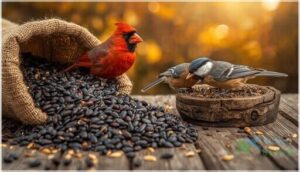
Black oil sunflower seeds are absolutely the benchmark for attracting songbirds to your backyard! These small, dark-hulled kernels pack a fat content of 40–50%, delivering the energy-rich nutrition your feathered friends need during migration and chilly weather. Cardinals, chickadees, and nuthatches can’t resist them, and the thin shells make cracking easy for nearly every species.
- High fat content bolsters daily energy needs and feather condition
- Thin shells allow easy access for diverse songbird species
- Attracts cardinals, blue jays, chickadees, and nuthatches consistently
- Store in airtight containers away from sunlight to prevent rancidity
- Widely available in bulk formats at lower per-pound prices
Nyjer Seeds for Finches and Goldfinches
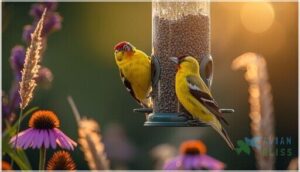
If you want to attract finches and goldfinches specifically, Nyjer seed is your go-to choice! This small, oil-rich black seed (Guizotia abyssinica) delivers high fat content that furnishes sustained flight and reproductive energy. American goldfinches absolutely love it, and you’ll often see them clinging to specialized tube feeders formulated for these tiny kernels. If you’re worried about cleanup, check out these no-mess bird food options that reduce shell waste while still attracting your favorite finches.
Store Nyjer in airtight containers to preserve freshness, and watch your finch population flourish throughout the seasons! Researchers use scientific study methods to understand bird behavior and preferences.
Safflower Seeds for Cardinals and Squirrel Resistance
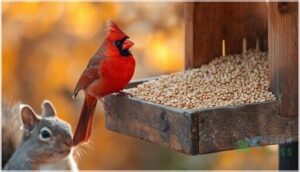
Cardinals love safflower seeds because the hard shell and high-fat kernels provide sumptuous nutrition during breeding and winter months. That’s why safflower seed is absolutely perfect for attracting these gorgeous wild birds while naturally deterring squirrels—who won’t bother with the tough, bitter shells!
Adult cardinals show a strong feeding preference for safflower, making it an excellent choice among bird seed types for squirrel resistance.
White Millet for Ground-Feeding Birds
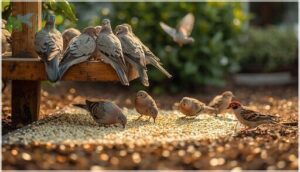
While cardinals prefer eating from elevated perches, sparrows, doves, and juncos thrive on ground feeding with white millet. This affordable bird seed type is formulated specifically for wild birds that forage on the ground, offering excellent millet nutrition at lower prices than premium sunflower blends! For those exploring budget-friendly options, different types of bird seeds like cracked corn can also attract ground feeders without breaking the bank.
- Scatter millet directly on clean ground or use platform bird feeders for easy access
- Store seed in airtight containers to prevent moisture and maintain freshness
- White millet attracts diverse species including mourning doves and native sparrows
- Proper feeder placement near cover helps ground-feeding birds feel secure while eating
Peanuts and Cracked Corn for High Energy
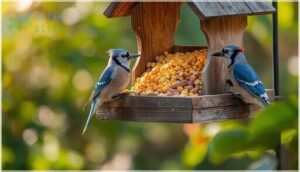
When backyard bird feeding demands powerful energy sources, peanuts and cracked corn deliver outstanding high-calorie nutrition for your wild bird diet! Peanuts pack roughly 45–50% fat content and 160–170 calories per ounce, while cracked corn offers carbohydrate-rich fuel that jays and doves absolutely love.
| Seed Type | Fat Content | Primary Benefit | Best For | Safety Note |
|---|---|---|---|---|
| Peanuts | 45–50% | High energy, protein-rich | Woodpeckers, jays, nuthatches | Use shelled to prevent choking |
| Cracked Corn | 3–4% | Carbohydrate fuel | Doves, quail, ground feeders | Attracts squirrels if not managed |
Here’s what makes these high-energy bird food options work for bird nutrition and health: Choosing the right mix of seeds and suet through proven bird food and feeder strategies helps ensure visiting birds get the fat and protein they need year-round.
- Offer shelled peanut kernels or hearts to reduce choking risks for smaller songbirds
- Mix peanuts with other bird seed types for balanced seed mixing that prevents feeder monopolization
- Check regularly for mold since aflatoxin contamination poses serious health risks
- Position feeders strategically because squirrels target these energy-dense options quickly!
Price Comparison of Common Bird Seeds
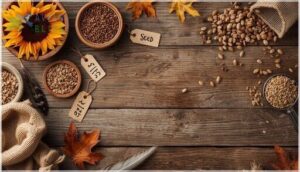
Understanding what you’ll spend on bird seed helps you plan your budget and make smart choices for your feathered visitors. Prices can vary quite a bit depending on the type of seed, where you buy it, and how much you purchase at once.
Let’s break down the costs of the most common bird seeds so you know exactly what to expect when you’re shopping for your backyard birds.
Black Oil Sunflower Seed Price Range
Black oil sunflower seeds remain the benchmark for attracting songbirds, and understanding seed cost factors helps you budget wisely. Retail pricing usually runs $1.50 to $2.50 per pound for small bags, while bulk discounts drop costs to $0.50–$0.90 per pound in 25–50 pound quantities. Seasonal savings can slash prices by 10–25 percent, so stock up during promotions! For a deeper dive into seed quality and feeder strategies, check out this guide on selecting the best bird seed for wild birds.
| Package Size | Price Per Pound | Best For |
|---|---|---|
| 1–5 lbs (retail) | $1.50–$2.50 | Testing preferences |
| 20–25 lbs | $0.60–$1.00 | Regular feeders |
| 25–50 lbs (bulk) | $0.50–$0.90 | Serious bird enthusiasts |
Nyjer Seed Cost Analysis
Finches absolutely adore nyjer seed, but your wallet mightn’t! Retail prices usually run $1.50 to $3.50 per pound depending on packaging size, while bulk options (40–50 lb bags) offer wholesale pricing relief at $1.20 to $2.50 per pound. If you’re mixing seed types to attract a broader range of visitors, check out which bird food blends work best for specific species before investing in bulk quantities.
Weather-related nyjer market fluctuations can affect seed price trends, and certified organic varieties command premiums due to rigorous seed quality control standards.
| Package Size | Price Per Pound |
|---|---|
| 5–10 lbs (retail) | $2.50–$4.50 |
| 40–50 lbs (bulk) | $1.20–$2.50 |
Safflower and Millet Seed Pricing
Safflower seed attracts cardinals while deterring squirrels, but you’ll pay $1.30 to $2.50 per pound at retail—higher than sunflower seeds due to lower yields. White millet, perfect for ground-feeders like sparrows, costs just $0.25 to $1.00 per pound.
Bulk discounts greatly reduce both prices, and regional pricing variations mean savvy shoppers can find better deals by comparing local suppliers and watching market trends.
| Seed Type | Retail Price Per Pound |
|---|---|
| Safflower | $1.30–$2.50 |
| White Millet | $0.25–$1.00 |
Mixed Seed Blends and Premium Mixes
You’ll find premium bird seed mixes priced between $1.20 and $2.00 per pound—markedly higher than standard blends at $0.60 to $1.10. Why the premium costs? Enhanced seed diversity, optimal blend ratios, and improved seed quality that boost bird attraction. These mixes emphasize sunflower seeds, safflower, and occasional nyjer seed while reducing filler ingredients.
| Mix Type | Price Per Pound | Key Features |
|---|---|---|
| Standard Seed Blends | $0.60–$1.10 | Sunflower, millet, cracked corn |
| Premium Bird Seed Mixes | $1.20–$2.00 | Diverse species appeal, less filler |
Bulk Vs. Retail Price Differences
Switching to bulk purchases absolutely transforms your wild bird food budget! Bulk pricing cuts costs dramatically—you’re looking at $0.40–$0.70 per pound for black oil sunflower versus $0.50–$0.90 retail. Wholesale discounts reward larger orders with tiered price reductions, while retail costs include packaging expenses that bump up per-pound rates.
| Purchase Method | Price Variance Benefits |
|---|---|
| Bulk Bird Seed | Lower per-pound costs, wholesale discounts |
| Retail Costs | Convenient packaging, smaller quantities |
| Bulk Nyjer Seed | Significant savings over retail ($1.50–$3.00) |
| Best Bird Seeds Quality | Both channels offer premium options |
| Seed Quality Control | Bulk requires proper storage containers |
Factors Influencing Bird Seed Prices
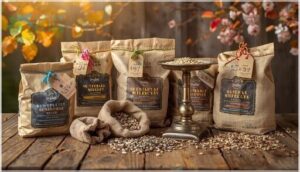
You’ve probably noticed that bird seed prices can swing wildly from one bag to the next, and it’s not just about the type of seed inside. Several factors work together to determine what you’ll pay at checkout, from the brand name on the label to the time of year you’re shopping.
Let’s break down the key elements that affect bird seed costs so you can make smarter purchasing decisions.
Seed Type and Species Preferences
Your seed selection directly shapes which bird species visit your yard, and that’s absolutely worth understanding! Black oil sunflower seeds attract cardinals and chickadees, while nyjer seed brings finches flocking to feeders.
Different bird species have distinct feeding habits and nutrient needs, so knowing these preferences helps you choose bird seed types that boost species diversity and keep your feathered friends healthy year-round.
Brand Reputation and Packaging Size
Once you’ve identified which species you want to attract, brand reputation and packaging size become your next consideration. Trusted names like Wagners Farmers Delight deliver consistent ingredient sourcing and clear labeling standards, building customer loyalty through product visibility and quality assurance. Larger bags usually offer better value per pound, making bulk purchases economical for regular feeders.
Key factors when evaluating wild bird food brands:
- Packaging design affects shelf visibility and helps you identify best bird seeds quickly
- Brand trust ensures you’re getting formulated blends with proper ingredient purity
- Reputable manufacturers maintain strict labeling standards for transparency
- Larger packaging correlates with lower unit costs, stretching your budget further
- Bird seed reviews from fellow enthusiasts guide you toward reliable products
Seasonal Demand and Regional Variations
Beyond brand and packaging, prices shift dramatically when winter demand peaks in northern regions and holiday promotions sweep through retail stores. Regional trends reveal that Midwestern buyers face price sensitivity tied to local crop yields, while East Coast markets show higher variation due to urban retail structures.
Here’s how seasonal fluctuations and geographic differences shape what you’ll pay:
| Factor | Impact on Price |
|---|---|
| Winter demand surge | Prices climb 15-30% in northern zones |
| Regional transport costs | Western areas see modest premiums |
| Holiday promotions | Late fall discounts boost purchases nationwide |
| Migratory patterns | Spring/fall demand spikes for specific seed blends |
Understanding these demand patterns helps you time purchases strategically and secure the best bird seeds at ideal prices throughout the year.
Quality, Freshness, and Ingredient Purity
When you’re comparing bird food, freshness testing and ingredient disclosure separate budget blends from premium sunflower seeds. Reputable brands screen for aflatoxins and pesticides, verify seed sourcing origins, and maintain storage practices below 70°F to prevent rancidity—factors that directly affect avian nutrition and justify higher prices.
Quality markers to prioritize in your seed selection:
- Packaging dates confirm recent harvesting and processing
- Third-party certifications validate contaminant screening standards
- Resealable bags preserve freshness after you open them
- Uniform color signals proper drying and minimal fillers
Top 10 Bird Seeds for Backyard Birds
Now that you understand what drives bird seed pricing, let’s talk about the options that’ll actually bring birds to your backyard.
I’ve put together a list of ten proven seeds and blends that work for different species and budgets. These picks cover everything from single-seed staples to carefully formulated mixes that attract a diverse crowd.
1. Wild Bird Food Variety Blend
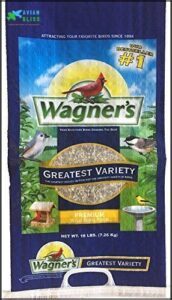
Wagner’s Greatest Variety Blend absolutely delivers on its promise with 11 different ingredients formulated to attract a colorful array of songbirds to your yard. This 16-pound wild bird food features 40% sunflower seeds and works beautifully in tube, hopper, or platform feeders.
You’ll appreciate that it’s made in the USA with high-quality grains, though proper seed storage matters since the bag isn’t resealable.
At around $0.70–$1.10 per pound for this seed mix quality, it offers solid value for attracting diverse bird species.
| Best For | Backyard bird enthusiasts who want to attract multiple songbird species without switching between different seed types throughout the year. |
|---|---|
| Weight | 16 pounds |
| Brand | Wagner’s |
| Item Form | Seed |
| Made in USA | Yes |
| Target Birds | Colorful songbirds |
| Primary Ingredient | Sunflower (40%) |
| Additional Features |
|
- Features 11 ingredients with 40% sunflower content that draws in a wide variety of colorful songbirds to your feeders
- Works in tube, hopper, or platform feeders, giving you flexibility in how you set up your bird-feeding station
- Made in the USA with high-quality grains at a reasonable price point of $0.70–$1.10 per pound
- Non-resealable bag makes it harder to keep seeds fresh and can lead to spoilage if not transferred to an airtight container
- Some customers have reported quality control issues including bugs, mold, and inconsistent batches
- High sunflower content attracts squirrels and other wildlife that may dominate your feeders
2. Lyric Wild Bird Seed Mix
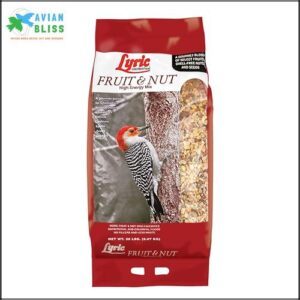
Lyric’s Fruit & Nut Wild Bird Seed Mix stands out with 13 premium, all-natural ingredients, including shell-free nuts and dried fruits that attract chickadees, cardinals, orioles, and even cedar waxwings. You won’t find fillers here, which means less waste and better bird health throughout the year.
This gourmet wild bird food works wonderfully in hopper, tray, or tube feeders, though the large pieces don’t fit well in slot-style feeders. At roughly $1.20–$2.00 per pound, it’s pricier than standard sunflower seeds, but the quality and bird attraction make it worthwhile.
| Best For | Bird enthusiasts who want to attract a diverse range of songbirds with a premium, no-filler mix and don’t mind spending a bit more for quality ingredients. |
|---|---|
| Weight | Not specified |
| Brand | Lyric |
| Item Form | Seed |
| Made in USA | Not specified |
| Target Birds | Chickadees, robins, orioles, cardinals |
| Primary Ingredient | Fruits and nuts |
| Additional Features |
|
- 13 all-natural ingredients including shell-free nuts and dried fruits create less mess and waste than standard mixes
- Attracts a wide variety of birds from chickadees and cardinals to orioles and cedar waxwings
- High-energy formula supports wild birds’ nutritional needs year-round
- Higher price point ($1.20–$2.00 per pound) compared to basic sunflower seed mixes
- Large pieces don’t work well in slot-style hanging feeders, limiting feeder options
- Contains a significant amount of corn that some birds may ignore
3. Black Oil Sunflower Bird Seed
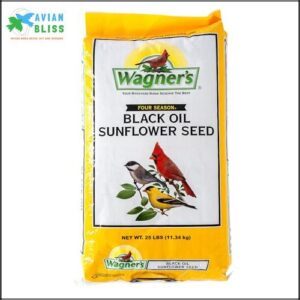
Black oil sunflower seeds absolutely deserve their reputation as the benchmark among bird seed types—they’re packed with 50–60% fat content by weight, delivering the high-energy nutrition songbirds crave! You’ll attract cardinals, chickadees, nuthatches, and woodpeckers with these thin-shelled kernels that small beaks crack effortlessly.
Wagner’s 25-pound bag runs about $0.50–$0.90 per pound, offering excellent value for consistent feeder maintenance.
Store your wild bird seed in airtight containers away from moisture to preserve that essential oil content and prevent rancidity between refills.
| Best For | Bird enthusiasts looking for a cost-effective, high-energy seed that attracts a wide variety of songbirds like cardinals, chickadees, and finches to their backyard feeders. |
|---|---|
| Weight | 25 pounds |
| Brand | Wagner’s |
| Item Form | Seed |
| Made in USA | Yes |
| Target Birds | Cardinals, chickadees, finches, woodpeckers |
| Primary Ingredient | Black Oil Sunflower |
| Additional Features |
|
- High fat content (50–60%) provides excellent energy for birds, especially during winter months
- Thin shells make it easy for small-beaked birds to crack open and consume efficiently
- Attracts a diverse range of popular bird species including cardinals, woodpeckers, and nuthatches
- Some customers report finding debris like wood chips and twigs mixed in with the seeds
- The 25-pound bag lacks a resealable closure, which can lead to spills and storage challenges
- May attract unwanted wildlife such as squirrels to your feeding area
4. Shafer Safflower Seed For Wild Birds
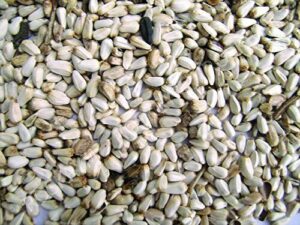
Safflower seeds work like a selective bouncer at your backyard feeder—attracting cardinals and grosbeaks while discouraging squirrels with their bitter seed coat.
Shafer’s 25-pound safflower seed delivers 40–50% crude fat for wild bird nutrition, comparable to sunflower seeds but with a hard hull that pests dislike.
You’ll pay roughly $1.30–$2.50 per pound depending on packaging size, which is higher than basic sunflower but worth it for squirrel deterrent benefits.
Store this bird seed in airtight containers away from moisture to maintain freshness and prevent rancidity.
| Best For | Bird lovers who want to attract cardinals and grosbeaks while keeping squirrels and blackbirds away from their feeders. |
|---|---|
| Weight | 25 pounds |
| Brand | Shafer Seed Company |
| Item Form | Seed |
| Made in USA | Not specified |
| Target Birds | Various species |
| Primary Ingredient | Safflower seed |
| Additional Features |
|
- High fat content (40–50%) provides excellent energy for wild birds, especially in colder months
- The bitter seed coat and hard hull naturally deter squirrels and pest birds without chemicals
- More cost-effective than premium mixes when you factor in reduced waste from unwanted visitors
- Priced higher per pound ($1.30–$2.50) than basic black-oil sunflower seed
- Some customers report flimsy cardboard packaging that doesn’t protect the seeds well during shipping
- Requires proper storage in airtight containers to prevent the high oil content from going rancid
5. Wagner’s Nyjer Seed Bird Food
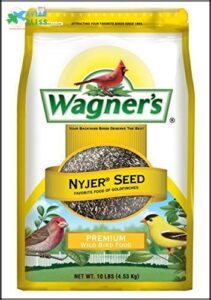
You’ll absolutely love watching goldfinches and pine siskins flock to your feeder when you offer Wagner’s Nyjer Seed, a tiny oily seed packed with around 150,000 seeds per pound.
This wild bird food delivers high fat and protein content that energizes finches during migration and winter months, making it one of the most effective finch attraction options available.
At $1.50–$3.00 per pound retail, it costs more than sunflower seeds but targets specific species beautifully.
Store it in airtight containers to prevent rancidity and maintain nyjer quality control for maximum freshness.
| Best For | Birdwatchers who want to attract goldfinches, pine siskins, and other small finches to their yard with a high-energy, species-specific seed. |
|---|---|
| Weight | 10 pounds |
| Brand | Wagner’s |
| Item Form | Seeds |
| Made in USA | Not specified |
| Target Birds | Finches, American Goldfinch |
| Primary Ingredient | Nyjer seed |
| Additional Features |
|
- Packed with 150,000 tiny seeds per pound, offering exceptional value and long-lasting feeder fill
- High fat and protein content provides crucial energy for finches during migration and cold weather
- Extra clean seed with convenient velcro press-lok closure reduces mess and keeps seed fresh
- Some customers report bags splitting or seeds spilling due to packaging durability issues
- More expensive per pound than sunflower seeds, typically costing $1.50–$3.00
- Requires proper airtight storage to prevent rancidity, and some buyers report occasional quality or freshness concerns
6. Shafer White Millet Bird Seed
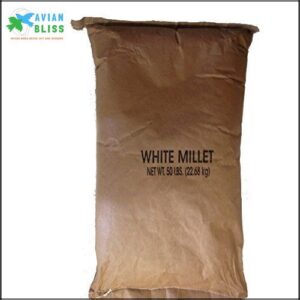
Ground-feeding birds like sparrows, doves, and juncos can’t resist Shafer White Millet Bird Seed, a 50-pound USA-grown option that’s perfect for diversifying your wild bird seed offerings.
This white millet delivers carbohydrate-rich energy at roughly $0.50–$0.90 per pound, making it more budget-friendly than sunflower seeds while still providing solid millet nutrition.
You can use it alone or blend it with other bird seed types for custom formulas. Store it in airtight containers to maintain freshness and prevent moisture damage, ensuring maximum bird attraction throughout the seasons.
| Best For | Bird enthusiasts who want an affordable, bulk seed option to attract ground-feeding birds like sparrows, doves, and juncos to their yard. |
|---|---|
| Weight | 50 pounds |
| Brand | Shafer Seed |
| Item Form | Seeds |
| Made in USA | Yes |
| Target Birds | Wide variety, buntings |
| Primary Ingredient | White Proso Millet |
| Additional Features |
|
- Budget-friendly at $0.50–$0.90 per pound, making it cheaper than sunflower seeds while still offering good nutritional value
- Attracts a wide variety of birds and can be used alone or mixed with other seeds for custom blends
- 100% natural, USA-grown seed that’s easy for smaller birds to crack and digest
- 50-pound bag is heavy and may require help to move or store properly
- Can be messy during feeding, with husks and spillage noted by some users
- Requires airtight storage containers to prevent moisture damage and maintain freshness
7. Wagners Cracked Corn Wild Bird Food
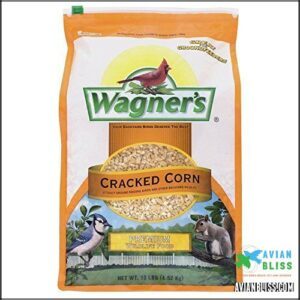
While white millet works wonders, Wagner’s Cracked Corn Wild Bird Food offers another economical way to keep your backyard birds thriving. This 10-pound bag attracts Blue Jays, Cardinals, and doves with high-energy carbohydrates that help birds power through cold winters.
You can scatter it on the ground or use a platform feeder, and it’s excellent for diverting squirrels away from your premium seed. At roughly $0.40–$0.70 per pound, cracked corn benefits your budget while providing wild bird nutrition that aids diverse species throughout the year.
| Best For | Budget-conscious bird watchers who want to attract ground-feeding birds like Blue Jays, Cardinals, and doves while also having an affordable option to divert squirrels from other feeders. |
|---|---|
| Weight | 10 pounds |
| Brand | Wagner’s |
| Item Form | Seed |
| Made in USA | Not specified |
| Target Birds | Blue Jays, Cardinals, Doves |
| Primary Ingredient | Cracked corn |
| Additional Features |
|
- High-energy carbohydrate content helps birds stay fueled during cold winter months
- Cost-effective at roughly $0.40–$0.70 per pound compared to specialty seeds
- Attracts a variety of wildlife including ground-feeding birds, rabbits, and chipmunks
- Bag doesn’t reseal, making storage and freshness maintenance more challenging
- May attract squirrels and rodents, which could be unwanted for some users
- Not suitable for all bird species as some smaller birds may have difficulty with the cracked corn size
8. Lyric Peanut Wild Bird Seed
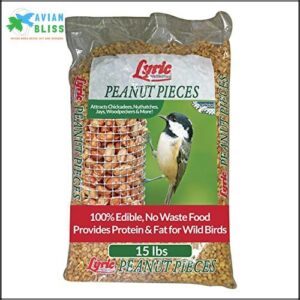
If cracked corn draws in doves and jays, Lyric Peanut Wild Bird Seed takes peanut nutrition to the next level for species like bluebirds, woodpeckers, and chickadees. This 15-pound bag features roasted, shelled peanuts that deliver high protein and fat—essential fuel for wild bird health year-round.
You’ll appreciate the zero-waste formula and feeder compatibility with tube or platform designs. Watch for mold after rain, and refresh your bird food regularly to maintain seed freshness.
At roughly $1.50–$2.50 per pound, it’s a sumptuous choice for attracting colorful songbirds.
| Best For | Backyard birders who want to attract high-energy species like woodpeckers, bluebirds, and chickadees with nutrient-rich, no-mess peanut feed. |
|---|---|
| Weight | 15 pounds |
| Brand | Lyric |
| Item Form | Pellet |
| Made in USA | Not specified |
| Target Birds | Bluebirds, woodpeckers, chickadees |
| Primary Ingredient | Peanuts |
| Additional Features |
|
- High protein and fat content provides essential energy for wild birds year-round
- Zero-waste formula with shelled peanuts means no messy hulls left behind
- Attracts a diverse range of colorful songbirds to your feeders
- Prone to mold in wet conditions, requiring frequent monitoring and refreshing
- May draw unwanted visitors like raccoons, squirrels, and opossums
- Peanut pieces can be too large for smaller birds without breaking them up first
9. Morning Song Wild Bird Seed Mix
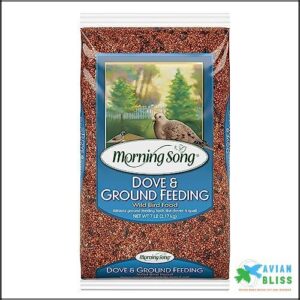
Morning Song Wild Bird Seed Mix delivers versatility with black oil sunflower seeds, white millet, and peanut pieces in 5–20 pound bags—perfect for multi-species bird attraction.
This wild bird seed blend nourishes songbirds, sparrows, and ground feeders while maintaining excellent seed freshness when stored in airtight containers.
You’ll notice improved bird attraction through thoughtful seed composition and strategic feeder placement at table or platform feeders.
Pricing usually lands between $8 and $25, making it accessible for year-round feeding without sacrificing quality in these well-formulated bird seed mixes.
| Best For | Backyard birders who want an affordable, versatile seed mix that attracts a wide variety of songbirds, ground feeders, and year-round visitors without needing specialized feeders. |
|---|---|
| Weight | 7 pounds |
| Brand | Not specified |
| Item Form | Seed |
| Made in USA | Yes |
| Target Birds | Doves, quail, sparrows, juncos |
| Primary Ingredient | Millet and sunflower |
| Additional Features |
|
- Nutrient-rich blend with black oil sunflower seeds and peanut pieces appeals to multiple bird species including sparrows, doves, and woodpeckers
- Available in convenient 5–20 pound bag sizes with reasonable pricing ($8–$25) that suits both casual and dedicated bird enthusiasts
- Works well in multiple feeding setups—table feeders, platform feeders, or scattered directly on the ground for maximum flexibility
- Mixed customer feedback indicates some birds ignore certain seeds in the blend, leading to waste and sprouted millet issues
- Quality control concerns with bags occasionally splitting open during shipping or handling
- Seed freshness varies depending on storage conditions and retailer turnover, requiring careful inspection before purchase
10. Wild Bird Mealworm Food Supplement
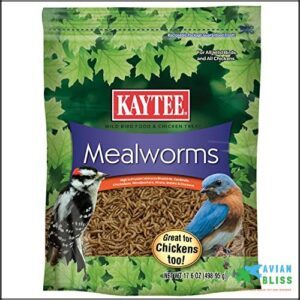
Kaytee Mealworms offer a protein-packed alternative to traditional bird seed, delivering 40–60% crude protein in a convenient 17.6-ounce package that attracts bluebirds, wrens, robins, chickadees, woodpeckers, and cardinals.
These oven-dried insect supplements support wild bird diets during nesting and migration when energy demands spike! You can feed mealworms alone or blend them with your favorite bird food to boost mealworm nutrition.
While they’re absolutely effective for bird feeding, expect to pay a premium compared to standard bird seed—usually running higher per pound than most conventional options.
| Best For | Backyard birders who want to attract insectivorous species like bluebirds and wrens, especially during nesting season when birds need extra protein. |
|---|---|
| Weight | 17.6 ounces |
| Brand | Kaytee |
| Item Form | Dried mealworms |
| Made in USA | Not specified |
| Target Birds | Bluebirds, Wrens, Robins, Cardinals |
| Primary Ingredient | Mealworms |
| Additional Features |
|
- High protein content (40–60%) gives wild birds the energy boost they need during migration and breeding periods
- Attracts a wide variety of desirable species that don’t always visit standard seed feeders
- Oven-dried with a resealable ziplock bag to maintain freshness between feedings
- Noticeably more expensive per pound than conventional bird seed options
- Strong smell that some people find off-putting when handling or storing
- Package size can be misleading—17.6 ounces goes quickly if you’re feeding multiple birds regularly
Tips for Buying and Storing Bird Seed
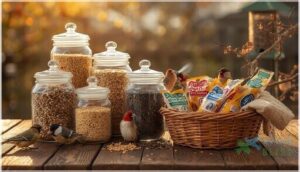
You’ve chosen the right seeds for your backyard birds, but buying and storing them properly makes all the difference in keeping your feathered visitors healthy and happy. Smart purchasing decisions can save you money while ensuring you’re offering fresh, nutritious food that birds actually want to eat.
Let’s walk through four essential tips that’ll help you get the most value from your bird seed investment while preventing waste and contamination.
Choosing Quality Bird Seed Brands
Brand reputation matters absolutely when you’re choosing the right bird seed for your feathered visitors. Established companies generally maintain rigorous quality control and deliver consistent seed purity, which means fewer fillers and fresher wild bird food.
Look for clear labeling, industry standards like AIB certification, and read customer reviews to verify you’re getting the best price bird seed without sacrificing quality for your backyard flock.
Buying in Bulk for Better Value
Buying in bulk absolutely delivers cost savings you’ll appreciate over time. Wholesale pricing on black oil sunflower or white millet can drop your per-pound expense by 20–40%, especially when you purchase 25–50 pound increments.
Bulk discounts make wild bird seed selection more affordable, and bulk ordering means fewer store trips. Just make sure you’ve got proper seed storage containers ready before your shipment arrives!
Storing Bird Seed to Maintain Freshness
Proper seed storage tips protect your bird seed selection from spoilage and keep your feathered visitors coming back for more. You’ll want airtight containers made of thick plastic or metal, stored in cool spots with stable temperatures around 50–70°F.
Use bird seed within 1–3 months for peak freshness!
- Transfer bird food to airtight containers immediately after purchase
- Keep containers away from sunlight and heat sources
- Monitor moisture control by maintaining humidity below 60%
- Practice seed rotation using first-in, first-out methods
- Conduct freshness checks every 2–4 weeks for quality assurance
Preventing Mold and Pest Contamination
Mold and pests can absolutely ruin your bird seed investment and threaten bird health! Keep seed storage tips simple: maintain moisture below 12% and temperatures between 32–60°F. Store bird seed in airtight containers off the ground, inspect weekly for clumping or odd smells, and clean spills monthly. These pest control methods and mold prevention strategies protect your bird feeder management efforts year-round.
| Threat | Prevention Strategy |
|---|---|
| Mold growth | Keep humidity under 60%; use desiccants in storage areas |
| Rodent access | Raise containers on shelving; seal all openings tightly |
| Insect infestation | Rotate stock using FIFO method; set traps away from seed types |
| Cross-contamination | Never mix new and old seed; isolate affected batches immediately |
Dry seed handling and proper bird feeding practices guarantee your backyard visitors stay healthy and happy!
Frequently Asked Questions (FAQs)
What is the best inexpensive bird seed?
Black oil sunflower seeds are absolutely unbeatable for budget birding—costing just $40–$90 per pound in bulk, these inexpensive options attract cardinals, chickadees, and nuthatches while keeping your bird feeder tips practical.
What is the cheapest way to feed the birds?
You can boost cost efficiency through bulk purchases of black oil sunflower seeds, mixing in white millet to extend your supply, and practicing feeder optimization with regular cleaning to minimize waste and spoilage.
Why is bird seed suddenly so expensive?
Rising production costs, supply chain issues, and weather variability in major growing regions have driven up bird seed prices.
Economic pressures, global demand shifts, and higher transportation expenses all contribute to increased costs for wild bird food.
What is the best birdseed to attract the most birds?
You’ll attract the most birds by offering black oil sunflower seeds—they’re a universal favorite.
Add nyjer for finches and white millet for ground-feeders, and you’ll create an irresistible backyard buffet!
How do you store bird seed long-term?
You’ll want airtight containers in a cool, dry spot—preferably below 75°F—to keep your bird seed fresh for months. Add desiccant packs for moisture control and label everything for easy rotation.
What bird seeds deter unwanted pests effectively?
Safflower seeds work wonders for pest control—squirrels dislike them while cardinals love them!
Nyjer seeds in tube feeders keep finches happy and larger pests out, creating truly pest-free feeders.
Can bird seed attract specific bird species?
You absolutely can tailor your menu to attract specific wild birds! Seed preferences drive bird behavior—cardinals love safflower, finches flock to nyjer, and feeder designs plus regional variations shape which species diversity visits your backyard buffet.
Are organic bird seeds worth the cost?
Organic bird seeds cost 20 to 100 percent more than conventional varieties, but birds don’t show preference for certified organic options.
Your choice depends on personal environmental values rather than measurable bird health advantages.
How do you prevent mold in bird seed?
An ounce of prevention is worth a pound of cure: store bird seed in airtight containers in cool, dry conditions below 60 percent humidity, and keep feeders clean to protect bird health and nutrition.
How to attract specific bird species?
You can attract specific wild birds by matching seed pairings to their preferences—black oil sunflower seeds for songbirds, nyjer for finches, safflower for cardinals—and optimizing feeder placement with nearby cover for safer visits.
Conclusion
Sure, experimenting with bird seed types and prices takes patience, but you’ll notice the difference when your feeders buzz with activity instead of sitting ignored. The investment in quality seed pays off in vibrant cardinals, cheerful chickadees, and dancing goldfinches—species that simply won’t settle for cheap filler.
Start with black oil sunflower seeds, watch what arrives, then adjust your blend accordingly. Your backyard isn’t just a feeding station anymore; it’s become a destination worth the visit.
- https://github.com/tugcekonuklar/msc-computer-science-notes/blob/main/research-methods/Home.md
- https://x.com/godofprompt/status/1990526288063324577
- https://www.linkedin.com/posts/bohdanlukianets_tasks-study-research-activity-7373377539521667072-UTEi
- https://www.sciencedirect.com/science/article/pii/S0749208123000268
- https://www.scribd.com/document/683678057/Academic-Research-Manual-V1-1-April-2016