This site is supported by our readers. We may earn a commission, at no cost to you, if you purchase through links.
A chickadee lands on your feeder, flashes its black cap, and disappears before you can get a clear look.
That split‑second frustration is exactly why the right pair of binoculars changes everything about backyard birding.
The difference between a blurry smudge and a sharp, detailed bird portrait often comes down to the glass in your hands—not your patience or skill.
Backyard birds move fast and don’t wait, so your binoculars need to keep up.
Knowing what to look for in bird watching binoculars for backyard birding turns a decent hobby into a genuinely rewarding one.
Table Of Contents
- Key Takeaways
- Key Features of Binoculars for Backyard Birding
- How to Choose Bird Watching Binoculars
- Essential Features for Backyard Birders
- Top 10 Binoculars for Backyard Birding
- 1. Nikon Monarch M7 8×42 Binoculars
- 2. Celestron Nature DX 8×42 Binoculars
- 3. Zeiss 10×32 Conquest HD Binocular
- 4. Leica Trinovid 10×42 HD Binocular
- 5. Vortex Viper HD 10×42 Binoculars
- 6. Celestron TrailSeeker ED 10×42 Binoculars
- 7. Vortex Razor HD 8×42 Binoculars
- 8. Swarovski EL 8.5×42 Binoculars
- 9. Vanguard Endeavor ED II 8×42 Binoculars
- 10. Athlon Optics 8×42 Midas Binoculars
- Binoculars for Different Budgets
- Tips for Using Binoculars in Your Backyard
- Accessories to Enhance Bird Watching
- Frequently Asked Questions (FAQs)
- Conclusion
Key Takeaways
- For backyard birding, 8×42 binoculars hit the sweet spot — they balance brightness, a wide field of view, and steady handling better than higher-powered options.
- Lens coatings, prism type, and objective lens size shape image quality far more than brand name or price tag alone.
- Features like close focus distance, eye relief, and weatherproofing matter just as much as magnification when you’re watching birds at feeder range.
- Your budget sets the ceiling on optical quality, but solid performers exist at every price point — from sub-$100 picks to premium glass above $500.
Key Features of Binoculars for Backyard Birding
Not all binoculars are built the same, and for backyard birding, the differences really do matter. A few key specs will shape how clearly you see that Cardinal at the feeder or track a Warbler through the branches.
If you want to go deeper, this guide to bird watching binoculars for hiking breaks down exactly which specs matter most in the field.
Here’s what to look for before you buy.
Magnification Power (7x, 8x, 10x)
Three numbers define how close a bird looks: 7x, 8x, and 10x. For backyard birding, 8x binoculars hit the sweet spot — they deliver a wide field of view, solid handshake stability, and a 5.25 mm exit pupil that keeps images bright even on overcast mornings.
Compared to 10x power, they’re simply easier to hold steady while tracking fast-moving bird species. The wider field of view helps locate birds quickly.
Objective Lens Size and Brightness
number after the "x" matters just as much.
A 42mm objective lens gathers roughly 70% more light than a 32mm, making a real difference during dawn feeding sessions. That larger glass boosts low light performance and produces a 5.25mm exit pupil in 8×42 binoculars — meaning brighter, sharper images with less eye strain.
The brightness-weight tradeoff is real, but 42mm stays manageable. weight considerations matter when choosing larger optics.
Field of View for Tracking Birds

Field of view — measured in real FOV metrics like degrees or feet at 1,000 yards — decides whether a darting warbler stays in your frame or vanishes. For backyard birding, 8x binoculars deliver a wider field of view than 10x models; the Nikon Monarch M7 8×42 offers 435 feet, making backyard tracking strategies almost simple.
Eyepiece design impact and apparent FOV benefits compound that advantage considerably.
Eye Relief for Comfort
Eye relief — the gap between eyepiece and your eye — determines whether you see the full image or clipped edges. For glasses compatibility, aim for at least 17mm. Top picks for backyard birding include:
- Vortex Viper HD 8×42 – 20mm relief
- Swarovski EL 8.5×42 – 20mm with adjustable eyecups
- Nikon Monarch M7 8×42 – 17.1mm, glasses-friendly
Adjustable eyecups make binocular selection straightforward for prolonged comfort and strain reduction.
Weatherproofing and Durability
Backyard conditions can turn fast — a surprise shower, morning dew, or a clumsy grab off the porch railing. Durability matters.
Look for binoculars with IPX7 or IPX8 waterproof ratings, sealed body O-rings, and nitrogen fogproof fill. Rubber armor grip protects against drops, while hydrophobic lens coatings shed rain instantly. Impact-resistant prisms keep alignment stable season after season.
Close Focus Distance
Close focus distance — often called the macro viewing range — tells you exactly how near a subject can be before your view goes blurry. For backyard birding, near-field clarity matters more than you’d think.
- Most binoculars for birdwatching focus down to 1.5–2.5 meters
- Short-distance optics let you study feather detail at feeder proximity
- Budget models may blur subjects closer than 4 meters
- Lower magnification aids close focus trade‑offs
- Wider field of view improves tracking at short range
How to Choose Bird Watching Binoculars
Picking the right binoculars comes down to a handful of factors that matter more than brand names or flashy specs.
Once you know what to look for, the decision gets a lot easier.
Here’s what to think about before you buy.
Determining The Right Magnification
For backyard birding, 8x magnification hits the sweet spot — it balances stability vs power better than 10x for most home setups. Higher magnification amplifies hand tremor impact, making views shakier without a tripod.
Since most feeder birds sit within 10–40 yards, 8x binoculars for birdwatching deliver solid optical quality, a wider field of view, and brighter light gathering for those early‑morning sessions.
Selecting Objective Lens Diameter
The objective lens — that front glass — controls light gathering more than any other specs.
For backyard birding, 42mm binoculars for bird watching strike the best balance: they deliver a 5.25mm exit pupil on 8x magnification, keeping images bright at dawn feeders without punishing weight impact. At 25 ounces versus 19 ounces for 32mm models, that portability trade‑off is real, but the low‑light performance gain wins.
The 42mm lens wins the light battle: brighter dawn views, heavier load, worth every ounce
Evaluating Field of View
Field of view decides whether you actually see the bird — or just the branch it just left. True field measures the real width of your scene (generally 5.5 to 8.5 degrees for quality optics for birding), while apparent field shapes how immersive it feels.
In backyard birding, edge sharpness matters too: soft corners mean missed details.
A wider field in your binoculars guides search beats raw magnification every time.
Assessing Ergonomics and Weight
Weight shapes every session — full-size 8×42 binoculars usually run 600 to 850 grams, and that difference hits your neck after 30 minutes. Good balance point and weight distribution matter as much as optics for birding.
- Material choice: Magnesium alloy chassis cuts weight 20% versus aluminum
- Grip texture: Rubber armor reduces slippage noticeably in damp conditions
- Eye cup adjustment: Multi-stop twist-ups suit glasses wearers and bare-eye birders alike
- Balance: Open-bridge designs shift mass rearward for steadier one-handed holds
Comparing Price Ranges
Price shapes what you get in optical quality more than any other factor.
Under $100, expect basic coatings and around 80% light transmission — workable, but not inspiring.
Spend $200–$300 and ED glass enters the picture, cutting color fringing noticeably. Hit $500+, and prism quality jumps to 92%+ transmission, with sharper close focus range for backyard birding details.
Essential Features for Backyard Birders
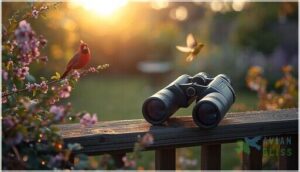
Once you’ve nailed down magnification and lens size, a few more features separate a good birding binocular from a great one. These details often get overlooked, but they make a real difference when you’re outside every morning watching birds.
Here’s what to look for before you buy.
Lens Coatings and Prisms
What’s inside your binoculars matters as much as the glass itself. Fully Multi-Coated Lenses push light transmission to 93–96%, so you’re pulling in real brightness at dawn.
Anti-Reflection Coatings kill glare and ghost images.
Phase Correction Prisms restore sharpness in roof prism designs, while Dielectric Prism Coatings reflect over 99% of light — keeping colors true across your entire field of view.
Waterproof and Fogproof Construction
Good glass means nothing if moisture ruins the view.
Rubber O‑ring seals lock out rain, dust, and humidity, while nitrogen purging or argon gas filling prevents internal fogging when temperatures shift—common in dewy backyard mornings.
Models with an IPX7 rating survive submersion up to one meter, and pressure testing confirms those seals hold.
For serious binoculars for bird watching, waterproof and fogproof construction isn’t optional.
Lightweight and Compact Design
Once you’ve got weatherproofing sorted, the next thing that’ll make or break your backyard sessions is how much your binoculars weigh. Heavy optical instruments tire your arms fast. That’s why lightweight birding binoculars matter more than people expect.
Look for these design wins in quality binoculars for bird watching:
- Magnesium chassis construction cuts weight by up to 20% over aluminum.
- Roof prism designs run 30% shorter than traditional porro prism builds.
- Compact objectives like 32mm lenses reduce bulk without sacrificing daytime brightness.
- Weight reduction under 600 grams prevents fatigue during long backyard birding sessions.
- Pocket dimensions make outdoor gear easy to grab and go.
Comfort and Grip for Prolonged Use
Holding birding binoculars for an hour straight reveals every comfort shortcut a manufacturer took. Rubber armor coating keeps your grip secure even when hands sweat, while thumb grip indents position your hands naturally — no white‑knuckling required.
Adjustable eyecups reduce eye strain session after session. A balanced barrel design prevents forward tipping, and a textured focus wheel means smooth, confident adjustments every time you spot something worth watching.
Top 10 Binoculars for Backyard Birding
Finding the right binoculars for backyard birding comes down to a handful of models that consistently deliver where it counts — sharp optics, comfortable handling, and reliable build quality.
The picks below cover a range of budgets and use cases, so whether you’re just getting started or ready to invest in something serious, there’s a fit for you.
Here are ten binoculars worth your attention.
1. Nikon Monarch M7 8×42 Binoculars
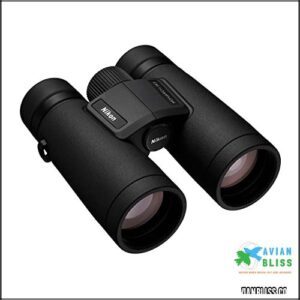
Nikon Monarch M7 8×42 sits near the top of backyard birding lists for good reason.
Its ED glass cuts chromatic aberration, so colors look true rather than fringed — that matters when you’re trying to identify a warbler’s subtle markings.
The 145-meter field of view at 1000 meters makes tracking a darting sparrow feel smooth.
Close focus down to about 6.3 feet means even a butterfly on the feeder is fair game.
Solid, practical, and built to last.
| Best For | Birders, hikers, and nature lovers who want sharp, true-color views in a durable everyday binocular. |
|---|---|
| Magnification | 8x |
| Objective Lens | 42mm |
| Waterproof | Yes |
| Fogproof | Yes |
| Prism Type | Roof |
| Lens Coating | Multi-coated |
| Additional Features |
|
- ED glass delivers crisp, color-accurate images — great for spotting fine details on birds and wildlife
- Wide field of view makes it easy to track fast-moving subjects without losing them
- Waterproof, fogproof, and close-focusing to 6.6 ft makes it versatile across all kinds of conditions
- A bit on the heavier side, which some people notice on long hikes
- The focus wheel and diopter adjustment can feel stiff, especially out of the box
- Struggles a little in very low light, so it’s not the best pick for dusk or dawn birding
2. Celestron Nature DX 8×42 Binoculars
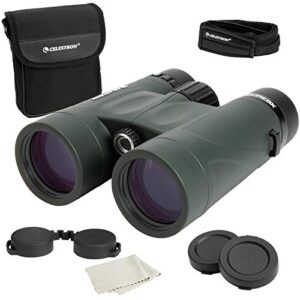
Celestron Nature DX 8×42 punches well above its $135 price tag. You get BaK-4 prisms with phase coatings and fully multi-coated lenses — that combination keeps colors honest and feather detail crisp, even on a grey morning.
Its 7.4° field of view is roomy enough to follow a darting chickadee without losing it.
Close focus sits around 6.5 feet, so your feeder birds are practically life-size.
Waterproof, nitrogen-filled, and light enough to grab without thinking twice.
| Best For | Birdwatchers and outdoor enthusiasts — beginner or seasoned — who want reliable, clear optics without spending a fortune. |
|---|---|
| Magnification | 8x |
| Objective Lens | 42mm |
| Waterproof | Yes |
| Fogproof | Yes |
| Prism Type | BaK-4 |
| Lens Coating | Fully multi-coated |
| Additional Features |
|
- BaK-4 prisms and fully multi-coated lenses deliver sharp, true-to-life images even in flat light
- Wide 7.4° field of view makes it easy to track fast-moving birds without losing them
- Waterproof, fogproof, and lightweight — grab-and-go ready for any adventure
- Some users have had eye cup screws loosen or fall out over time
- Not the best pick for low-light use or serious stargazing
- The included strap and ergonomics may feel lacking during long sessions
3. Zeiss 10×32 Conquest HD Binocular

Few backyard binoculars earn their price tag like the Zeiss Conquest HD 10×32.
That 10x magnification pulls in fine plumage detail — streaks, wingbars, eye rings — that 8x glass can miss.
The 32mm objective keeps things compact at around 630 g, easy to grab off the hook and hold steady.
Zeiss T multi‑coatings and 90 % light transmission mean colors stay true even in early morning shade.
Close focus hits 1.5 m, so feeder birds fill the view.
Worth every penny of the $1,099 ask.
| Best For | Birders, hunters, and nature lovers who want premium optics and don’t mind paying for the best. |
|---|---|
| Magnification | 10x |
| Objective Lens | 32mm |
| Waterproof | Yes |
| Fogproof | Yes |
| Prism Type | Roof |
| Lens Coating | Zeiss T coating |
| Additional Features |
|
- Stunning image clarity with 90% light transmission and Zeiss T coatings — colors pop even in dim early-morning light
- Compact and lightweight for a 10x glass, so it won’t wear you out on long hikes or field sessions
- Built tough with LotuTec weather coating, meaning rain and fog won’t ruin your view
- At $1,099, it’s a serious investment that won’t fit every budget
- Eye cups can feel stiff or gritty, which gets annoying during long glassing sessions
- Some users notice a rolling globe effect — a slight distortion when panning — that takes some getting used to
4. Leica Trinovid 10×42 HD Binocular
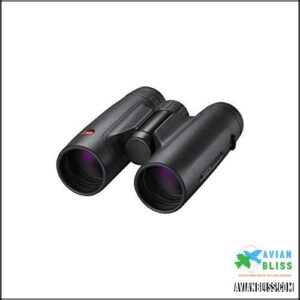
Leica Trinovid 10×42 HD is the kind of glass that makes you wonder why you waited so long to upgrade.
10x magnification resolves fine feather detail — wingbars, eye rings, subtle streaks — while the 42mm objective pulls in enough light for sharp views at dawn.
Close focus hits just 5.25 ft, so feeder birds fill the frame beautifully.
15mm eye relief, eyeglass wearers get the full field without strain.
Waterproof and nitrogen-filled, it’s built to last.
The $948.99 price is steep, but the quality justifies it.
| Best For | Birders and wildlife watchers who want top-tier optics and don’t mind paying a premium for glass that performs in any condition. |
|---|---|
| Magnification | 10x |
| Objective Lens | 42mm |
| Waterproof | Yes |
| Fogproof | Yes |
| Prism Type | Roof |
| Lens Coating | Fully multi-coated |
| Additional Features |
|
- Stunning color and contrast — details like wingbars and eye rings pop even in low light
- Close focus of just 5.25 ft means feeder birds and nearby subjects fill the frame
- Rugged, waterproof build that’s ready for rain, humidity, and hard field use
- At $948.99, it’s a serious investment that won’t suit every budget
- Some users have had issues with the Adventure-Strap and included accessories
- The field of view may feel limiting for users who prefer wider-angle binoculars
5. Vortex Viper HD 10×42 Binoculars
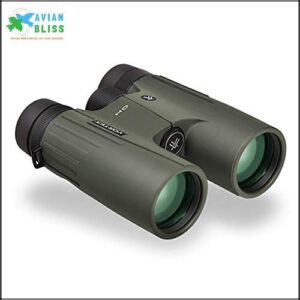
Vortex built the Viper HD 10×42 for people who want serious glass without a four-figure price tag. The 10x magnification pulls distant birds in close, while HD extra-low dispersion glass keeps colors true and feathers sharp — no muddy edges or color fringing.
You get a 341-foot field of view at 1,000 yards, about 16.5mm of eye relief, and a close focus of roughly six feet.
It’s waterproof, argon-purged, and backed by Vortex’s lifetime warranty.
| Best For | Birders, hunters, and nature lovers who want sharp, reliable optics without spending a fortune. |
|---|---|
| Magnification | 10x |
| Objective Lens | 42mm |
| Waterproof | Yes |
| Fogproof | Yes |
| Prism Type | Roof |
| Lens Coating | Multi-layer coated |
| Additional Features |
|
- HD glass delivers crisp, color-accurate images with no muddy edges or fringing
- Waterproof and argon-purged, so it holds up in rain, fog, and cold
- Backed by Vortex’s lifetime warranty — buy it once and you’re covered
- Struggles in low-light conditions compared to higher-end glass
- Eye relief is borderline, which can be frustrating for eyeglass wearers
- The eyecup cover feels stiff and can be a hassle to work with
6. Celestron TrailSeeker ED 10×42 Binoculars
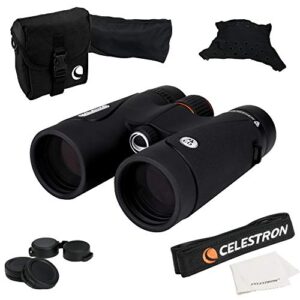
If the sharp-dressed competitor is the hardworking underdog that quietly keeps up, the Celestron TrailSeeker ED 10×42 is the hardworking underdog that quietly keeps up.
ED glass cuts color fringing on bright backyard backgrounds, and fully multi-coated lenses push light transmission high enough for decent early‑morning performance.
You get a 340-foot field of view at 1,000 yards, an 8.2-foot close focus for butterflies on the patio, and a nitrogen-filled, waterproof body — all in a magnesium frame weighing just 23.5 ounces.
| Best For | Birdwatchers, hunters, and outdoor enthusiasts who want premium optics without stepping up to a flagship price tag. |
|---|---|
| Magnification | 10x |
| Objective Lens | 42mm |
| Waterproof | Yes |
| Fogproof | Yes |
| Prism Type | BaK-4 |
| Lens Coating | Broadband multi-coated |
| Additional Features |
|
- ED glass delivers sharp, color-accurate images with minimal fringing — great for picking out detail in bright or high-contrast scenes
- Lightweight magnesium frame keeps things manageable at under 1.5 pounds, and the waterproof, nitrogen-filled body holds up in the field
- Tripod-adaptable with twist-up eyecups, so it works just as well for long sits in a blind as it does for casual backyard use
- 10x magnification can amplify hand shake, especially during long handheld sessions
- No published field of view or close focus specs from the manufacturer, which makes direct comparisons tricky
- The neck strap can get uncomfortable over time, and the weight may feel like too much on a long backcountry hike
7. Vortex Razor HD 8×42 Binoculars
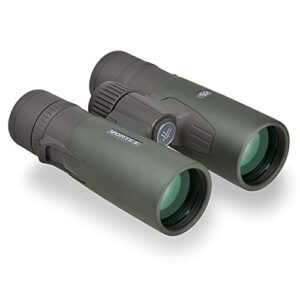
Step up in glass quality, and the Razor HD 8×42 is where things get serious. Hand-selected HD prisms, phase correction coatings, and fully multi‑coated XR Plus lenses combine to deliver colors that stay true — even on a warbler tucked deep in shadow.
The 388-foot field of view at 1,000 yards keeps fast movers in frame, while a 6-foot close focus pulls in feeders right outside your window.
At 24.2 ounces, it’s built tough without punishing your neck.
| Best For | Birders, hunters, and wildlife watchers who want top-tier optics and don’t mind paying for them. |
|---|---|
| Magnification | 8x |
| Objective Lens | 42mm |
| Waterproof | Yes |
| Fogproof | Yes |
| Prism Type | Roof |
| Lens Coating | Multi-coated |
| Additional Features |
|
- Stunning image clarity with true-to-life colors, even in low light
- Wide field of view makes it easy to track fast-moving birds or game
- Tough, waterproof build that holds up in rough weather without feeling like a brick
- Premium price tag puts it out of reach for casual or budget-conscious buyers
- Some users notice minor chromatic aberration at the edges
- May feel underpowered for those who need higher magnification at long distances
8. Swarovski EL 8.5×42 Binoculars
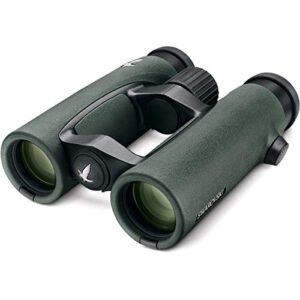
If the Razor HD raised the bar, the Swarovski EL 8.5×42 is the bar. That extra half-power over a standard 8x gives you more reach without sacrificing the steady, hand‑held view you need in the yard.
SWAROVISION field flattener lenses keep detail sharp edge‑to‑edge, and the 133‑meter field of view at 1,000 meters means fast movers stay in frame. With 20mm of eye relief and 90% light transmission, early morning sessions — when light is everything — become genuinely easy.
Premium glass at a premium price: $1,999.
| Best For | Serious birders and hunters who want the sharpest, most capable glass money can buy and don’t mind paying for it. |
|---|---|
| Magnification | 8.5x |
| Objective Lens | 42mm |
| Waterproof | Yes |
| Fogproof | Yes |
| Prism Type | Roof |
| Lens Coating | Multi-coated |
| Additional Features |
|
- That 8.5x magnification hits a sweet spot — more reach than a standard 8x, still steady in your hands
- 90% light transmission and a 4.9mm exit pupil make it a beast in low light, especially at dawn or dusk
- Edge-to-edge sharpness from the SWAROVISION field flatteners means the whole image looks good, not just the center
- At $1,999, it’s a serious investment — this isn’t an impulse buy
- Nearly 30oz of weight adds up fast on long days out; you’ll probably want a harness
- No hard case in the box, and a few buyers have run into frustrating customer service experiences
9. Vanguard Endeavor ED II 8×42 Binoculars

Not everyone wants to spend two grand on glass.
The Vanguard Endeavor ED II 8×42 brings HOYA extra-low dispersion glass into a much friendlier price range — and it shows.
Colors stay true across the full view, and the open-bridge design gives your fingers a natural, secure grip.
With 19.5mm of eye relief, eyeglass wearers won’t miss a thing.
Close focus sits at just 6.6 feet, so feeder birds are fair game.
Nitrogen-filled, waterproof, and built to last.
| Best For | Birders, hikers, and outdoor enthusiasts who want quality ED glass optics without dropping a fortune. |
|---|---|
| Magnification | 8x |
| Objective Lens | 42mm |
| Waterproof | Yes |
| Fogproof | Yes |
| Prism Type | BaK-4 |
| Lens Coating | Advanced multi-coated |
| Additional Features |
|
- HOYA ED glass keeps colors accurate and sharp — no washed-out edges or color fringing
- 19.5mm eye relief is genuinely comfortable for eyeglass wearers
- Waterproof and fogproof build holds up in real outdoor conditions
- At 27 ounces, it can feel heavy on long days out
- Some users notice chromatic aberration, especially in high-contrast scenes
- The screw-on eyepiece covers are easy to lose and the strap system feels like an afterthought
10. Athlon Optics 8×42 Midas Binoculars
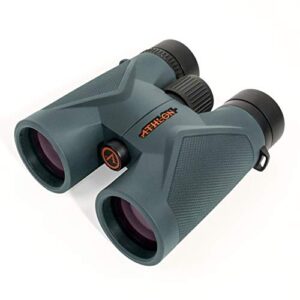
The Athlon Midas 8×42 punches well above its price tag. ED glass cuts color fringing so bird plumage looks crisp and true, while dielectric-coated BaK-4 prisms keep contrast sharp in early morning light.
The 8.1-degree field of view is genuinely wide for this class — finding a sparrow in a dense shrub takes seconds, not frustration.
Close focus of 6.5 feet means feeder birds fill the frame beautifully.
Argon purging and a lifetime warranty make it a confident long-term investment.
| Best For | Birders, hunters, and outdoor enthusiasts who want premium optics without breaking the bank. |
|---|---|
| Magnification | 8x |
| Objective Lens | 42mm |
| Waterproof | Yes |
| Fogproof | Yes |
| Prism Type | BaK-4 |
| Lens Coating | FMC advanced |
| Additional Features |
|
- ED glass and dielectric-coated BaK-4 prisms deliver sharp, true-to-life colors even in low light
- Wide 8.1° field of view and 6.5 ft close focus make spotting and framing subjects fast and easy
- Argon-purged, waterproof build with a lifetime warranty means it’s gear you can count on for years
- At 25 oz, it’s on the heavier side for all-day carry
- Some users may notice a black border if eye relief and interpupillary distance aren’t dialed in just right
- Not the best pick if you regularly need to glass targets beyond 500 yards
Binoculars for Different Budgets
Good binoculars don’t have to cost a fortune — or make you feel like you’re settling.
Whether you’re just getting started or ready to invest in something serious, there’s a solid pair at every price point.
Here’s a breakdown of the best options by budget, so you can find what fits your backyard birding style and your wallet.
Under $100 Options
You don’t need to spend a fortune to get solid backyard birding binoculars. Under $100, a few standout options deliver real value:
- Celestron Nature DX 8×42 – fully multi-coated optics, waterproof, around $80–$90
- Bushnell H2O 8×42 – fogproof, rubber-armored, BAK4 prisms near $85
- Athlon Neos G2 HD 8×42 – HD glass, generous warranty, under $100
Budget brand comparisons consistently show these birding equipment picks punch above their price.
$100–$300 Choices
Stepping up to the $100–$300 range is where backyard birding binoculars really hit their stride. Models like the Nikon ProStaff P7 (~$180) and Vortex Diamondback 10×42 (~$260) earn strong user reviews for their price performance, sharp optics, and solid warranty coverage.
Brand reputation matters here — Vortex especially backs their budget binoculars with a lifetime guarantee.
Watch for retail discounts that push these even lower.
$300–$500 Selections
The $300–$500 range is where optical quality takes a real leap. ED glass becomes standard here, tightening color fringing around feathers and keeping images crisp.
The Athlon Midas ED 8×42 (~$300) and Maven C.1 (~$425) both deliver magnification and field of view that rival pricier European brands. Strong brand reputation, solid warranties, and backyard birding value performance — without the luxury price tag.
$500–$1000 Premium Picks
This is where bird watching binoculars stop making compromises.
In the $500–$1000 tier, you’re getting HD glass, dielectric prisms, and color fidelity that makes a goldfinch look almost unreal.
Premium picks like the Vortex Razor HD 8×42 (~$980) back that optical quality with an unlimited warranty coverage — plus solid accessory bundles included in the box.
- Sharp edge-to-edge clarity
- Vivid, true-to-life color rendering
- Wide field of view for backyard birding
- Lifetime warranty protection
- Padded straps and cases included
Tips for Using Binoculars in Your Backyard
Having the right binoculars is only half the equation — knowing how to use them well makes all the difference.
A few simple habits can sharpen your backyard birding sessions almost immediately.
Here’s what to focus on.
Adjusting The Diopter and Focus
Getting your diopter calibration steps right makes everything click — literally. Start at zero, focus the center wheel for your stronger eye, then use the diopter ring to sharpen the other.
That diopter lock mechanism keeps your setting safe during long backyard birding sessions. Master the central wheel technique after, and your optics will deliver crisp image quality every time.
Achieving Proper Eye Relief
Once your diopter is dialed in, eye relief becomes your next comfort win. For backyard bird watching, most birding binoculars list 17–18 mm of eye relief — enough for glasses wearers and bare‑eyed birders alike.
- Eyecup Adjustment Techniques: twist up without glasses, retract fully with glasses on
- Glasses Compatibility Tips: aim for at least 16 mm
- Eye Relief Measurement: check the spec sheet before buying
- Customizable Eyecup Stops: click‑stop settings let you fine‑tune fit
- Field of View Alignment: correct eye relief eliminates dark edge shadows
Locating and Tracking Birds
eye relief sorted, sharpen your quick spotting game. Spot the bird with naked eyes first, then raise your binoculars without looking away — that’s your focus pre-set in action.
Use peripheral vision to anticipate where it’s headed, then practice a smooth panning motion to track it. Habitat edge scanning along hedges or fence lines, combined with your binoculars’ field of view, makes backyard birding and bird identification feel almost easy.
Cleaning and Maintaining Binoculars
Now that you’re tracking birds like a pro, keeping your optics clean makes all the difference.
- Lens cleaning: Blow off loose dust first, then wipe with a microfiber cloth and lens solution — never household glass cleaner.
- Body care: Wipe the exterior with a damp, lint‑free cloth; avoid alcohol on rubber armor.
- Storage tips: Keep binoculars in their case with a silica gel packet for fog‑proof, moisture‑free storage.
- Weatherproof maintenance: Dry waterproof models thoroughly after rain to prevent corrosion.
- Damage prevention: Skip home disassembly — misaligned prisms mean blurry views and costly optical equipment reviews at a repair shop.
Accessories to Enhance Bird Watching

good pair of binoculars will only take you so far — the right accessories are what turn a casual backyard session into something you’ll actually look forward to every morning.
They protect your gear, sharpen your skills, and make the whole experience more comfortable and connected.
Here are five accessories worth adding to your birding setup.
Binocular Straps and Harnesses
A good strap is the unsung hero of backyard birding. Standard neck straps work fine for short sessions, but wide neoprene padding — usually 1.5 inches across — spreads the load and keeps heavy birding binoculars from grinding into your neck.
For longer walks, an X‑style support system with adjustable buckles and quick‑release clips improve weight distribution dramatically.
| Feature | Neck Strap | X-Style Support System |
|---|---|---|
| Weight Distribution | Neck only | Shoulders and back |
| Quick Access | Instant | Near-instant |
| Best For | Short backyard sessions | Long outdoor recreation gear walks |
Protective Cases and Lens Covers
Your birding binoculars deserve protection that actually works in the field. Semi-rigid EVA cases — generally 3 to 6 millimeters thick — deliver solid crush resistance without bulk, while microfiber linings prevent scratches on rubber armor.
For outdoor optics and outdoor recreation gear, look for waterproof, IPX4-rated cases with smart attachment systems like belt loops. Tethered, flip-down lens covers handle moisture control and stay put when action picks up fast.
Lens Cleaning Kits
Keeping your binoculars clean makes a real difference in what you actually see at the feeder. Portable kit design usually includes a microfiber cloth, air blower, lens pen, and safe cleaning solution — everything backyard birding demands.
Use the air blower first, then the lens pen for stubborn smudges. Always follow solution safety guidelines: apply fluid to the microfiber cloth, never directly onto the glass.
Smartphone and Tripod Adapters
Digiscoping — attaching your phone to binoculars or a tripod — turns backyard birding into a shareable experience.
Smartphone tripod adapters follow universal 1/4"-20 thread standards, so compatibility with your existing outdoor recreation gear is rarely an issue.
Spring-loaded clamp mechanisms grip phones up to 3.25 inches wide, while stability enhancements like ball-end swivels let you track birds smoothly.
Models like the Ulanzi ST-14 even offer accessory integration via cold shoe mounts.
Birding Apps and Field Guides
Your binoculars only tell half the story — the right app fills in the rest. Pair your optics with tools that make every backyard sighting click into place:
- Merlin Bird ID delivers Live ID Alerts, Sound ID, and Offline Species Packs for 10,000+ species
- eBird tracks checklists, Migration Maps, and yard lists tied to GPS
- Sibley Birds offers a full Audio Call Library with 2,800+ recordings
- iBird Pro includes Birding Quiz Games and 30+ identification filters
Frequently Asked Questions (FAQs)
How do I focus binoculars on fast-moving birds?
Rest your index finger on the central wheel, always. Spot the bird first with naked eyes, then lift smoothly — no jerking.
Quick draw plus body panning locks onto fast movers instantly.
Can children use adult birding binoculars comfortably?
It depends on age. Kids under 10 often struggle with adult binoculars — the weight, wide interpupillary fit, and complex focus make it tough. Teens usually manage fine.
What binocular features help with low-light birding?
Low light rewards patience — and the right optics.
Prioritize a large exit pupil size, high lens transmission efficiency, phase‑correction coating, and a dielectric prism for brighter, sharper views when twilight factor matters most.
How long do quality binoculars typically last?
Quality bird watching equipment can last 15 to 30 years with proper care.
Warranty length, seal integrity, and coating longevity vary by tier — but solid waterproof pair built for backyard birding genuinely rewards the investment.
Are refurbished binoculars worth buying for beginners?
Yes — refurbished binoculars can be a smart buy. You get better optics for less, but check seller certification, warranty considerations, and optical alignment before committing.
Conclusion
A warbler perches at the edge of your yard, its colors catching the morning light for just a moment. With the right bird watching binoculars for backyard birding in hand, that moment doesn’t slip away—it becomes something you actually see.
Every feature covered in this guide brings you closer to that clarity. Choose the pair that fits your budget, your hands, and your backyard, and let the birds finally show themselves.
- https://www.oreateai.com/blog/8x-vs-10x-binoculars-finding-your-perfect-magnification-for-every-glimpse/f5310956223540d43c2a79ee1a04ce92
- https://www.curlewcall.org/best-binoculars-for-bird-watching-2025-expert-guide/
- https://www.bestbinocularsreviews.com/birding/backyard-bird-watching-binoculars.php
- https://www.allaboutbirds.org/news/close-focus-binoculars-enjoy-birdwatching/
- https://shopping.rspb.org.uk/page/how-to-choose-binoculars-for-bird-watching