This site is supported by our readers. We may earn a commission, at no cost to you, if you purchase through links.

My first birdhouse sat empty for two years. Turned out I’d drilled the entrance hole a half inch too big, and the house sparrows moved in and chased off every bluebird that came sniffing around. Cost me a season of watching the wrong birds bully the right ones off my property.
That’s the thing nobody tells you about birdhouses for beginners: the difference between a thriving nest box and an empty one usually comes down to a few numbers—hole diameter, floor size, mounting height. Get those wrong, and you’re just building a fancy box for wasps.
Grab your tape measure. We’re building this one right, measurement by measurement.
Table Of Contents
- Key Takeaways
- Choose The Right Beginner Birdhouse Design
- Gather Safe Birdhouse Materials and Tools
- Build Your First Birdhouse Step-by-Step
- Mount, Protect, and Maintain Your Birdhouse
- Top 10 Birdhouse Products for Beginners
- 1. Kettle Moraine Cedar Bluebird Predator Guard
- 2. Woodlink Bluebird House BB1
- 3. Stovall Western Mountain Bluebird House
- 4. PLESIU Cedar Bird Nesting Box
- 5. Birds Choice Cedar Nesting Platform
- 6. Woodlink Cedar Wren Chickadee Birdhouse
- 7. Woodlink Audubon Wren Birdhouse
- 8. Stokes Purple Martin Guide
- 9. FMS Ravenox Purple Martin Gourd Rack
- 10. BestNest Purple Martin House Gourds Kit
- Frequently Asked Questions (FAQs)
- What do birds like most in birdhouses?
- What not to do when building a birdhouse?
- What time of year should you put up a bird box?
- How high off the ground should a birdhouse be placed?
- Can I paint my birdhouse bright colors?
- How do I attract birds to a new box?
- What time of year should I put up birdhouses?
- How long before birds move in?
- Can two species share the same birdhouse?
- How long does it take birds to find a birdhouse?
- Conclusion
Key Takeaways
- Getting the entrance hole size exactly right for your target species (like 1.5 inches for bluebirds vs 1⅛ inches for wrens) is the single biggest factor in whether the right birds move in or sparrows take over.
- Skip pressure-treated lumber and decorative trim—untreated cedar, cypress, or pine keeps chemicals away from eggs while clean ventilation and drainage prevent mold and rot.
- Mounting height, entrance direction (east-facing, tilted down), and keeping at least 15 feet between the birdhouse and any feeder all make a real difference in whether birds actually nest there.
- A hinged or sliding clean-out panel plus a predator guard turns a birdhouse from a one-season novelty into something you’ll actually maintain and that keeps working year after year.
Choose The Right Beginner Birdhouse Design
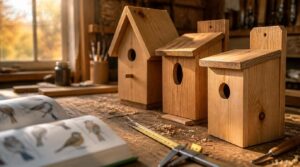
Before you touch a saw, you’ve got to figure out what you’re actually building for. Every bird species has its own preferences—size, hole diameter, even the style of box—and getting it wrong just means an empty birdhouse hanging on a pole. Here’s what you need to nail down first.
Once you’ve nailed down your target species, matching the right lumber to your cutting plan makes all the difference, and this guide on choosing wood and materials for birdhouse building walks you through picking boards that hold up outdoors while keeping your saw work clean.
Select Beginner-Friendly Bird Species
Before you touch a saw, pick your tenant. Species compatibility makes or breaks a first build—bluebirds, wrens, chickadees.
- Wrens/chickadees: 4×4" floor, gentle temperament
- Bluebirds: open poles, calmer feeding needs
- Avoid decorative designs that ignore real birds
Match your birdhouse plans to local species now, and dimensions in the next section will make sense. Understanding local bird species richness can help guide your birdhouse design choices for better ecological impact. local bird species richness is a key factor in creating effective bird-friendly habitats.
Match Floor Dimensions to Species
Floor size isn’t a place to eyeball it. Wren floor dimensions and chickadee floor specs both run about 4×4 inches, snug quarters for a small cup nest.
Bluebirds need more elbow room—5×5 inches minimum.
Goldfinch nesting floors also run 4×4, while purple martins, being colonial nesters, need roughly 6×6 per compartment.
Get the birdhouse dimensions wrong, and you’ll get squatters instead.
Choose The Entrance Hole Size
Now that your floor’s sized right, the entrance hole is where most beginners blow it. Bluebirds want 1.5 inches; wrens and chickadees, 1⅛ to 1¼ inches—tight enough to block sparrows.
- Keep predators out
- Stop nest raids
- Protect fragile eggs
- Give fledglings a fair shot
Drill clean, no burrs. Wrong size, empty box.
Compare Boxes and Nesting Platforms
Once your hole’s drilled right, decide: nest box or open shelf?
A nest box shields eggs with an enclosed cavity—better weather and predator defense. A nesting shelf invites robins and phoebes but skips the entrance size question entirely.
| Feature | Nest Box |
|---|---|
| Species | Bluebirds, wrens |
| Cleaning | Hinged panel |
| Weather | Enclosed |
| Predators | Guarded hole |
Avoid Decorative Birdhouse Designs
That gingerbread trim you’re eyeing? Skip it. Fancy scrollwork blocks ventilation, traps moisture, and breeds mold fast in tight cavities.
Painted interiors off-gas fumes that stress fledglings. Cute add-ons also eat interior space birds need for nesting material, and crevices give predators a foothold.
Stick to clean DIY birdhouse plans—function first, decoration never.
Gather Safe Birdhouse Materials and Tools

Once you’ve picked a design, the wood pile and toolbox decide whether that birdhouse actually survives outside. Not every board or screw from the hardware store belongs on a nest box—some choices flat-out hurt the birds you’re trying to help. Here’s what to grab, and what to leave on the shelf.
Choose Cedar, Cypress, or Pine
Wood choice makes or breaks your build. Three options work well: **western red cedar (light, rot-resistant, easy to cut), red cypress (denser, controls humidity best), and kiln-dried pine (cheapest, needs care). Cedar’s grain looks great weathered. Cypress outlasts cedar in wet climates. Pine’s fine for beginners on a budget—just know it decays faster untreated.
Avoid Pressure-Treated Lumber
Here’s the thing about pressure-treated boards: they’re built for decks, not nesting cavities. Copper and arsenic compounds leach out, especially once weathered. Skip treated lumber entirely for birdhouse materials.
Stick with untreated wood, and wear gloves plus a dust mask when cutting—chemical dust matters even on safe species. Your birdhouse safety and the environment both benefit.
Gather Essential Beginner Tools
You don’t need a full shop to start—just the right tool selection guide in your head. Grab a cordless drill, hole saw for the entrance, hand saw, tape measure, combination square, bar clamp, and sandpaper.
Safety gear checklist: glasses, dust mask, gloves. Skip any piece and you’ll feel it later—splinters teach fast.
Select Weather-Resistant Fasteners
Regular screws will rust and bleed orange streaks down your siding. Use 1-5/8 in galvanized deck screws—cheap, effective, sacrificial zinc protects the steel underneath. Near the coast? Spring for 316 stainless; it shrugs off salt spray.
Predrill every hole, use exterior glue at joints, and you’ve got a genuinely weather-resistant birdhouse that’ll outlast the tree it hangs on.
Use Non-Toxic Outdoor Finishes
Bare cedar weathers fine, but a little non-toxic sealant buys years. Skip anything with biocides—pure tung oil or linseed oil penetrate deep, stay breathable, and let moisture escape.
- Keeps chicks safe from fumes
- Preserves natural wood grain
- Resists cracking through winter
- Easy brush-on application
- Simple yearly touch-up
Recoat every 1-3 years. Plant-based pigments add color without synthetic junk—way better than exterior paint.
Build Your First Birdhouse Step-by-Step
Now that your materials are sorted, it’s time to actually build the thing. This is where sawdust meets patience, and where five simple steps turn flat boards into a real birdhouse. Grab your panels and let’s walk through it, one cut and one hole at a time.
Measure and Cut Six Panels

Grab your board and mark six panels: front and back at 9 × 5.5 in, sides 6.25 × 5.5 in, base 8.5 × 5.5 in, roof 8 × 6 in. Cutting accuracy matters here—use a fine tooth hand saw or miter saw, clamp stock tight, cut with the grain. Sand every edge smooth before moving on.
Drill Entrance and Airflow Holes
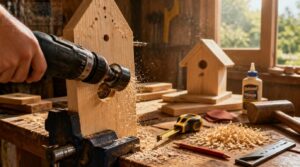
With panels sanded, mark your entrance hole 6-8 in above the floor, then bore it with a hole saw for clean edges. Add ventilation holes—¼ to ⅜ in—near the top rear for airflow.
- Center the hole horizontally.
- Match hole size to species.
- Round edges smooth.
- Keep vents unobstructed.
Add Floor Drainage Holes

Before flipping panels over, drill drainage holes near the floor’s center—¼ to ⅜ in, angled slightly downward so water runs out instead of pooling. Cluster a few small holes rather than one big one; less debris gets in that way. Sand burrs smooth.
Come autumn, check these along with your vents—clogged drains rot untreated wood fast.
Predrill, Clamp, and Assemble
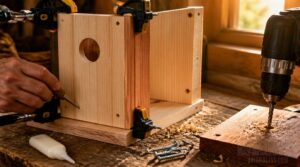
Once your drainage holes are clear, mark centers with an awl and predrill pilot holes 1.5–2mm smaller than your screws.
Square everything on a flat surface, clamp with quick-action bars—checking alignment before final fastening.
Assemble back, then sides, then front: glue joints with PVA, drive 1-5/8 in galvanized deck screws, don’t overtighten near edges.
Install a Clean-Out Panel
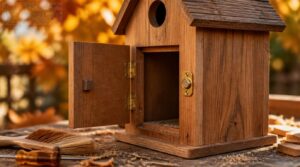
Here’s the step you’ll thank yourself for come October: cut one side wall short, hinge it, done. Use a magnetic latch for a tight seal, mount screws mid-height for easy reach, and pick cedar to match your build.
Cleaning frequency: once every autumn, soft brush only.
Mount, Protect, and Maintain Your Birdhouse
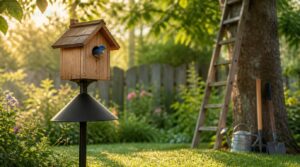
Building the box is only half the job—where and how you hang it decides whether birds move in or fly right past. Get the height, angle, and guard setup wrong, and you’re basically building a squirrel feeder with extra steps. Here’s what actually matters once that birdhouse leaves your workbench.
Follow Species-Specific Mounting Heights
Height isn’t one-size-fits-all. Best mounting height depends entirely on who you’re hosting: bluebirds want 4-6 feet, wrens and chickadees do fine at 5-15 feet, martins need 10-20 feet up.
Match species-specific dimensions to height, and add a predator guard regardless.
Keep boxes under 12 feet for easy monitoring—nobody wants to haul a ladder every spring.
Face Entrances East and Downward
Point that entrance hole east and tilt it down slightly. East-facing orientation catches morning sun for early nesting activity, while the downward tilt provides wind protection and stops rain from blowing straight in.
Bonus: this angle limits how predators approach and gives nesting birds better visibility on who’s coming and going.
Separate Birdhouses From Feeders
Ever wonder why a fully stocked feeder sits fifteen feet from an empty birdhouse? Birds won’t nest where they’re dodging traffic all day.
Birds won’t nest where they’re dodging feeder traffic all day
- Keep 15 feet minimum between box and feeder
- Mount nest boxes 6–10 ft up, feeders down at 3–6 ft
- Use separate poles or trees for each
That vertical and physical buffer cuts territory fights and predator interest fast.
Install Predator Guards and Baffles
Raccoons don’t care how careful your birdhouse assembly was—they’ll raid it in seconds without a guard. Slide a predator guard below the entrance hole, 6 inches minimum, using galvanized steel or aluminum (skip plastic—it cracks in cold). Baffles need clearance above and below the box. Test by tugging: no wobble means secure birdhouse mounting and placement.
If you’re weighing pole-mounted versus wrap-around styles, this guide to predator guards for bird feeders breaks down which materials and mounting heights actually keep raccoons out.
Clean and Inspect Each Autumn
Come fall, birds are gone and it’s time to play doctor. Pop the cleanout panel, scrub with boiling water, no chemicals.
- Roof and hardware: check for rust, tighten screws
- Entrance and ventilation: clear debris, confirm airflow
- Predator guard: verify it’s still snug
Note the date somewhere. Future you will thank present you.
Top 10 Birdhouse Products for Beginners
Not every beginner wants to start from a pile of cedar boards, and that’s fine—sometimes buying beats building.
Maybe you’re short on shop time, or you just want something solid while you practice your saw skills.
Here are ten ready-made options worth checking out, from bluebird boxes to purple martin gourds.
1. Kettle Moraine Cedar Bluebird Predator Guard
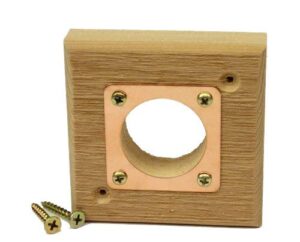
Squirrels are patient chewers, and that’s exactly what this guard stops. The Kettle Moraine guard is 3⅜ inches square, cut from 7/8-inch solid cedar, with a copper-clad portal bonded right over the entry. Copper doesn’t gnaw down the way bare wood does, so raccoons and woodpeckers lose interest fast.
The hole itself holds steady at 1½ inches — dead-on for Eastern Bluebirds, no drifting wider from years of pecking. Two included 1¼-inch screws handle mounting, and you don’t need anything fancier than a screwdriver.
One thing to know: this guard won’t keep out House Sparrows, since they’ll squeeze through that same opening.
Even with that gap, it’s a smart retrofit. You’re not rebuilding a whole box, just bolting on a few years of extra protection against the critters that do the most damage.
| Best For | Owners of standard-sized Eastern Bluebird houses who want to add extra predator protection without replacing the entire box. |
|---|---|
| Material | Cedar & Copper |
| Target Species | Eastern Bluebirds |
| Mounting Hardware | Included |
| Assembly Required | Minimal |
| Cleaning Method | Not Applicable |
| Price Tier | Budget |
| Additional Features |
|
- Copper-clad portal resists chewing and keeps the 1.5 inch entry from wearing wider over time
- Easy retrofit installation with two included 1¼ inch screws and just a screwdriver
- Effectively deters raccoons, woodpeckers, and other larger predators from accessing the nest cavity
- Won’t stop House Sparrows, since they can fit through the same 1.5 inch opening
- Only fits houses with a 1.5 inch entry, so it won’t work on larger nest boxes
- Copper portal may develop patina after prolonged outdoor exposure
2. Woodlink Bluebird House BB1
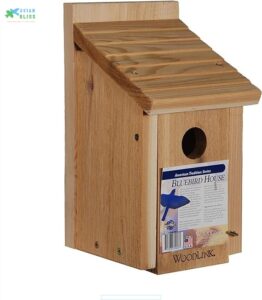
If you’d rather skip the cutting altogether, the Woodlink BB1 ships fully assembled — no clamps, no kerf marks to clean up. It’s built from kiln-dried inland red cedar, sized with a 1½-inch hole and a 5×5-inch floor, right on the mark for Eastern, Western, and Mountain Bluebirds.
The sliding front panel is the real selling point. Pop it down after nesting season, brush out the debris, done. No fumbling with screws or hinges.
A half-inch vent gap up top and a drain hole at the base keep the cavity dry, which matters more than folks think — soggy nests don’t hatch. At one pound, though, mount it snug. A light box on a wobbly pole will swing in any decent wind, and bluebirds don’t stick around for a rocking cradle.
| Best For | Bird lovers who want a ready-to-mount, low-maintenance nesting box to attract Eastern, Western, or Mountain Bluebirds without any assembly required. |
|---|---|
| Material | Kiln-Dried Cedar |
| Target Species | Bluebirds |
| Mounting Hardware | Not Included |
| Assembly Required | None |
| Cleaning Method | Sliding Panel |
| Price Tier | Mid-Range |
| Additional Features |
|
- Arrives fully assembled, so there’s no cutting, clamping, or cleanup needed
- Sliding front panel makes post-season cleaning quick and simple
- Weather-resistant cedar with a vent gap and drain hole keeps nests dry
- At just 1 lb, it needs a sturdy, well-secured mount to avoid swaying in wind
- The 1½-inch hole limits it strictly to bluebirds, excluding other species
- Mounting hardware and pole aren’t included, so setup requires extra purchases
3. Stovall Western Mountain Bluebird House
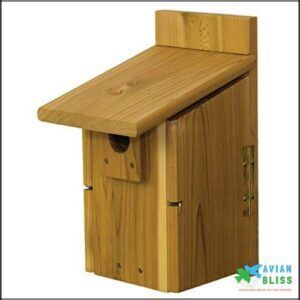
Sliding panels are nice, but if you want something built to last generations, look at Stovall’s Western Mountain Bluebird House. At $84.65, it costs more than most beginner builds — you’re paying for hand-sanded Michigan cedar and dichromate-plated stainless screws that shrug off rust for years.
The standout feature: dual side doors with plastic viewing windows. You can check on nestlings without cracking the box open and spooking the parents. The 5×5½-inch interior gives chicks room to stretch before fledging.
Two catches worth knowing. It ships with no mounting hardware, so budget for a pipe and flange separately. And at 5 pounds, it’s heavier than it looks — make sure your post can handle the weight without leaning.
| Best For | Homeowners or bird enthusiasts who want a durable, handcrafted nesting spot specifically suited to western and mountain bluebirds. |
|---|---|
| Material | Hand-Sanded Cedar |
| Target Species | Western Mountain Bluebirds |
| Mounting Hardware | Not Included |
| Assembly Required | Minimal |
| Cleaning Method | Side Doors |
| Price Tier | Premium |
| Additional Features |
|
- Made entirely of hand-sanded cedar wood, handcrafted in Michigan for a natural, long-lasting build
- Stainless-steel, dichromate-plated screws resist rust and hold up well outdoors
- Cedar’s natural weather resistance helps the house endure the elements over time
- Doesn’t include mounting hardware or predator guards, so extra accessories may be needed
- Fixed dimensions (15 in H × 7.25 in D × 10.25 in W) might not suit every mounting spot or smaller garden
- Green finish may fade or need repainting over time
4. PLESIU Cedar Bird Nesting Box
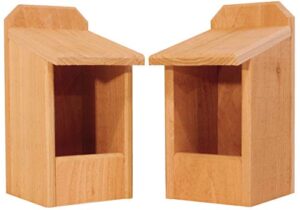
Not everyone’s ready to spend $84 on a birdhouse, and that’s fine. The PLESIU Cedar Nesting Box runs under $20 a unit, sold in two-packs, so you get a spare for less than one Stovall box costs.
You’re still getting real western red cedar, just rough sawn instead of hand-sanded — grain and color will vary some, box to box. The 1.5-inch entrance hole works for bluebirds, and the included predator guard adds a layer of protection most budget boxes skip entirely.
Drain holes come pre-drilled in the bottom panel, and the front tilts open when it’s time to clean out old nesting material. No mounting hardware in the box, so grab galvanized screws before you head outside. Simple, affordable, and built from the right wood — hard to beat for a first birdhouse.
| Best For | budget-conscious birders who want a durable, real-cedar nesting box for cardinals, robins, or bluebirds without paying premium prices. |
|---|---|
| Material | Rough Sawn Cedar |
| Target Species | Bluebirds & Cardinals |
| Mounting Hardware | Not Included |
| Assembly Required | Minimal |
| Cleaning Method | Tilt-Open Front |
| Price Tier | Budget |
| Additional Features |
|
- Made from genuine rough sawn western red cedar for natural weather and water resistance
- Hand constructed in the USA using non-toxic glue and galvanized finish nails
- Sold as a two-pack, so you get double the coverage for one price
- Rough sawn texture means color and grain will vary from box to box
- Smaller 2.5-inch front opening may limit the range of bird species that can use it
- No mention of included mounting hardware, so you may need to source your own
5. Birds Choice Cedar Nesting Platform
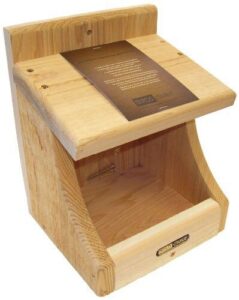
Robins won’t touch a box with a hole cut in it. They want a flat, open shelf to build on — which is exactly what the Birds Choice Cedar Nesting Platform gives them.
At 10 × 9 × 11 inches, there’s real room to work with. Cedar controls rot on its own, no chemical treatment needed, and the sloped roof kicks rain off before it pools. Pre-drilled holes mean you’re mounting to a post or fence rail in minutes, not fighting a drill in your yard.
Skip the compass work here — face it away from harsh afternoon sun, keep it 30 feet clear of feeders, and you’re done. Doves and swallows take to open platforms fast. If boxes feel fussy for a first build, this is the easier path in.
| Best For | Bird lovers looking to attract tree-nesting species like doves and robins with an easy-to-install, open nesting platform. |
|---|---|
| Material | Inland Red Cedar |
| Target Species | Doves & Robins |
| Mounting Hardware | Included |
| Assembly Required | Minimal |
| Cleaning Method | Open Platform |
| Price Tier | Mid-Range |
| Additional Features |
|
- Made from high grade inland red cedar for durability and natural weather resistance
- Comes with mounting screws, making installation on a pole or fence post simple
- Provides an open platform design that suits tree-nesting birds like doves and robins
- Requires a separate pole or fence post for mounting, which isn’t included
- Compatibility can vary depending on the specific bird species in your area
- Open platform design offers less enclosed protection compared to a traditional birdhouse
6. Woodlink Cedar Wren Chickadee Birdhouse
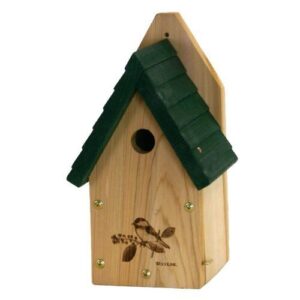
Small hole, big payoff. That’s the whole idea behind the Woodlink Cedar Wren Chickadee House — a 1⅛-inch entrance sized to let wrens and chickadees in while keeping starlings and bigger pests locked out.
The body’s built from kiln-dried inland red cedar, so you’re not fighting warp or rot after a few soggy weeks. A hinged side panel swings open for cleanout, and you’ll actually use it come fall — that’s half the battle with any nest box.
At $54, it’s pricier than a scrap-wood build. But pre-drilled mounting holes and included hardware mean you skip the fussy layout work. Bolt it to a post, done.
Not fancy, just functional. If wrens or chickadees are your target, dimensions matter more than looks — and this one’s got them right.
| Best For | Backyard bird lovers hoping to attract wrens or chickadees while keeping larger, more aggressive birds out of the nest box. |
|---|---|
| Material | Kiln-Dried Cedar |
| Target Species | Wrens & Chickadees |
| Mounting Hardware | Included |
| Assembly Required | Minimal |
| Cleaning Method | Hinged Side Panel |
| Price Tier | Mid-Range |
| Additional Features |
|
- Entry hole is precisely sized for wrens and chickadees, naturally excluding larger species
- Kiln-dried inland red cedar resists rot and warping for lasting outdoor durability
- Hinged side panel makes seasonal cleaning quick and simple
- Price of $54 runs higher than a basic DIY birdhouse
- Green roof finish may fade or show wear with prolonged sun exposure
- Not recommended for extremely windy locations without extra stabilization
7. Woodlink Audubon Wren Birdhouse
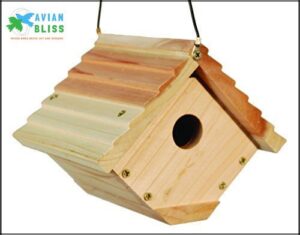
Twenty-six bucks buys you the Woodlink Audubon Wren Birdhouse — white-painted cedar with a 1⅛-inch hole sized right for house wrens and Carolina wrens. That’s the same hole size as the pricier Woodlink box, just without the pre-drilled mounting hardware.
It hangs from a brass-screwed cable, so setup’s quick — no fussing with brackets. The roof unscrews for cleanout, though that’s a step down from a hinged panel. You’ll need a screwdriver every fall instead of just flipping a latch.
One heads-up: the paint soaks into the wood fast. If you’re customizing the finish, sand first or you’ll burn through a whole can.
A few buyers mentioned slow wren activity. That’s rarely the birdhouse’s fault — hole size and mounting height matter more than the label on the box.
| Best For | Gardeners and backyard birders who want an affordable, natural-cedar nesting box specifically sized for house wrens and Carolina wrens. |
|---|---|
| Material | Painted Cedar |
| Target Species | House & Carolina Wrens |
| Mounting Hardware | Included |
| Assembly Required | Minimal |
| Cleaning Method | Unscrew Roof |
| Price Tier | Budget |
| Additional Features |
|
- Cedar construction with a properly sized 1⅛-inch hole for wrens
- Sturdy brass-screwed cable makes hanging quick and easy
- Removable roof allows for seasonal cleaning
- Roof requires a screwdriver to remove, unlike hinged-panel designs
- Wood may have uneven joints or gaps depending on the unit
- Paint absorbs quickly into the cedar, often requiring sanding first
8. Stokes Purple Martin Guide
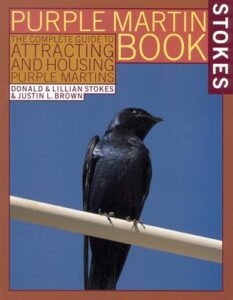
Purple Martins don’t play by birdhouse rules — they need a landlord, not just a box. The Stokes Purple Martin Guide ($17.96) is your crash course, written by Lillian and Donald Stokes with Justin L. Brown.
At 96 pages, it’s a fast read packed with over 100 full-color photos for telling males, females, and juveniles apart at a glance. You’ll get arrival timing by region, site selection basics, and predator control tips — the stuff that separates an empty gourd rack from a thriving colony.
Published in 1997, some range maps feel dated. Even so, the essential guidance on colony management still holds up. Just don’t expect construction plans here; it’s a management guide, not a blueprint. Pair it with actual housing specs, and you’re set for your first martin season.
| Best For | Homeowners and birding enthusiasts looking to attract and successfully establish their first Purple Martin colony. |
|---|---|
| Material | Paperback Book |
| Target Species | Purple Martins |
| Mounting Hardware | Not Applicable |
| Assembly Required | None |
| Cleaning Method | Not Applicable |
| Price Tier | Budget |
| Additional Features |
|
- Over 100 full-color photos make it easy to identify males, females, and juveniles at a glance
- Covers essential colony management topics like regional arrival timing, site selection, and predator control
- Compact, lightweight paperback that’s easy to bring outdoors for on-the-spot reference
- Doesn’t include building plans or dimensions for constructing martin houses
- Missing specific guidance on ideal house height off the ground
- Some regional range maps and predator advice may be outdated since it was published in 1997
9. FMS Ravenox Purple Martin Gourd Rack

Colony housing at this scale is basically a landlord job, and the Ravenox rack is built for it. You get 12 UV-protected HDPE gourds hung on aluminum arms, a Troyer-Haskell tunnel trap for sparrow control, and a 24-inch predator guard, all riding a 14-foot two-piece aluminum pole.
The winch-and-pulley setup is the real selling point. Weekly nest checks that’d normally mean hauling a ladder around become a matter of cranking the gourds down, checking, and sending them back up — no disturbing the whole colony to peek at one nest.
At 225 pounds, this isn’t a solo Saturday project. Get a second set of hands for the pole staking and anchoring, especially in loose soil.
Made in the USA with a one-year guarantee, it’s pricier upfront than loose gourds, but you’re not scrounging for hardware later.
| Best For | Serious purple martin landlords managing an established or growing colony who want expandable, low-maintenance housing with easy nest access. |
|---|---|
| Material | HDPE & Aluminum |
| Target Species | Purple Martins |
| Mounting Hardware | Included |
| Assembly Required | Extensive |
| Cleaning Method | Winch Lowering |
| Price Tier | Premium |
| Additional Features |
|
- Winch-and-pulley system makes weekly nest checks quick and non-disruptive to the colony
- Predator guard and sparrow trap built in, so protection isn’t an afterthought purchase
- Durable HDPE gourds and aluminum pole resist rot, cracking, and fading for long-term use
- At 225 pounds, installation isn’t a one-person job and needs help anchoring the pole
- Higher upfront cost compared to basic gourd housing setups
- Gourds still need seasonal cleaning to stay hygienic and attractive to nesting birds
10. BestNest Purple Martin House Gourds Kit
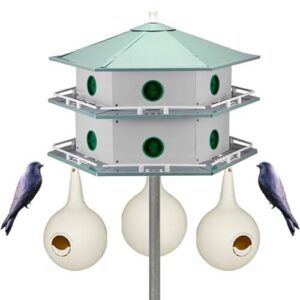
Twelve rooms, gourds, and decoys in one box — this AH-12D is the whole starter kit for folks who want a real martin colony, not just one nesting pair. The aluminum construction keeps the whole rig light at 10 pounds, and the powder-coated finish shrugs off rust better than raw metal ever would.
Heads up on assembly, though: the pole’s round, but a lot of folks report the hardware doesn’t play nice, so keep gloves handy and expect a little troubleshooting. Some reviewers mention sharp edges and needing a second set of hands to wrangle the panels into place.
Once it’s mounted, the mix of traditional compartments and gourds gives martins options, which seems to matter to them. The decoys help sell new colonies on moving in, especially the first season when the house looks empty and unfamiliar.
| Best For | Bird enthusiasts and hobbyists looking to establish a full purple martin colony with multiple housing options right out of the box. |
|---|---|
| Material | Aluminum Construction |
| Target Species | Purple Martins |
| Mounting Hardware | Included |
| Assembly Required | Extensive |
| Cleaning Method | Multiple Compartments |
| Price Tier | Premium |
| Additional Features |
|
- Twelve-room deluxe design with both traditional and gourd-style compartments to suit different martin preferences
- Predator-resistant decoys included to help attract martins to new housing
- Lightweight aluminum construction at just 10 pounds despite its large 26"x26"x26" size
- Assembly can be difficult, with small hardware, unclear instructions, and reports of hand injuries
- Requires a separate round mounting pole and isn’t compatible with triangular poles without an adapter
- Best handled with two people due to the complexity of putting it together
Frequently Asked Questions (FAQs)
What do birds like most in birdhouses?
Safety sells it every time: a snug, species-sized entrance hole, a dry floor with drainage, top-side airflow, and untreated cedar or pine walls that won’t leach chemicals anywhere near their eggs.
What not to do when building a birdhouse?
I once used leftover pressure-treated decking on a box—birds never touched it. Skip that lumber, skip wrong hole sizes, and skip missing cleanout panels. These three mistakes alone will cost you nesting birds every season.
What time of year should you put up a bird box?
Late winter, roughly February through April, is your window—get boxes up before scouting starts. Southern yards can go early February; northern builds wait till March. Miss that gap, and birds pick natural cavities instead.
How high off the ground should a birdhouse be placed?
Ever wonder why some boxes sit empty year after year? Height’s often the culprit. Wrens settle in around 5 to 6 feet, while bluebirds and chickadees do best between 5 and 9 feet off the ground.
Can I paint my birdhouse bright colors?
Go easy on the neon. Muted earth tones match the trees and won’t spook shy species or flag predators. Use water-based, low-VOC exterior paint, and never touch the interior or entrance hole with a brush.
How do I attract birds to a new box?
Patience wins the day. Get the hole size right, mount near native shrubs, and skip the feeder zone. Give it a few weeks — curious chickadees and wrens usually find a well-placed box before you’d expect.
What time of year should I put up birdhouses?
Think of it like circling a job on your calendar with a No. 2 pencil before the crew shows up. February’s your sweet spot — birds scout early, so an early box beats a late one every time.
How long before birds move in?
Most tenants show up within 1 to 4 weeks of a clean box going up. Bluebirds and chickadees move fastest—sometimes days—when the hole size, height, and location are dialed in right from the start.
Can two species share the same birdhouse?
Two roommates who both want the whole fridge to themselves — that’s what a shared box usually becomes. Skip the drama: build separate boxes sized to each species’ hole and floor dimensions instead.
How long does it take birds to find a birdhouse?
Most boxes get noticed within 2 to 6 weeks once birds start prospecting, usually late winter into spring. A well-placed, properly sized box with clean lines and no clutter nearby usually gets picked faster than a cluttered, poorly located one.
Conclusion
A good nest box is like a well-fitted boot: the right size matters more than the style. That half-inch mistake taught me more than any manual could. Now my hole saws are labeled, my floor dimensions memorized, and bluebirds stick around.
Birdhouses for beginners aren’t about fancy joinery—they’re about respecting the numbers. Grab your scraps, cut six panels, drill true, and hang it right. The birds will handle the rest, and that’s the final reward.
- https://happygardens.com/blogs/news/best-wood-bird-houses
- https://nestwatch.org/learn/all-about-birdhouses
- https://www.massaudubon.org/nature-wildlife/birds/your-guide-to-birdhouses
- https://www.kingsyard.com/blog/4-essential-birdhouse-tips-to-create-perfect-nesting-spots
- https://100things2do.ca/diy-birdhouse