This site is supported by our readers. We may earn a commission, at no cost to you, if you purchase through links.
warbler lands on a branch thirty feet away, flicks its tail twice, and vanishes. You blink. Gone.
That split-second window is exactly why the right pair of bird watching binoculars for hiking can make or break a morning on the trail.
most hikers grab whatever’s on sale and wonder why they’re squinting at blurry shapes while the serious birders next to them are rattling off species names with confidence.
optics matter more than people think—and with so many options flooding the market, knowing what actually performs in the field separates a frustrating outing from an unforgettable one.
Table Of Contents
- Key Takeaways
- Key Features of Hiking Binoculars
- Benefits of Binoculars for Bird Watching
- Factors to Consider Before Buying
- Top 10 Binoculars for Hiking and Birding
- 1. Adasion 12×42 HD Binoculars Phone Adapter
- 2. Timorn 10×42 HD Binoculars Bird Watching
- 3. Celestron Outland X 8×42 Binoculars
- 4. Aurosports 10×25 Compact Binoculars
- 5. DEESOO 25×32 Compact Binoculars
- 6. Nikon Monarch M5 8×42 Binoculars
- 7. Leica Ultravid BR 8×20 Waterproof Binocular
- 8. Athlon Optics 8×42 Midas Binoculars
- 9. Vortex Viper HD Roof Prism Binoculars
- 10. Celestron Nature DX ED 8×42 Binoculars
- Choosing The Right Magnification for Hiking
- Essential Accessories for Hiking Binoculars
- Tips for Using Binoculars on The Trail
- Frequently Asked Questions (FAQs)
- What strength of binoculars is best for bird watching?
- Are 8x or 10X binoculars better for bird watching?
- What magnification binoculars for hiking?
- What is better for birding, 8×42 or 10×42?
- Can binoculars be used for stargazing too?
- How long do quality binoculars typically last?
- Are binoculars safe for children to use?
- Can I wear glasses while using binoculars?
- Do binoculars require any break-in period?
- Conclusion
Key Takeaways
- An 8×42 binoculars hit the sweet spot for most hikers and birders — steady enough to track fast-moving birds, bright enough for dawn light, and light enough to carry all day.
- Weatherproofing isn’t optional: look for IPX7 rating, O-ring seals, and nitrogen purging to keep your optics sharp when conditions turn fast on the trail.
- The best binoculars balance field of view, close focus distance, and weight — because gear you don’t bring can’t help you spot anything.
- Mid-range options like the Nikon Monarch M5 or Vortex Viper HD deliver premium-level performance without pushing you into four-figure territory.
Key Features of Hiking Binoculars
Not all binoculars are built the same, and when you’re out on the trail chasing warblers at dawn, the difference really shows.
For low-light forest birding especially, choosing the right glass matters more than most beginners expect—here’s a solid breakdown of top binoculars for bird watching in forest habitats worth checking before your next outing.
The right pair comes down to a handful of features that separate a frustrating experience from a great one.
Here’s what to look for before you buy.
Magnification Power and Objective Lens
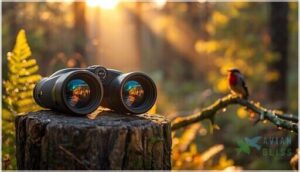
When choosing hiking binoculars, magnification and objective lens size matter most. An 8×42 setup gives you solid magnification stability and a 5.25mm exit pupil size — perfect for long birding sessions without eye strain.
The 42mm objective lens boosts light gathering efficiency at dawn and dusk, while quality objective lens coatings sharpen optical quality.
Larger objective lenses gather more light and improve low‑light performance.
Your bird watching binoculars should work as hard as you do.
Field of View and Close Focus Distance

Beyond magnification, field of view determines how quickly you spot birds darting through foliage. Typical birding binoculars offer 5.5 to 8.5 degrees angular FOV measurement—and that gap matters.
An 8-degree field shows 33 percent more than 6 degrees. For close focus distance, aim under 10 feet.
Wide FOV benefits pair perfectly with short close focus range, making your hiking binoculars genuinely adaptable bird watching equipment.
Understanding the field of view importance helps you choose the right binoculars for hiking.
Waterproof and Fogproof Design
Weather doesn’t wait for perfect conditions — and neither do birds. That’s why your hiking binoculars need solid waterproof and fogproof protection.
O-ring seals block moisture and debris at every opening, while nitrogen purging eliminates internal fogging when temperatures shift fast. Argon-krypton mix options last even longer.
Look for an IPX7 rating and hydrophobic coating to keep your outdoor optics sharp through downpours.
Weight and Portability
Once you’ve got weatherproofing sorted, weight becomes your next trail companion — or burden.
Full-size hiking binoculars can run 20–28 ounces, which adds up fast.
Compact binoculars in the 8–10 ounce range disappear into your pack.
Carry system weight matters too — belt system vs neck strap changes everything over eight miles.
Smart packable dimensions and lightweight outdoor gear mean you’ll actually bring them every time.
Durability and Build Quality
tough trails demand tough gear.
rubber armor that absorbs drops without rattling your optics — the Vortex Viper HD manages rocky impacts well.
magnesium chassis keeps things lightweight without sacrificing strength.
nitrogen sealing locks out fog and moisture, while a solid IPX rating means waterproof, fogproof binoculars you can trust.
shockproof certification isn’t marketing fluff — it’s your outdoor gear insurance.
Adjustable Focus and Diopter Settings
Sharp focus can make or break a birding moment. Your central focus wheel sits right under your index finger, letting you lock onto a warbler mid-hop without missing a beat. Pair that with a diopter ring lock to match your eyes once and forget it.
- Focus Speed Control manages close brush to open sky fast
- Interpupillary Adjustment fits any face width comfortably
- Quick Focus Reset keeps moving birds in frame
- Optical Quality stays consistent across full magnification range
Benefits of Binoculars for Bird Watching

right pair of binoculars can completely change how you experience a day on the trail.
Beyond just magnification, they bring real, practical advantages that make birding easier and more rewarding.
Here’s a look at what good binoculars actually do for you out there.
Comfortable Ergonomics for Long Hikes
full day on the trail demands hiking gear that works with your body, not against it. The right binoculars for hiking features rubber armor grips for secure handling, thumb indent placements for natural balance, and lightweight body designs under 600 grams to prevent neck fatigue.
| Ergonomic Feature | Why It Matters |
|---|---|
| Support strap systems | Distributes weight, prevents neck strain |
| Long eye relief (16mm+) | Comfortable viewing for glasses wearers |
| Compact binoculars design | Reduces bounce and bulk on trails |
outdoor adventure equipment details turn hours of birding into pure enjoyment.
Improved Low-Light Performance
prime birding hours — but only if your optics can keep up. Birding binoculars with ED glass benefits eliminate color fringing, while multi-coated optics push light transmission up to 95%.
Phase coating impact and dielectric prism boost and sharpen contrast in shadowed canopies. Large objective light intake through 42mm lenses delivers real low‑light performance, even in compact binoculars that don’t weigh you down.
Tracking Birds in Motion
A warbler doesn’t wait for you to focus. That’s where image stabilization and responsive focus become game-changers for bird watching on the trail.
Wide-field tracking keeps fast flyers centered, while smooth panning techniques let you lead the bird instead of chasing it. Lightweight binoculars for birdwatching with image stabilized optics — and even motion AI on sophisticated models — turn frantic scrambles into confident, fluid follows.
Versatility for Different Terrains
From foggy wetlands to sun‑baked ridgelines, your birding binoculars need to keep up without missing a beat. The best binoculars for hiking handle every environment you throw at them.
- Altitude Adaptability keeps optics sharp on high, thin‑air ridges
- Temperature Resilience protects lenses from tundra cold to desert heat
- Terrain Grip and rubber armor steady your hold on slick trails
- Moisture Management through waterproof, nitrogen‑purged builds prevents fogging mid‑scan
Lightweight optics for nature observation with rapid refocus capability make versatility easy.
Factors to Consider Before Buying
Picking the right binoculars isn’t complicated, but a few key factors can make or break your experience on the trail.
Before you spend a dollar, it’s worth knowing what actually matters for hiking and birding. Here’s what to look at before you buy.
Magnification Needs for Hiking
terrain power needs should guide your magnification choice. For most hikers, 8×42 binoculars hit the sweet spot — they offer a stability trade-off that keeps images steady on uneven ground.
10x works well on open ridges where the bird distance range is greater. Either way, your low-light exit pupil stays practical, making both solid birding binoculars for hiking.
Size and Weight Preferences
Size matters more than you’d think. Full-size binoculars for hiking, like an 8×42, weigh 22–27 ounces — manageable for day trips but noticeable by mile five.
Compact vs full-size really comes down to your pack. The Leica Ultravid Compact 8×20 slips into a jacket pocket, while an 8×32 offers ergonomic balance without the bulk. Know your weight thresholds before you buy.
Weather Resistance and Reliability
Weather can flip fast on the trail. That’s why waterproof binoculars built for hiking and birdwatching aren’t optional — they’re your insurance policy.
Look for these four protections in any pair you consider:
- IPX Rating — IPX7 or higher manages real submersion durability
- O-Ring Seals — locks moisture out of lenses and prisms
- Nitrogen Purging — stops internal fogging during temperature swings
- Rubber Armoring — absorbs drops and improves grip in wet conditions
Solid weather resistance means your binoculars survive outdoor activities, not just survive light drizzle.
Price Range and Value
Price matters — but so does what you’re getting for it. Budget vs midrange binoculars for hiking sit at very different performance levels.
| Price Tier | Cost-per-Year | Value for Money |
|---|---|---|
| Budget (~$150) | ~$30/yr | Casual birding, light trails |
| Midrange ($300–$650) | ~$45/yr | Frequent hiking, optical quality |
| Premium ($900+) | ~$60/yr | High resale value, low-light edge |
Discount timing also helps — some binocular reviews track 20–50% seasonal drops.
Brand Reputation and Reviews
Reputation carries weight when you’re choosing optics you’ll rely on for years.
Nikon Monarch M5 earns strong community feedback from Cornell Lab’s All About Birds, while Vortex Optics wins loyal fans with trouble‑free warranty service.
Swarovski NL Pure and ZEISS Conquest HD dominate expert endorsements at premium tiers.
Check binocular reviews and user ratings on trusted forums — real‑world field notes beat marketing copy every time.
Top 10 Binoculars for Hiking and Birding
Finding the right binoculars can make or break your time on the trail.
There are a lot of options out there, but these ten stand out for performance, value, and real-world usability.
Here’s what made the cut.
1. Adasion 12×42 HD Binoculars Phone Adapter
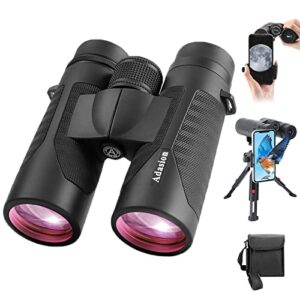
The Adasion 12×42 HD Binoculars punch well above their price tag. You get 12x magnification, BAK4 prisms, and fully multi-coated lenses — a combination that pulls in sharp, bright images even in early morning light.
The IPX7 waterproof rating keeps you covered through rain or mist on the trail.
What really sets this kit apart is the included phone adapter and tripod, letting you capture what you see without extra gear.
At 1.2 pounds, it won’t slow you down.
| Best For | Outdoor enthusiasts — birders, hikers, hunters, and sports fans — who want sharp, reliable optics with the bonus of phone shooting capability without spending a fortune. |
|---|---|
| Magnification | 12x |
| Objective Lens | 42mm |
| Waterproof | IPX7 |
| Prism Type | BAK4 |
| Weight | 1.2 lbs |
| Fog Proof | Yes |
| Additional Features |
|
- BAK4 prisms and fully multi-coated lenses pull in bright, detailed images even in low light — great for early mornings or overcast days
- IPX7 waterproof and fog-proof build means you’re not babying it on the trail
- The included phone adapter and tripod let you snap photos or video on the spot without hauling extra gear
- The phone adapter can be hit or miss depending on your smartphone model, which is frustrating if you’re counting on that feature
- The instruction manual leaves a lot to be desired — expect some trial and error getting set up
- The case design makes it oddly hard to keep all the accessories together and organized
2. Timorn 10×42 HD Binoculars Bird Watching
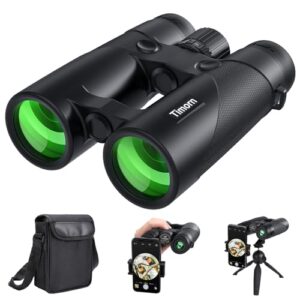
The Timorn 10×42 is a solid trail companion that won’t let you down when a warbler darts through the canopy. Its 10x magnification paired with HD green-film-coated lenses pulls in crisp, color-rich detail — even in shaded spots.
The single-finger focus wheel keeps things quick when birds move fast.
Twist-up eyecups work great whether you wear glasses or not.
At 1.43 pounds, with waterproof and fogproof protection, it copes with real outdoor conditions.
The included phone adapter and tripod are nice extras for capturing memorable sightings.
| Best For | Bird watchers, hikers, and outdoor beginners who want a reliable, all-weather binocular that’s easy to use and won’t break the bank. |
|---|---|
| Magnification | 10x |
| Objective Lens | 42mm |
| Waterproof | IPX7 |
| Prism Type | BAK4 |
| Weight | 1.43 lbs |
| Fog Proof | Yes |
| Additional Features |
|
- Sharp, bright images thanks to BAK4 prisms and FMC green-film coating — works well even in low light
- Fast single-finger focus wheel keeps up when birds are on the move
- IPX7 waterproof and fogproof build handles rain, fog, and whatever the trail throws at you
- The diopter dial sits close to the focus wheel, so you might accidentally nudge it mid-use
- Wide barrels can be tricky for users with a narrower eye distance, leading to overlapping circles
- The phone and tripod adapters are a nice touch but feel like extras most birders won’t reach for often
3. Celestron Outland X 8×42 Binoculars
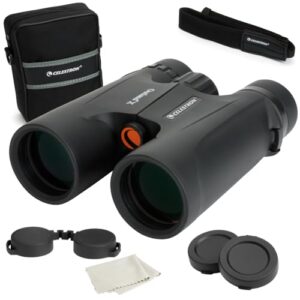
The Celestron Outland X 8×42 punches well above its $100–$120 price tag. You get BaK-4 prisms, fully multi-coated optics, and a genuinely wide 356-foot field of view at 1,000 yards — great for tracking birds darting through tree lines.
The 13-foot close focus means nearby feeders are fair game too.
It’s waterproof, nitrogen-purged to prevent fogging, and rubber-armored for real trail abuse.
At 22 oz, it won’t drag you down mile after mile.
| Best For | Birders, hikers, and sports fans who want solid glass without spending a fortune. |
|---|---|
| Magnification | 8x |
| Objective Lens | 42mm |
| Waterproof | Yes |
| Prism Type | BaK-4 |
| Weight | 22 oz |
| Fog Proof | Yes |
| Additional Features |
|
- BaK-4 prisms and multi-coated optics give you sharp, bright views across a wide 356-foot field — great for fast-moving subjects
- Waterproof, nitrogen-purged, and rubber-armored, so it can take real outdoor punishment
- At 22 oz with 18mm eye relief, it’s comfortable all day whether you wear glasses or not
- The eye cup adjustment is a bit finicky — small moves make a bigger difference than you’d expect
- Focus wheel takes some getting used to, especially if you’re used to smoother high-end glass
- Not a great pick for low-light or nighttime use, so stargazers should look elsewhere
4. Aurosports 10×25 Compact Binoculars
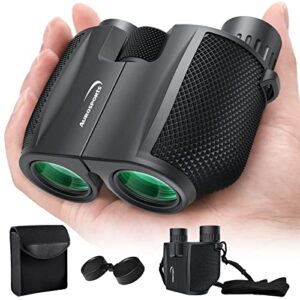
Sometimes the best hiking companion fits right in your jacket pocket. The Aurosports 10×25 weighs just 8.8 ounces and measures under 4 inches — small enough to forget it’s there until a warbler lands nearby.
You get 10x magnification, BaK4 prisms, and fully multi‑coated lenses that deliver surprisingly sharp images for the price.
The waterproof, fog‑proof housing manages trail weather without complaint. It’s a solid grab-and-go option for casual birders who want lightweight convenience without sacrificing too much optical quality.
| Best For | Casual hikers and birdwatchers who want a lightweight, affordable binocular they can toss in a pocket and forget about until they need it. |
|---|---|
| Magnification | 10x |
| Objective Lens | 25mm |
| Waterproof | Yes |
| Prism Type | BAK4 |
| Weight | 8.8 oz |
| Fog Proof | Yes |
| Additional Features |
|
- Genuinely compact at 8.8 oz — easy to carry all day without noticing the weight
- BaK4 prisms and multi-coated lenses punch above their price point for sharpness and clarity
- Waterproof and fog-proof, so a little trail weather won’t ruin your day
- The neck strap feels cheap and has a reputation for giving out
- Struggles in low-light conditions, so dawn and dusk birding can be frustrating
- Not built for serious long-distance viewing — best kept to mid-range observations
5. DEESOO 25×32 Compact Binoculars
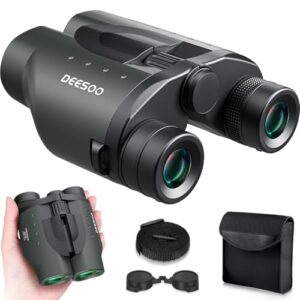
Want serious reach without hauling heavy glass up the trail? The DEESOO 25×32 delivers 25x magnification in a package weighing just 14 ounces. That’s surprisingly powerful for something this compact.
BAK4 prisms and fully multi-coated lenses push light transmission to around 90%, so early morning birding stays sharp. The 175-foot field of view at 1000 yards gives you enough room to track moving birds without losing them.
Twist-up eyecups, a textured grip, and a ready-to-go kit make it an easy pick for casual hikers.
| Best For | Casual outdoor enthusiasts—hikers, birders, and sports fans—who want solid reach and portability without spending big on pro-grade glass. |
|---|---|
| Magnification | 25x |
| Objective Lens | 32mm |
| Waterproof | Yes |
| Prism Type | Not specified |
| Weight | 14 oz |
| Fog Proof | Yes |
| Additional Features |
|
- 25x magnification in a 14-ounce package makes it genuinely easy to carry anywhere
- 90% light transmission keeps images clear during early morning or evening outings
- Comes ready to use with a case, neck strap, and lens cloth right out of the box
- Some buyers have doubted whether the magnification lives up to the 25x claim
- The carrying pouch lacks a shoulder strap, so it’s not as grab-and-go as it could be
- Low-light performance has limits—don’t expect it to shine in near-dark conditions
6. Nikon Monarch M5 8×42 Binoculars
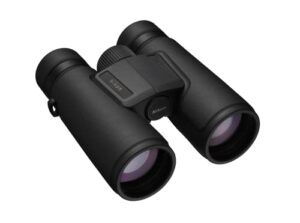
If you’re ready to step up to something more refined, the Nikon Monarch M5 8×42 is worth a serious look.
It packs ED glass that cuts chromatic aberration and keeps colors true — a real difference when you’re scanning a tree line at dawn.
At 22.2 ounces, it’s trail‑friendly without feeling cheap.
The 335-foot field of view and 8.2-foot close focus make it adaptable for both distant hawks and nearby warblers.
Plus, it’s waterproof to 3.3 feet.
Built to last, backed by a 10-year warranty.
| Best For | Outdoor enthusiasts — from beginners to seasoned birders and hikers — who want sharp, reliable optics without lugging around a heavy setup. |
|---|---|
| Magnification | 8x |
| Objective Lens | 42mm |
| Waterproof | Yes |
| Prism Type | Not specified |
| Weight | 1.39 lbs |
| Fog Proof | Yes |
| Additional Features |
|
- ED glass delivers bright, true-to-life images with minimal color fringing, even in tricky lighting
- Lightweight and ergonomic, so it sits comfortably in your hands on long days out
- Solid build quality backed by a 10-year warranty — it’s made to take some punishment
- The included strap can rub against your neck, so you might want to swap it out
- 8x magnification is great for most uses, but won’t cut it if you’re trying to spot very distant subjects
- The focus wheel can feel a little stiff, which takes some getting used to
7. Leica Ultravid BR 8×20 Waterproof Binocular
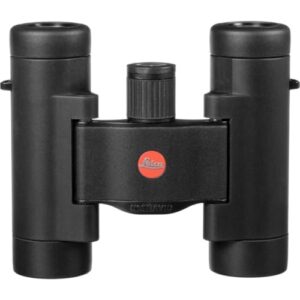
If the trail-ready Nikon feels ready, the Leica Ultravid BR 8×20 takes portability to another level.
At just 8.5 oz and small enough to slip into a jacket pocket, it’s built for hikers who don’t want extra bulk.
Don’t let the compact 20mm lenses fool you — AquaDura coating, waterproofing down to 16.5 feet, and nitrogen-filled housing keep views sharp in rain or fog.
The 1.8-meter close focus is a bonus for watching small birds up close.
| Best For | Hikers, travelers, and nature lovers who want a premium compact binocular that’s tough enough for wet conditions without weighing them down. |
|---|---|
| Magnification | 8x |
| Objective Lens | 20mm |
| Waterproof | Yes, 16.5ft |
| Prism Type | Roof prism |
| Weight | 8.5 oz |
| Fog Proof | Yes |
| Additional Features |
|
- Seriously compact and light at 8.5 oz — fits in a jacket pocket without a second thought
- AquaDura coating and waterproofing down to 16.5 ft means rain and fog won’t ruin your view
- Sharp, bright optics for the size, with a close focus that’s great for watching birds up close
- The price is steep — you’re paying a premium for the Leica name and build quality
- Field of view at 341 ft/1,000 yds is on the narrower side, which can feel limiting for fast-moving birds
- No front lens covers included, and the neck strap is surprisingly tricky to adjust
8. Athlon Optics 8×42 Midas Binoculars
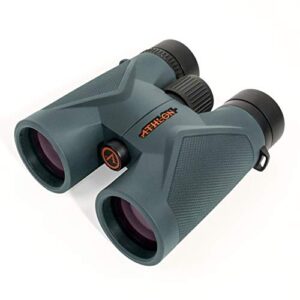
The Leica is hard to beat for pockets, but step up to the Athlon Optics Midas G2 8×42 and you get a full-size performer that punches well above its price.
UHD ED glass keeps colors honest and edges sharp, while the ESP dielectric coating reflects over 99% of incoming light — noticeable in dim forest shade.
At around 25 oz with a magnesium chassis, it’s sturdy without feeling heavy.
That 426-foot field of view at 1,000 yards makes tracking fast-moving warblers surprisingly easy.
| Best For | Hunters, birders, and outdoor enthusiasts who want serious glass without a serious price tag. |
|---|---|
| Magnification | 8x |
| Objective Lens | 42mm |
| Waterproof | Argon purged |
| Prism Type | Bak-4 |
| Weight | 25 oz |
| Fog Proof | Yes |
| Additional Features |
|
- ED glass with ESP dielectric coating pulls in sharp, color-accurate images even in low light
- Wide 426-foot field of view makes tracking fast-moving birds or game much easier
- Solid magnesium build at 25 oz — tough enough for the field, not a burden to carry
- Some users notice a black border creeping into the edges of their view
- At 25 oz, it’s not a compact option — leave the Leica if you want something pocketable
- Not the best pick if you regularly need to pick out detail beyond 500 yards
9. Vortex Viper HD Roof Prism Binoculars
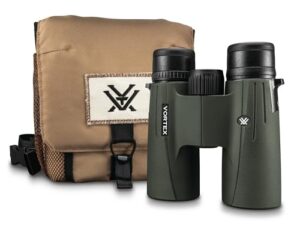
Step up even further, and the Vortex Viper HD is waiting. With 10×42 magnification and HD extra-low dispersion glass, it delivers sharp, color-accurate views from dawn forest light to open ridgelines.
The XR fully multi-coated lenses push brightness right when birds are most active. Argon-purged and O-ring sealed, it manages rain and fog without hesitation.
The locking diopter won’t drift on a chest strap, and Vortex’s lifetime VIP warranty means you’re covered for the long haul.
| Best For | Hunters, birders, and outdoor enthusiasts who want premium optics that perform in low light and tough weather conditions. |
|---|---|
| Magnification | 10x |
| Objective Lens | 42mm |
| Waterproof | O-ring sealed |
| Prism Type | Not specified |
| Weight | 1.6 lbs |
| Fog Proof | Yes |
| Additional Features |
|
- Crystal-clear, color-accurate views edge to edge, even in dim early-morning light
- Weatherproof build with argon purging and O-ring seals handles rain and fog without skipping a beat
- Locking diopter stays put on the move, so you’re not constantly readjusting
- Pricey upfront, though most users agree it earns its keep over time
- Higher magnification can make images feel shaky without a steady hand or support
- Some users may notice slight chromatic aberration in high-contrast lighting situations
10. Celestron Nature DX ED 8×42 Binoculars
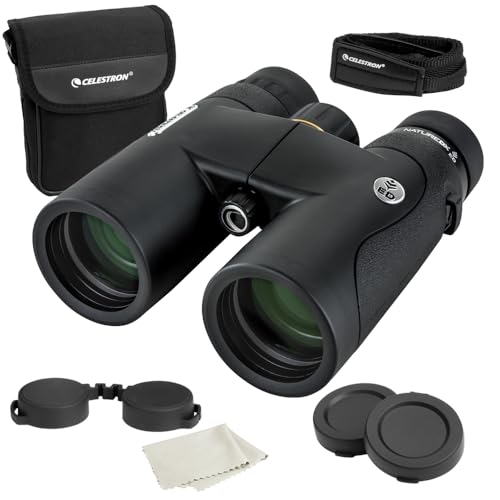
Round out your list with the Celestron Nature DX ED 8×42 — a solid closer that doesn’t ask you to break the bank. The ED glass cuts chromatic aberration cleanly, giving you sharp, true‑color views whether you’re tracking a warbler through dense brush or scanning an open hillside.
At just over two pounds, it won’t punish your neck on long days out. Nitrogen‑purged, waterproof, and tripod‑adaptable, it manages real trail conditions.
A close focus of 6.5 feet makes backyard birding just as rewarding.
| Best For | Birdwatchers and outdoor enthusiasts who want sharp, reliable optics without spending a fortune. |
|---|---|
| Magnification | 8x |
| Objective Lens | 42mm |
| Waterproof | Nitrogen purged |
| Prism Type | BaK-4 |
| Weight | 2.09 lbs |
| Fog Proof | Yes |
| Additional Features |
|
- ED glass delivers crisp, true-color images with minimal chromatic aberration
- Waterproof and nitrogen-purged, so it handles real weather without fuss
- 6.5-foot close focus makes it great for backyard birding and butterfly watching
- At just over two pounds, it can feel heavy during long sessions
- The focus dial needs more travel than some competing models
- Shallower depth of field means you’ll be refocusing more often
Choosing The Right Magnification for Hiking

Picking the right magnification can make or break your time on the trail.
Too much power and you’ll struggle to track a bird darting through the trees — too little and distant details slip away.
Here’s what you need to know before you decide.
8x Vs 10x Magnification
Choosing between 8x and 10x magnification comes down to how you hike.
An 8×42 gives you a larger exit pupil — about 5.25mm — meaning better low-light brightness at dawn. It also delivers stronger image stability with less hand shake.
A 10x sharpens bird size perception across open water but narrows your field of view, making fast-moving birds trickier to track.
Pros and Cons of High Magnification
High magnification sounds like a dream for birding and wildlife observation — until you’re on a windy ridge and the image stability falls apart. At 12x, your binoculars for hiking become harder to hold steady, arm fatigue sets in faster, and the smaller exit pupil dims your view in shade.
High magnification promises clarity but delivers shake, fatigue, and dimmed views when it matters most
Watch for:
- Atmospheric distortion washing out distant detail
- Higher cost & weight from optical quality upgrades
- High-powered models struggling in low light
Balancing Field of View and Detail
Wide field of view gets you on the bird fast — but detail seals the ID.
For bird watching, the sweet spot sits around 8x magnification, where field of view and edge sharpness work together naturally.
| Feature | Wide FOV | Narrow FOV |
|---|---|---|
| Best For | Forest birding | Open terrain |
| Exit Pupil | Larger, forgiving | Smaller, precise |
| Edge Sharpness | Varies by coating quality | Consistently sharp |
| Eye Relief & Prism Design | More critical | More forgiving |
Binoculars for hiking with strong optical quality and thoughtful prism design give you both — without compromise.
Essential Accessories for Hiking Binoculars
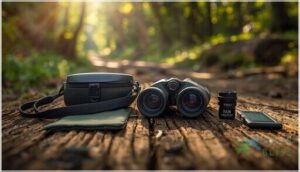
Good binoculars are only half the story — the right accessories make every hike smoother and your gear last longer.
A few smart add-ons can mean the difference between a frustrating outing and a truly great one.
Here’s what you’ll want to pair with your binoculars before hitting the trail.
Harnesses and Straps for Comfort
A good gear turns a long day on the trail into a real pleasure.
Look for adjustable strap lengths that fit over layers, quick‑release clip systems for fast access, and moisture‑wicking padding to stay comfortable on warm climbs.
Mesh ventilation panels cut heat buildup, while smart weight distribution design keeps your lightweight binoculars for hiking stable — essential gear for hiking, camping, and serious bird watching.
Lens Cleaning Kits and Maintenance
Dirty lenses are the fastest way to ruin a birding moment. A basic kit — blower, lens pen tips, and microfiber cloth — keeps your optics sharp on trail.
Always use proper cleaning solution safety: skip household glass sprays and stick to coated-lens-safe formulas. Apply solution to the cloth, never the glass. After wet hikes, let binoculars air out fully before storage to avoid humidity-related damage.
Protective Cases and Storage
once your lenses are clean, keeping them safe is the next step. good case does more than just hold your binoculars for hiking — it protects your investment.
EVA padding, magnetic closures, and weather-resistant zippers in your outdoor equipment. MOLLE attachment points help with trail access, and tossing in a desiccant pack prevents moisture buildup during long-term storage.
Tripod Adapters for Stability
A tripod adapter turns shaky 10x views into rock-solid images.
Threaded mount compatibility is standard on most binoculars for hiking — look for a 1/4"-20 socket under the hinge cap.
Quick release mechanisms like the Vortex Uni-Dapter snaps on fast without fuss.
Adapter weight impact stays minimal at under two ounces.
For serious bird watching, stability enhancements make lightweight, image‑stabilized glassing genuinely easy.
Floating Straps for Water Safety
Stability matters on the trail — but so does keeping your gear off the lake bottom.
Floating strap combines buoyancy materials like closed-cell foam and neoprene with bright visibility markings (think vivid yellow or orange) so you can spot dropped binoculars fast. Look for:
- Secure attachment mechanisms that fit most binoculars for hiking
- Comfort padding wide enough to ease neck strain on long bird watching days
- Waterproof construction that resists saltwater and trail moisture
Tips for Using Binoculars on The Trail

Having the right binoculars is only half the battle — knowing use them on the trail makes all the difference.
A few simple habits can sharpen your experience and help you spot more birds with less frustration.
Here’s what to keep in mind every time you head out.
Adjusting Focus and Eye Relief
Getting sharp views starts with two quick adjustments. First, twist up the eyecups to match your eye relief — glasses wearers should keep them down for full field coverage.
Then set your diopter for your right eye, and use the central focus wheel for everything else. These small steps release real optical performance for bird watching and hiking alike.
Proper Carrying Techniques
Carrying your binoculars for hiking the right way makes a real difference on long trails.
A support system beats a neck strap every time — support system weight distribution spreads the load across your torso, not just your neck.
Nail your chest strap positioning just below the collarbone, and the quick-release buckle lets you grab your binoculars for birdwatching in seconds.
Backpack-support system integration and swing-motion reduction keep everything stable and lightweight on the move.
Maintaining Binoculars in The Field
Keeping your binoculars trail-ready doesn’t have to feel like a chore. A little daily care goes a long way — especially when dust, fog, and rain are part of the adventure.
- Brush loose dust off lenses, then use a blower bulb before wiping
- Wipe rubber armor weekly to remove sweat and dirt
- Store with silica gel storage packets to prevent internal moisture
- Apply fog prevention tactics by letting binoculars acclimate before use
- Follow a simple lens cleaning routine using microfiber and proper solution
Your waterproof, lightweight binoculars for hiking deserve that attention.
Bird Identification While Hiking
Spotting a bird is one thing — knowing what it takes is a sharper eye.
field marks like wing bars, bill shape, and tail patterns to nail bird identification fast.
Size comparison helps too: is it sparrow-small or crow-large?
behavioral cues, listen for sound identification, and apply smooth tracking techniques with your binoculars for hiking.
Bird watching gets easier on every trail.
Frequently Asked Questions (FAQs)
What strength of binoculars is best for bird watching?
For most bird watching, 8x magnification hits the sweet spot. It gives you a wide field of view, steady images, and enough detail without hand-shake ruining the shot.
Are 8x or 10X binoculars better for bird watching?
For most birders, 8x wins. It’s steadier in hand, brighter at dawn, and easier to track fast-moving birds. Go 10x only when you’re consistently watching distant open-water or coastal species.
What magnification binoculars for hiking?
For hiking, 8x magnification binoculars hit the sweet spot — steady enough for moving trails, wide field of view, and lightweight lens choice that won’t slow you down.
What is better for birding, 8×42 or 10×42?
For most birding, 8×42 wins. You get a wider Field of View, better Exit Pupil for Twilight Viewing, and less Handheld Shake — making it the steadier, brighter choice overall.
Can binoculars be used for stargazing too?
Yes — your hiking binoculars double as solid stargazers. Their wide field viewing and exit pupil brightness reveal star clusters and even Jupiter’s moons on clear nights.
How long do quality binoculars typically last?
Quality binoculars last 10 to 20 years with proper care. Premium pairs can reach 40+ years. Regular maintenance, waterproof seals, and strong lens coating longevity all play a big role.
Are binoculars safe for children to use?
Binoculars are safe for kids when chosen carefully.
Look for low magnification under 8x, lightweight design under 290g, shock-proof construction, and proper IPD adjustment. Correct eye alignment prevents strain and double vision.
Can I wear glasses while using binoculars?
Absolutely, you can wear glasses while using binoculars. Look for at least 16mm eye relief and twist-down eyecups for a clear, full field of view without dark edges.
Do binoculars require any break-in period?
No break-in period needed.
Good binoculars for hiking offer instant mechanical smoothness, solid optical alignment, and factory lubrication settling from day one.
Temperature stabilization takes just minutes, and user adaptation happens naturally on your first trail.
Conclusion
What’s stopping you from finally seeing every wing beat and tail flick in sharp, vivid detail? The right bird watching binoculars for hiking don’t just improve your view—they change the whole experience on the trail.
You’ll spot more species, track faster movements, and feel the confidence that comes with gear that actually performs. Pick the pair that fits your needs, head out at dawn, and let the birds show up for you.