This site is supported by our readers. We may earn a commission, at no cost to you, if you purchase through links.
You hang a birdhouse in your backyard and wait for feathered guests to move in. Weeks pass with no takers. The problem isn’t your hospitality—it’s your real estate strategy.
Most cavity-nesting birds won’t use a house that’s too close to feeders, facing the wrong direction, or mounted at the wrong height for their species. Eastern bluebirds need different conditions than house wrens, and what works in your suburban garden might fail in a rural woodlot. Getting the location right makes the difference between an empty box and a thriving nest full of chicks.
Table Of Contents
- Key Takeaways
- Key Factors for Birdhouse Placement
- Choosing The Right Location for Birdhouses
- Birdhouse Design and Material Considerations
- Top 10 Birdhouses and Feeders for Any Yard
- 1. Audubon Swirl Glass Hummingbird Feeder
- 2. Audubon Mesh Combo Bird Feeder Beige
- 3. Woodlink Cedar Bluebird House Model BB1
- 4. Toysmith Build A Birdhouse Building Kit
- 5. Build and Paint Your Own Birdhouse
- 6. CARTMAN Colorful Hanging Birdhouse Bird Feeder
- 7. Perky Pet Wren Home Birdhouse
- 8. Dawhud Direct Butterfly Flowers Bird House
- 9. Easy Clean Purple Martin Bird Gourds
- 10. Nature’s Way Cedar Wren Birdhouse
- Maintenance Tips for Long-Lasting Birdhouses
- Frequently Asked Questions (FAQs)
- How often can you do birdhouse runs?
- Do higher-tier birdhouses offer more nests?
- Are birdhouses worth it?
- Where should bird houses be placed?
- Should a birdhouse be in sun or shade?
- Why should bluebird houses face east?
- Which direction should a bird box face?
- How long do birdhouses last unharvested?
- What happens if birdhouses are left full?
- Can birdhouses attract special or rare loot?
- Conclusion
Key Takeaways
- Mount your birdhouse 5–15 feet high facing east or northeast to catch morning warmth while avoiding afternoon overheating and storm-driven rain.
- Keep nest boxes at least 10–20 feet from feeders and human activity zones to reduce territorial fights and disturbance during the breeding season.
- Install boxes on smooth metal poles with predator baffles rather than trees—this approach increases fledging success by up to 70% by blocking raccoons and snakes.
- Clean your birdhouse every fall with a 10% bleach solution and inspect for damage before spring to prevent parasite buildup and ensure birds return.
Key Factors for Birdhouse Placement
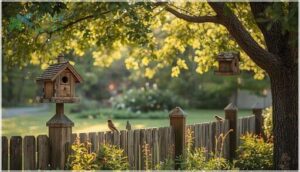
Where you place your birdhouse matters just as much as the birdhouse itself. Getting it right means you’ll attract the birds you want while keeping them safe from predators and harsh weather.
Let’s look at the key factors that help you choose the perfect spot.
Safe Mounting Heights for Different Species
Getting the height right isn’t just about convenience—it’s about giving your nesting birds the best chance at survival. Different species need different elevations to feel secure from predators and thrive in their habitat. Mounting materials and regional variations also play a role in successful birdhouse design. Understanding songbird nesting requirements helps guarantee successful habitation.
- Small songbirds (chickadees, wrens): Mount 5–10 feet for predator avoidance
- Bluebirds and swallows: Place 4–6 feet in open areas
- Wood ducks and owls: Install 10–30 feet based on habitat considerations
Optimal Distance From Feeders and Human Activity
Feeder proximity matters more than you might expect for successful nest placement. Keep birdhouses at least 10 to 20 feet from bird feeders to reduce aggressive encounters and human disturbance around nesting sites.
Species tolerance varies—bluebirds and wrens need quieter activity zones away from busy feeding stations. Position boxes in calmer corners of your yard, separating nest placement from high-traffic areas where you’re attracting birds with seed.
Consider nesting away from activity to encourage a wider variety of birds.
Orientation for Weather Protection
Where your birdhouse faces shapes the internal conditions birds experience daily. Point entrance holes away from prevailing wind to block rain and draft, ideally toward the east or northeast. This catches gentle morning sun without afternoon overheating while dodging storm-driven moisture.
- East-facing boxes warm quickly without harsh sun exposure
- Partial shade microclimate prevents dangerous temperature spikes
- Adequate ventilation and a sloped roof improve air flow year-round
Predator Prevention Strategies
Even a well-oriented birdhouse won’t succeed if predators can reach it. Mount boxes on smooth poles at least five feet high and add stovepipe baffles below to stop raccoons and snakes from climbing. Keep birdhouses ten feet from fences or shrubs that predators use as launch points.
A predator guard increases nest survival by up to 16%, protecting birds from predators and ensuring safe nesting for cavity species.
Choosing The Right Location for Birdhouses
Picking the right spot for your birdhouse isn’t just about height and direction. You need to think about where you’re mounting it and what kind of space surrounds it.
Let’s look at the key location choices that will help birds find and use your birdhouse safely.
Tree-mounted Vs. Pole-mounted Options
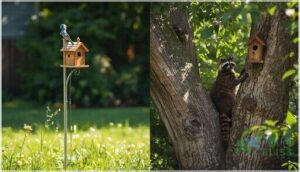
Your choice between pole and tree mounting shapes the safety and success of your birdhouse design and placement. Poles offer enhanced predator access control through guards and mounting height flexibility, while tree cavity locations provide natural aesthetics but invite climbing predators like raccoons and snakes.
Consider these differences:
- Pole-mounted boxes with baffles achieve 70% higher fledging success than tree installations
- Habitat flexibility lets you position poles in favorable open areas away from undergrowth
- Microclimate control and structural integrity improve with smooth metal poles versus rough bark
Placement in Gardens, Backyards, and Parks
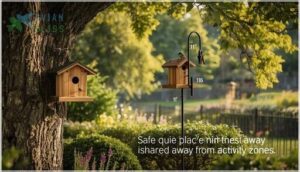
In gardens and backyards, install birdhouses between 5 and 15 feet high to balance predator avoidance with accessible monitoring. Research shows boxes near recreation facilities produce lower nestling growth, so position yours in quieter zones. Keep nest boxes at least 10 to 20 feet from feeders to reduce competition. Secure mounting prevents sway and improves occupancy.
| Setting | Recommended Height |
|---|---|
| Small gardens | 5–10 feet |
| Backyard trees | 8–12 feet |
| Park poles | 10–15 feet |
| Urban walls | 6–10 feet |
Urban, Suburban, and Rural Considerations
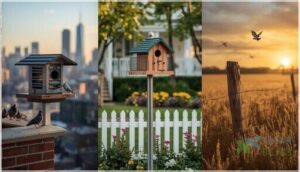
Across different landscapes, birdhouses face unique challenges. Urban noise near major roads can cut breeding success by up to 25%, so find quieter side streets. In suburban backyards, domestic cats account for roughly 29% of small-bird deaths—mount boxes on smooth metal poles with baffles. Rural cavities are scarce in farmland, making nest box placement along tree lines important for attracting birds to your yard.
- Urban: Install building-mounted boxes on high ledges away from traffic
- Suburban: Position boxes 10–20 feet from feeders to reduce predation
- Rural: Place along shelterbelts where natural nesting sites are limited
Avoiding Environmental Hazards
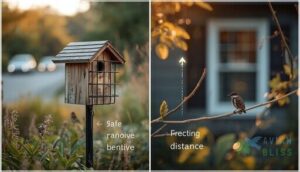
Roads and windows pose serious threats to nesting birds. Place your birdhouse either within 3 feet of glass or beyond 30 feet to prevent window collisions that kill 1 billion birds yearly.
To avoid deadly window strikes, place your birdhouse within 3 feet of glass or beyond 30 feet
Avoid busy roads where noise pollution disrupts breeding and predators hunt along edges. Keep boxes away from areas treated with pesticides, and install predator guards on poles.
Artificial light near nest sites can trigger premature breeding and increase predator activity, compromising bird safety and safe nesting success.
Birdhouse Design and Material Considerations
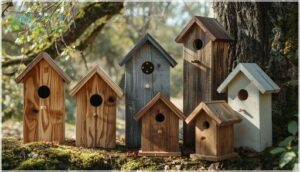
A well-placed birdhouse won’t attract nesting birds if the design doesn’t meet their needs. The right entry hole size, materials, and maintenance features make all the difference in creating a safe home that birds will actually use.
Let’s look at the key design elements you should consider before choosing a birdhouse.
Entry Hole Size for Target Species
The entry hole determines which birds will use your birdhouse. Eastern bluebirds need 1.5-inch openings, while chickadees prefer 1.125 inches. Smaller holes exclude invasive house sparrows and starlings, boosting nesting success for your target species.
Body size matters—undersized holes reduce occupancy, but oversized openings invite competitors. Regional standards help you match hole diameter to local nesting birds, turning your birdhouse into a species-specific sanctuary.
Importance of Ventilation and Drainage
Think of ventilation and drainage as your birdhouse’s life-support system—without them, heat and moisture can turn a safe nest into a deadly trap. Proper airflow and water escape keep nestlings alive during heatwaves and prevent mold, parasites, and rot.
- Drill four ¼-inch ventilation holes near the top of side walls for air circulation
- Add drainage holes in floor corners to shed rainwater and maintain humidity balance
- Recessed floors improve airflow around nesting material and boost structural integrity
- Placement matters—shaded boxes stay cooler and support better nestling survival and parasite control
Weather-resistant and Durable Materials
Your birdhouse material decides whether birds thrive or abandon ship. Cedar birdhouses lead the pack—natural wood with built-in rot and insect resistance that lasts years without chemicals. Untreated pine and poplar work well too, offering solid thermal performance and moisture resistance. Skip pressure-treated lumber; those pesticides leach into nesting cavities.
For weather-resistant durability, pair wooden boxes with metal predator guards or PVC pole sleeves that handle freeze-thaw cycles without cracking.
Ease of Cleaning and Maintenance
Material durability means nothing if you can’t clean the box. Annual cleaning prevents parasite buildup and keeps birds coming back—studies show cleaned boxes attract 72% more eastern bluebirds. Choose designs with hinged roofs or removable panels for quick access. Here’s what makes maintenance simple:
- Hinged roof or side panel for full interior access
- Mesh floor promoting drainage and ventilation
- Non-rusting stainless steel hardware that won’t seize
- Predator guard protecting against raccoons during inspections
- Quick-release fasteners enabling seasonal cleaning in minutes
Scrub with boiling water, wear gloves, and let it dry completely.
Top 10 Birdhouses and Feeders for Any Yard
Once you know where to place your birdhouse, the next step is choosing the right one for your yard.
The options below include both feeders and houses that work well in different settings. Each pick is designed to attract specific birds and fit different yard sizes and budgets.
1. Audubon Swirl Glass Hummingbird Feeder
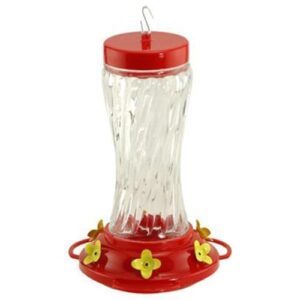
Hummingbirds arrive like jewels in your garden when you offer them the right invitation.
The Audubon Swirl Glass Hummingbird Feeder holds 16 ounces of sugar water in a clear glass reservoir with four feeding ports and perches for multiple visitors. Hang it about five feet high in partial shade—direct sun spoils nectar quickly.
Change the solution every one to two days in warm weather. The dishwasher-safe glass and hand-washable base make seasonal care manageable throughout the feeding season.
Best For: Birding enthusiasts who want to attract multiple hummingbirds at once and don’t mind frequent cleaning and nectar changes in warm weather.
- Clear glass reservoir lets you monitor nectar levels at a glance so you know when to refill
- Four feeding ports with perches allow several hummingbirds to eat at the same time without competing
- Dishwasher-safe glass and wide-mouth base make weekly cleaning quick and straightforward
- Some customers report leakage issues that can attract ants and waste nectar
- Plastic parts may fade or crack after one season of outdoor use
- Requires nectar changes every 1–2 days in hot weather, which adds up to more maintenance than some feeders
2. Audubon Mesh Combo Bird Feeder Beige
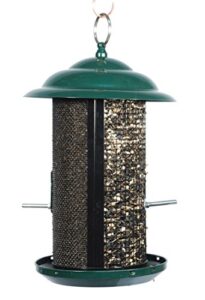
While hummingbirds sip nectar, songbirds need seed year-round. The Audubon Mesh Combo Bird Feeder Beige holds three pounds in powder-coated metal construction that resists gnawing and weather.
You’ll attract chickadees, finches, and nuthatches when you fill both compartments—try black-oil sunflower on one side and Nyjer on the other. Hang it five feet high near shrub cover but at least fifty feet from your house to reduce disturbance.
The easy-open top simplifies cleaning, which you’ll want to do whenever seed clumps after rain.
Best For: Backyard birders who want to attract multiple species at once without buying separate feeders for finches and larger songbirds.
- Dual-compartment design lets you offer two seed types simultaneously—black-oil sunflower for chickadees and cardinals, Nyjer for goldfinches—so you’ll see more variety without cluttering your yard with extra feeders.
- Metal mesh and powder-coated components hold up against squirrels and weather better than plastic models, giving you a feeder that lasts through multiple seasons of rain, snow, and chewing attempts.
- Three-pound capacity means you’ll refill less often, and the easy-open top makes cleaning quick when seed gets damp or clumped.
- Small mesh openings make filling tricky—you’ll likely spill seed unless you use a funnel or pour very carefully.
- Drainage holes can clog, so seed sitting in the tray after rain may mildew if you don’t check and clean regularly.
- The mesh design can trap damp seed along the sides, requiring more frequent scrubbing than smooth-walled tube feeders if you want to prevent mold buildup.
3. Woodlink Cedar Bluebird House Model BB1
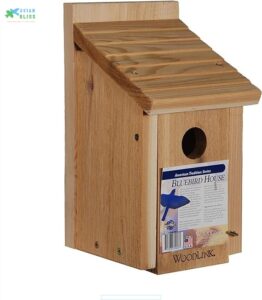
Three North American bluebird species rely on cavity nesting, so proper birdhouse design becomes essential for their survival. The Woodlink Cedar Bluebird House Model BB1 features a 1.5-inch entrance that welcomes bluebirds while blocking starlings.
Kiln-dried inland red cedar resists decay for up to twenty years, and the half-inch ventilation gap plus drainage holes keep nesting birds comfortable.
Mount it on a pole four to six feet high, at least fifty feet from feeders, and the easy-open front panel makes annual cleaning simple.
Best For: Homeowners who want to attract bluebirds to their yard with a durable, low-maintenance house that’s easy to clean and monitor throughout the nesting season.
- Built from kiln-dried red cedar that naturally resists rot and can last 10–20 years outdoors without needing chemical treatment
- The 1.5-inch entrance hole is sized perfectly for bluebirds while keeping out larger competitors like starlings
- Front panel opens easily for quick nest checks and annual cleaning, so you can maintain it without taking the whole thing apart
- Some customers reported the roof can come loose or separate over time, which may require occasional repairs
- The door latch might not always stay secure, and in rare cases birds could get their feet caught in gaps
- Priced higher than some competing bluebird houses, and you might need to add stain or waterproofing to maximize its lifespan
4. Toysmith Build A Birdhouse Building Kit
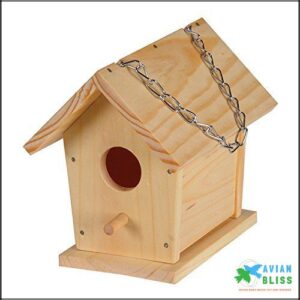
The Toysmith Build A Birdhouse kit transforms craft time into a doorway to backyard science. It includes pre-cut, pre-drilled wooden panels that five-year-olds can nail together with adult help, plus four paint pots for creative expression.
Assembly difficulty stays low thanks to the tabbed design, though paint quality may disappoint for outdoor durability. Safety standards meet ASTM F963 toy requirements, but habitat suitability remains limited—think decorative starter project rather than serious cavity-nester housing.
Educational value shines when you discuss entry-hole size and nesting box placement with young builders.
Best For: Parents and educators looking for a simple, supervised craft that introduces kids ages 5 and up to basic woodworking, bird biology, and creative decoration in a single afternoon project.
- Pre-cut, pre-drilled panels make assembly fast and frustration-free for young children with minimal adult help
- Complete kit includes nails, paint, brush, and hanging cord so you can start building right away
- Doubles as a hands-on STEM activity that connects craft time to real backyard bird observation and science lessons
- Paint quality is weak and may not hold up outdoors, limiting the birdhouse to decorative or short-term use
- Small size and generic entry hole may not suit larger bird species or meet strict nesting-box guidelines for serious wildlife projects
- Thin plywood construction feels fragile, and some buyers report the house breaking easily during assembly or outdoor exposure
5. Build and Paint Your Own Birdhouse
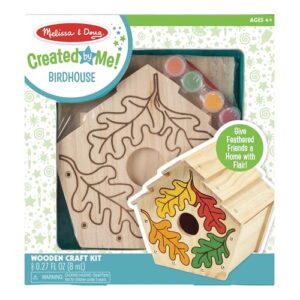
Building and painting your own birdhouse merges Educational Woodworking with genuine habitat creation. The Melissa & Doug kit (model 3101) provides pre-cut wooden panels, screws, four paint pots, and a brush—DIY Kit Safety certified under ASTM F963 standards.
Children age five and up develop fine motor coordination and problem-solving skills while learning nesting box fundamentals. Paint Selection matters: choose zero-VOC finishes to protect both young crafters and future cavity-nesters.
Functional Design remains modest given the small entry hole, yet this hands-on project strengthens Child Development and nature connectedness when you discuss species needs during assembly.
Best For: Parents looking for a screen-free craft that teaches kids basic woodworking while creating something useful for the backyard.
- Combines hands-on building with art, helping kids develop fine motor skills and spatial reasoning through a real project
- Uses safety-tested materials under ASTM F963 standards, with non-toxic paints suitable for both children and birds
- Creates a functional birdhouse that can actually attract cavity-nesting birds when installed outdoors
- Predrilled holes sometimes don’t align properly, requiring adult troubleshooting during assembly
- Entry hole may be too small for many common bird species to use effectively
- Paint quality can be inconsistent, and outdoor durability often requires additional weatherproof sealing
6. CARTMAN Colorful Hanging Birdhouse Bird Feeder
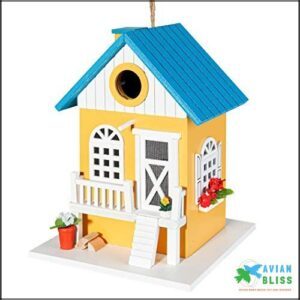
Bright paint may catch your eye, but the CARTMAN Colorful Hanging Birdhouse Bird Feeder (7.09″×9.06″×7.09″H) shows significant design flaws that limit its usefulness among hanging bird feeders. The wooden construction lacks weather durability—roofs peel and warp after one season outdoors.
Cleaning access through the rear sliding door proves difficult in practice, and flimsy build quality undermines hanging stability. While marketed as dual-purpose for bird house design and placement, most cavity-nesters avoid this decorative unit.
Consider sturdier hanging birdhouse options if bird attraction matters more than garden color.
Best For: Budget-conscious buyers who prioritize garden decoration over long-term functionality and don’t mind replacing the birdhouse after a season or two.
- Bright, colorful design adds visual appeal to gardens and patios as a decorative accent piece
- Arrives fully assembled and ready to hang without any additional hardware or setup required
- Compact size (7.09″×9.06″×7.09″H) fits well in small outdoor spaces like balconies or modest yards
- Poor weather durability with roofs that peel and warp after one outdoor season
- Flimsy wooden construction compromises stability and doesn’t hold up to normal outdoor conditions
- Difficult to clean despite the rear sliding door, and birds often avoid nesting in it due to design issues
7. Perky Pet Wren Home Birdhouse
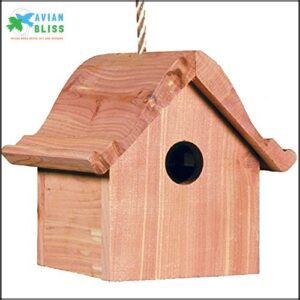
Cedar construction sets the Perky-Pet Wren Home Birdhouse apart from cheaper alternatives—its aromatic wood naturally resists decay for 5–10 years of outdoor service life. You’ll appreciate the 1–1.5 inch entrance, sized perfectly for wren attraction while excluding larger competitors.
The hanging design fits yards where pole mounts won’t work, and the removable roof makes seasonal cleaning ease a reality.
At 6.5 inches tall with ventilation and drainage built in, this compact nest box consistently attracts nesting birds like wrens and chickadees to backyard bird habitats.
Best For: Bird lovers who want a durable, easy-to-maintain nest box that attracts small cavity nesters like wrens and chickadees to yards without space for pole-mounted options.
- Cedar construction naturally resists rot and insects for 5–10 years outdoors without treatment
- Removable roof makes annual cleaning simple and keeps the box bird-ready season after season
- 1–1.5 inch entrance is perfectly sized to welcome wrens while keeping out starlings and larger competitors
- Some buyers report the roof can separate or break apart after a season or two of weather exposure
- Mixed success attracting birds—placement and local competition matter more than the box itself
- Construction feels a bit flimsy in spots and may need light sanding to smooth rough edges out of the package
8. Dawhud Direct Butterfly Flowers Bird House
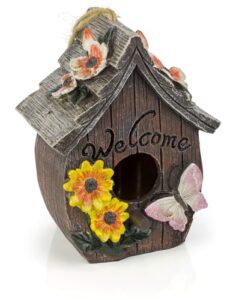
If you’re drawn to visual charm as much as habitat function, this hand-painted polyresin birdhouse merges garden decor with hanging birdhouse options. Its 6×7 inch dimensions and 1.15-pound resin durability suit small songbirds, though size limitations exclude larger cavity nesters.
The jute hanging cord and clean-out plug simplify installation and seasonal maintenance, while butterfly-and-flower motifs add aesthetic appeal to patios and gardens.
Orient the entrance away from prevailing winds and position 5–10 feet high near protective cover to improve bird house design and placement for nesting success.
Best For: Gardeners and bird lovers who want a decorative outdoor accent that can also attract small songbirds like chickadees or wrens to their patio or deck.
- Hand-painted butterfly and flower design adds visual charm to outdoor spaces while still functioning as a real birdhouse
- Polyresin construction holds up well to weather and maintains its appearance after a year outdoors according to buyers
- Comes fully assembled with hanging cord and a removable bottom plug that makes seasonal cleaning straightforward
- The 6×7 inch size limits use to smaller bird species and won’t accommodate larger cavity nesters
- Some customers report the clean-out plug isn’t very durable and the jute cord may need replacing after exposure to rain and sun
- A few reviews mention concerns about overall sturdiness in windy conditions, suggesting it works best in sheltered spots
9. Easy Clean Purple Martin Bird Gourds
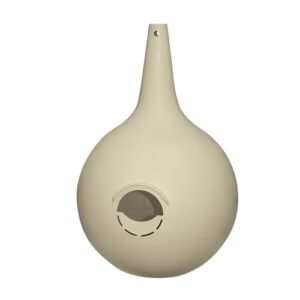
Purple martins nest in colonies, so these Heath Outdoor Products gourds come in four-pack systems designed for rack mounting at 12–20 feet. The two-piece white plastic construction uses UV-resistant materials that reflect heat while allowing you to open the back panel for thorough cleaning between seasons.
Starling-resistant crescent entrances and included predator guards help protect nesting birds.
Mount racks at least 40 feet from tall trees in open areas, spacing gourds 18–24 inches apart to reduce aggression and create clear flight paths for attracting birds to your yard.
Best For: Purple martin enthusiasts starting a backyard colony who want easy-to-maintain housing that keeps out starlings and stays cool in summer heat.
- Two-piece design splits open for full interior access, so you can scrub out old nests and check on chicks without tools
- Starling-resistant crescent entrances and UV-resistant white plastic help protect nesting birds while reflecting heat to keep cavities cooler
- Four-gourd pack with mounting hardware lets you create a starter colony setup at the recommended 12–20 foot height in open areas
- Some users report the two halves don’t snap together securely and can come apart, requiring modifications or extra fasteners
- No built-in access hole for quick checks means you still need to open the entire back section to monitor nestlings during the season
- Attracting martins requires proper site selection—at least 40 feet from tall trees in wide-open spaces—which not every yard can provide
10. Nature’s Way Cedar Wren Birdhouse
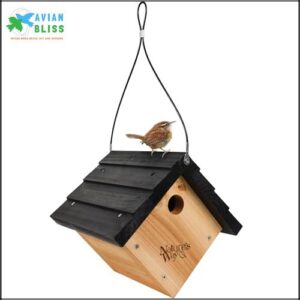
For wrens and chickadees, this Nature’s Way cedar birdhouse offers a 1 1/8-inch entrance that excludes starlings while welcoming small cavity nesters. Premium cedar resists rot for years, and air vents through walls and floors keep nestlings cool during warm weather.
The hinged clean-out door lets you remove old nesting material each fall. Hang it 5–10 feet high in a sheltered spot under branches, facing away from prevailing winds.
The included vinyl-coated cable makes tree mounting simple while protecting nesting birds from climbing predators.
Best For: Homeowners who want to attract wrens and chickadees while keeping out larger, aggressive birds like starlings.
- Premium cedar construction with rust-free hardware resists rot and holds up for multiple seasons outdoors
- 1 1/8-inch entrance hole is sized specifically to welcome wrens and chickadees while blocking starlings
- Built-in air vents and drainage openings keep the interior cool and dry, creating a healthier environment for nestlings
- Some customers reported durability issues, with units falling apart sooner than expected
- The entrance hole may be too small for certain wren species, and the bottom clasp doesn’t always stay tight
- May need extra protection like a metal portal guard to stop predators from chewing the hole larger
Maintenance Tips for Long-Lasting Birdhouses
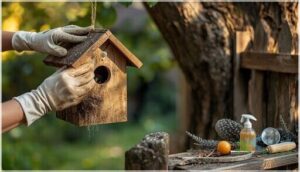
A birdhouse won’t last long if you forget about it after hanging it up. Birds need clean and safe spaces to raise their young, which means you’ll need to check in regularly.
Here’s what you should do to keep your birdhouse in good shape year after year.
Seasonal Cleaning and Repairs
Once nesting season wraps up in late fall, you’ll want to deep-clean your birdhouses to prevent parasite buildup. Use a 10% bleach solution (1 part bleach to 9 parts water) after scraping out old material, then rinse thoroughly and let dry completely. Inspect for cracks, warped roofs, or loose screws, and remove any mouse nests or wasp colonies before spring arrives.
| Task | When to Do It |
|---|---|
| Deep cleaning | Late September–February |
| Structural inspection | Before breeding season |
| Remove debris | After each nesting attempt |
| Check ventilation | Annual fall check |
Monitoring for Pests and Predators
With your birdhouse freshly cleaned, you’ll need to keep an eye on what’s happening inside. Weekly checks during breeding season help you catch problems early—raccoons, snakes, and cats top the predator list in most yards. Here’s how to protect your nesting birds:
- Install a predator guard (cone or stovepipe baffle) to boost nest success by roughly 7%
- Check for blow fly larvae under the nest cup after chicks hatch
- Remove wasp nests and rub unscented soap on interior walls
- Inspect every 5–7 days without lingering too long at the box
- Skip trail cameras in open areas—they can attract ravens and other visual predators
Updating Placement as Needed
When a nest fails or low occupancy persists for a full season, relocation timing and microclimate adjustments become essential. Move birdhouses in winter before breeding resumes. Reorient entries toward the east or away from the afternoon sun during heat waves. If predators strike repeatedly, shift the box at least 50 feet from feeders and trails.
Failure relocation and maintenance decisions protect future nesting attempts while attracting birds back to safer nesting boxes.
| Relocation Trigger | Recommended Action | Timing Window |
|---|---|---|
| Nest failure or abandonment | Move box 50+ feet to cooler, shadier spot | Immediately after failure or winter months |
| Excessive heat exposure | Reorient entrance east; add shade cloth | Before next breeding season |
| High human disturbance | Increase distance from trails by 10–15 meters | Off-season maintenance period |
Ensuring Continued Safety and Comfort for Birds
Balancing thermal regulation with hygiene practices keeps your boxes welcoming year after year. Internal temperatures can swing more than 10 °C daily without proper ventilation, stressing nestlings and adults alike.
You reduce threats to birds by combining multiple strategies:
- Install predator guards—increasing nest success up to 15.7%
- Maintain air flow through drainage and vent holes
- Clean annually to lower bacterial and parasite loads
- Monitor noise exposure and adjust placement away from chronic disturbance
Climate adaptation depends on these integrated steps for a safe nesting environment for birds.
Frequently Asked Questions (FAQs)
How often can you do birdhouse runs?
You can check nesting boxes weekly during breeding season—usually March through August—to track eggs and fledglings without excessive disturbance.
More frequent visits risk stressing birds, while longer gaps may miss critical data collection opportunities.
Do higher-tier birdhouses offer more nests?
Higher-tier structures like multi-compartment Purple Martin houses can support more nests for colonial species, but territorial songbirds prefer single boxes.
Habitat context and species preference determine nest density more than tier benefits or maintenance impact alone.
Are birdhouses worth it?
Yes, birdhouses offer clear benefits for backyard birds and urban biodiversity. They improve breeding success where natural cavities are scarce, support habitat conservation, and provide pest control by attracting insectivorous species to your yard.
Where should bird houses be placed?
You’ll want to install birdhouses 5–15 feet high in open habitats near water access.
Species preferences and territory size matter—bluebirds need 250 feet between nesting boxes, while proper habitat considerations and birdhouse design greatly boost nesting success.
Should a birdhouse be in sun or shade?
Morning sun with midday shade works best for most birds. East-facing birdhouses prevent overheating risks while offering warmth.
Climate factors and species needs matter—northern gardens tolerate more sun exposure than southern yards.
Why should bluebird houses face east?
East-facing entrances shield nesting boxes from prevailing winds while capturing morning sun for thermal regulation. This orientation aids predator avoidance by directing openings toward safe habitat, improving occupancy patterns based on decades of bluebird birdhouse design research.
Which direction should a bird box face?
Think of nest box orientation as a weather compass for your birds. Preferred orientation between north and east shields nesting boxes from sun exposure and prevailing winds while supporting species preference and protecting cavity-nesting birds from climate effects.
How long do birdhouses last unharvested?
Birdhouses remain functional unharvested for 8-12 weeks annually during multi-brood nesting cycles, but mite infestations peak after 4 weeks and wasps colonize within 1-2 months post-fledging, making annual cleaning essential.
What happens if birdhouses are left full?
When you neglect cleaning, your nesting box transforms into a parasite nursery. Mites multiply by the thousands, bacteria coat surfaces, and rodents move in. Predators memorize locations, dramatically reducing successful hatching and fledging rates.
Can birdhouses attract special or rare loot?
In Old School RuneScape, birdhouse tier and hunter level directly affect drop rates on loot tables, including rare clue scrolls and high-value seeds.
However, real birdhouses simply attract birds seeking nesting habitat in gardens.
Conclusion
You’ve learned where to mount your birdhouse. You’ve chosen the right height for your target species. You’ve positioned it away from feeders and predators. Now the hardest part begins—waiting.
Birds won’t rush to claim your offering, but with proper placement following this birdhouse location guide, they’ll come. Check your house weekly without disturbing it. Clean it each fall.
The patience you invest now brings mornings filled with chirping hatchlings and the satisfaction of habitat restored.
- https://www.winssolutions.org/simple-steps-to-create-a-save-haven-for-birds-on-your-terrace-or-garden-with-a-birdhouse/
- https://www.bto.org/learn/helping-birds/nest-boxes/putting-nest-box
- https://extension.okstate.edu/fact-sheets/three-designed-birdhouse-plans-for-eastern-bluebirds.html
- https://mtcubacenter.org/conservation/recent-research/eastern-bluebird-nest-box-study/
- https://nestwatch.org/learn/all-about-birdhouses/nest-box-placement/