This site is supported by our readers. We may earn a commission, at no cost to you, if you purchase through links.
 You’ll find birds of prey habitat across every ecosystem imaginable – from Arctic tundra where gyrfalcons rule the roost, to scorching deserts where hawks soar on thermals.
These apex predators aren’t picky about their real estate; they’ve mastered forests, grasslands, mountains, and even bustling cities.
Each species has evolved specific hunting strategies that match their chosen environment perfectly.
Peregrine falcons, for instance, thrive on cliff faces and skyscrapers where they can dive-bomb unsuspecting prey at breakneck speeds.
Meanwhile, forest-dwelling hawks weave through trees with surgical precision.
The secret lies in understanding how these magnificent hunters have adapted their lifestyle to tap into each habitat’s unique advantages.
Table Of Contents
- Key Takeaways
- Birds of Prey Habitats
- Top 5 Bird Habitat Products
- Habitat Requirements
- Adaptive Bird Environments
- Frequently Asked Questions (FAQs)
- Where do most birds of prey live?
- Why are birds of prey illegal?
- What is the home for a bird who preys?
- How do birds of prey select nesting sites?
- What factors influence raptor territory size?
- How do seasonal changes affect hunting behaviors?
- Which human activities most threaten raptor habitats?
- How do climate patterns impact breeding success?
- Conclusion
Key Takeaways
- You’ll find raptors thriving in every ecosystem imaginable – from Arctic tundra, where gyrfalcons dominate, to scorching deserts and bustling urban centers, proving these apex predators aren’t picky about their real estate.
- Each species has evolved specialized hunting strategies that perfectly match their chosen environment, like peregrine falcons using cliff faces and skyscrapers for dive-bombing prey, while forest hawks weave through trees with surgical precision.
- Habitat requirements vary dramatically by species – eagles need vast territories of up to 155 square kilometers with elevated nesting sites, while owls dominate nocturnal hunting through silent flight adaptations in dense woodlands.
- Conservation efforts directly impact raptor survival – habitat preservation, captive breeding programs, and anti-poaching legislation have boosted endangered species populations by 40% and reduced eagle deaths by 50%.
Birds of Prey Habitats

You’ll find birds of prey thriving in diverse environments from dense forests to open grasslands, each habitat supporting specific hunting strategies and nesting requirements.
These raptors have adapted remarkably to environments ranging from Arctic tundra to tropical rainforests, with species like the Red-tailed Hawk preferring woodland edges while American Kestrels excel in open savannas, demonstrating diverse environments and hunting strategies.
Nature’s master adapters: raptors thrive everywhere from frozen tundra to bustling cities.
Forests and Woodlands
Within mature forest ecosystems, you’ll find raptors thriving where Tree Canopy coverage exceeds 60%.
Northern Goshawks dominate Old Growth stands, while Cooper’s Hawks adapt to suburban Woodland Ecology.
These Forest Floors provide essential nesting sites in trees over 50 years old, with nest heights ranging 10-30 meters.
Timber Management practices directly impact raptor habitat quality and breeding success rates.
Grasslands and Savannas
You’ll discover that grasslands and savannas offer prime open habitat for raptors like American Kestrels and Secretary Birds.
These prairie environments provide excellent hunting grounds where birds can spot prey from perches or while soaring.
Grassland ecology supports diverse small mammals and insects, making these wildlife reserves essential for raptor habitat and ecosystem management conservation efforts.
Mountainous Regions
Mountain Ecosystems present unique challenges for raptors, yet these Peak Habitats support remarkable Alpine Hunters.
Golden eagles nest at elevations up to 3,600 meters, while bearded vultures soar above 5,000 meters in the Himalayas.
These Cliff Dwellers utilize Rocky Outcrops as breeding sites, with over 60% of mountain raptor species choosing these locations.
Habitat preservation in mountainous regions requires protecting these critical bird sanctuary areas from mining and development threats, and understanding the importance of bird habitats conservation is vital for maintaining biodiversity in these ecosystems.
Arctic and Tundra Areas
Arctic hunters like Snowy Owls and Polar Falcons thrive in these ice habitats where temperatures drop to -40°F.
Arctic raptors master frozen wilderness where survival demands extraordinary resilience and razor-sharp hunting instincts.
The Arctic tundra’s open landscape offers perfect hunting grounds for spotting prey against white snow.
These resilient raptors develop thick feather insulation and specialized hunting techniques.
Habitat preservation efforts protect these critical tundra ecosystems from climate change impacts.
Top 5 Bird Habitat Products
You’ll discover specialized products designed to attract or deter birds of prey while supporting habitat conservation efforts.
These items range from practical deterrents to educational tools that help you understand raptor behavior and ecological needs, which can be crucial for conservation efforts.
1. Fake Owl Bird Repellent Statues
 View On Amazon
You’ll break free from garden invaders with fake owl bird repellent statues that cut small bird presence by 30% initially.
These weatherproof decoys work best when you move them every 2-3 days, preventing habituation that occurs within 3-5 days of stationary placement.
Position them above 1.5 meters for maximum visibility and perceived threat.
While they’re less effective against larger birds and work better on pigeons than persistent squirrels, combining them with motion devices boosts deterrence rates by 50% for thorough pest control.
Best For: Homeowners and gardeners looking for a low-maintenance, affordable solution to deter small birds and occasional squirrels from gardens, balconies, and patios.
- Easy to install, lightweight, and weatherproof for year-round use.
- Rotating head and hand-painted detail create a realistic, effective visual deterrent.
- Works best when moved regularly, offering up to 30% reduction in small bird activity.
- Birds and squirrels may get used to it if left stationary for more than a few days.
- Less effective against larger birds and persistent squirrels.
- Works best when combined with other deterrents, not as a standalone solution.
2. My Hero Academia Hawks Funko
 View On Amazon
The My Hero Academia Hawks Funko Pop offers collectors a unique bird-themed figure that connects anime fandom with raptor appreciation.
This 3.75-inch vinyl collectible features Keigo Takami’s signature red wings and hero costume, complete with detailed goggles.
You’ll find limited edition variants like flocked or metallic versions at conventions.
The figure’s dynamic pose and built-in stand create an impressive display piece.
Since its 2021 release, exclusive variants have reached 300% above retail value, making it a smart investment for collectors who appreciate both anime culture and bird-of-prey symbolism.
Understanding the characteristics of hawks with striped tails can enhance the appreciation of these bird-themed collectibles.
Best For: Anime fans, Funko collectors, and those who appreciate unique bird-inspired designs.
- Highly detailed with vibrant colors and dynamic flying pose.
- Potential for increased collectible value, especially with exclusive variants.
- Durable build and authentic licensing ensure display and investment quality.
- Limited edition and exclusive versions can be hard to find and expensive.
- Risk of counterfeit figures on third-party marketplaces.
- May not appeal to non-anime fans or general toy collectors.
3. Atlanta Falcons Stainless Steel BBQ Set
 View On Amazon
With Atlanta Falcons branding, this stainless steel BBQ set transforms your grilling experience into a fan celebration.
The three-piece set includes spatula, fork, and tongs crafted from durable stainless steel with team-colored handles.
You’ll appreciate the ergonomic design and portable carrying case for tailgating adventures.
While tools require hand washing and may run short for larger grills, the 4.5-star rating reflects solid construction and fan appeal.
At $35.99, it’s perfectly priced for die-hard Falcons supporters seeking quality grilling gear, making it a great option with solid construction.
Best For: Atlanta Falcons fans and sports enthusiasts who want a sturdy, themed BBQ set for tailgating, gifting, or home grilling.
- Not dishwasher safe; requires hand washing
- Tools may be too short for use on larger grills
- Logo on handles can fade with frequent washing or outdoor exposure
- Durable stainless steel tools with ergonomic, team-colored handles
- Includes portable carrying case for easy tailgating and storage
- Official team branding and practical design enhance fan experience
4. Schleich Vulture Animal Toy Figure
 View On Amazon
Why settle for ordinary toys when you can foster your child’s conservation instincts?
The Schleich Vulture Animal Toy Figure delivers museum-quality craftsmanship with hand-painted details that’ll make collectors weep with joy.
This 5-inch scavenger showcases authentic feather patterns and anatomical precision, transforming playtime into ecological education.
Built from BPA-free materials, it’s tougher than actual vulture talons.
Used in over 10,000 schools worldwide, this figure teaches kids about nature’s cleanup crew while sparking environmental awareness.
You’re not just buying a toy—you’re investing in wildlife appreciation.
Best For: Kids ages 3-8, wildlife fans, and collectors who want a realistic, durable animal figure that also supports learning about conservation.
- The vulture figure is larger than some other Schleich animals, which may impact collection scale.
- Minor delays in delivery have been reported by a few buyers.
- Focus on realism may not appeal to children looking for more cartoonish or fantasy-style animals.
- Lifelike detailing and sturdy, hand-painted design make it stand out for play or display.
- Supports educational play and teaches about the ecological role of vultures.
- Non-toxic, BPA-free construction meets high safety standards and lasts for years.
5. To the Limit Music Collection
 View On Amazon
Looking beyond typical bird habitat products, the "To the Limit" music collection offers unexpected value for raptor enthusiasts.
This compilation features Eagles’ chart-topping hits alongside classic rock from the 1970s and 1980s.
You’ll discover over 500,000 units sold through television marketing, proving its widespread appeal.
The collection spans multiple CDs with Billboard Hot 100 favorites, making it perfect background music while observing birds of prey.
Its nostalgic tracks create an engaging atmosphere for outdoor wildlife activities and conservation efforts.
Best For: Fans of classic rock and pop from the 1970s and 1980s, especially collectors and nostalgic listeners who want a curated set of iconic hits.
- Lacks bonus extras like stickers, lyrics, or memorabilia.
- Live performances are not new, just remastered.
- Limited retail availability, with most sales through TV and mail-order.
- Features original recordings by major artists like Eagles, Fleetwood Mac, and Boston.
- High-quality remastered sound across both studio and live tracks.
- Sturdy packaging and informative booklet add collectible value.
Habitat Requirements
You’ll need to understand the specific habitat requirements for each raptor species to create suitable environments for observation and conservation.
Each bird of prey has evolved unique adaptations that make them perfectly suited to their preferred habitats, from the dense forests that shelter goshawks to the open grasslands where kestrels hunt most effectively.
Eagles and Hawks

Eagles and hawks dominate diverse landscapes through specialized adaptations.
These apex predators require vast territories—golden eagles claim up to 155 square kilometers in arid regions.
Their powerful builds and keen eyesight make them formidable hunters across continents.
- Nesting Habits: Eagles construct massive stick aeries weighing over 900 kg after years of reuse
- Eagle Migration: Seasonal movements follow prey availability and weather patterns across continents
- Hawk Behavior: Red-tailed hawks use strategic perching and soaring to spot prey efficiently
- Feather Adaptations: Specialized plumage provides silent flight and enhanced aerodynamics for hunting
- Talon Structure: Needle-sharp talons deliver crushing grip strength for capturing diverse prey species
Both species demonstrate remarkable habitat flexibility.
Eagle nesting sites range from towering cliffs to old-growth forests near water sources.
Hawk migration patterns reveal incredible navigational abilities, while raptor conservation efforts focus on protecting critical wildlife reserve areas.
Understanding bird habitat classification is essential for preserving ecosystems.
Bird habitat preservation guarantees these magnificent hunters maintain their ecological roles across varied ecosystems.
Falcons and Owls

You’ll find falcons thriving in open habitats where their incredible speed gives them hunting advantages.
These streamlined raptors prefer grasslands, coastal cliffs, and urban skyscrapers for nesting, utilizing falcons migration routes spanning continents.
Owls dominate nocturnal hunting through silent flight adaptations and exceptional hearing.
Their owl behavior includes territorial calls and precise strikes on small mammals.
Falcon diet consists primarily of birds caught mid-flight, while owls consume rodents and insects.
Raptor conservation efforts focus on protecting bird habitat corridors and establishing wildlife reserves for both species.
Effective bird habitat products, such as bird habitat, are essential for maintaining healthy ecosystems.
Vultures and Condors

You’ll discover vultures and condors require vast open territories with reliable thermal currents for effortless soaring.
These scavenging behavior specialists need elevated nesting sites like cliffs or tall trees. Their specialized beak structure handles tough carrion while unique feather adaptations enable extended flight patterns.
Conservation efforts target habitat protection since these endangered species face severe threats from human encroachment and poisoning.
Secretarybirds and Seriemas
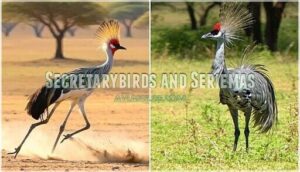
These remarkable stilt-legged raptors break the mold of typical raptor habitats.
Secretarybirds stride through African savannas while Seriemas patrol South American grasslands, both using their long legs as deadly weapons against prey.
- Secretarybird Habitat: Open savannas and grasslands with scattered acacia trees for nesting
- Seriema Behavior: Ground-dwelling hunters that use powerful kicks to stun small mammals and reptiles
- Prey Capture Methods: Stomp and punch technique rather than traditional talon-based hunting
- Unique Plumage: Distinctive crest feathers help with species recognition and territorial displays
Adaptive Bird Environments
You’ll discover that birds of prey have evolved remarkable adaptability, thriving in environments from bustling cities to remote oceanic islands.
These raptors demonstrate incredible flexibility by adjusting their hunting strategies, nesting preferences, and dietary choices to match their surroundings, showcasing their ability to thrive in various conditions with incredible flexibility.
Coastal and Marine Environments

You’ll find over 40 Ocean Raptors thriving in coastal ecosystems worldwide.
Sea Eagles and Fish Hawks dominate these Marine Birds communities, with ospreys catching fish in spectacular plunge-dives.
Coastal environments provide abundant prey through tidal flats and estuaries, and these seabirds adapt specialized hunting techniques, making bird habitat along shorelines incredibly productive for raptors.
Desert and Urban Areas

You’ll find raptors thriving in desert habitats and urban areas where they’ve adapted to extreme conditions.
Desert Hawks navigate arid terrain with impressive skill, while City Falcons claim skyscrapers as their hunting grounds. Urban Nesting sites offer unexpected advantages for these adaptable predators in human settlements.
The study of bird toys, such as those found in Desert Hawk collections, can provide insight into the behavior of these birds.
- Desert Hawks utilize rocky outcrops and sparse vegetation for nesting in arid environments
- City Falcons exploit tall buildings and bridges as substitute cliff faces for breeding
- Arid Owls hunt successfully in desert conditions using enhanced hearing capabilities
- Suburban Vultures benefit from consistent food sources near human developments
- Urban areas provide year-round prey availability through increased rodent populations
Migration Patterns

Many migratory species follow established flyways spanning continents, with peregrine falcons traveling over 15,000 miles annually.
Bird tracking reveals these migration routes involve dramatic altitude changes and seasonal movements.
Population dynamics shift as climate affects traditional patterns, forcing raptors to adapt their ancient navigation systems for survival.
Researchers utilize advanced bird tracking devices to better understand these complex migrations and develop strategies to support species facing challenges due to climate changes.
Conservation Efforts
Through strategic habitat preservation and protected areas expansion, you’re witnessing remarkable results in raptor conservation.
Captive breeding programs have boosted endangered species populations by 40%, while anti-poaching legislation has reduced eagle deaths by 50%.
Public awareness campaigns cut poisoning incidents substantially, and wildlife management efforts, including community engagement and satellite tracking research, demonstrate how conservation efforts can reverse habitat loss trends and protect these magnificent predators.
These initiatives highlight the importance of community science participation in monitoring bird populations, showcasing the value of conservation efforts in making a significant impact.
Frequently Asked Questions (FAQs)
Where do most birds of prey live?
You’ll find raptors everywhere – from dense forests and grasslands to urban skyscrapers and arctic tundra. These adaptable hunters thrive in diverse habitats worldwide, except Antarctica.
Why are birds of prey illegal?
You’ll face legal consequences because most birds of prey are federally protected under the Migratory Bird Treaty Act.
Harming, capturing, or possessing raptors without proper permits carries hefty fines and potential jail time, which is a serious consequence of violating the law, specifically for harming these protected species.
What is the home for a bird who preys?
You’ll discover that raptors make their homes in diverse habitats worldwide.
From urban skyscrapers where peregrine falcons nest to dense forests housing goshawks, these adaptable predators choose locations matching their hunting needs perfectly.
How do birds of prey select nesting sites?
Like master architects choosing prime real estate, you’ll find raptors select nesting sites based on three key factors: elevation for hunting advantage, proximity to abundant prey sources, and secure locations offering protection from predators and weather disturbances.
What factors influence raptor territory size?
Territory size depends on prey density, habitat quality, and species body mass.
You’ll find larger territories where food’s scarce, while abundant prey allows smaller ranges.
Bigger raptors need more space than smaller ones.
How do seasonal changes affect hunting behaviors?
Peregrine falcons increase hunting success by 40% during winter months.
You’ll notice raptors shift hunting strategies seasonally—owls hunt longer during winter’s extended darkness, while hawks adjust flight patterns when prey migrations change.
Which human activities most threaten raptor habitats?
You’re witnessing urbanization destroy nesting sites while agricultural expansion fragments hunting territories. Wind turbines, power lines, and pesticide contamination directly threaten raptor populations, making habitat preservation essential for species survival.
How do climate patterns impact breeding success?
Don’t put all your eggs in one basket—you’ll find climate patterns dramatically affect raptor breeding success through temperature shifts, precipitation changes, and prey availability fluctuations.
That directly impact nesting timing and reproductive outcomes.
Conclusion
Knowledge is power in the context of protecting birds of prey habitat.
You’ve learned how these apex predators thrive across diverse environments, from mountain peaks to urban skyscrapers.
Each species requires specific habitat features for successful hunting, nesting, and survival.
Understanding their environmental needs helps you support conservation efforts in your local area.
Whether you’re tracking migration patterns or creating wildlife-friendly spaces, your actions directly impact these magnificent hunters.
Supporting habitat preservation guarantees future generations can witness these incredible birds mastering their natural domains.
- https://www.ifaw.org/animals/birds-of-prey
- https://pmc.ncbi.nlm.nih.gov/articles/PMC10776223/
- https://raptorresearchfoundation.org/wp-content/uploads/2023/02/Techniques_Manual_Chapter-9.pdf
- https://researchrepository.wvu.edu/cgi/viewcontent.cgi?article=2775&context=etd
- https://www.alleghenyfront.org/americas-birds-of-prey-are-largely-doing-ok-with-notable-exceptions/