This site is supported by our readers. We may earn a commission, at no cost to you, if you purchase through links.
A single African Grey Parrot once outwitted a roomful of scientists, rattling off hundreds of words and phrases with unsettling precision. Birds that mimic humans don’t just parrot back what they hear—they decode, improvise, and sometimes outshine our own conversational skills.
From city-dwelling mockingbirds that sample urban soundtracks to lyrebirds staging wild imitations of chainsaws, the avian world is packed with vocal virtuosos.
If you think talking birds are mere party tricks, prepare for a reality check: their mimicry reveals deep intelligence, social cunning, and a knack for adaptation that rivals the sharpest minds in nature.
Table Of Contents
- Key Takeaways
- Birds Famous for Mimicking Humans
- Wild Birds With Mimicry Skills
- How Birds Imitate Human Speech
- Why Birds Mimic Human Voices
- Intelligence and Conservation of Mimic Birds
- Frequently Asked Questions (FAQs)
- Can birds mimic human emotions or just sounds?
- Which bird species are best for beginners?
- Do mimic birds understand what theyre saying?
- How long does it take birds to learn?
- Are there health risks from bird mimicry?
- Can all parrot species learn to mimic humans?
- How long does it take birds to learn words?
- Do female birds mimic as well as males?
- What age should you start training a bird?
- Can mimicry birds understand what theyre saying?
- Conclusion
Key Takeaways
- African Grey Parrots and Hill Mynas demonstrate genuine cognitive sophistication beyond rote mimicry, with greys mastering 600+ words and using deductive reasoning comparable to young children while strategically deploying phrases in appropriate social contexts.
- The syrinx—a uniquely avian vocal organ positioned at the tracheal bifurcation—enables bilateral sound production and efficient phonation that allows parrots and songbirds to reconstruct human speech formants with remarkable acoustic precision.
- Wild mimics like Northern Mockingbirds and Superb Lyrebirds adapt their vocal repertoires to environmental pressures, copying urban noise pollution and adjusting frequencies in response to habitat fragmentation, revealing mimicry as a survival tool rather than mere entertainment.
- Responsible ownership of talking birds demands recognition of their 50+ year lifespans and complex welfare needs, as 86% of behavioral pathologies stem from owner ignorance regarding proper nutrition, mental enrichment, and the neural stimulation these cognitively demanding species require.
Birds Famous for Mimicking Humans
You’ve probably heard a parrot drop a perfect “hello” or watched a viral video of a bird mimicking a ringtone with uncanny precision. These vocal showoffs aren’t just party tricks—they’re some of the most intelligent creatures in the avian world.
Let’s meet the species that have mastered the art of talking back.
African Grey Parrot
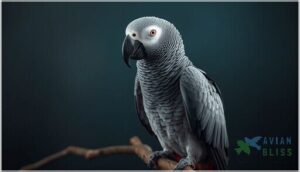
The African Grey Parrot stands as the undisputed champion of bird intelligence and vocal learning. These birds can master up to 600 distinct human words, matching toddlers in vocabulary size. Their brain structure features specialized vocal nuclei that enable outstanding cognitive development:
- Label 50+ objects with consistent accuracy
- Count quantities up to six
- Discriminate colors, shapes, and materials
- Use deductive reasoning like 3-4 year-old children
Social interaction drives their mimicry in nature, transforming parrot behavior into complex communication. The African Grey’s role in pollination processes is also vital for its ecosystem.
Hill Myna
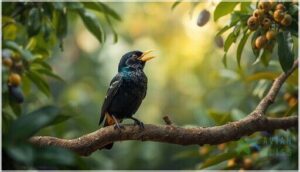
If you think the African Grey is a chatterbox, Hill Mynas might just steal the show. Their Vocal Learning rivals parrots, with some mastering 100 human phrases. Hill Myna Behavior shines brightest in captivity—daily social interaction supercharges their Vocal Mimicry. Wild populations, shaped by Myna Migration Patterns and Hill Myna Diet, face threats, making Captive Care essential. The ability to study speech imitation mechanisms is key for understanding these birds.
| Feature | Wild Hill Myna | Captive Hill Myna |
|---|---|---|
| Vocal Mimicry | Limited repertoire | Expansive vocabulary |
| Hill Myna Diet | Fruits, insects | Mixed, supplemented |
| Birds That Talk | Rarely imitative | Highly imitative |
| Myna Behavior | Territorial, social | Interactive, playful |
| Migration Patterns | Seasonal movement | Stationary |
Amazon Parrot
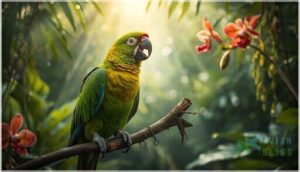
While Hill Mynas charm captive audiences, Amazon Parrots bring sociability into the spotlight. You’ll find these vibrant Parrot Species across Amazon Habitat ranges, where Parrot Behavior reveals their genius: contextual Mimicry isn’t just noise—it’s Bird Communication.
Nearly 90% use learned phrases in appropriate situations, rearranging words like linguistic rebels. Their Vocal Learning thrives on interaction, while Feather Care and Beak Structure keep them thriving as Birds That Talk.
Macaw
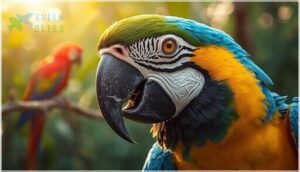
Blue-and-yellow and scarlet macaws stand among the Parrot Species elite, with males producing three to four times the Vocal Mimicry repertoire of females—usually mastering 20–30 human words.
You’ll witness their Social Bonding genius when over 80% of these Talking Parrots deploy learned phrases contextually, recombining words into fresh sequences.
Macaw Behavior thrives on cognitive flexibility: they solve multi-step tool puzzles while their Vocal Learning rivals corvid innovation, proving Bird Mimicry demands more than repetition—it requires brains.
Budgerigar (Parakeet)
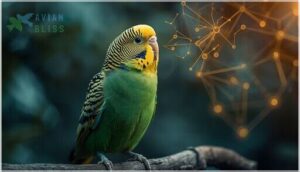
You’d never guess that males in this Talking Birds clan learn up to 600 distinct words—yet budgerigars crush stereotypes through sheer Vocal Learning grit. Their Avian Communication prowess relies on Social Behavior triggers:
- Neural circuitry fires in feature-based patterns rivaling human speech cortex
- Wild flocks coordinate through call-switching “dialects” spanning thousands of birds
- Operant tests show 81.8% accuracy in Speech Imitation under shifting cues
- Beak Structure and syrinx collaboration enable phonetic-like contrasts
- Feather Care routines calm minds primed for Mimicry mastery
Their Nesting Habits fuel curiosity—brains demand enrichment or stereotypies emerge.
Indian Ringneck Parakeet
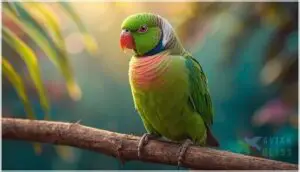
You won’t find flashier Talking Birds than the Indian Ringneck Parakeet—males dominate phrase repertoires (Z = −2.26, p = 0.024), building 200+ vocabularies through lifelong Vocal Learning. Their Beak Anatomy and von Economo neurons wire Speech Imitation clarity rivaling that of African greys. Social Bonding triggers recombination: 42% “sometimes” shuffle words into novel sentences. Color Mutations in greens, blues, and lutinos all master Mimicry when Feather Care rituals meet daily drills.
| Feature | Wild Baseline | Captive Peak |
|---|---|---|
| Lifespan | 15–20 years | 34 years |
| Phrase Count | Flock calls only | 0–600+ words |
| Neuron Type | Von Economo present | Same substrate |
| Social Context Use | Territorial signals | 80%+ appropriate |
| Recombination Rate | Dialect shifts | 42% novel phrases |
Cockatoo
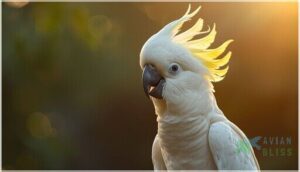
You’ll love cockatoos—these extravagant Talking Birds pair walnut-sized brains with twice the forebrain neurons of equivalent-mass mammals, fueling Parrot Intelligence that rivals great apes on tool tasks.
Vocal Learning produces 20+ distinct phrases through systematic Socialization Techniques, though clarity trails African greys. Their Mimicry shines when daily Beak Health checks and Feather Care rituals cement trust, turning Cockatoo Behavior into 70-year partnerships rich with Birds with Humanlike Speech.
Quaker Parrot
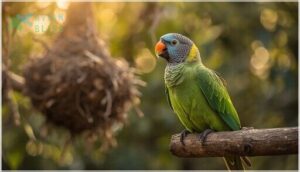
You’ll spot Quaker Parrots—Myiopsitta monachus, the stick-nest architects of South America—building chattiness into 20- to 30-year companionships when Socialization Techniques and Parrot Nutrition align.
Their Mimicry registers as moderate yet compelling among Talking Birds:
- Life-long Vocal Learning refines Birds with Humanlike Speech through decades of social exchange
- Quaker Behavior thrives on interactive routines that reinforce Parrot Intelligence and Feather Care
- Regular Beak Health checks sustain their expressive, colony-bred vocal drive
Wild Birds With Mimicry Skills

You don’t need a cage to witness nature’s most audacious vocal thieves. Wild birds across multiple continents have evolved mimicry skills that rival—and sometimes surpass—their captive cousins, copying everything from chainsaw motors to car alarms with unsettling accuracy.
Here are five wild species that’ve turned imitation into an art form.
Northern Mockingbird
You’ll find the Northern Mockingbird thriving in urban landscapes where song complexity peaks amid traffic noise. This master of vocal mimicry adjusts pitch to cut through city din, documenting up to 150 bird species in its territorial repertoire.
Their breeding habits reflect outstanding urban adaptation—pairs coordinate aggressive nest defense, achieving higher reproductive success than rural counterparts while managing migration patterns across their expanding range.
Brown Thrasher
You’re looking at North America’s champion mimic—Brown Thrashers command over 1,100 song types, doubling phrases where mockingbirds triple them. Their territorial behavior intensifies during breeding, males belting repertoires from elevated perches across 2–10 acre territories.
This vocal mimicry in birds demonstrates exceptional animal intelligence, pairing nesting strategies with documented migration routes from New England toward the Carolinas, showcasing adaptive bird behavior under mounting habitat pressures.
Gray Catbird
Gray Catbird habitat preferences—dense thickets and undergrowth—mask a vocal powerhouse. You’ll recognize their namesake mewing call, yet their mimicry rivals any performer: recordings capture individuals imitating over a dozen species plus tree frogs.
Key traits include:
- Slate-gray plumage with black cap
- Repertoires spanning 1.0–9.6 kHz frequencies
- Migration routes from British Columbia to Mexico
- Catbird diet favoring berries during winter
Their animal cognition adapts vocal mimicry in birds to urban noise, proving bird behavior isn’t just instinct—it’s a strategic wildlife conservation priority.
European Starling
European Starling vocal learning rivals any parrot. One captive individual packed 49% human speech and 25% whistling into its song structure, while another hit 68% human-derived mimicry patterns.
You’ll hear them belt out 256 cowbird riffs in thirty minutes or nail robot sounds better than parrots, showcasing animal cognition that’s both cheeky and strategic across European habitat and beyond.
Lyrebird
If you think starlings are bold, the Superb Lyrebird is a true showstopper. Its Mimicry Techniques border on theatrical—chainsaws, car alarms, and multispecies mobbing calls all stitched into elaborate Courtship Displays. Habitat Fragmentation, though, chips away at their Repertoire Complexity. Lyrebird Vocal Imitation isn’t just mimic speech; it’s a living archive of environmental memory.
- Mimicry Techniques reflect environmental diversity
- Vocal Learning shaped by social transmission
- Courtship Displays blend dance and sound
- Habitat Fragmentation erodes Repertoire Complexity
How Birds Imitate Human Speech
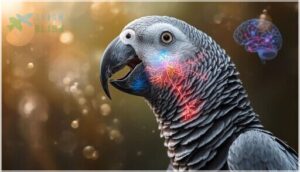
You’ve probably wondered how a bird can copy your voice so convincingly—it’s not just mimicry, it’s a fascinating biological feat. The secret lies in specialized anatomy, brain wiring, and social learning that work together in ways that still surprise researchers.
Let’s break down the key factors that turn certain birds into vocal copycats.
The Role of The Syrinx
You might think birds need a larynx like yours to talk, but they’ve got something far more radical: the syrinx. This vocal organ sits where the trachea splits into bronchi, generating sound through self-sustained tissue oscillations at surprisingly low air pressures—sometimes 25% more efficient than your own voice box.
Its unique position facilitates tracheal resonance that can shift spectral emphasis into ranges matching human consonants and vowels. Bilateral control in parrots and songbirds allows simultaneous production of two different frequencies, which is the secret behind their uncanny vocal imitation abilities.
| Syrinx Feature | Mimicry Advantage |
|---|---|
| Tracheobronchial location | Optimizes source–filter acoustics for complex sounds |
| Bilateral independence | Facilitates rapid frequency shifts and two-voice syllables |
| Low phonation threshold | Produces high-frequency components with less effort |
| Tracheal resonance tuning | Matches spectral properties of human speech formants |
Brain Structure and Learning
Your parrot’s brain circuits aren’t just impressive—they’re groundbreaking. Vocal learning hinges on specialized pallial–basal ganglia loops where nuclei like HVC and Area X coordinate auditory processing with motor output, enabling birds to decode human phonemes and reconstruct them syllable by syllable.
Parrots even boast a core–shell song system architecture that turbocharges neuroplasticity, letting adult brains rewire for lifelong cognitive development and avian intelligence unparalleled in animal communication.
Social Interaction and Training
Consistently, social learning transforms your bird’s brain into a vocal powerhouse—but only if you’re actually there to coach them. Studies reveal that live tutor feedback accelerates mimicry far beyond passive playback, with zebra finches showing dramatically higher song similarity when exposed to interactive training versus recorded sounds alone.
Your parrot’s cognitive development demands:
- Daily vocal coaching sessions with contingent responses that reinforce emerging phonemes
- Direct eye contact and turn-taking during interactive training to strengthen neural pathways
- Contextually appropriate use of phrases tied to routines, cementing social bonds through animal communication
That’s how intelligent bird species crack the code—social birds thrive on tutor feedback, not isolation.
Environmental Influences
Beyond your living room, habitat fragmentation and urban noise reshape vocal learning in profound ways. Albert’s lyrebirds in disturbed forests produce drastically smaller mimetic repertoires than conspecifics in intact habitats, while Northern Mockingbirds shift to higher frequencies in traffic-heavy zones—acoustic adaptation to environmental degradation.
Your bird’s mimicry reflects avian ecology’s delicate balance, where environmental science reveals how wildlife adaptation hinges on surrounding soundscapes and ecological balance.
Why Birds Mimic Human Voices
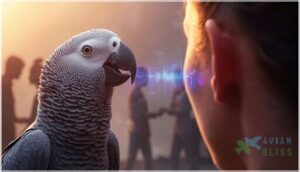
You might assume birds mimic us just to show off, but the truth is more complicated—and more fascinating. Their reasons range from forming social bonds with their flock (yes, you’re part of it) to defending territory and simply keeping their sharp minds entertained.
Understanding what drives this behavior reveals just how intelligent and socially complex these feathered mimics really are.
Communication and Social Bonds
When you talk to a bird and it talks back, you’re not just hearing clever noise—you’re witnessing social attachment in action. Companion parrots form bonds as intense as those between humans and dogs, using vocal learning and human speech to cement their place in your household’s social structure.
When your parrot talks back, you’re witnessing social attachment as intense as a dog’s bond—vocal learning that cements you as flock
- Social intelligence drives parrots to map your words onto specific contexts, tracking who you’re and what matters to you
- Bonding mechanisms through human interaction shape their repertoire; they’ll drop phrases when relationships shift
- Avian cognition turns mimic speech into animal communication—your bird isn’t performing, it’s participating
That’s the secret: they’re speaking your language because you’ve become their flock.
Breeding and Territory Defense
You might think your parrot’s talking is just cute mimicry, but in the wild, vocal signaling fulfills strategic survival goals: breeding and territorial defense. Duetting behavior in many species proves that coordinated song bolsters mate guarding and nest defense. Red-backed fairy-wrens that deliver quicker duet responses achieve better paternity outcomes, linking vocal range to reproductive success. Territorial song in mockingbirds and thrashers stakes claims on breeding sites, while vocal learning in parrots helps pairs recognize mates and repel intruders near nest cavities. Your bird’s brain evolved these skills for survival, not just entertainment.
| Function | Mechanism |
|---|---|
| Territorial defense | Males use territorial song and vocal matching to escalate aggression and deter rivals from breeding areas |
| Mate guarding | Coordinated duetting behavior signals pair strength; quicker responses correlate with reduced extra-pair paternity |
| Nest defense | Parrots defend immediate nest sites with learned contact calls; avian intelligence bolsters selective aggression toward intruders |
| Breeding success | Vocal signaling quality predicts reproductive outcomes; parrot behavior and care in captivity mirrors wild pair communication |
Entertainment and Enrichment
Captive talking bird species crave vocal interactions and puzzle toys as enrichment, not just treats. Recent tech enrichment studies show parrots initiated 147 video calls voluntarily, prioritizing cognitive challenges over food. Auditory stimulation from human mimic speech shifts comfort behaviors and vocal patterns, while social play with conspecifics reduces stereotypies.
Your parrot’s cognitive appetite demands:
- Foraging puzzles that challenge avian intelligence and cognition
- Rotated climbing structures and manipulable objects
- Group housing for affiliative vocal exchanges
Parrot behavior and care must honor this need for mental stimulation alongside basic husbandry.
Intelligence and Conservation of Mimic Birds

These birds aren’t just talented mimics—they’re remarkably intelligent creatures that deserve our respect and protection. Their cognitive abilities rival those of young children, but their survival depends on habitat conservation and thoughtful human interaction.
Let’s explore what makes these feathered linguists so smart and how you can help secure their future.
Cognitive Abilities in Talking Birds
Intelligence in talking birds isn’t just about mimicry—it’s about true cognitive abilities that rival young children. African Grey Parrots, for instance, master numerical concepts and symbolic labels with striking precision, their brain function enabling them to identify quantities and abstract relationships.
This neuroplasticity drives outstanding problem solving, memory recall, and vocal learning. You’re witnessing avian intelligence that challenges everything we thought we knew about bird brains and their remarkable vocal abilities.
Importance of Mental Stimulation
Without proper mental stimulation, your intelligent birds risk serious behavioral disorders. African Grey Parrots and cockatoos show feather-damaging rates exceeding 24% when under-stimulated. You’ll need to provide cognitive enrichment through foraging puzzles, social interaction, and environmental stimulation that mirrors wild time budgets.
Parrots naturally devote 4–8 hours daily to foraging; captive birds given standard bowls spend merely 47 minutes, starving those exceptional vocal abilities and avian cognition of essential behavioral diversity.
Conservation Efforts and Habitat Protection
You can’t truly appreciate a parrot’s wit without protecting its home. African Grey Parrot populations plummeted 50-79% from habitat loss and trade, earning Endangered status and CITES Appendix I protection in 2016.
Effective wildlife conservation and protection demands:
- Expanding protected areas beyond the current 10% of parrots’ geographic range
- Restoring biodiversity in fragmented ecosystems
- Monitoring density through point-count surveys in national parks
- Halting deforestation that’s already reduced Cameroon’s grey parrot habitat by 55.5%
Ecosystem management secures these clever mimics’ survival.
Responsible Pet Ownership
Wildlife protection matters little if your feather-clad Einstein spends decades feather-picking in solitary confinement. Experts agree that 86% of parrot problems stem from owner ignorance—cockatoos and African greys face welfare crises at alarming rates of 93% and 87%, respectively.
Pet care tips include planning for a 50+ year commitment, rejecting seed-only diets due to calcium deficiency, providing daily out-of-cage flight, securing parrot-experienced veterinary support, and ensuring social housing. Bird nutrition, mental enrichment, and a realistic long-term commitment are essential to distinguish responsible guardianship from slow-motion suffering.
| Owner Preparation Challenge | Welfare Impact | Evidence-Based Solution |
|---|---|---|
| Lack of species knowledge | Behavioral pathology (11.7–30.6% feather damage) | Research natural social needs before acquisition |
| Inadequate housing space | Stereotypies, chronic stress markers | Daily flight time, enriched foraging environments |
| Poor nutritional practices | Calcium/vitamin deficiencies, excess fat | Formulated diets over seed mixes; veterinary guidance |
| Absence of life planning | Surrender, relinquishment after decades | Designate long-term guardians for 50+ year lifespan |
Frequently Asked Questions (FAQs)
Can birds mimic human emotions or just sounds?
Let’s call it “reading the room”—birds pick up on emotional cues embedded in human voices.
They master vocal imitation through auditory perception and brain function, but whether they feel our feelings remains a gray area in avian cognition.
Which bird species are best for beginners?
For beginners, budgerigars and cockatiels make ideal small parrots—they’re hardy, trainable, and fit in modest spaces. Indian ringneck parakeets offer stepping-stone challenges.
All need consistent interaction, proper housing, and mental enrichment to thrive as pet birds.
Do mimic birds understand what theyre saying?
They don’t truly “speak,” yet some grasp meaning. African grey parrots can associate words with objects and concepts, demonstrating cognitive insights.
Most parrots, though, rely on associative learning rather than semantic understanding of human speech.
How long does it take birds to learn?
Learning windows vary dramatically across intelligent birds. Zebra finches crystallize song maturation in roughly 90 days of practice duration, while parrot species develop vocal abilities and human speech over months to years through neural adaptation.
Are there health risks from bird mimicry?
You face genuine risks when sharing space with parrots and other intelligent birds boasting impressive vocal abilities. Airborne pathogens, zoonotic diseases, respiratory infections, allergic reactions, and even noise pollution can hitch a ride on bird speech and mimicry.
Can all parrot species learn to mimic humans?
Parrots present perplexing patterns in mimicry genetics and vocal anatomy. While all parrot species possess the physical capacity for human speech, only certain lineages—African Grey Parrot, Amazons, macaws—demonstrate reliable learning capacity, revealing profound species variation in parrot intelligence.
How long does it take birds to learn words?
Vocal learning speed varies dramatically—African grey parrots often produce their first recognizable human speech around four months, while budgerigars may begin within weeks.
Training methods, social interaction, and individual learning speed shape each bird’s unique mimicry patterns and speech development timeline.
Do female birds mimic as well as males?
Contrary to old myths, vocal learning and mimicry behavior aren’t male-only talents. Female intelligence shines across parrots and bird species: sex differences in human speech mimicry are minimal, with social behavior and avian cognition mattering most in animal communication.
What age should you start training a bird?
You can begin training young birds around three to four months—right when they’re fledging.
Early vocal learning during this window maximizes speech acquisition and behavioral development in parrots and other pet bird species.
Can mimicry birds understand what theyre saying?
Think of mimicry as a translator without a dictionary. Some parrots, like African Greys, genuinely grasp meanings—labeling objects correctly—while most birds don’t understand their borrowed human speech beyond social cues.
Conclusion
Like a master linguist armed with nothing but a syrinx and audacity, birds that mimic humans remind you that intelligence wears feathers just as easily as it wears skin. Their vocal prowess isn’t merely evolutionary showmanship—it’s a window into cognitive complexity, social ingenuity, and adaptive resilience.
Whether you’re captivated by a cockatoo’s antics or a mockingbird’s urban remix, these avian mimics challenge your assumptions about communication, consciousness, and what it truly means to speak with purpose.
- https://www.npr.org/2022/12/08/1141645084/a-scientific-survey-takes-a-look-at-vocal-mimicry-in-parrots
- https://www.allaboutbirds.org/news/why-do-some-birds-mimic-the-sounds-of-other-species/
- https://www.scientificamerican.com/article/experts-parrots-mimic/
- https://www.audubon.org/news/why-do-parrots-talk
- https://pmc.ncbi.nlm.nih.gov/articles/PMC11196360/