This site is supported by our readers. We may earn a commission, at no cost to you, if you purchase through links.
A Blue Jay doesn’t just scream when a hawk circles overhead—it tells the flock exactly what kind of hawk and roughly where it’s coming from. That level of behavioral complexity surprises most people, even those who’ve been watching birds for years.
North American birds carry more depth than casual glances reveal, and once you start reading the details—plumage patterns, territorial calls, habitat choices—a backyard or forest trail transforms into something genuinely worth paying attention to.
This bird information guide covers identification, behavior, and habitat across common species, giving you the grounding to recognize what you’re seeing and understand why it matters.
Table Of Contents
- Key Takeaways
- Common North American Birds
- Bird Habitats and Range
- How to Identify Birds
- Bird Behavior and Feeding
- Bird Conservation and Learning Tools
- Frequently Asked Questions (FAQs)
- What birds are good for asthma?
- How do birds navigate during long-distance migration?
- What should I feed wild birds year-round?
- How can I attract specific birds to my yard?
- When is the best time to watch birds?
- How do I identify birds by their flight patterns?
- How do birds migrate using magnetic field navigation?
- What diseases can wild birds transmit to humans?
- How long do common backyard birds typically live?
- Can birds recognize individual human faces over time?
- Conclusion
Key Takeaways
- Blue Jays aren’t just loud—they use distinct alarm call sequences to communicate the type and location of a threat, which points to a level of vocal intelligence most people don’t expect from a backyard bird.
- Where a bird lives isn’t fixed; feeders, milder winters, and urban green corridors are actively pushing species like the Northern Cardinal into ranges they didn’t occupy a few decades ago.
- You don’t need to memorize hundreds of species to get good at identification—silhouette, key field marks, and a handful of calls will get you surprisingly far, and the skills stack quickly with practice.
- Most common backyard birds currently hold a Least Concern conservation status, but habitat fragmentation and climate shifts are quietly squeezing specialists while generalists adapt and expand.
Common North American Birds
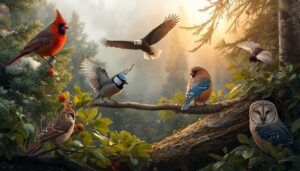
impressive variety of bird species, each with its own personality, range, and set of quirks worth knowing. Whether you’re just starting out or sharpening your field skills, handful of common species makes an excellent foundation.
Getting familiar with a few key species also helps you pick up on common bird recognition techniques that make every future sighting faster and more rewarding.
Here are some you’re likely to encounter—and what makes each one worth a second look.
Northern Cardinal Range and Field Marks
Few backyard birds stop you mid-coffee like the Northern Cardinal (Cardinalis cardinalis). Its range expansion into southeastern Canada reflects impressive habitat plasticity, aided largely by winter feeders. When identifying one, watch for:
- Vivid scarlet plumage (males) or warm brown with reddish highlights (females)
- That signature crest display when alert
- Stout orange-red bill morphology built for cracking seeds
- Regional feather pattern variation across populations
they’re a year‑round resident behavior maintaining territories throughout all seasons.
Barred Owl Behavior and Daytime Activity
From the vivid red of a cardinal, shift your gaze upward — into denser canopy where the Barred Owl (Strix varia) keeps quieter company. Unlike most owl species, it occasionally forages by day, especially near urban roosting sites and residential perches.
Dawn vocalizations signal territory, while prey ambush techniques rely on silence and patience. Seasonal daylight patterns noticeably shape when and how often you’ll spot one active.
Blue Jay Intelligence and Vocalizations
Where the owl fades into shadow, the Blue Jay (Cyanocitta cristata) announces itself with confidence.
Its Alarm Call Syntax is intricate — different sequences signal hawks versus ground threats.
Cache Retrieval Memory lets it locate thousands of hidden seeds across seasons.
Mimicry Strategies include convincing Red-shouldered Hawk screams, and Urban Vocal Adaptation means city jays have even added car alarms to their repertoire.
Red-tailed Hawk Size and Plumage Traits
If the Blue Jay is theater, the Red-tailed Hawk (Buteo jamaicensis) is architecture — built to be seen.
Sexual dimorphism is real here: females are 10–20% larger, with wingspans approaching 4.9 feet. Wing length variation tracks geography, and subspecies plumage differences mean western birds (calurus) skew darker overall.
Watch for these field marks in your identification guide for common birds:
- Brick-red tail, conspicuous mid-soar
- Pale belly band across the chest
- Dark malar stripe framing a light face
- Juvenile feather development shows brown-banded tails before maturity
- Tail color gradient shifts richly in adults — rust deepening toward the tip
House Finch, Gray Catbird, and Mourning Dove Facts
Three species round out your identification guide for common birds with diverse variety.
House Finch showcases classic plumage sexual dimorphism — males blazing red, females streaked brown — and runs an extended breeding season with three or more broods.
Urban feeders can quietly shift these nesting patterns, as explored in this guide to how supplemental feeding affects house finch breeding behavior.
Gray Catbirds rely on mew mimicry patterns to stake territory from dense thickets.
Mourning Doves, quietly prolific in urban and suburban bird populations, shift between seasonal diet shifts with ease, favoring seeds year-round.
Bird Habitats and Range

Where a bird lives shapes everything about it—what it eats, when it moves, and how far it roams.
North American birds occupy a surprisingly wide range of environments, from dense old-growth forests to neighborhood backyards. Here’s a closer look at the key habitats and range patterns worth knowing.
Forest, Wetland, and Grassland Habitats
Each habitat tells its own story.
Forests and woodlands reward birds that navigate vertical complexity — from canopy hunters to understory skulkers using deadwood resources for nest cavities.
Freshwater wetlands pulse with hydrological cycles that refresh feeding grounds seasonally.
Fields, meadows, and grasslands, shaped by fire regimes, expose ground-nesters to open sky.
Edge effects between these zones quietly concentrate the most surprising species diversity you’ll encounter.
Urban and Suburban Bird Populations
Cities and suburbs aren’t just concrete sprawl — they’ve quietly become thriving corridors for urban wildlife. Species like the Northern Cardinal and House Finch exploit bird feeders year-round, while greenway connectivity helps birds navigate fragmented neighborhoods.
Feeder impact shapes who shows up in your yard.
Heat island effects shift local activity patterns, and noise pollution pushes sensitive species toward quieter green spaces.
Citizen science trends confirm suburban habitats consistently punch above their weight in species richness.
Regional Range Expansion Patterns
Range expansion rarely follows a straight line.
The Northern Cardinal’s slow northward push into Canada, aided by feeders and milder winters, is a textbook example of how dispersal corridors and human-made pathways reshape species distribution over decades.
The House Finch spread similarly — fast, multi-front, and aided by genetic edge adaptation. Seasonal phenology shifts and multi-front merging continue rewriting bird range maps every year.
Climate and Habitat Factors Shaping Distribution
Climate doesn’t just set the backdrop — it actively draws the lines of where birds live and thrive. Temperature seasonality shifts migration timing, while precipitation habitats determine whether wetlands, forests, or grasslands even exist in a region.
Four factors consistently shape species distribution:
- Microclimate refugia let local populations persist beyond expected range boundaries
- Topographic elevation creates distinct humidity and temperature zones birds exploit vertically
- Land‑use impacts fragment nesting habitat, shrinking connectivity across corridors
- Climate change impact accelerates range expansion but also deepens habitat loss through habitat fragmentation
Why Feeders Influence Bird Range Changes
A backyard feeder does more than attract birds — it reshapes how they move. Through feeder anchoring, birds reduce their home ranges, clustering around reliable food rather than wandering broadly.
This resource concentration turns neighborhoods into urban stepping stones, enabling species like the Northern Cardinal to push steadily northward. Seasonal movement delay keeps some birds from migrating at all, gradually reinforcing population trends well beyond historic range boundaries.
Backyard feeders turn neighborhoods into stepping stones, nudging the Northern Cardinal steadily northward one winter at a time
How to Identify Birds
Identifying a bird comes down to reading a handful of reliable clues, and the good news is you don’t need to memorize every species to get started.
Most birders build their instincts around four core techniques that work together in the field. Here’s what to focus on.
Using Size, Shape, and Silhouette
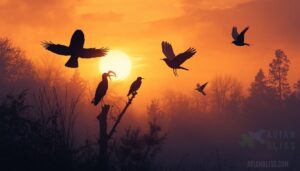
Before you even raise your binoculars, a bird’s silhouette often tells you everything you need. Silhouette Proportions—head size, neck length, chest depth—create instant recognition cues.
Wing Shape Indicators separate the buteonine hawk’s broad, soaring profile from a swift’s swept-back points.
Tail Morphology Cues and Body Contour Analysis sharpen your reading further, while Perch Posture Profiles reveal species identity even at dusk.
Recognizing Colors and Field Marks
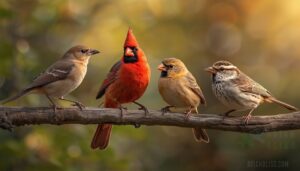
Once you’ve read the silhouette, color becomes your confirmation. Crown Coloration—male cardinal’s blazing red versus a female’s warm buff—instantly narrows your options.
Wing Bar Patterns, Eye Ring Identification, Throat Patch Variations, and Underpart Streaking each function like puzzle pieces in bird identification.
solid field guide pairs these visual cues with images, sharpening your bird ID skills one field mark at a time.
Identifying Birds by Calls and Songs
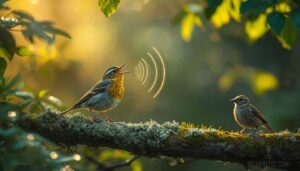
Color gets you close, but bird sounds seal the deal. Songs follow a recognizable Song Structure—a clear start note, repeating phrases, and a steady Temporal Rhythm you can almost count. Pay attention to Frequency Range, too; warblers pitch high while sparrows run deeper.
- Note phrase length and repetition rate
- Track pitch—ascending or descending
- Use Call Playback against a bird sounds and songs archive
- Log Dialect Variation across regions
Bird call identification sharpens fast with audio recordings of birds alongside bird identification using images and sounds.
Comparing Similar Species Side by Side
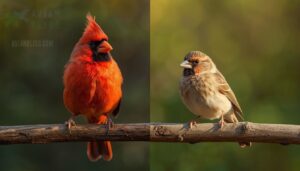
Once calls click into place, your eye needs the same workout.
Plumage Pattern Charts and a Metric Size Grid cut through confusion quickly—a Cardinal’s stout 21–23 cm build looks nothing like a House Finch’s slender frame.
Range Overlap Insets clarify where similar species actually share territory, while Behavioral Pose Matching and an Acoustic Signature Grid sharpen the full picture.
| Feature | Northern Cardinal | House Finch |
|---|---|---|
| Length | 21–23 cm | ~14 cm |
| Plumage | Bright red, black mask | Red-washed throat |
| Habitat | Brushy edges, suburbs | Urban structures |
Bird Behavior and Feeding
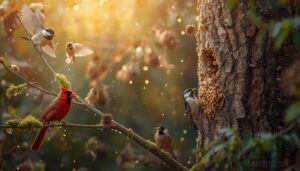
Birds are creatures of habit, and once you understand their routines, everything starts clicking into place. Knowing when they feed, how they nest, and why they claim certain territories makes every backyard or trail visit more rewarding.
Here’s what you need to know about bird behavior and feeding.
Daytime and Nighttime Activity Patterns
Most birds aren’t strictly day or night creatures — they shift. Many species exploit crepuscular foraging windows at dawn and dusk, squeezing extra feeding time around the margins.
Moonlit foraging extends activity for some, while urban light pollution blurs natural cues entirely, nudging adaptable species into irregular schedules.
Thermal activity shifts in summer also push songbirds toward cooler twilight roosting hours, quietly reshaping daily bird behavior patterns.
Hunting, Foraging, and Nesting Habits
Watch a cardinal work a shrub edge and you’ll see foraging strategies in real time — gleaning insects in summer, switching to seeds when temperatures drop. Hunting timing follows predator pressure, not just hunger.
Nest material use is equally deliberate:
- Grasses and twigs form the structural base
- Feathers and moss line the cup for insulation
- Camouflage layers finish the exterior
Breeding behavior drives every choice.
Feeder Preferences and Seed Selection
Not all seeds are equal, and your feeder setup reflects that. Black oil sunflower seeds remain the preferred option — high calories, broad appeal, and reliable feeder attraction across species.
Nyjer draws finches; safflower pulls cardinals while naturally discouraging squirrels.
Seasonal strategies matter too: lean into high-fat seeds come winter.
Smart placement guidelines (10–15 feet from cover) and consistent seed quality keep birds returning — and gradually influence distribution patterns across your region.
Breeding Cycles and Brood Counts
Mourning Doves are the outliers here — raising up to six broods annually, their multi-brood potential far exceeds most songbirds. Clutch size variation normally follows food availability, while parental care strategies shift between parents as nestlings grow.
Seasonal breeding timing, triggered by day length, means brood survival factors like nest predation and weather matter enormously for bird population monitoring and conservation planning.
Territorial Displays and Social Behavior
Territory is a bird’s currency, and they spend it loudly. Five behaviors define how they protect it:
- Crest Feather Displays signal readiness without contact
- Wing Flick Rituals strengthen ownership alongside calls
- Boundary Song Variation shifts from melodic to aggressive near nests
- Dominance Hierarchy determines resource access among rivals
- Habitat Edge Patrols reinforce claimed space during breeding season
Bird Conservation and Learning Tools

Knowing a bird’s conservation status changes how you look at it in the field — it adds context that a field mark alone can’t give you. The good news is that connecting that knowledge to real tools, community data, and daily habits has never been more straightforward.
Here’s what you’ll want to know.
Conservation Status of Common Species
Here’s some reassuring news: most of the birds you’re likely to spot in your backyard carry a Least Concern conservation status. Northern Cardinals, Blue Jays, Red-tailed Hawks, Barred Owls, and House Finches all fall into that category.
Threat Category Trends and Population Stability Indicators suggest that habitat protection impact, legal protection measures, and monitoring program effectiveness are genuinely working for these widespread species.
Habitat Loss and Population Threats
That Least Concern status doesn’t mean birds are immune to pressure. Fragmentation impacts shrink habitat connectivity, and edge effects expose nests to higher predation pressure—forcing population bottlenecks in once-stable communities.
Wetland drainage, deforestation, and urban sprawl reduce bird habitat diversity across regions, while climate change quietly reshapes bird ranges. Generalists adapt; specialists often don’t.
Bird Photos, Maps, and Sound Libraries
Good bird identification resources pull together three things that matter: photos, maps, and sound.
- Bird photography archives like Macaulay Library hold over 32 million images, searchable with solid metadata standards.
- Species distribution maps use interactive filtering by season, region, and habitat.
- Bird sounds and songs archives offer WAV and MP3 recordings with citizen science integration.
Licensing models vary, so check permitted use before downloading.
Citizen Science Sightings and Field Notes
Beyond those photos and maps, your observations can actually feed the science. Citizen science bird observations submitted through mobile submission apps get geotagged, timestamped, and filtered through data quality standards before they reach researchers.
Even a single well-documented field note—species, behavior, location—strengthens seasonal migration tracking and range models.
Observer training programs help you record smarter, not just more often.
Building a Better Birdwatching Routine
Building consistency matters more than clocking hours. A focused 15-minute morning window—your Morning Timing sweet spot—often outperforms sporadic half-day outings. Pair that with Compact Gear (binoculars, a quick-note app) and rotate habitats monthly through Habitat Rotation to keep your species list fresh. Weekly Log Review reveals patterns you’d otherwise miss.
- Set a fixed dawn birdwatching block daily
- Use field guides and a lightweight notebook
- Rotate through varied habitat descriptions each month
- Review your bird identification logs every week
- Practice Patience Practice: let birds come to you
The birdwatching community grows stronger every time you show up consistently.
Frequently Asked Questions (FAQs)
What birds are good for asthma?
No bird is truly hypoallergenic. For asthma sufferers, low-dander species like smaller parakeets reduce allergen exposure, but ventilation strategies and cage hygiene matter just as much as pet bird selection.
How do birds navigate during long-distance migration?
Birds rely on a extraordinary fusion of Magnetic Orientation, a Celestial Compass, Olfactory Mapping, Key Memory, and an Internal Map to navigate migration patterns across continents with surprising precision.
What should I feed wild birds year-round?
The more you feed them, the wilder they stay.
Black oil sunflower seeds offer Year-Round Nutrient Balance, while suet delivers Energy-Dense Winter Feeds, mealworms supply Insect Protein Summer Needs, and fresh fruit provides Moisture-Rich Spring Offerings.
How can I attract specific birds to my yard?
Start with the right seeds. Black oil sunflower draws cardinals and chickadees, while nyjer thistle pulls in finches. Strategic feeder placement, native plantings, and a heated birdbath do the rest.
When is the best time to watch birds?
Dawn is your golden window. The Morning Light Surge—roughly 6 to 10 a.m.—delivers peak song and foraging activity.
Spring Migration Surge multiplies species overnight.
Don’t overlook Rainy Day Foraging; a light shower pulls birds surprisingly close.
How do I identify birds by their flight patterns?
Watch the wingbeat rhythm first — slow and steady usually mean a large soaring bird, while rapid bursts suggest small songbirds.
Glide ratio, flight formation, and aerial hunting style sharpen your bird ID skills fast.
How do birds migrate using magnetic field navigation?
Like Odysseus guided by stars, birds navigate by Earth’s magnetic field—using radical pair theory and a magnetic map in a two-stage navigation system that pinpoints position, then sets a heading home.
What diseases can wild birds transmit to humans?
Wild birds can transmit Avian Influenza, West Nile Virus, Salmonella Risks, and Psittacosis Exposure through direct contact or contaminated droppings. Fungal Infections like histoplasmosis also pose risks near nesting sites.
How long do common backyard birds typically live?
Most common backyard birds live 2–5 years, though Northern Cardinals can reach Blue Jays and Mourning Doves vary widely based on predator impact, feeder nutrition, and seasonal survival conditions.
Can birds recognize individual human faces over time?
Yes — and it’s more complex than you’d expect.
Birds like crows rely on long-term memory and specialized neural pathways to recognize your face across repeated human interactions, with notable species variation in recall duration.
Conclusion
Once you start pulling the thread, it’s hard to stop—a single hawk overhead becomes a lesson in silhouette, then territory, then migration. This bird information guide gives you the foundation, but the real learning happens in the field, where a familiar call suddenly has a name and a behavior behind it.
Keep a notebook, use the tools, and pay attention to what’s already there. Birds have been telling their stories long before anyone thought to listen.