This site is supported by our readers. We may earn a commission, at no cost to you, if you purchase through links.

Most budgie owners are caught off guard when their bird dies at seven years old—convinced they’d done everything right. Here’s the uncomfortable truth: a seed bowl, a small cage, and good intentions aren’t enough.
A well-cared-for American budgie can reach twelve years or more, while an English budgie bred for show traits may struggle past eight. That gap isn’t luck—it’s husbandry.
Understanding your budgie’s lifespan means knowing which type you own, what silently shortens their years, and which daily habits genuinely add time to the clock.
Table Of Contents
- Key Takeaways
- How Long Do Budgies Live?
- Budgie Lifespan by Type
- Budgie Life Stages Explained
- How to Tell Budgie Age
- Diet and Budgie Longevity
- Common Lifespan-Limiting Health Problems
- Habitat for Longer Life
- Sleep, Socialization, and Enrichment
- Household Hazards That Shorten Lifespan
- Top 7 Budgie Lifespan Supplies
- Frequently Asked Questions (FAQs)
- Should I get 1 or 2 budgies?
- How long do budgerigars live?
- How to identify if a budgie is less than 18 days old?
- How long do budgies live?
- How old is a budgie if he dies?
- How old is the oldest Budgie?
- What factors affect Budgie lifespan?
- How old do budgies get?
- Can budgies live alone?
- How long do budgies live as a pet?
- Conclusion
Key Takeaways
- A seed-only diet quietly cuts years off your budgie’s life — pellets should make up 60–80% of daily intake, with seeds limited to just 10%.
- Your home’s air can kill your budgie fast: overheated nonstick cookware releases odorless fumes that are fatal within minutes, and cigarette smoke, sprays, and scented candles aren’t far behind.
- American budgies can realistically reach 12–15 years, while English show budgies often struggle past 8 — genetics and breeding quality set the ceiling, but daily care determines where your bird lands.
- Sleep, social interaction, and free-flight time aren’t extras — budgies need 10–12 hours of dark quiet each night and 1–3 hours of out-of-cage flight daily to stay genuinely healthy.
How Long Do Budgies Live?
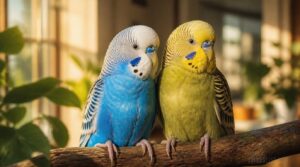
Budgies in captivity commonly live between 5 and 15 years — a wide range that comes down almost entirely to how well they’re cared for. In the wild, that number drops to just 4–6 years, mostly due to predators and harsh conditions. Here’s what shapes their lifespan and what you can realistically expect.
Most captive budgies land somewhere in the 5–12 year range, though with attentive care some reach 15 — and understanding what affects budgie lifespan in captivity can make a real difference in where your bird falls on that spectrum.
Captive Budgie Lifespan Range
Most pet budgies live 5 to 10 years in captivity, though that number climbs to 12–15 years with ideal nutrition and regular vet care. A few remarkable birds reach 20 years. In contrast, budgies in the wild usually have a shorter wild lifespan of only 4 to 6 years.
- Balanced pellets and fresh greens directly extend lifespan
- Routine checkups catch problems early
- Daily exercise and low stress reduce disease risk
Wild Budgie Lifespan Range
Wild budgerigars commonly live 4 to 6 years in Australia’s harsh interior. Drought shrinks water sources fast — a bird weighing just 30 to 40 grams dehydrates dangerously quickly. Predators like falcons and hawks claim many birds before old age.
Nomadic flock movement improves survival, but young birds that can’t keep pace rarely make it through their first year.
Oldest Recorded Budgie
That 4–6 year wild average puts the captive record in sharp relief. Charlie, a budgerigar kept in Stonebridge, London by J. Dinsey, holds the Guinness World Record for the oldest captive budgie — living 29 years and 2 months, from April 1948 until June 20, 1977. That’s roughly five times the wild average.
- A lifespan most humans wouldn’t expect from a small bird
- Nearly three decades of daily care, attention, and connection
- Proof that pet bird longevity is deeply tied to the environment you create
Lifespan Expectations by Care
Charlie’s nearly three decades prove one thing clearly: care quality shapes budgie lifespan more than almost anything else.
| Care Level | Expected Lifespan |
|---|---|
| Neglected or seed-only | 5–7 years |
| Basic routine care | 8–12 years |
With a balanced diet plan, routine vet visits, daily flight time, and a safe indoor space, your budgie can realistically reach the higher end.
Budgie Lifespan by Type
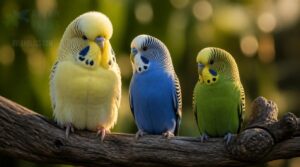
Not all budgies are built the same, and that difference shows up clearly in how long they live. The type you have — English, American, or wild-type — plays a real role in setting that timeline. Here’s how each one stacks up.
English Budgie Lifespan
English budgies commonly live 5 to 8 years. With consistent care, a balanced diet, and prompt veterinary treatment, some reach 10 or beyond.
Five factors shape how long yours lives:
- Pellet ratio: aim for 70% formulated pellets daily
- Exercise frequency: out-of-cage flight each day
- Veterinary care: annual checkups catch problems early
- Hazard mitigation: eliminate PTFE fumes and smoke
- Cere color evolution: monitor for hormonal changes
American Budgie Lifespan
American budgies commonly live 8 to 12 years, but birds from reputable breeders often reach 15 or more. That extra longevity comes down to breeder quality and genetics — well-bred birds simply carry fewer inherited health risks.
Pair that with a pellet-based diet, daily exercise, and annual vet checkups, and you’re giving your budgie a real shot at a long, healthy life.
Wild Budgerigar Lifespan
Wild budgerigars live just 4 to 6 years on average — a stark contrast to their captive counterparts. Survival in inland Australia hinges on rainfall influence and drought survival, with food and water disappearing fast in dry years. Nomadic migration and flock dynamics help, but predation pressure from falcons and hawks keeps life expectancy short and uncertain.
- Rainfall directly drives seed availability and survival odds
- Nomadic flocks of up to thousands track food across vast distances
- Predators and drought are the two biggest lifespan limiters in the wild
Genetics and Breeding Impact
Genetics quietly shapes how long your budgie will live. Selective breeding for show traits — bigger heads, denser feathers, heavier frames — has pushed English show budgies toward shorter lifespans of just 5 to 8 years. Repeated inbreeding weakens immune function, reduces fertility, and raises hereditary tumor risk.
Mutation colors like lutino or blue don’t shorten life on their own, but breeding them from tiny, genetically limited pools does.
Budgie Life Stages Explained

Every budgie goes through the same life stages, from a blind, helpless hatchling to a curious, playful adult. Knowing what to expect at each stage helps you spot problems early and give the right care at the right time. Here’s how each phase unfolds.
Incubation and Hatching
Every budgie life begins in a nest box, timed down to the day. The egg incubation period runs 17 to 20 days, with hatching often spread across several days since the female lays one egg every other day. Here’s what happens during that window:
- The female begins incubating early eggs before the clutch is complete.
- She rotates each egg regularly, preventing the embryo from sticking to the shell membrane.
- The male assists her throughout by regurgitating food directly to her — parental feeding starts before a single hatchling arrives.
When hatching begins, the chick uses a temporary egg tooth on its beak tip to pip the shell. This process takes hours, not minutes. Newly hatched nestlings are blind and nearly featherless, fully dependent on warmth and feeding from their parents from day one.
Fledging Age Range
Fledging usually happens between 4 and 6 weeks after hatching, though the exact day varies. Most hatchlings leave the nest around 30–35 days. Before a nestling becomes a true fledgling, you’ll notice it standing upright, flapping wings inside the box, and peeking at the entrance — classic pre-flight behavior.
Brood size influence matters here. Juveniles from larger broods often fledge later because they compete harder for feedings.
Sexual Maturity Timeline
Once your budgie can fly, the next big shift comes fast. Sexual maturity usually starts between 3 and 6 months.
Males signal readiness when their cere turns solid bright blue; females develop a tan or brown cere as breeding hormones rise.
Don’t breed before 10–12 months — young bodies, especially hens, aren’t ready.
Senior Budgie Changes
Around 6–8 years, you’ll notice your budgie slowing down. Activity level decline is the first real sign — shorter flights, more naps, and a preference for lower perches as joint stiffness sets in.
Watch for:
- Rougher feathers from reduced preening
- Missed perch landings
- Slower interest in food or water
- A sharper keel bone
How to Tell Budgie Age
Figuring out how old your budgie is can feel like a bit of a puzzle, especially if you didn’t get them as a chick. Luckily, their body gives away more than you’d think. Here are the key signs to look for.
Cere Color Clues
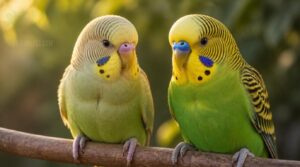
The cere — that small, fleshy patch above the beak — is one of the most reliable age clues you’ll find on a budgie.
In juveniles under four months, males show a uniform pink or lavender cere, while females display pale whitish-blue tones with white rings around the nostrils. By four to six months, adult males develop a bright, smooth royal blue cere, though mutations like lutino or albino can keep it pink for life.
Iris Color Changes
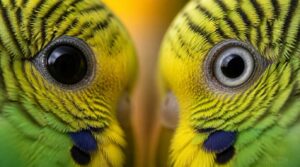
The eye tells a different story than the cere, but you have to know what to look for.
Juvenile budgies under four months have eyes that appear completely black — the iris blends with the pupil because melanin is still dense. By four to six months, a faint gray iris ring gradually emerges. In bright natural light, most adults show a clearly pale silver ring by eight to twelve months.
Feather and Behavior Signs
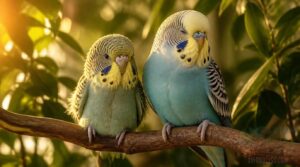
Feathers and behavior together tell a layered story about your budgie’s age.
- Dark forehead bars extending to the cere indicate birds under 3–4 months
- Short tail feathers are common in recently fledged birds
- Clumsy landings and short flights suggest 4–5 weeks of age
- Less precise preening is typical in young budgies still developing grooming skills
- Daytime napping and rougher feather condition often signal a senior bird
Juvenile Versus Adult Budgies
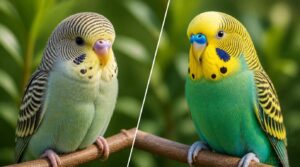
Telling a juvenile from an adult budgie comes down to reading a few key developmental markers together. Full forehead barring, dark solid eyes, and a pink or lilac cere point to a bird under four months.
Once the first molt completes, the forehead clears, an iris ring appears, and cere color stabilizes — marking the shift into adult plumage and behavior.
Diet and Budgie Longevity

What your budgie eats every day has a direct impact on how long it lives. The right balance of nutrients can be the difference between a bird that thrives for 15 years and one that struggles past 7. Here’s what that diet should actually look like.
Pellet-based Daily Diet
Think of pellets as a complete foundation — each piece is engineered to deliver balanced protein, fat, vitamins, and minerals in one bite. Veterinary guides recommend pellets make up 60–80% of your budgie’s daily diet.
Choose a fine or budgie-size pellet so your bird can eat without wasting food. Offer pellets first thing in the morning, when hunger peaks.
Fresh Vegetables for Health
Vegetables are the living color in your budgie’s diet. Leafy greens like kale, romaine, and bok choy deliver vitamin A, calcium, and folate. Carrot’s beta-carotene promotes healthy feathers and eyes.
Rotate colorful veg daily — red bell pepper, broccoli, zucchini — to cover a wider nutrient range. Chop pieces small, wash thoroughly, and never add salt or seasoning.
Seed Limits and Obesity
Seeds are the fast food of the budgie world — easy, tempting, and quietly damaging. A seed-only diet creates real gaps: too little protein, vitamin A, and calcium, opening the door to liver disease and nutritional deficiencies.
Limit seeds to 10% of the daily ration, measure with a spoon, and treat millet spray as an occasional reward, never a staple.
Calcium and Cuttlefish Bone
Calcium is quietly one of the most important minerals in your budgie’s body — supporting muscle contraction, nerve signaling, and bone density maintenance. Without enough, bones weaken and egg-laying hens risk egg binding.
A cuttlefish bone mounted at perch height gives your bird free-choice access to calcium carbonate, making mineral absorption efficient and natural throughout the day.
Vitamin Deficiency Risks
Calcium covers a lot of ground, but it’s only one piece of the puzzle. Seed diet risks run deeper — a seed-heavy bowl can quietly drain your budgie of vitamins A, D, E, and iodine without any obvious warning.
- Vitamin A deficiency damages mouth and airway tissue
- Vitamin D deficiency weakens bones and harms egg quality
- Iodine deficiency goiter causes wheezing and breathing changes
- Vitamin E deficiency leads to tremors and poor coordination
- Quality pellets deliver nutrients consistently in every bite
Common Lifespan-Limiting Health Problems
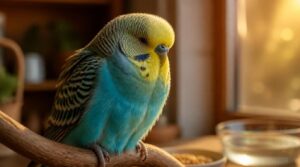
Even with the best diet and care, budgies can still develop health problems that quietly chip away at their years. Catching the early signs makes all the difference between a quick recovery and a serious decline. Here are the most common conditions you’ll want to know about.
Early Illness Warning Signs
Budgies are masters at hiding illness — by the time they look sick, they’re often already serious.
Watch for fluffed feathers and floor-sitting, both classic signs of a struggling bird. Tail bobbing with every breath signals real respiratory effort. A budgie ignoring food for even 6–12 hours weakens fast.
Trust your gut: quiet, still, and puffed usually means vet visit today.
Lipomas and Obesity
Obesity is a slow, quiet threat. Seed-heavy diets and limited flight are the main culprits — fat builds around the chest and abdomen before you notice anything unusual.
That buildup can fuel lipomas, soft fatty lumps under the skin, most common over the keel.
Shift toward measured pellets, daily flight time, and regular weigh-ins to stay ahead of it.
Renal Tumor Symptoms
Renal tumors press on the sciatic nerve inside the pelvis, causing one-sided leg weakness that’s easy to miss at first. Your budgie may grip the perch unevenly, curl its toes, or spend more time on the cage floor.
Watch for polyuria signs too — wetter droppings with a large clear ring signal kidney stress. An avian veterinarian can confirm the diagnosis quickly.
Pituitary Adenoma Signs
Pituitary adenomas are among the most alarming threats to budgie lifespan. A small tumor pressing on the brain can cause seizure symptoms, sudden blindness, and opisthotonos — where your bird’s head arches backward uncontrollably. You may also notice behavioral shifts like confusion, reduced vocalization, or stupor.
Cere color changes and hormonal imbalance — including excessive thirst or irregular molting — can appear alongside these neurological signs.
See an avian veterinarian immediately.
Trichomoniasis Risks
Trichomoniasis is a silent killer. The parasite Trichomonas gallinae spreads through contaminated water dishes and crop feeding between parent and chick. Infected birds develop cheesy mouth plaques, struggle to swallow, and can suffocate or starve within days.
Change water daily, quarantine new birds, and keep budgies away from pigeons and doves. Any regurgitation or open-mouth breathing needs immediate veterinary attention.
Habitat for Longer Life
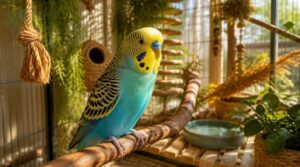
Where your budgie lives matters just as much as what it eats. The right setup can add real years to its life — or quietly take them away. Here’s what to get right.
Proper Cage Length
The cage you choose matters more than most people realize. Budgies move side to side, not up and down — so length beats height every time. Aim for at least 76 cm (30 inches) long for one bird, and 81 cm (32 inches) for a pair.
Watch interior clutter too; toys blocking the center shrink your budgie’s actual flight lane considerably.
Safe Perch Variety
Think of your budgie’s perches as footwear — variety matters. Natural wood branches from apple, willow, or manzanita create uneven surfaces that shift foot pressure throughout the day, protecting joints long-term.
Aim for two to three diameters between 1.0 and 2.0 cm. Avoid sandpaper covers; a single concrete grooming perch is plenty.
Place perches at staggered heights, never directly above food bowls.
Daily Flight Exercise
Free flight outside the cage is the single most effective form of exercise your budgie can get. Even the largest flight cage can’t replicate a full room-length pass or wide turn.
Key flight exercise basics:
- Aim for 1–3 hours daily, split into shorter supervised sessions
- Cover windows and mirrors before every session
- Keep ceiling fans off — blade strikes are fatal
- Use the cage top or a play gym as a clear landing target
- Offer millet at the cage door to encourage voluntary returns
Morning and late afternoon are your budgie’s natural peak activity windows — ideal timing for sessions. Regular daily flight builds breast muscle, promotes heart health, and reduces obesity risk far better than occasional weekend exercise does.
Clean Cage Conditions
A dirty cage is a slow health hazard. Replace the liner daily using plain unprinted newspaper or paper towels — both absorb moisture and are non-toxic. Each morning, spot-clean droppings and wipe food dishes with hot water.
Once weekly, deep clean every surface with a diluted white vinegar solution, rinse thoroughly, and rotate in a spare cage to keep your budgie stress-free during the process.
Draft and Sunlight Safety
Keep your budgie’s cage away from air vents, exterior doors, and windows — drafts chill small birds fast. Even mild airflow can cause fluffing and heat loss in a 30–40 gram bird.
Aim for 18–24°C indoors. Indirect natural light is fine, but direct midday sun overheats cages quickly. If your budgie starts panting or spreading its wings, move it immediately.
Sleep, Socialization, and Enrichment
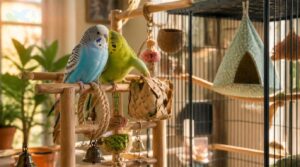
A well-fed budgie in a spacious cage still won’t thrive if it’s exhausted, bored, or lonely. Sleep, social connection, and mental stimulation are just as important as diet and space. Here’s what actually improves your bird’s daily quality of life.
Ten to Twelve Hours Sleep
Getting sleep right might be the simplest thing you can do to protect your budgie’s lifespan. Most pet budgies need 10 to 12 hours of uninterrupted darkness each night. An 8 PM lights-out and 7 AM wake-up hits that target reliably. Use a timer — it removes the guesswork and keeps your bird’s sleep schedule consistency solid every single day.
A dark, quiet room matters more than most owners realize. Televisions, phone screens, and early-morning sunlight through uncovered windows can all cut the sleep cycle short. Dark room benefits are real: budgies deprived of proper rest show weakened immunity and increased stress over time — both quietly chipping away at avian health.
You’ll know your budgie is sleeping well when it stands on one foot, head tucked into its back feathers, barely moving. That’s textbook healthy rest. If your bird is prone to night frights — sudden panicked flapping in the dark — a dim night light nearby can reduce disorientation without disrupting the sleep-dark cycle.
Daily Social Interaction
Sleep sets the foundation — but daily social interaction is what truly shapes a budgie’s quality of life. A lone budgie needs at least an hour of human interaction each day.
Short sessions of 5 to 10 minutes, repeated several times, work better than one long stretch. Mutual preening sessions and step-up practice build trust steadily.
Rotating Budgie Toys
Rotating toys every 7 to 14 days keeps your budgie’s environment fresh without overwhelming them. Swap one or two items at a time — not everything at once — so the cage still feels familiar. Include different functions in each rotation: a swing, a shred toy, and a bell cover the basics well.
Safe materials only: untreated wood, stainless steel, paper, and natural fiber rope in good condition.
Foraging Activities
Hiding food turns mealtime into a mini adventure. Tuck pellets inside a paper cup or folded cardboard strip, and your budgie has to search, pull, and problem-solve before eating. Clip leafy greens to cage bars, or scatter seeds under shredded paper in a shallow tray.
Start simple — visible food, easy access — then gradually add layers as your budgie gets confident.
One Versus Two Budgies
Two budgies comfort each other during long hours without you — a real pair bonding benefit that reduces stress and boredom. But consider these trade-offs:
- Social contact stays constant between birds, easing owner absences
- Individual attention still matters — handle each bird separately
- Quarantine new birds 30–45 days before introducing them
- Weight monitoring catches hidden illness in paired birds early
Household Hazards That Shorten Lifespan

Your home might feel safe, but for a budgie, everyday items can be quietly deadly. Some of the most common household hazards are things you’d never think twice about — cookware, candles, even a ceiling fan. Here’s what to watch out for.
PTFE and Teflon Fumes
PTFE toxicosis is one of the fastest killers in a budgie home — and most owners never see it coming. Overheated nonstick cookware releases odorless fumes that cause 97% mortality within nine minutes. Your budgie’s highly efficient respiratory system absorbs these toxins almost instantly.
Overheated nonstick cookware releases odorless fumes that kill 97% of budgies within nine minutes
Replace all nonstick pans with stainless steel, cast iron, or ceramic alternatives immediately.
Scented Candles and Sprays
Scented candles and aerosol sprays are quieter threats than Teflon, but no less serious.
Budgie lungs absorb airborne chemicals on both inhale and exhale, meaning a single spritz of perfume across the room can reach your bird. Fragrance compounds spread invisibly — if you can smell it, your budgie is already breathing it.
Cigarette Smoke Exposure
Cigarette smoke is one of the most underestimated threats to indoor air quality for pet birds. It contains more than 7,000 chemicals, including formaldehyde, benzene, and hydrogen cyanide — many of which are carcinogens.
Here’s why it hits budgies so hard:
- Their air sac system means toxins pass across gas exchange surfaces on both inhale and exhale
- A budgie weighs just 25–40 grams, so even trace exposure represents a high relative dose
- Thirdhand smoke settles on feathers, perches, and food dishes — your budgie ingests it while preening
- Ongoing exposure causes air sac inflammation, sinus irritation, and pneumonia over time
- Warning signs include open-beak breathing, tail bobbing, clicking sounds, and fast breathing at rest
Don’t smoke near your bird — ever.
Ceiling Fans and Accidents
A ceiling fan doesn’t look dangerous — but to a budgie, it’s a spinning blade at eye level. Budgies naturally fly high, putting them directly in the path of rotating blades. Even at low speed, blade tips move fast enough to cause fatal head or chest trauma on impact.
Switch the fan completely off before your bird leaves the cage.
Cleaning Product Risks
Spinning fans aren’t the only silent threat in your home. Your cleaning routine can be just as dangerous.
Ammonia cleaner dangers are real — those fumes irritate a budgie’s respiratory tract fast. Bleach vapor exposure causes eye, throat, and lung irritation. Never mix the two: the reaction produces chloramine gas, which can kill a small bird within minutes.
Top 7 Budgie Lifespan Supplies
Everything covered in this article points to one conclusion: the right supplies make a real difference. Whether it’s what your budgie eats, where it sleeps, or how its cage gets cleaned, your choices shape its years. Here are seven products worth knowing about.
1. Harrisons Organic High Potency Bird Pellets
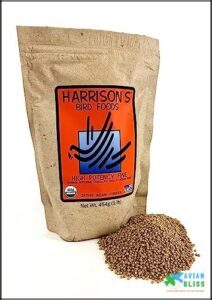
Harrison’s Organic High Potency Bird Pellets are a go-to recommendation for budgies going through diet conversion, molt, recovery, or breeding. The formula is certified organic and non-GMO, made from human-grade grains and legumes without artificial dyes or preservatives. It delivers at least 18% crude protein and essential Omega-3 and 6 fatty acids.
Once your bird stabilizes, most avian vets suggest moving to the Adult Lifetime formula — High Potency is rich by design, not meant for everyday long-term use.
| Best For | Small to medium birds like cockatiels, conures, and parakeets going through molt, breeding, weaning, or illness recovery. |
|---|---|
| Product Type | Organic Pellet Food |
| Primary Use | Bird Nutrition |
| Bird Suitability | Small to Medium Birds |
| Size or Format | Fine Pellets |
| Key Limitation | Gradual Diet Transition Required |
| Ideal For | Molting and Breeding Birds |
| Additional Features |
|
- Certified organic and non-GMO with human-grade ingredients — no dyes, bleach, or unnecessary additives
- Solid nutritional profile with at least 18.5% protein and essential Omega-3 and 6 fatty acids
- Trusted by avian vets for diet conversions and birds that need extra nutritional support
- Costs more than standard seed or pellet diets
- Birds used to seeds need a slow, gradual transition — it won’t happen overnight
- Not a standalone diet; fresh fruits and veggies are still needed to round things out
2. Harrisons High Potency Fine Bird Pellets
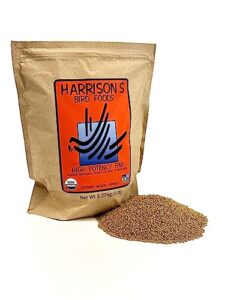
If your budgie is on the smaller side — and most are — pellet size matters more than you’d think. Harrison’s High Potency Fine uses a smaller pellet than the coarse version, making it far easier for budgies to pick up and bite through.
It’s the same nutrient-rich formula: certified organic, non-GMO, with at least 20% crude protein and Omega-3 and 6 fatty acids. Use it during molt, recovery, or diet conversion, then consider stepping down to a maintenance formula once your bird is stable.
| Best For | Small birds like budgies, cockatiels, and lovebirds that need extra nutritional support during molting, breeding, illness recovery, or switching to a pellet-based diet. |
|---|---|
| Product Type | Organic Pellet Food |
| Primary Use | Bird Nutrition |
| Bird Suitability | Small to Medium Birds |
| Size or Format | Fine Pellets |
| Key Limitation | May Need Supplementation |
| Ideal For | Growth and Feather Health |
| Additional Features |
|
- Certified organic and non-GMO with human-grade ingredients — you know exactly what your bird is eating
- The fine pellet size is easy for small birds to pick up and chew through without a struggle
- Covers the tough times well: molt, recovery, diet conversion, and weaning all in one formula
- Laying birds may need additional food on the side to meet their nutritional needs
- It costs more than a lot of other bird foods on the market
- Not a great fit if you have larger birds — it’s built specifically for small to medium sizes
3. Prevue Hendryx Bird Flight Cage
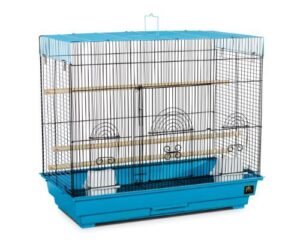
Once your bird’s diet is dialed in, housing becomes the next big variable. The Prevue Hendryx Flight Cage measures 31 x 20.5 x 53 inches — well above the 60 cm minimum flight length budgies need. The ½-inch bar spacing keeps small heads safely inside.
You get three wood perches, four feeding cups, and a pull-out tray that makes daily cleaning realistic, not a chore. Separate feeder doors mean fewer escape attempts during routine top-ups.
| Best For | Bird owners looking for a spacious, easy-to-clean home for parakeets, cockatiels, or other small to medium birds. |
|---|---|
| Product Type | Wire Bird Cage |
| Primary Use | Bird Housing |
| Bird Suitability | Small to Medium Birds |
| Size or Format | 26 x 14 x 20 Inches |
| Key Limitation | Requires Significant Space |
| Ideal For | Multiple Small Birds |
| Additional Features |
|
- The large front-opening door makes getting in and out a breeze — no awkward reaching required.
- A pull-out tray means cleanup takes minutes, not a whole ordeal.
- Versatile enough to hang or place on a stand, so it fits most living setups.
- At 26 x 14 x 20 inches, it needs a decent chunk of space in your home.
- The wire bars run a bit thin, so it may not feel as solid as you’d expect.
- The door can rattle during use, and the color might look a little duller than the product photos suggest.
4. Prevue Large Steel Bird Flight Cage with Wheels
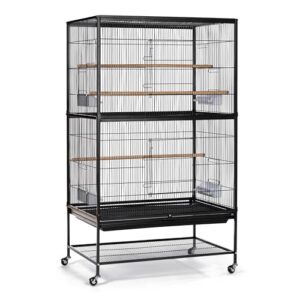
If you move your flock regularly between rooms, the rolling caster design changes everything. This cage measures 31 x 20.5 x 53 inches — clearing the 60 cm flight minimum your budgie needs.
Steel construction with powder coating resists rust and allows for easy cleaning. The pull-out tray and removable floor grille keep waste-removal quick.
Four feeding cups and multiple access doors reduce daily handling stress. Assembly needs two people, so plan ahead.
| Best For | Small to medium bird owners — think parakeets, canaries, cockatiels, or conures — who want a roomy cage they can move around the house easily. |
|---|---|
| Product Type | Wire Bird Cage |
| Primary Use | Bird Housing |
| Bird Suitability | Small Birds and Flocks |
| Size or Format | 31 x 20.5 x 53 Inches |
| Key Limitation | Complex Two-Person Assembly |
| Ideal For | Small Bird Flocks |
| Additional Features |
|
- Spacious interior (31 x 20.5 x 53 in.) gives small flocks real room to fly and play
- Rolling wheels make repositioning effortless, no lifting required
- Pull-out tray and removable grille make cleanups fast and low-hassle
- Assembly is tricky and really needs two people to do it right
- Parts aren’t clearly labeled, so expect some frustration putting it together
- Not built for larger, more aggressive birds like macaws or cockatoos
5. F10 Concentrated Veterinary Disinfectant Solution
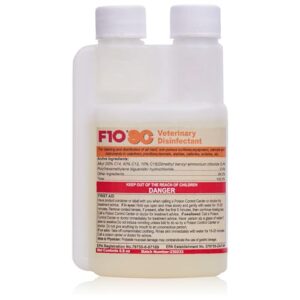
Cage hygiene directly affects how long your budgie lives. F10 SC is a veterinary-grade disinfectant used widely in avian and exotic animal care. It’s effective against bacteria, viruses, and fungi — covering the pathogens most likely to threaten a small bird’s respiratory and digestive health.
Mix 4 ml per liter of water for routine disinfection. Always remove your budgie first, let surfaces air-dry completely, and you won’t need to rinse hard, non-porous surfaces like metal bars or plastic bowls.
| Best For | Bird owners, exotic animal keepers, and anyone working in a vet clinic, shelter, or stable who needs a reliable, no-fuss disinfectant that’s tough on pathogens. |
|---|---|
| Product Type | Liquid Disinfectant |
| Primary Use | Habitat Sanitation |
| Bird Suitability | All Bird Species |
| Size or Format | 200 ml Concentrate |
| Key Limitation | Must Be Diluted Before Use |
| Ideal For | Routine Cage Cleaning |
| Additional Features |
|
- Kills bacteria, viruses, and fungi in one step — no rinsing needed on hard surfaces after it air-dries
- EPA-registered and biodegradable, so it’s a responsible choice for regular use around animals
- Versatile enough for cages, water bowls, floors, hands, and full veterinary environments
- The concentrate is harmful to animals — you must dilute it properly and remove pets before applying
- Mixed solution doesn’t keep well, so you’ll need to make a fresh batch each week
- Porous surfaces like wood or fabric do need a rinse, which adds a step to the process
6. F10 Concentrated Veterinary Disinfectant

Think of this as F10 SC’s sibling — the same trusted veterinary formula in a 100 ml concentrate that yields up to 25 liters of working solution. Use 4 ml per liter for routine cage cleaning, or bump to 10 ml per liter when dealing with heavier contamination.
It’s non-corrosive on metal bars and free-rinsing on hard surfaces. Remove your budgie first, let everything dry fully, and you’re done.
| Best For | Pet owners, exotic animal keepers, and veterinary professionals who need a reliable, versatile disinfectant for cages, habitats, and high-contact surfaces. |
|---|---|
| Product Type | Liquid Disinfectant |
| Primary Use | Habitat Sanitation |
| Bird Suitability | All Bird Species |
| Size or Format | 100 ml Concentrate |
| Key Limitation | Must Be Diluted Before Use |
| Ideal For | Multi-Surface Disinfection |
| Additional Features |
|
- Stretches a long way — 100 ml makes up to 25 liters of ready-to-use solution, so a little goes a long way
- Broad-spectrum formula kills viruses, bacteria, and fungi, and it’s odorless so it won’t stress sensitive animals
- No-rinse on hard surfaces means cleaning is quick and straightforward
- Requires careful measuring every time — too strong and it can harm animals, too weak and it loses effectiveness
- Mixed solution only stays good for about a week, so you can’t batch-prep too far ahead
- Animals need to be removed during application and surfaces must dry fully before they return
7. Budgie Parakeet Facts Guide
At just $2.99 for 11 pages, the Budgie Parakeet Facts Guide packs a surprising amount of useful knowledge into a slim format. It covers selecting a parakeet, cage setup, feeding, breeding, hand training, and basic healthcare — everything a new owner needs in one place.
It’s written accessibly enough for adults and older children alike. The only real limitation is its length, so treat it as a practical quick-reference, not a detailed examination.
| Best For | New parakeet owners — and curious kids — who want a no-fuss, affordable starting point for learning the basics. |
|---|---|
| Product Type | Care Guide Book |
| Primary Use | Bird Care Education |
| Bird Suitability | Parakeets and Budgies |
| Size or Format | 11 Pages |
| Key Limitation | English Language Only |
| Ideal For | New Bird Owners |
| Additional Features |
|
- Covers all the essentials in one place — picking a bird, cage setup, feeding, training, and health
- Easy enough for kids and adults to read without feeling overwhelmed
- At $2.99, it’s a low-risk way to get up to speed fast
- 11 pages won’t satisfy anyone looking for deep, detailed coverage
- English only, so it’s out of reach for non-English speakers
- Better as a quick reference than a go-to guide for complex situations
Frequently Asked Questions (FAQs)
Should I get 1 or 2 budgies?
Both work, but budgies are flock animals by nature. A solo bird needs significant daily attention from you. Two budgies keep each other company, stay more active, and handle your absence better.
How long do budgerigars live?
Most captive budgies live 5 to 15 years. Wild budgerigars rarely exceed 6 years. With good diet, safe housing, and regular vet care, many reach 10 to 12 years comfortably.
How to identify if a budgie is less than 18 days old?
A budgie under 18 days old has bare pink skin, faint down, and dark, iris-free eyes. The cere is smooth and pale, and the chick can’t feed itself or move independently.
How long do budgies live?
Most pet budgies live 8 to 12 years with good care, though some reach Wild budgerigars average just 4 to 6 years, facing predators and harsher conditions daily.
How old is a budgie if he dies?
Most die somewhere between 5 and 10 years, though well-cared-for birds often reach their teens. Without proper care, many don’t make it past
How old is the oldest Budgie?
The oldest budgie on record was Charlie, who lived an astonishing 29 years and 2 months in England — a feat recognized by Guinness World Records and still peerless today.
What factors affect Budgie lifespan?
Several factors play a role: diet quality, genetics, habitat safety, daily exercise, and regular veterinary care. Social interaction and sleep also matter more than most owners expect.
How old do budgies get?
Captive budgies commonly live 7 to 15 years, while wild ones rarely exceed With excellent care, some reach their late teens. One record-holder, Charlie, lived an astonishing 29 years.
Can budgies live alone?
Yes, budgies can live alone, but they need significant daily interaction from you. Without it, loneliness sets in fast. Aim for 15–30 minutes of hands-on time every day.
How long do budgies live as a pet?
Pet budgies usually live 5 to 15 years, though many well-cared-for birds reach the higher end of that range. With the right diet, clean air, and regular vet visits, some even push past
Conclusion
The irony is almost funny: the birds most owners lose early aren’t neglected—they’re deeply loved with all the wrong information. A seed-only diet, a cramped cage, and scented candles feel like genuine care until they quietly become causes.
Budgie lifespan isn’t determined by luck or genetics alone; it’s shaped every single day by what you put in the bowl, what you remove from the air, and how much room you give them to fly.