This site is supported by our readers. We may earn a commission, at no cost to you, if you purchase through links.
When former President Jimmy Carter isn’t making headlines for diplomacy, he’s quietly logging his 1,100th bird species—a feat that puts most dedicated lifelisters to shame. You’d be surprised how many celebrities trade red carpets for muddy trails, armed with binoculars and field guides. These famous bird watchers aren’t just dabbling in a trendy hobby—they’re using their platforms to fund conservation projects, normalize wildlife appreciation, and prove that birding transcends every boundary we’ve invented.
Margaret Atwood champions bird-friendly coffee between novels, while horror legend Wes Craven found his darkest inspirations in avian symbolism. From comedians like Bill Oddie earning an OBE for wildlife work to musicians like Guy Garvey tracking white-tailed sea eagles, the birding world draws an unexpectedly eclectic crowd.
Whether you’re curious about which actors log species for breeding surveys or how professional ornithologists like David Lindo spark urban birding revolutions, the stories ahead reveal why this pastime captivates presidents and rock stars alike.
Table Of Contents
- Key Takeaways
- Celebrities Who Love Birds
- Comedians and Actors Who Bird Watch
- Musicians Who Bird Watch
- Professional Birdwatchers
- Keeping a Species List
- Frequently Asked Questions (FAQs)
- Who is a famous bird watcher?
- What is a professional bird watcher called?
- Who are the famous female bird watchers?
- Which celebrity loves birds?
- What is a famous birdwatcher?
- What do birdwatchers do?
- Do birdwatchers keep a species list?
- Who are some famous birders?
- How has birdwatching influenced global political relations?
- What ethical guidelines should birdwatchers follow?
- Conclusion
Key Takeaways
- High-profile birders like Jimmy Carter (1,100+ species) and Margaret Atwood leverage their platforms to fund conservation projects and normalize wildlife appreciation, proving that celebrity advocacy can drive measurable environmental impact beyond traditional activism.
- Comedians and actors such as Bill Oddie (OBE recipient) and Bill Bailey transform birding into accessible entertainment and educational content, expanding BBC natural history programming to prime-time slots and reaching younger demographics through humor-infused conservation messaging.
- Musicians like Guy Garvey and Jimi Goodwin directly integrate birdwatching into their creative work—Garvey’s “Starlings” emerged from field observations while Goodwin’s documentary scores connect indie audiences to extinction-focused ornithology and habitat protection.
- Urban birding pioneer David Lindo’s “just look up” philosophy challenges the wilderness-only myth by demonstrating that city streets and forgotten parks like London’s Wormwood Scrubs are thriving avian hotspots, making conservation accessible to marginalized urban communities.
Celebrities Who Love Birds
Curiosity, it seems, knows no bounds—especially regarding birdwatching celebrities. You’ll find Jimmy Carter with a life list topping 1,100 species, using his platform for wildlife preservation and Bird Conservation. Margaret Atwood, meanwhile, pushes for bird-friendly coffee and environmental education. Wes Craven drew creative fire from birds, weaving their symbolism into his work.
These famous birdwatchers show how Celebrity Advocacy can spark real Environmental Impact, making birding tourism and conservation a cause worth rallying around. Many of these celebrities are also celebrity birdwatchers.
Comedians and Actors Who Bird Watch
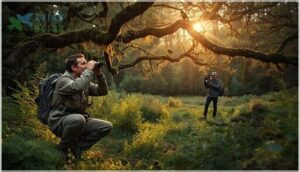
You’d be surprised how many comedians and actors swap the spotlight for binoculars. Bill Oddie, who drew over 3 million viewers to BBC’s “Springwatch,” earned an OBE for his wildlife work—proving birding comedy and conservation go hand in hand. Bill Bailey took a different route, penning a humorous bird guide and auctioning swift artwork for environmental causes. Meanwhile, Jane Alexander has spent 40 years contributing to breeding bird surveys and sits on boards at major conservation groups, while Tig Notaro represents a new wave of Hollywood birders treating birdwatching as meditation. Even Alison Steadman traded North London for coastal Dungeness, recording purple herons alongside naturalists.
These celebrity interests and hobbies spark real change:
- Bill Oddie’s TV work expanded BBC natural history programming across prime-time slots
- Bill Bailey’s birdwatching humor reaches younger demographics drawn to nature hobbies
- Jane Alexander’s advocacy highlights projections that 20-45% of bird species face potential loss
- Actor birders like Sean Bean and Samuel West normalize wildlife appreciation among fans
- Celebrity conservation efforts boost causes for organizations with millions of members
Conservation efforts require addressing bird species loss.
Musicians Who Bird Watch
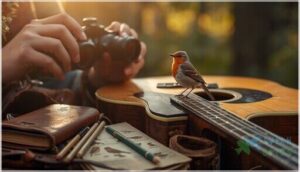
You mightn’t think of rock stars and indie legends trading guitar riffs for field notes, but some of the music world’s finest have swapped stages for hedgerows.
These musicians find the same quiet thrill in spotting a rare warbler as they do in nailing a perfect chorus.
Here are two birders who’ve turned their love of feathers into something worth singing about.
Guy Garvey: Prefers Binoculars With Self-steadying Feature
When Guy Garvey, the acclaimed Elbow frontman, won the Mercury Prize in 2008, he didn’t splurge on typical rock-star gear—he invested in image-stabilizing binoculars. You might wonder why a musician would prioritize optical equipment, but Garvey’s one of those famous birdwatchers who takes birding seriously. On Scotland’s Isle of Mull, he’s used these self-steadying optics to track white-tailed sea eagles, even lying motionless in a bright red coat to draw curious raptors closer. That kind of wildlife encounter demands steady glass.
| Feature | Garvey’s Priority | Why It Matters |
|---|---|---|
| Stabilization | Image-steadying tech | Eliminates hand shake at distance |
| Magnification | 8-10x range | Balances detail with field coverage |
| Build Quality | Rugged, weather-ready | Survives Scottish moors and coastal winds |
His birdwatching feeds directly into his songwriting—”Starlings” appeared right around his binocular upgrade. For Garvey, birding techniques and nature observations aren’t separate from music; they’re fuel for it.
Jimi Goodwin: Featured in The Bird Effect Film
Jimi Goodwin traded stadium stages for a different kind of performance when he composed the soundtrack for Ceri Levy’s documentary “The Bird Effect.” You’ll find him listed among famous birdwatchers who channel their passion into environmental themes through music collaboration and film soundtracks.
Key contributions to bird conservation through documentary scores:
- Formed The Bird Effect Ensemble to perform live compositions synchronized with extinction-focused imagery
- Collaborated on the Ghosts of Gone Birds multimedia project, blending indie credibility with avian advocacy
- Worked from his Herefordshire base—a locale chosen partly for its birding opportunities
- Connected Doves’ fanbase to contemporary ornithology and habitat protection messaging
His soundtrack demonstrates how celebrities in birding can boost conservation work beyond traditional nature programming.
Professional Birdwatchers
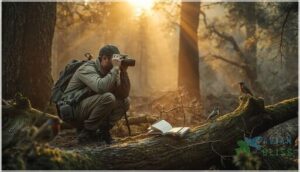
While celebrities dabble in birding between gigs, some people turn it into their life’s work. These professionals don’t just watch birds—they study them, document them, and share their passion with the rest of us.
Let’s look at three ornithologists who’ve made serious contributions to the field.
David Lindo: Urban Birder
If you’re ready to break free from the myth that birding belongs only in remote wilderness, meet David Lindo—the Urban Birder who’s been proving since 2011 that your city streets are teeming with wings. His “just look up” mantra has sparked a quiet revolution in urban birding, turning forgotten parks like London’s Wormwood Scrubs into hotspots.
David Lindo’s just look up mantra proves city streets teem with wings, sparking a quiet revolution in urban birding since 2011
Through international wildlife tours, BBC appearances, and his Urban Birder Foundation, Lindo champions city wildlife and bird conservation, connecting marginalized communities to nature hiding in plain sight.
John James Audubon: Ornithologist and Artist
Few figures loom larger in ornithology history than John James Audubon, the artist-naturalist whose double-elephant folio transformed how you see birds. Between 1827 and 1838, his 435 life-sized wildlife paintings captured North American species with groundbreaking drama, fueling both bird conservation movements and your modern birdwatching tradition.
His artistic contributions include:
- Leading one of North America’s earliest bird-banding experiments
- Traveling 15+ states documenting avian diversity
- Creating plates that now sell for over $8 million
- Inspiring the Audubon legacy of habitat protection
- Making ornithology accessible beyond academic circles
Yet his pro-slavery stance complicates this towering influence today.
Induchoodan K.K. Neelakantan: Ornithologist
If you’re serious about birdwatching, you’ll want to know about K.K. Neelakantan—Kerala’s most celebrated ornithologist. From 1944 through 1992, his ornithology career pioneered bird conservation and environmental advocacy across India. His 1958 masterwork documented 261 Kerala wildlife species in Malayalam, making species discovery accessible beyond English-speaking circles. That innovative approach earned him recognition from WWF-India and fueled the Silent Valley movement, proving famous bird watchers can reshape how we connect with nature.
| Achievement | Impact |
|---|---|
| “Birds of Kerala” (1958) | 261 species documented in local language |
| Silent Valley agitation (1979) | Led major forest conservation campaign |
| Kerala Natural History Society | Founded citizen science movement |
| International recognition (1963) | Exhibited at Moscow Indian Exhibition |
Keeping a Species List
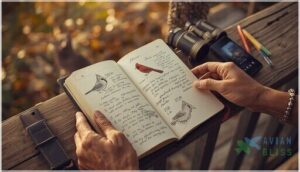
You don’t need to travel the globe to start your own life list—just step outside. Species tracking begins in your backyard, and digital checklists like eBird make it simple to log every sighting.
With over 11,000 bird species recognized globally, you’ll never run out of additions to chase. Use field guides for species identification, record location and date for each entry, and watch for taxonomy updates that might split or lump your finds.
This birding journal becomes your personal roadmap through ornithology, connecting you to a community where 73% of birdwatchers actively monitor and count birds.
Frequently Asked Questions (FAQs)
Who is a famous bird watcher?
One name stands tall among birding legends: Phoebe Snetsinger. She documented 8,398 species before her death in 1999, becoming the first person ever to surpass 8,000 birds—a record that defined serious lifelisting.
What is a professional bird watcher called?
A professional bird watcher goes by ornithologist—someone who dives deep into avian research, behavior, and conservation.
These wildlife experts bridge the gap between casual birding and serious scientific work, shaping our understanding of birds.
Who are the famous female bird watchers?
You’ll find trailblazers like Phoebe Snetsinger, who documented over 8,000 species globally, and Florence Merriam Bailey, whose 1889 guide helped popularize birdwatching. Margaret Atwood champions bird conservation today.
Which celebrity loves birds?
Jimmy Carter’s passion for bird conservation runs deep—he’s documented over 1,100 species across continents.
His commitment to wildlife advocacy makes him stand out among famous birders who blend celebrity interests with genuine birdwatching dedication.
What is a famous birdwatcher?
Former President Jimmy Carter stands out among birdwatching’s most dedicated celebrities. His life list spans over 1,100 species observed across 25 countries, reflecting decades of commitment to both field birding and habitat conservation efforts.
What do birdwatchers do?
Put simply, birdwatchers are the eyes in the field. You’re scanning canopies with binoculars, logging species for conservation tracking, and joining citizen science counts.
You’re also photographing wildlife, monitoring habitat changes, and connecting with the birding community to share ornithology insights and behaviors you’ve witnessed firsthand.
Do birdwatchers keep a species list?
Yes—most birders maintain a life list tracking every species they’ve positively identified. 74% of birdwatchers keep systematic records, turning field observations into lifelong achievements through digital logging or traditional birding journals.
Who are some famous birders?
You’d be amazed who shares your passion—from President Jimmy Carter cataloguing over 1,100 species to rock legend Mick Jagger spotting birds between tours, the birding community includes comedians, actors, and conservation champions worldwide.
How has birdwatching influenced global political relations?
You wouldn’t think scanning wetlands for warblers could ease diplomatic tensions, yet Migratory Bird Treaties and international cooperation on conservation have quietly bridged borders.
Birdwatching ecotourism and environmental governance foster global policy impact through shared wildlife conservation and environmentalism.
What ethical guidelines should birdwatchers follow?
Birding ethics center on minimizing disturbance near nests, using responsible playback sparingly, protecting habitat by staying on trails, preventing disease at feeders, and upholding community standards that support conservation efforts and wildlife protection.
Conclusion
You’d think spotting a rare warbler would pale next to Grammy stages or Oval Office briefings—but famous bird watchers prove otherwise. They’ve swapped spotlights for dawn chorus, using influence to bankroll wetland restoration and normalize muddy boots in high society.
Whether you’re inspired by Carter’s 1,100 species or Atwood’s shade-grown advocacy, the takeaway is clear: binoculars don’t discriminate. Start your list today, because the best birders aren’t born with field guides—they’re made one sighting at a time.