This site is supported by our readers. We may earn a commission, at no cost to you, if you purchase through links.
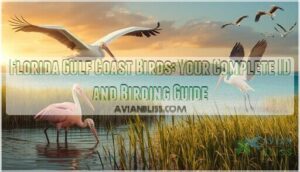
The Florida Gulf Coast hosts more than 400 bird species throughout the year. This 700-mile stretch of shoreline creates a meeting point where wading birds stalk shallow waters, shorebirds probe wet sand, and raptors patrol from above.
You’ll find everything from tiny sanderlings that chase retreating waves to massive pelicans that crash-dive for fish just beyond the breakers. The mix of salt marshes, mangrove forests, sandy beaches, and coastal wetlands provides the habitat diversity that draws both year-round residents and long-distance migrants.
Whether you’re scanning a mudflat at low tide or watching terns hover over the surf, you’re looking at one of North America’s most productive birding destinations.
Table Of Contents
- Key Takeaways
- Iconic Waterbirds of The Florida Gulf Coast
- Shorebirds and Waders: Beachfront Residents
- Gulls, Terns, and Skimmers: Coastal Flyers
- Raptors and Other Notable Coastal Birds
- Birdwatching, Migration, and Conservation
- Frequently Asked Questions (FAQs)
- Are there birds on the Florida Gulf Coast?
- Do shorebirds live in Florida?
- Where can you see shorebirds in Florida?
- How many shorebirds are in Florida?
- What is a Florida shorebird?
- When can you see shorebirds in Florida?
- What are the little birds in Florida beach?
- What are the birds you see at the beach?
- What are the little brown birds at the beach?
- Are there any tropical birds in Florida?
- Conclusion
Key Takeaways
- Florida’s Gulf Coast supports over 400 bird species across 700 miles of shoreline, with more than 200,000 breeding waterbird pairs and peak spring migration bringing 2.1 billion birds through in just 18 days from mid-April to early May.
- The region hosts iconic species like Brown Pelicans (40,000 breeding pairs representing 60% of US population), Roseate Spoonbills, and Black Skimmers, though many face severe decline with Black Skimmers down 87% since 1966 due to habitat loss and beach disturbance.
- Prime birding locations include Fort De Soto County Park with 250+ species, J.N. “Ding” Darling National Wildlife Refuge on Sanibel Island with 238 annual species, and Gulf Islands National Seashore, with early morning visits near low tide offering optimal viewing conditions.
- Conservation programs target a 10% population increase by 2029 for focal species through habitat restoration and predator control, while responsible birdwatching requires maintaining 30-meter distances from nests and following Leave No Trace principles to protect vulnerable coastal populations.
Iconic Waterbirds of The Florida Gulf Coast
The Florida Gulf Coast hosts some of the most recognizable waterbirds in North America. You’ll spot long-legged waders, fish-diving specialists, and birds with bills shaped like tools.
These iconic species define the coastal wetland experience and are often the first birds you’ll notice on any birding trip.
Ibises and Spoonbills (White Ibis, Glossy Ibis, Roseate Spoonbill)
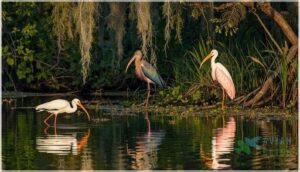
You’ll spot three stunning waders along Florida’s Gulf Coast: the White Ibis with its curved orange bill, the darker Glossy Ibis with purple-green shimmers, and the bright pink Roseate Spoonbill. These wading birds gather in mixed colonies for nesting, often sharing mangroves and marshes.
Ibis foraging happens in shallow flats and wetlands. The White Ibis is known to inhabit both freshwater and saltwater wetlands.
Despite conservation programs, habitat degradation from development threatens these colonial nesters across the region.
Cormorants and Anhingas (Double-crested Cormorant, Anhinga)
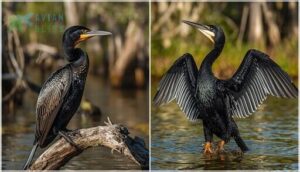
Two similar dark waterbirds share Florida Gulf Coast habitats but use different foraging strategies. The Double-crested Cormorant, with blue eyes and a long neck, dives from the surface to chase fish. The Anhinga swims with its snake-like neck exposed, spearing prey underwater with its sharp bill. Both parents participate in feeding their young.
Both species show strong population trends:
- Double-crested Cormorants rebounded after DDT bans
- Anhingas maintain stable numbers at 2 million globally
- Conservation challenges include habitat loss and pollution
- Identification tips: cormorants perch upright; anhingas spread wings to dry
Pelicans (Brown Pelican, American White Pelican)
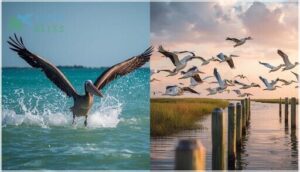
Pelicans represent the Gulf Coast’s most recognizable waterbirds. You’ll spot Brown Pelicans year-round plunge-diving for fish—their feeding ecology requires 4 pounds of fish daily. American White Pelicans arrive mid-November as winter visitors, foraging cooperatively in shallow waters.
Florida maintains 60% of the U.S. Brown Pelican breeding population, with 40,000 pairs. Conservation threats include fishing gear entanglement, claiming 700 Brown Pelicans annually, though population trends show stability since DDT bans.
Shorebirds and Waders: Beachfront Residents
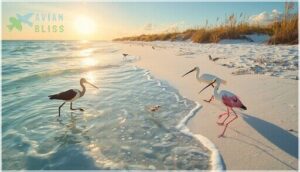
When you walk the beaches and mudflats of Florida’s Gulf Coast, you’ll spot dozens of shorebirds darting along the waterline or wading through shallow pools. These busy little hunters come in all sizes, from tiny sandpipers to long-legged stilts, each with its own feeding style and habitat preference.
Here’s a closer look at the species you’re most likely to see during your coastal visits.
Sandpipers and Sanderlings
When you watch Sanderlings dash along the surf line, you’re seeing birds that made an epic journey from the Arctic. These small shorebirds use Florida Gulf Coast beaches as critical winter homes, chasing waves to snatch tiny invertebrates from wet sand.
Their foraging ecology relies on healthy beaches, but habitat loss and disturbance contribute to Sanderling decline. Shorebird identification starts with noticing their tireless wave-chasing behavior.
Dowitchers (Short-billed, Long-billed)
Along Florida Gulf Coast beaches, you’ll encounter two dowitcher species that look remarkably similar. Short-billed Dowitchers favor coastal mudflats and salt marshes, while Long-billed Dowitchers prefer freshwater wetlands. Bill length helps with shorebird identification, though habitat preference is your most reliable clue.
Climate impact threatens to reduce suitable Gulf wintering habitat by 87%, making conservation needs urgent for these declining shorebirds and their migration routes.
Plovers and Killdeer
Three notable plover species and the widespread killdeer call Florida’s Gulf beaches home. Snowy Plover breeds locally on protected barrier islands, while Wilson’s Plover nests on less developed shores. Piping Plover winters here from northern breeding grounds, arriving mid-September. Conservation threats include habitat loss from rising seas, recreational pressure, and predation—prompting seasonal restrictions and stewardship programs to protect these declining shorebirds and their critical migration patterns.
Key Identification Features:
- Snowy Plover – Pale sandy coloring with dark patches on head
- Wilson’s Plover – Heavier black bill and single dark chest band
- Piping Plover – Orange legs and pale gray back (winter plumage)
- Killdeer – Two distinct black bands across white chest
Stilts and Oystercatchers (Black-necked Stilt, American Oystercatcher)
You’ll spot Black-necked Stilts by their striking black-and-white plumage and impossibly long pink legs wading through mudflats and saltwater wetlands. These adaptable shorebirds have expanded their range by nesting in artificial habitats like drainage ditches.
American Oystercatchers—with jet-black heads and bright red bills—remain rarer, with only 350–400 breeding pairs statewide.
Both species face coastal threats from habitat loss and human disturbance, making conservation status monitoring essential for population trends.
Gulls, Terns, and Skimmers: Coastal Flyers
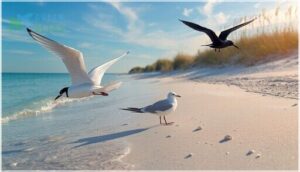
When you look up along the Gulf Coast, chances are you’ll spot gulls and terns wheeling overhead or resting on the sand. These birds are some of the most recognizable coastal species, but many people don’t realize just how different they’re from each other.
Let’s look at the gulls, terns, and one unusual fishing bird you’re likely to see on your next beach visit.
Common Gulls (Laughing Gull, Ring-billed Gull, Herring Gull)
You’ll spot three common gulls on Florida’s Gulf Coast shores, each with its own personality. The Laughing Gull lives up to its name with raucous calls and a black head. Ring-billed Gulls arrive as winter visitors, sporting a distinctive yellow bill with a black band. Herring Gulls are the largest, with pink legs and gray wings.
All three share similar foraging behavior at beaches, docks, and even landfills, reflecting their adaptation to human impact on coastal environments.
Terns (Royal Tern, Forster’s Tern, Caspian Tern)
Terns are sleeker than gulls, built for precision diving as they hunt small fish along Florida’s coast. Royal Terns nest in large colonies on barrier islands, with about 5,600 breeding pairs documented in the region. Forster’s Terns prefer shallow marshes and bays during migration. The Caspian Tern stands out as the world’s largest tern species, sporting a thicker bill and broader wings than its relatives.
- Royal Terns plunge headfirst into Gulf waters, their gray mantles flashing in sunlight
- Forster’s Terns hover delicately over marsh edges before dropping to catch prey
- Caspian Terns patrol estuaries with powerful wingbeats, occasionally stealing from smaller seabirds
- Black-capped terns rest in dense groups on sandbars between foraging trips
Unique Species (Black Skimmer)
Watch a Black Skimmer slice its lower bill through calm Gulf waters at dusk, and you’ll witness one of nature’s most specialized fishing techniques. This striking coastal bird species displays dramatic black-and-white plumage and a unique skimmer morphology, featuring an elongated mandible perfectly adapted for surface foraging behavior. Despite active management actions to protect remaining colonies, Florida’s population has crashed by 87% since 1966 due to beach disturbance and nesting threats.
| Field Mark | Description |
|---|---|
| Bill | Lower mandible longer than upper, bright red-orange |
| Upperparts | Jet black back and wings |
| Underparts | Bright white belly and chest |
| Foraging | Flies low, lower bill slicing water surface |
| Habitat | Sandy beaches, shell rakes, coastal estuaries |
Raptors and Other Notable Coastal Birds
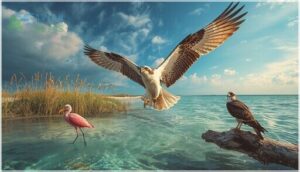
Not every Gulf Coast bird sticks to the shoreline or wades in the shallows. Some patrol the skies in search of fish, while others stand out with unusual feeding methods or vivid colors.
Let’s look at a few raptors and distinctive species you’ll encounter along Florida’s coastal habitats.
Osprey: The Gulf’s Fishing Hawk
You’ll recognize the Osprey by its dark brown upperside and white underside as it hovers over coastal waters before plunging feet-first to catch fish. This impressive bird of prey achieves fishing success rates as high as 70% in Gulf habitats.
Ospreys use nesting platforms along shorelines and have seen a population increase in Florida, though conservation threats like habitat loss and fishing line entanglement remain concerns.
Their migration routes extend from Central America to northern breeding grounds.
Unique and Colorful Birds (Roseate Spoonbill, Black Skimmer)
The Roseate Spoonbill stands out with its bright pink spoonbill plumage and distinctive spatulate bill. You’ll find most nesting within Everglades mangrove islands, though habitat loss and nesting decline affect populations statewide.
The Black Skimmer catches fish through unique skimmer behavior—flying low with its lower bill slicing through water.
Conservation efforts now track both Florida Gulf Coast bird species as population indicators, with development pressures threatening their coastal breeding sites.
Other Frequently Seen Species (Clapper Rail, Pine Warbler)
Beyond colorful coastal birds, you’ll spot Florida Gulf Coast birds in quieter habitats too. Clapper rails hide in salt marshes, with 210,000 individuals along the Gulf supporting healthy rail habitats despite subspecies variation and habitat loss. Pine warblers prefer mature pines exclusively—their 13 million population shows stable trends across North America.
Understanding warbler ecology and coastal conservation helps protect these common Florida bird species. Bird species identification requires patience in their specialized environments.
Birdwatching, Migration, and Conservation
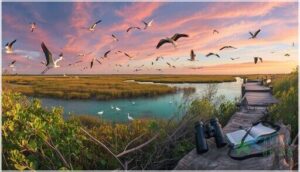
The Florida Gulf Coast isn’t just a great place to spot birds—it’s an important stopover for millions of migrating species each year. Knowing where to go and when to visit can make all the difference in what you see.
This section covers the best birding spots, migration timing, conservation challenges, and how you can watch birds responsibly.
Best Birding Locations on The Gulf Coast
You’ll find remarkable birding locations scattered along Florida’s Gulf Coast, each offering unique refuge accessibility and trail diversity. Fort De Soto County Park delivers over 250 species across beaches and trails, while Sanibel Island’s J.N. “Ding” Darling National Wildlife Refuge hosts 238 annual species.
Consider these proven seasonal hotspots:
- Fort De Soto County Park for spring songbird migration
- Lettuce Lake Park’s 3,500-foot boardwalk for herons and ospreys
- Cedar Keys National Wildlife Refuge for waterbird nesting colonies
- Gulf Islands National Seashore for year-round species variation
Early morning visits near low tide optimize your sightings.
Seasonal Migration Patterns and Timings
Each spring, roughly 2.1 billion birds cross Florida’s Gulf Coast between April 19 and May 7—peak migration compressed into 18 days. Fall migration unfolds more gradually from mid-July through November, with over 30 million birds passing on a single night. Climate impact is shifting spring arrivals earlier by 1.5 days per decade.
Florida’s Gulf Coast sees 2.1 billion birds pass through in just 18 spring days, while fall migration stretches across four months
| Season | Peak Window | Migration Duration |
|---|---|---|
| Spring | April 19–May 7 | 18 days |
| Fall | Mid-July–November | 4+ months |
| Winter visitors | October–March | 5–6 months |
You’ll spot migratory shorebirds arriving as early as late July, with terns and raptors following through October. Bird behavior and habitats shift dramatically as these winter visitors settle into coastal refuges until their spring departure.
Conservation Status and Efforts
Conservation efforts across Florida’s Gulf Coast target a 10% population increase by 2029 for five focal species through habitat restoration and wildlife management. The Florida Fish and Wildlife Conservation Commission partners with Audubon Florida to protect nesting sites, control predators, and monitor population trends.
Despite these conservation initiatives, future challenges remain. Habitat loss threatens species like the American Oystercatcher, while the Florida grasshopper sparrow has rebounded from just 80 to over 200 birds through targeted species protection programs.
Tips for Responsible Birdwatching
When birding coastal ecosystems, protect bird habitats by keeping a safe distance of at least 30 meters from nesting sites. Don’t feed wild birds—feeding impacts their health and leads to aggressive behavior.
Always respect signage marking protected areas. Keep your group size small and voices low to minimize disturbance.
Follow Leave No Trace principles by carrying out all trash, supporting wildlife conservation efforts along Florida’s shores.
Frequently Asked Questions (FAQs)
Are there birds on the Florida Gulf Coast?
Yes. The Florida Gulf Coast hosts over 200,000 breeding pairs of waterbirds, plus millions more migrating shorebirds each year.
You’ll encounter remarkable bird diversity across coastal habitats, from barrier islands to tidal marshes.
Do shorebirds live in Florida?
Absolutely. Over 40 shorebird species regularly visit Florida’s beaches. Sanderlings, dowitchers, and plovers are among the most common types of beach birds you’ll encounter during migration and winter months along the coast.
Where can you see shorebirds in Florida?
The early bird catches the worm, and you’ll catch unforgettable views at Gulf hotspots like Fort De Soto Park, Sanibel Island’s Ding Darling refuge, and Gulf Islands National Seashore—prime coastal habitats along designated birding trails throughout Florida’s beaches.
How many shorebirds are in Florida?
Over 7 million shorebirds were counted across Florida’s coastline in This impressive number includes more than 40 species, from tiny sanderlings to large oystercatchers, all calling Florida’s beaches home.
What is a Florida shorebird?
Shorebirds are long-legged wading birds with slender bills adapted for probing wet sand and mud.
You’ll find them feeding along Florida’s coastlines, lakes, and rivers, hunting aquatic invertebrates in shallow waters.
When can you see shorebirds in Florida?
You can spot shorebirds year-round on Florida’s coast. Migration peaks draw the largest numbers from mid-July through November and again March through May.
Winter visitors stay through early spring, while nesting seasons run February through August.
What are the little birds in Florida beach?
You’ll find sanderlings at the water’s edge, measuring just over six inches with black bills. Wilson’s Plovers and Snowy Plovers also nest along Florida Gulf Coast beaches in sandy habitats.
What are the birds you see at the beach?
You’ll see shorebirds like sandpipers and plovers darting along the tide line, gulls and terns soaring overhead, and pelicans plunge-diving for fish just beyond the surf zone.
What are the little brown birds at the beach?
Those quick little runners in the sand are often Sanderlings, Wilson’s Plovers, or Semipalmated Plovers. Behind the dunes, look for Seaside Sparrows and Marsh Wrens in salt marsh grasses.
Are there any tropical birds in Florida?
Yes, Florida hosts numerous tropical birds. You’ll encounter exotic parrot species like Monk and Black-hooded parakeets, Neotropical migrants including warblers and terns, tropical waders such as Roseate Spoonbills, and vagrant species from Caribbean islands.
Conclusion
The more time you spend watching Florida Gulf Coast birds, the more you realize how much you’ve been missing. A single morning on the shore can reveal species you’ve walked past a hundred times without seeing.
Your field guide and binoculars transform familiar beaches into discovery zones. Each tide brings different opportunities. Each season shuffles the cast of characters.
The birds were always there. Now you know where to look.
- https://gomamn.org/wp-content/uploads/2019/06/MIgratory-Bird-Habitat-Report-low-res.pdf
- https://abcbirds.org/program/gulf-coast-birds/gulf-birds-risk/
- https://www.sfwmd.gov/sites/default/files/documents/SFWBR_2021_Final_3-13-23.pdf
- https://www.cfpublic.org/environment/2025-06-25/shorebirds-florida-losing-habitat-living-shorelines-part-of-solution
- https://myfwc.com/research/about/archive/shorebird/