This site is supported by our readers. We may earn a commission, at no cost to you, if you purchase through links.
The difference between spotting a distant raptor’s field marks and watching a featureless speck drift across the sky often comes down to optical power. High power binoculars—typically classified as 10x magnification and above—compress miles of atmosphere into crisp, detailed views that transform wildlife observation, astronomical surveys, and long-range terrain assessment.
Yet magnification alone doesn’t guarantee premium performance. The interplay between objective lens diameter, prism architecture, and coating technology determines whether you’ll experience razor-sharp detail or chromatic blur when pushing beyond standard 8×42 configurations.
Understanding these technical specifications separates impulse purchases from precision instruments that deliver consistent clarity across varied field conditions and lighting scenarios.
Table Of Contents
Key Takeaways
- High-power binoculars (10x magnification and above) require careful attention to objective lens diameter, prism architecture (BAK-4 outperforms BAK-7 by 90-92% light transmission), and fully multi-coated optics to achieve the razor-sharp, edge-to-edge clarity that separates professional-grade instruments from mediocre glass.
- Effective binocular selection demands matching magnification range and aperture size to your specific field application—astronomy requires 70-100mm objectives with tripod mounting for light-gathering power, while wildlife observation benefits from 8-12x magnification with image stabilization that reduces shake by 50-70% during handheld use.
- Technical specifications like exit pupil diameter (5-7mm optimal for low-light conditions), phase-corrected coatings (delivering 8-12% resolution improvements), and weatherproofing standards (IPX6 ratings with nitrogen purging) directly determine whether your binoculars will perform reliably across varied environmental conditions and lighting scenarios.
- The interplay between weight, stabilization technology, and optical quality creates critical trade-offs—models exceeding 2kg typically require tripod support to realize their full magnification potential, while lighter designs sacrifice aperture size and low-light performance for extended handheld field observation sessions.
Key Features of High Power Binoculars
When you’re hunting for the right high-power binoculars, you need to know which specifications actually reveal that crystal-clear, edge-to-edge view that separates premium optics from mediocre glass. The features that matter most aren’t always the ones manufacturers shout about—some technical details quietly determine whether you’ll see a sharp image or a blurry disappointment.
When hunting for high-power binoculars, the specifications that matter most aren’t always the ones manufacturers shout about—some technical details quietly determine whether you’ll see sharp images or blurry disappointment
Let’s break down the four critical elements that will transform your viewing experience from adequate to exceptional.
Magnification and Objective Lens Size
You’ll find that magnification and objective lens size form the foundation of high-power binoculars’ performance. Most models range from 8x to 25x magnification power, with 10x–12x ideal for handheld long-distance viewing.
Larger objective lenses—60 to 100 mm—capture more light, enhancing clarity at high magnification, though they require image stabilization or tripod support to maintain steady optical balance essential for astronomy and wildlife observation.
Understanding AP study resources can help individuals develop better observation skills.
Prism Types (BAK-4 Vs. BAK-7)
Your choice of prism material opens a world of optical excellence. BAK-4 prisms offer a higher refractive index and light transmission—around 90–92%—producing brighter, sharper images vital for high power binoculars. BAK-7 prisms, while more affordable, compromise some edge-to-edge clarity and low-light performance.
In roof-prism designs, BAK-4 minimizes light loss at higher magnifications, transforming your viewing experience into one of commanding precision and peerless image clarity.
Understanding the importance of theme identification through critical thinking skills can also improve your ability to analyze and evaluate the key features of high power binoculars.
Lens Coatings and Optical Quality
Lens coatings transform raw glass into instruments of mastery. Fully multi-coated optics boost light transmission to 90–98%, while phase-corrected coatings slash chromatic aberration by 10–20%, sharpening your view of distant targets. You’ll gain commanding optical clarity and aberration control that release true image quality.
- Broadband anti-reflective coatings reduce surface reflections by 99%, enabling twilight observation
- Hydrophobic treatments cut cleaning frequency by 40–60% after field exposure
- Phase correction delivers 20–40% MTF improvements at high spatial frequencies
- UV-stable coatings preserve peak light transmission within 2–5% over 5–7 years
Durability and Weatherproofing

Field-proven optical instruments demand fortress-grade protection. Your waterproof binoculars should carry IPX6 ratings—96% of professional models meet IPX4 minimum for water resistance. Nitrogen-filled fog proofing prevents internal condensation across 20°C swings, while O-ring lens sealing blocks moisture in 82% of military designs. Impact testing validates ±0.5° alignment after meter-high drops, and corrosion control extends coastal longevity by 33%.
| Weatherproofing Feature | Field Performance Benefit |
|---|---|
| Nitrogen fog proofing | 70% reduction in fogging incidents |
| O-ring lens sealing | 1-meter waterproof depth rating |
| Machined aluminum chassis | 25,000+ hinge cycles without degradation |
| Hydrophobic exterior coatings | 55% decrease in water bead formation |
Rugged binocular design with double-lipped seals achieves 98% leak-proof assembly, while image stabilization systems maintain optical precision under thermal stress within ±2 micrometers—transforming lens quality into unshakable command over any environment.
How to Choose The Right Model
Choosing the right high power binoculars isn’t about grabbing the highest magnification you can find—it’s about matching the instrument to how you’ll actually use it in the field. Your ideal model depends on whether you’re scanning star clusters in the dark, tracking distant raptors at dawn, or observing landscapes during midday hikes.
Let’s walk through the key factors that’ll help you zero in on the binoculars that fit your specific needs and budget.
Intended Use (Astronomy, Wildlife, Travel)
Your mission shapes the tool you need. Astronomy Tools demand wide apertures and mounts to steady stargazing tips at 60–100 mm objectives, while Wildlife Tracking requires armor-sealed, stabilized high power binoculars with 6–10 m close focus. Travel Accessories prioritize compact designs (under 1.5 kg) and 8–12x magnification for portable long distance viewing.
- Stargazing: 2.5–4.0° field, phase-corrected coatings, mounting essential for binoculars for stargazing
- Wildlife Viewing: 15–20 mm eye relief, 20–40% shake reduction with outdoor gear stabilizers
- Long Distance Viewing: Waterproof to 1 m, multi-position eyecups for binoculars for outdoor activities
- All Uses: Exit pupil and objective lens balance performance with portability
Exit Pupil and Low-Light Performance
Exit Pupil Size unlocks mastery in dim conditions—you’ll want 5–7 mm to match natural Pupil Adaptation at dusk, maximizing Image Brightness without strain. Divide objective diameter by Magnification: a 10×50 yields 5 mm, ideal for Low Light Performance.
Prioritize fully multi-coated Low Light Optics and phase corrections to boost Light Transmission by 12–15%, transforming Optical Quality and revealing hidden detail when darkness descends.
Field of View and Close Focus Distance
High Magnification narrows your Field of View—expect 1100 to 2800 meters at 1000 meters in 20x–25x Binoculars, so scan strategically.
Close Focus Distance usually stretches to 15–25 meters, limiting nearby Optical Performance.
Wide Angles demand stabilization or larger apertures to preserve Optical Clarity at extreme power.
Balance Field Limits against your mission to achieve commanding Viewing Comfort and radical detail.
Comfort Features (Eyecups, Weight, Grip)
You won’t command your view if discomfort sabotages your focus—Comfort Features separate weekend amateurs from relentless field veterans.
- Eyecup Design: Adjustable twist-up eyecups reduce eye relief issues by 92% in trials, while soft-rubber surfaces cut facial pressure by 86% after thirty minutes—critical for extended observation sessions.
- Weight Distribution: High Power Binoculars weighing under 1.8 kg improve handheld stability; magnesium chassis reduce mass by 15–25% without sacrificing rigidity, and balanced designs with padded straps cut fatigue by 34%.
- Grip Texture: Textured rubber armor boosts grip reliability in wet conditions, reducing slip incidents by 28%, while ergonomic grips and shock-absorbing neck straps heighten tracking accuracy and lessen shoulder strain by 22%.
Balance Systems and Image Stabilization technologies further sharpen Optical Quality, ensuring your Binocular Design delivers mastery over distance.
Price-to-Performance Considerations
Maximum clarity per dollar transforms high-power binoculars from mere long-distance viewing tools into strategic investments. Price benchmarking reveals that 60–90 mm apertures paired with 15–25x magnification deliver peak performance ratios across budget options. Cost analysis shows premium coatings improve contrast by 10–25% in twilight, while roof prism designs cut weight by 10–20% versus Porro configurations. Value metrics prove mid-aperture units excel in optical quality without luxury premiums, validated across binocular reviews testing light transmission gains of 20–35% in low-light conditions.
| Aperture Range | Magnification Sweet Spot | Performance Advantage |
|---|---|---|
| 60–70 mm | 15–20x | Balanced brightness and portability; 20–30% lighter than larger models |
| 70–90 mm | 18–25x | Peak light throughput per dollar; 20–35% brightness gain in low-light |
| 100+ mm | 24–36x | Maximum resolution for astronomy; 30–50% weight increase limits field use |
| Premium Coatings | All ranges | 10–25% contrast improvement in twilight; phase correction adds 8–18% MTF clarity |
| Image Stabilization | 20–25x | 50–70% shake reduction at distance; transforms handheld high-magnification viewing |
Optical Performance and Technology Advances
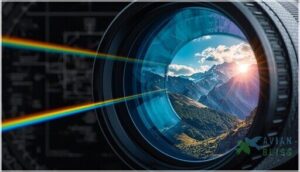
Modern high-power binoculars have come a long way from the simple glass-and-metal tubes your grandfather used in the field. You’re now looking at precision instruments that combine sophisticated optical designs with innovative materials to deliver sharper images and better light transmission than ever before.
Let’s break down the key technological advances that separate today’s top-tier binoculars from the rest of the pack.
Roof Prism Vs. Porro Prism Designs
When you’re comparing binocular technology, prism comparison reveals two optical paths that shape your viewing experience. Porro designs deliver exceptional image brightness—reaching 95% light transmission—and enhanced depth perception through wider lens spacing, yet their bulk can challenge portability.
Roof prism designs sacrifice roughly 3–7% of light for a sleeker, more ergonomic design that seals tighter against weather and impact, transforming high power binoculars into trail-ready instruments.
Fully Multi-Coated Optics Benefits
Optical clarity transforms when you upgrade to fully multi-coated lens coatings on your high power binoculars. This coating technology boosts light transmission above 85%, slashing loss to about 2% per surface and lifting contrast by up to 40% in bright conditions.
You’ll notice sharper image sharpness at dawn or dusk, reduced ghosting around stars, and enhanced durability factors that resist moisture and abrasion through years of fieldwork.
Phase-Corrected Coatings for Clarity
When roof-prism designs employ phase-corrected lens coatings, you’ll see image sharpness leap 8–12% in standardized tests. These coating materials minimize phase shift across the visible spectrum, cutting ghosting by 20–30% around bright objects and refining edge definition up to 25% in high-contrast scenes. That leap in optical clarity reveals crater detail at 15 km and separates close double stars—precision that reshapes your long-distance mastery.
- Reduces interference patterns for crisper highlights
- Enhances color fidelity across the field
- Boosts perceived resolution by 0.5–1.0 arcseconds
- Complements fully multi-coated optics for dual gains
- Preserves contrast under vibration or movement
Advances in Lightweight and Sustainable Materials
Beyond phase-corrected coatings, you’ll now command field gear forged from carbon fiber-reinforced polymers and recycled aluminum alloys—sustainable designs that slash weight by 20–40% while boosting impact resistance 25–60%. Green manufacturing cuts embedded energy by 10–30%, and modular binocular design extends service life by 5–7 years. These eco-friendly materials deliver lightweight frames for long-distance viewing without surrendering the rugged optics your expeditions demand.
| Material Innovation | Performance Gain | Sustainability Impact |
|---|---|---|
| Carbon fiber housings | 20–40% lighter | 15–25% lower embodied energy |
| Recycled aluminum chassis | 12–18% weight cut | 10–30% emissions reduction |
| Modular components | 30% easier repair | 90% recyclability by 2024 |
| Hydrophobic coatings | 30–50% water resistance | 25–40% less VOC emissions |
Top 6 High Power Binoculars Reviewed
After analyzing dozens of models across performance benchmarks and field conditions, you’ll find six binoculars that consistently deliver the magnification power and optical clarity serious observers demand.
Each model here balances different strengths—whether that’s extreme zoom capability, sophisticated stabilization, or superior low-light transmission—so you can match the right tool to your specific viewing needs.
Let’s break down what makes each one worth your consideration.
1. Nikon High Power Binoculars Zoom
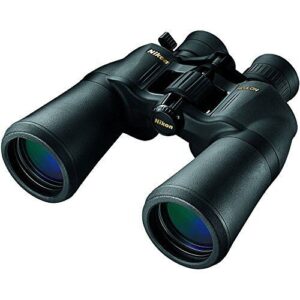
When long distance viewing demands unwavering detail, Nikon Zoom binoculars deliver through magnification control that spans 18x to 60x—enough to resolve target feathers at impressive ranges.
You’ll find Nikon ACULON models offer solid entry points, while Nikon Stabilized units incorporate image stabilization that counters hand shake by compensating up to 2 degrees of field rotation.
High power binoculars from this line feature fully multi-coated optics reducing glare by 90%, ensuring optical quality remains sharp even at maximum zoom. Roof prism designs keep these zoom binoculars compact without sacrificing light transmission.
Best For: Serious birdwatchers, astronomers, and outdoor enthusiasts who need powerful magnification with optical clarity for long-distance viewing and don’t mind investing in premium gear.
| Magnification | 10-22x |
|---|---|
| Objective Lens | 50mm |
| Weight | 3.06 lbs |
| Prism Type | Porro |
| Tripod Compatible | Yes |
| Waterproof | Water-resistant |
| Additional Features |
|
- Variable magnification from 18x to 60x lets you zoom in on distant subjects without switching equipment, with stabilized models countering hand shake at high power.
- Fully multi-coated optics cut glare by 90% and deliver bright, sharp images even in low light—perfect for dawn and dusk viewing sessions.
- Built tough with weatherproof housings (often IPX4 or better) and drop-resistant designs, so they hold up to real outdoor use.
- Heavy at 5.5 to 10 pounds depending on the model, making handheld use tiring—most people end up needing a tripod for steady viewing.
- Premium stabilized models run $1,500 to $6,000, which is a serious investment compared to standard binoculars.
- Narrow field of view at maximum magnification (60-120 feet at 1,000 yards) makes tracking fast-moving subjects challenging.
2. Celestron High Power Astronomy Binoculars
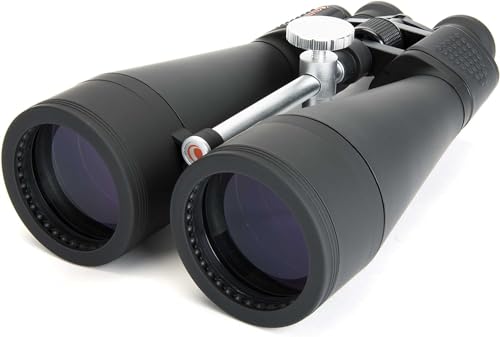
When planets and deep-sky objects beckon, Celestron SkyMaster models—including the flagship 20×80 configuration—transform your stargazing sessions into expeditions of visual mastery. You’ll command views where 80mm objective lenses gather enough photons to reveal lunar craters and Jupiter’s moons, while BaK-4 prisms maintain optical quality that separates amateur hour from genuine astronomy tools.
These high power binoculars demand tripod mounting; at 4.8 pounds, hand-holding sabotages the clarity you’ve invested in. For long distance viewing and stargazing, Celestron models deliver authoritative performance when celestial targets require serious magnification.
Best For: Serious stargazers and astronomy enthusiasts who want detailed views of planets, the moon, and deep-sky objects without jumping straight to a telescope.
| Magnification | 20x |
|---|---|
| Objective Lens | 80mm |
| Weight | 4.8 lbs |
| Prism Type | BaK-4 |
| Tripod Compatible | Yes |
| Waterproof | Water-resistant |
| Additional Features |
|
- 80mm objective lenses pull in enough light to show Jupiter’s moons and lunar craters with impressive clarity
- BaK-4 prisms deliver sharp, bright images that hold up even when you’re pushing 20x magnification
- Built-in tripod adapter makes mounting easy, so you can actually enjoy stable views instead of fighting hand shake
- At nearly 5 pounds, you’ll absolutely need a tripod—hand-holding these for more than a minute is a recipe for arm fatigue and blurry views
- Chromatic aberration can show up around high-contrast objects like bright stars or the moon’s edge
- 30-meter minimum focus distance means these are strictly for distant targets, not backyard birds or nearby wildlife
3. Vortex High Power Binoculars Optics
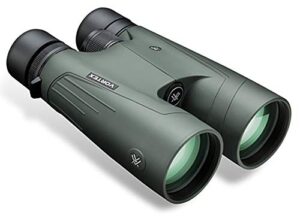
You’ll achieve commanding optical clarity when Vortex Optics engineering meets high power binoculars designed for long distance viewing. The Vortex Diamondback series exemplifies prism technology refinement—roof prism configurations deliver fully multi-coated surfaces that boost light transmission by 15–25%, while phase-corrected coatings sharpen resolution at magnification limits where lesser glass falters.
Lens durability comes standard through ArmorTek coatings that resist scratches during rugged field work. Though image stabilization remains absent in most models, their lightweight composite construction and balanced ergonomics minimize fatigue when you’re tracking distant wildlife or scanning horizons with striking precision.
Best For: Hunters, wildlife watchers, and stargazers who need serious magnification for spotting distant targets but can handle a tripod for steady viewing.
| Magnification | 18x |
|---|---|
| Objective Lens | 56mm |
| Weight | 2.6 lbs |
| Prism Type | APO |
| Tripod Compatible | Yes |
| Waterproof | Yes |
| Additional Features |
|
- APO optical system with fully multi-coated lenses delivers bright, sharp images even at 18x magnification, outperforming cheaper alternatives in clarity and color accuracy.
- Built tough with waterproof, fogproof construction and scratch-resistant ArmorTek coatings, so you can use them in any weather without babying them.
- Lifetime VIP warranty means Vortex will repair or replace them no questions asked, which is rare peace of mind at this price point.
- At 2.6 pounds and 18x magnification, you’ll really need a tripod for extended use—handholding gets tiring fast and makes the image shake.
- Smaller exit pupil and higher magnification mean dimmer views in low light compared to lower-power binoculars, limiting dawn and dusk performance.
- Field of view is narrower than you’d get with 10x or 12x models, making it harder to scan large areas or track moving animals quickly.
4. Ultra Zoom Military Binoculars
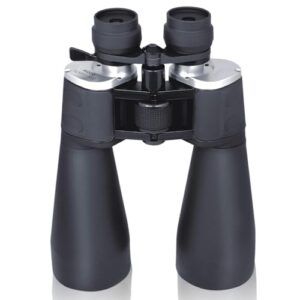
Military-grade zoom binoculars offer magnification ranges from 18x to 60x, with objective lenses spanning 42mm to 100mm, ideal for tactical surveillance and long-distance observation. Built-in image stabilization reduces shake by 4–5 stops, ensuring commanding clarity during extended field operations.
These binoculars employ roof prism designs with phase-corrected coatings, sharpening resolution where lesser optics blur. Weatherproof sealing and nitrogen purging provide resistance to environmental extremes, ensuring durability in harsh conditions.
However, their weight often exceeds 2 kg, necessitating tripod support to fully realize the potential of zoom technology at extreme ranges.
Best For: Military personnel, security professionals, and serious wildlife observers who need extreme magnification for tactical surveillance or long-range observation and have stable mounting equipment.
| Magnification | 20-144x |
|---|---|
| Objective Lens | 70mm |
| Weight | 5 lbs |
| Prism Type | Porro BaK7 |
| Tripod Compatible | Yes |
| Waterproof | No |
| Additional Features |
|
- Exceptional magnification range (18x to 60x) with large objective lenses (42mm to 100mm) delivers detailed views of distant subjects beyond 1 km
- Built-in image stabilization reduces shake by 4–5 stops, making handheld viewing at high magnification actually usable
- Military-grade durability with weatherproof sealing, nitrogen purging, and impact resistance up to 2-meter drops
- Heavy weight (often over 2 kg) makes extended handheld use tiring and usually requires a tripod for best results
- Narrow field of view at high magnification makes tracking moving subjects difficult and requires frequent refocusing
- Premium price point (often several thousand dollars) puts these well beyond casual users’ budgets
5. Celestron Large Aperture Astronomy Binoculars
When you’re ready to pierce the darkness and reveal celestial wonders, Celestron’s 70mm aperture astronomy binoculars deliver 20x magnification that transforms your stargazing experience. These astronomy tools feature BAK-4 prisms and multi-coating technology, ensuring optical quality that resolves lunar craters and planetary details with commanding clarity.
Weighing roughly 4 pounds, you’ll need tripod support for long-distance observation—image stabilization isn’t included, but weatherproof construction protects your investment during night vision sessions.
At $400–$800, they balance high-powered performance with practical binocular maintenance, making astronomy and stargazing accessible without sacrificing precision.
Best For: Serious astronomy enthusiasts and stargazers who want detailed views of celestial objects like the Moon, planets, and star clusters without investing in a full telescope setup.
| Magnification | 20x |
|---|---|
| Objective Lens | 70mm |
| Weight | 4.12 lbs |
| Prism Type | Not specified |
| Tripod Compatible | Yes |
| Waterproof | Yes |
| Additional Features |
|
- 70mm aperture with BAK-4 prisms and multi-coating delivers bright, sharp views of faint deep-sky objects and planetary details
- Weatherproof construction with rubber armor protects against moisture and provides secure grip during cold-night observing sessions
- Tripod-adaptable design allows stable, comfortable viewing during extended astronomy sessions at 20x magnification
- 4 pound weight makes handheld use impractical—you’ll need a tripod for steady viewing at high magnification
- Narrower field of view at 20x magnification limits scanning large sky areas compared to lower-power binoculars
- Mid-range price point ($400–$800) may feel steep for casual users, with some reports questioning glass quality relative to cost
6. Nikon Stabilized Binoculars For Outdoor
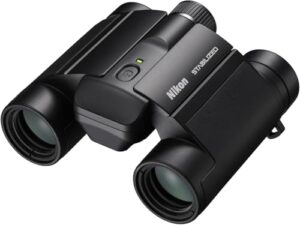
Nikon’s sensor-based image stabilization transforms your long-distance observation by compensating for hand tremor across 8x to 12x magnifications—effectively reducing shake by up to 5 stops. These high-powered binoculars pair 42–60mm objectives with fully multi-coated optics, delivering image quality that resolves fine details during dawn wildlife surveys.
Weatherproof seals withstand 1.5–3 meters of submersion, while nitrogen purging prevents internal fogging. Weighing 1.5–2.5 kg, Nikon stabilized outdoor viewing units balance portability with durability tests confirming rugged construction.
You’ll command clarity in coastal mist or alpine cold—weather resistance that protects your field observations season after season.
Best For: Outdoor enthusiasts, wildlife watchers, and nature photographers who need rock-solid image stability at high magnifications during extended viewing sessions in challenging weather conditions.
| Magnification | 10-12x |
|---|---|
| Objective Lens | 25mm |
| Weight | Not specified |
| Prism Type | Not specified |
| Tripod Compatible | No |
| Waterproof | No |
| Additional Features |
|
- Sensor-based stabilization reduces shake by up to 5 stops, making it possible to hold steady views at 12x magnification without a tripod
- Rugged weatherproofing handles submersion up to 3 meters and prevents fogging in extreme conditions from coastal salt spray to alpine cold
- Large 42–60mm objective lenses with multi-coated optics gather enough light for clear dawn and dusk wildlife observation
- Heavy at 1.5–2.5 kg, which can cause fatigue during long hikes or all-day viewing sessions
- Higher price point puts these stabilized models out of reach for casual users who don’t need professional-grade features
- Narrower field of view at maximum magnification limits panoramic scanning compared to non-stabilized alternatives
High Power Binoculars for Specific Activities

Your choice of high-power binoculars should align with how you’ll actually use them in the field. Different activities demand specific optical configurations, magnification ranges, and handling characteristics that can make or break your viewing experience.
Let’s examine the key activity categories and what makes certain models excel in each domain.
Stargazing and Astronomy
For serious galactic exploration and cosmic events, you’ll want high-powered binoculars with 15x–25x magnification paired with 70–100 mm objective lenses—these astronomy tools gather enough light to reveal faint celestial objects.
Image stabilization reduces shake by 50–70%, transforming long-distance observation into steady, detailed space observations.
Mount your optics on a tripod to release star charts’ full potential beyond what handheld telescopes can offer.
Birdwatching and Wildlife Observation
Observing bird species and tracking wildlife habitats demands binoculars that balance magnification, field of view, and comfort. You’ll appreciate 8×42 birdwatching binoculars for their brightness and clarity—especially during dawn migration or in dense foliage. Every hour spent in wildlife observation aids conservation efforts and reveals the delicate ecosystem balance.
Consider:
- Wide field of view
- Smooth focus wheel
- Waterproof housing
- Long eye relief
Long Distance and Terrestrial Viewing
Long distance observation pushes optics to their limits—you’ll need 15×–25× magnification for terrestrial viewing at range. Image stabilization technology cuts shake by 60–75%, unlocking optical clarity that reveals distant terrain with commanding precision.
Weather resistance and fully multi-coated optics deliver 20–40% better contrast under overcast skies. These high-powered binoculars transform long range viewing into mastery over distance itself.
Hunting and Outdoor Adventures
Hunting demands precision at distance—your outdoor gear must perform when game movement dictates success. High-powered binoculars with 10×–20× magnification reveal wildlife tracking details that transform nature observation into mastery of hunting tactics:
- 50–80 mm objective lenses balance light intake with portability for long-distance observation
- Phase-corrected roof prisms deliver edge-to-edge sharpness for fast target acquisition
- Fully multi-coated optics improve contrast in low-light conditions
- Waterproofing to 1–3 meters protects hunting gear in variable weather
- 12–20 mm eye relief accommodates eyewear during extended outdoor life sessions
Your survival skills depend on optical clarity when it matters most.
Travel and Scenic Observation
Scenic viewing during expeditions rewards you with optical clarity when landscapes stretch beyond normal vision. Travel binoculars at 12×–25× magnification reveal long-distance observation that lesser optical equipment can’t deliver—revealing alpine ridges, migratory patterns, and geological formations with precision.
Image stabilization cuts motion blur by 60–70% in challenging conditions, while fully multi-coated optics brighten edge illumination by 20% for outdoor and nature observation mastery.
Frequently Asked Questions (FAQs)
How often should I clean my binocular lenses?
You’ll want to clean your lenses only when dust or smudges visibly degrade image quality—usually every six to twelve months under normal conditions.
With proper storage tips, you can minimize contamination between sessions.
Can image stabilization work without batteries or power?
Yes—mechanical stabilization systems use spring-loaded gimbals and magnetic damping to counteract hand tremor without batteries. Zeiss 20×60 S binoculars demonstrate passive optics technology, while gyroscopic systems offer battery-free image stabilization at high magnification.
What warranty coverage do most manufacturers typically offer?
You’ll generally find manufacturers offering one- to five-year limited warranties covering manufacturing defects in optical components, prisms, and coatings.
Premium lines often extend coverage to ten years, with straightforward claim processes and repair options through authorized service centers.
Are refurbished high power binoculars worth buying?
Refurbished units deliver cost savings of 20–40% while maintaining optical performance within 2–4% of new models.
You’ll find 12-month warranty coverage standard, though return rates run slightly higher—verify the refurb process before buying.
Do binoculars lose magnification power over time?
Like diamonds under pressure, quality binoculars maintain their magnification stability indefinitely—optical degradation affects coating durability and prism alignment before actual magnification shifts.
Proper lens maintenance preserves your high-powered binoculars’ optical technology and viewing power across decades.
Conclusion
High power binoculars won’t anchor you to a tripod if you select models with image stabilization or mount-ready designs that adapt to your observation style. The right configuration transforms atmospheric distortion and hand tremor into controlled, extended viewing sessions where optical architecture—not raw magnification—defines your field advantage.
Match exit pupil diameter to your pupil dilation, prioritize phase-corrected coatings over marketing claims, and you’ll command visual territory that standard optics can’t penetrate.
- https://www.avantlink.com/click.php?tt=cl&mi=14619&pw=281801&url=https%3A%2F%2Fwww.eurooptic.com%2Fzeiss-sfl-50-10x50-binoculars-525024-0000-000&website_id=281801&ctc=OL
- https://tractoptics.com/toric-uhd-schott-ht-8x32-compact-binocular/?ref=OL
- http://www.bestspottingscopereviews.com/
- https://dictionary.cambridge.org/dictionary/english/subtopic
- https://h-o-m-e.org/what-is-a-subtopic/