This site is supported by our readers. We may earn a commission, at no cost to you, if you purchase through links.

A pair of 20×80 binoculars reveals detail the naked eye simply can’t process—individual feathers on a hawk riding thermals half a mile away, the surface texture of a distant cliff face, star clusters that blur into a smudge without optical help. Resolving power changes how you interact with a landscape entirely.
But high-power binoculars aren’t all equal, and the wrong choice leaves you squinting through a shaky, dim image that undermines the purpose. Magnification, glass quality, prism type, and construction all determine what you actually see—and what you don’t.
Table Of Contents
- Key Takeaways
- Top 10 High Power Binoculars Reviewed
- 1. Nikon Aculon 10-22×50 Binocular
- 2. Celestron SkyMaster 20×80 Binoculars
- 3. Vortex Kaibab HD 20×56 Binoculars
- 4. BetaOptics 144X Military Zoom Binoculars
- 5. Celestron Echelon 20×70 Binocular
- 6. Barska X Trail 30×80 Binocular
- 7. Celestron SkyMaster Large Aperture Binoculars
- 8. Celestron SkyMaster 25×70 Astronomy Binoculars
- 9. Vortex Diamondback HD 12×50 Binoculars
- 10. Bushnell 12×42 Waterproof Binocular
- Key Features That Affect Clarity
- Best Uses for Bird Lovers
- Optical Quality and Build
- Buying Guide and Value Tips
- Frequently Asked Questions (FAQs)
- How often should I clean my binocular lenses?
- Can image stabilization work without batteries or power?
- What warranty coverage do most manufacturers typically offer?
- Are refurbished high power binoculars worth buying?
- Do binoculars lose magnification power over time?
- How do I clean high power binocular lenses?
- Can high power binoculars damage your eyesight?
- What magnification works best for marine use?
- Are high power binoculars suitable for children?
- How does altitude affect binocular optical performance?
- Conclusion
Key Takeaways
- Beyond 15x magnification, your hands become your worst enemy — a tripod isn’t a nice-to-have, it’s the only way to actually use what you paid for.
- Bigger objective lenses (like 80mm) pull in dramatically more light than smaller ones, making them the real difference-maker at dawn, dusk, or under the stars.
- BAK-4 prisms and fully multi-coated lenses aren’t marketing fluff — they’re what separate a sharp, bright image from a muddy, washed-out one, especially in low light.
- No warranty means no safety net — brands like Vortex and Celestron back their glass for life, while budget options like BetaOptics leave you on your own the moment something goes wrong.
Top 10 High Power Binoculars Reviewed
Finding the right high-power binoculars comes down to matching the specs to what you actually need.
Understanding how magnification power and aperture work together makes it much easier to zero in on the pair that fits your situation.
Each model on this list hits a different sweet spot — magnification, build quality, price, or all three.
Here’s how the top 10 stack up.
1. Nikon Aculon 10-22×50 Binocular
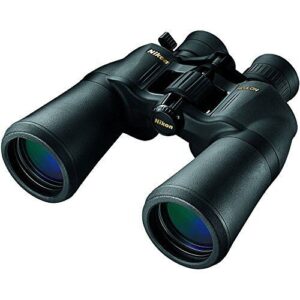
The Nikon Aculon 10-22×50 puts real versatility in your hands. Its finger-reachable zoom knob lets you seamlessly transition from a wide 10x view to a tight 22x close-up without swapping gear.
The 50mm objective lens gathers solid light, while multi-coated eco-glass lenses ensure images remain bright and clear.
Weighing about 1.85 pounds, the binocular is comfortable for extended handheld use. However, above 15x magnification, a tripod is recommended for stability.
The included tripod adapter simplifies setup, and Nikon backs the product with a strong warranty.
| Best For | Birders, wildlife watchers, and casual astronomers who want one binocular that can handle both wide scanning and high-magnification detail without carrying multiple pairs. |
|---|---|
| Magnification | 10x-22x zoom |
| Objective Lens | 50mm |
| Prism Type | Porro |
| Exit Pupil | 2.3-5mm |
| Tripod Compatible | Yes, adapter included |
| Warranty | Limited |
| Additional Features |
|
- Smooth 10x–22x zoom range means you can go from spotting to studying in seconds, no gear swap needed.
- 50mm lenses with multi-coated eco-glass pull in solid light, keeping images bright even in lower-light conditions.
- Rubber-armored body with adjustable eyecups makes it comfortable to use for long stretches out in the field.
- Anything above 15x gets shaky fast — you’ll really need a tripod to get the most out of the higher magnifications.
- It’s bulkier than compact binoculars, so if you’re covering serious miles on foot, it might wear on you.
- Only water-resistant, not waterproof — and there have been reports of a hidden staple in the tripod adapter packaging that can catch you off guard.
2. Celestron SkyMaster 20×80 Binoculars
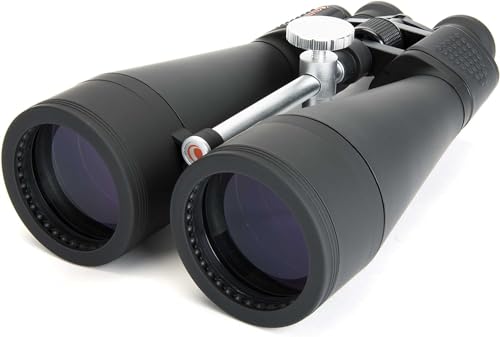
If you’re ready to step up in power, the Celestron SkyMaster 20×80 delivers a serious upgrade. Those 80mm objective lenses pull in considerably more light than the Nikon’s 50mm, making it a strong choice for astronomy and low-light terrestrial viewing.
BaK-4 prisms with fully multi-coated optics keep images bright and contrast.
The exit pupil measures 4mm — solid for nighttime use.
At 4.8 pounds, you’ll want a sturdy tripod.
It includes a built-in ¼-20 adapter, so mounting is straightforward.
| Best For | Stargazers and low-light observers who want serious magnification and don’t mind setting up a tripod. |
|---|---|
| Magnification | 20x |
| Objective Lens | 80mm |
| Prism Type | BaK-4 Porro |
| Exit Pupil | 4mm |
| Tripod Compatible | Yes, integrated rod |
| Warranty | Celestron Lifetime |
| Additional Features |
|
- 80mm lenses pull in a ton of light — great for deep-sky objects like nebulae and star clusters
- BaK-4 prisms with fully multi-coated optics keep images bright and sharp
- Built-in ¼-20 tripod adapter makes mounting quick and hassle-free
- At nearly 5 pounds, handheld use is pretty much off the table
- Collimation can be off out of the box, which means some DIY tweaking
- Chromatic aberration shows up on bright targets like the Moon, and the soft case won’t survive rough handling
3. Vortex Kaibab HD 20×56 Binoculars
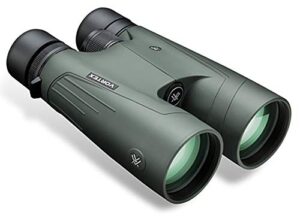
The Vortex Kaibab HD 20×56 combines serious glass with serious intent. Operating at true 20x magnification with 56mm objectives, it delivers an exit pupil of approximately 2.8mm—tight but functional in well-lit conditions.
Its apochromatic optical design and fully multi-coated lenses minimize chromatic aberration, ensuring colors remain accurate at distance. Handheld use is challenging at 20x magnification, so a tripod is recommended to mitigate shake.
The argon-purged, O-ring sealed body provides robust protection against harsh field conditions, while Vortex’s transferable lifetime warranty safeguards the investment.
Priced at $1,149, this optic balances high-performance features with long-term reliability.
| Best For | Hunters, wildlife observers, and astronomy enthusiasts who need serious long-range magnification and plan to use a tripod in well-lit conditions. |
|---|---|
| Magnification | 18x |
| Objective Lens | 56mm |
| Prism Type | APO/Porro |
| Exit Pupil | 3.1mm |
| Tripod Compatible | Yes, required |
| Warranty | Unlimited Lifetime |
| Additional Features |
|
- APO glass with full multi-coating keeps colors sharp and accurate even at distance
- Argon-purged, waterproof build handles tough field conditions without complaint
- Transferable lifetime warranty means you’re covered for the long haul
- High magnification makes handheld use shaky and tiring—a tripod is basically required
- The small exit pupil struggles in low light, so dawn and dusk hunting gets tricky
- Some users feel image quality falls short of similarly priced competitors like Swarovski
4. BetaOptics 144X Military Zoom Binoculars
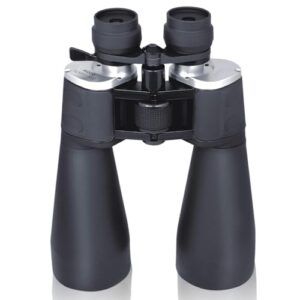
The Vortex demands $1,149 for refined performance, while the BetaOptics 144X Military Zoom prioritizes raw magnification range and accessibility. This model offers a 20x to 144x zoom through 70mm BaK7 objectives, with an exit pupil measuring 3.36mm at 20x that narrows to 0.68mm at maximum power.
At extreme zoom levels, the 0.68mm exit pupil becomes effectively unusable without a tripod. Users should also anticipate chromatic aberration—color fringing—when operating at higher magnifications.
Critically, the product lacks a manufacturer warranty, a notable omission compared to premium alternatives like the Vortex.
| Best For | Budget-conscious buyers who want serious zoom range for wildlife watching or sporting events and don’t mind using a tripod. |
|---|---|
| Magnification | 20x-144x zoom |
| Objective Lens | 70mm |
| Prism Type | BaK7 Porro |
| Exit Pupil | 0.68-3.36mm |
| Tripod Compatible | Yes, adapter optional |
| Warranty | Limited |
| Additional Features |
|
- Massive 20x–144x zoom range gives you a lot of flexibility for long-distance viewing
- 70mm objectives pull in decent light, so dawn and dusk sessions are more usable than you’d expect
- Comes with a carrying case, strap, and tripod adapter right out of the box
- Image quality falls apart at high magnifications—expect blur, color fringing, and a frustratingly narrow field of view
- Hand-holding at 100x is basically impossible; a tripod isn’t optional, it’s a must
- No manufacturer warranty, and the plastic build feels more toy-like than the "military-grade" label suggests
5. Celestron Echelon 20×70 Binocular
Step up to the Celestron Echelon 20×70, and you’re holding serious stargazing power. Its 70mm BaK-4 Porro prisms and fully multi-coated XLT optics pull in impressive light — useful at dusk or deep into a dark-sky session.
The 3.5mm exit pupil manages low-light viewing comfortably, and nitrogen-filled sealing keeps fog out in cold or wet conditions. At roughly 64.9 ounces, you’ll want a tripod.
Individual eyepiece focusing adds precision, especially during long observation sessions.
| Best For | Stargazers and wildlife spotters who want serious light-gathering power and don’t mind setting up a tripod for long, steady observation sessions. |
|---|---|
| Magnification | 20x |
| Objective Lens | 70mm |
| Prism Type | Porro |
| Exit Pupil | 3.5mm |
| Tripod Compatible | Yes, mounting bar |
| Warranty | Limited Lifetime |
| Additional Features |
|
- The 70mm objective lenses soak up a ton of light, making faint stars, nebulae, and planets much easier to pick out at dusk or in a dark sky.
- Nitrogen-sealed and weatherproofed, so rain, fog, or cold nights won’t slow you down.
- Tripod-adaptable design makes it genuinely comfortable for extended sessions without fighting hand shake.
- At nearly 65 ounces, handheld use is really not practical — you’ll need a tripod almost every time.
- The narrow field of view at 20× makes tracking anything that moves quickly pretty frustrating.
- The price is on the higher end, and some buyers feel the glass clarity doesn’t quite justify the cost.
6. Barska X Trail 30×80 Binocular
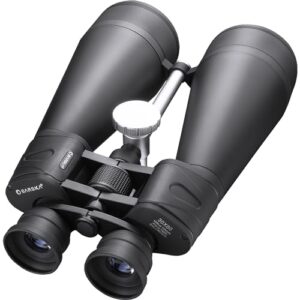
Push the limits with the Barska X Trail 30×80, as its 30× magnification reveals the moon’s craters and distant ridgelines in striking detail.
Its 80mm BAK-4 Porro prism objectives gather significant light, producing a 2.7mm exit pupil that maintains clarity reasonably well at dusk.
The built-in tripod adapter is essential—weighing roughly 3.2 kg, hand-holding becomes impractical beyond a few minutes.
Priced around $143, it offers high-power reach on a budget, though reported collimation issues on some units necessitate careful inspection upon arrival.
| Best For | Astronomy enthusiasts and long-range observers who already own a sturdy tripod and want serious magnification without breaking the bank. |
|---|---|
| Magnification | 30x |
| Objective Lens | 80mm |
| Prism Type | BAK-4 |
| Exit Pupil | 2.7mm |
| Tripod Compatible | Yes, integrated post |
| Warranty | Not specified |
| Additional Features |
|
- 30× magnification pulls in incredible detail on the moon, planets, and distant landscapes
- 80mm BAK-4 lenses do a solid job gathering light, keeping images usable into dusk
- At around $143, the optical reach you get is hard to beat at this price point
- At 3.2 kg, a tripod isn’t optional — it’s a must, which adds cost and limits spontaneity
- Some units ship with collimation problems, so check carefully when yours arrives
- High magnification has a learning curve — beginners may find focusing and eye relief frustrating
7. Celestron SkyMaster Large Aperture Binoculars
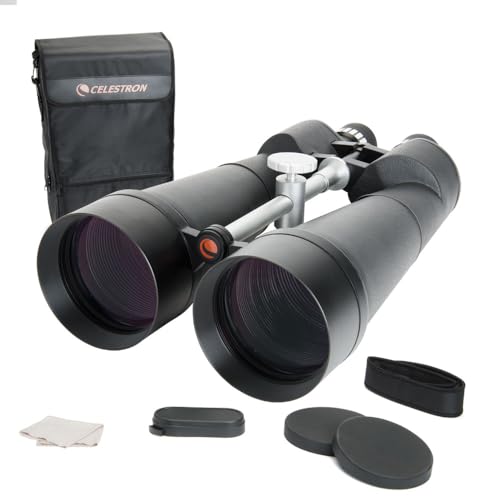
The Celestron SkyMaster Large Aperture binoculars command attention the moment you lift them. With 20× magnification and 80mm objectives, they pull in serious light — ideal for scanning faint nebulae or tracking distant shorelines after sunset.
BaK-4 prisms and fully multi-coated lenses ensure images remain bright and contrast-rich. The integrated tripod adapter is essential at this size, as the binoculars weigh around 2.5–3.0 kg. You’ll need a solid mount to stabilize them effectively.
For the price, their light-gathering power is genuinely hard to beat, making them a standout choice for both celestial and terrestrial observation.
| Best For | Serious amateur astronomers and stargazers who want powerful, wide-aperture views of deep-sky objects and don’t mind setting up a tripod for a stable, immersive experience. |
|---|---|
| Magnification | 25x |
| Objective Lens | 100mm |
| Prism Type | BaK-4 Roof |
| Exit Pupil | 4mm |
| Tripod Compatible | Yes, integrated rod |
| Warranty | Limited |
| Additional Features |
|
- Massive 100mm objectives soak up light beautifully — faint galaxies and nebulae actually show up
- BaK-4 prisms with multi-coated optics keep images sharp, bright, and high-contrast
- Built-in tripod adapter and weather-resistant housing make it a solid, ready-to-go setup for outdoor use
- At nearly 4 kg, handheld use is basically off the table — budget extra for a sturdy tripod
- No central focus knob means adjusting for each eye separately, which gets old fast when sharing with others
- Quality control can be hit or miss — some units arrive with loose screws, collimation issues, or minor chromatic aberration
8. Celestron SkyMaster 25×70 Astronomy Binoculars
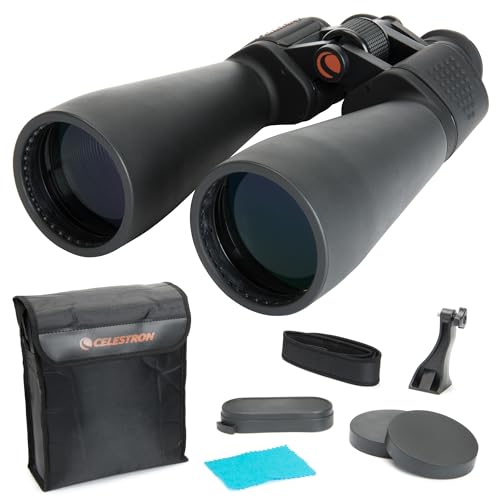
Want serious reach without the serious price tag? The SkyMaster 25×70 delivers exactly that. Its 70mm objectives gather real light, and BaK-4 prisms ensure sharp, color-accurate images—especially valuable during dusk or early-morning astronomy sessions.
At 25x magnification, you’ll resolve Jupiter’s moons and distant mountain ridges with clarity. The 2.8mm exit pupil minimizes glare in daylight, making tripod mounting essential for stable viewing.
Weighing just 1.4 kg, it’s surprisingly manageable—and the included tripod adapter simplifies setup for steady observation.
| Best For | Amateur astronomers and long-distance observers who want serious magnification and light-gathering power from a fixed, tripod-mounted setup without spending a fortune. |
|---|---|
| Magnification | 25x |
| Objective Lens | 70mm |
| Prism Type | BaK-4 Roof |
| Exit Pupil | 2.8mm |
| Tripod Compatible | Yes, integrated rod |
| Warranty | Limited |
| Additional Features |
|
- 70mm objectives pull in a ton of light, giving you genuinely bright views at dusk, dawn, or under the stars
- BaK-4 prisms keep images sharp and color-accurate — no muddy edges or washed-out contrast
- Built-in ¼-20 tripod adapter makes it easy to mount on any standard photo tripod right out of the box
- 25x magnification makes hand-holding basically useless — you really do need a solid tripod every single time
- The narrow 2.4° field of view makes it tricky to find and track targets, especially for beginners
- Some users report focus wheel slop and collimation issues, which can get frustrating during a session
9. Vortex Diamondback HD 12×50 Binoculars
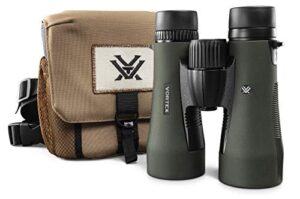
The Vortex Diamondback HD 12×50 punches well above its $200 price. It features fully multi-coated optics, dielectric prisms, and Armortek exterior coatings — a combination that cuts glare, resists scratches, and keeps images bright from dawn to dusk.
At 12x magnification, the 50mm objectives pull in real light with a 4.2mm exit pupil, making early-morning wildlife viewing genuinely sharp.
Weighing just 1.8 lb, carrying it all day won’t wear you down.
The unconditional lifetime warranty seals the deal.
| Best For | Birders, hunters, and outdoor enthusiasts who want sharp, long-range glass at a price that doesn’t hurt. |
|---|---|
| Magnification | 12x |
| Objective Lens | 50mm |
| Prism Type | Dielectric/Multi-coat |
| Exit Pupil | 4.2mm |
| Tripod Compatible | Yes, collar included |
| Warranty | Unlimited Lifetime |
| Additional Features |
|
- HD optics with dielectric and Armortek coatings deliver bright, clear images from first light to last
- Argon-purged, O-ring sealed build handles rain, fog, and rough field conditions without complaint
- Unconditional lifetime warranty means you buy it once and Vortex has your back forever
- The focus wheel runs a little sensitive, so nailing fine adjustments takes some getting used to
- At 1.8 lb and full-size dimensions, it’s not the binocular you’ll want stuffed in a jacket pocket
- Edge sharpness and color fidelity fall a small step behind pricier premium models in side-by-side tests
10. Bushnell 12×42 Waterproof Binocular
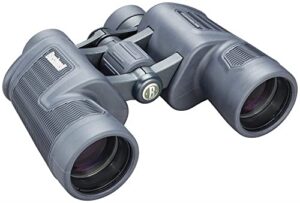
Built for the elements, the Bushnell H2O 12×42 won’t quit when conditions turn ugly. IPX7 waterproofing and nitrogen purging ensure rain, fog, and sudden temperature drops can’t compromise your view.
BaK-4 prisms with fully multi-coated lenses deliver sharp, bright images at 12x magnification—ideal for wildlife and birdwatching without excessive bulk.
At 765 g, it’s comfortable for all-day carry. Twist-up eyecups accommodate glasses wearers, enhancing versatility.
For reliable wet-weather performance at a sensible price, this binocular earns its spot.
| Best For | Outdoor enthusiasts, birdwatchers, and marine users who need a tough, waterproof binocular that holds up in rough weather without breaking the bank. |
|---|---|
| Magnification | 12x |
| Objective Lens | 42mm |
| Prism Type | BaK-4 |
| Exit Pupil | 3.5mm |
| Tripod Compatible | Yes, standard mount |
| Warranty | Limited Lifetime |
| Additional Features |
|
- Fully waterproof and nitrogen-purged, so rain and fog won’t ruin your view
- BaK-4 prisms with multi-coated lenses give you sharp, bright images at 12x magnification
- Twist-up eyecups and 15 mm eye relief make it comfortable for glasses wearers
- On the heavier side at 765 g, which can wear on you during long handheld sessions
- Interpupillary adjustment can be tricky for people with smaller heads, causing alignment issues
- Lens caps aren’t attached, so losing them in the field is a real possibility
Key Features That Affect Clarity
Picking the right binoculars isn’t just about the number on the box — the specs underneath that number are what actually determine what you’ll see. A few key features work together to either sharpen your view or quietly sabotage it.
Key features work together to influence performance, so understanding these details is critical before purchasing a pair. Here’s what you need to understand before committing to a pair.
Magnification Versus Image Shake
Higher magnification doesn’t just zoom in on your target — it zooms in on every tremor in your hands. Past the 15× magnification threshold, handheld binocular stability breaks down fast.
Past 15×, your binoculars stop magnifying your target and start magnifying your hands
Master these five image shake reduction habits:
- Breathing Control — exhale slowly before viewing
- Hand‑holding Technique — grip firmly, elbows tucked in
- Brace against something solid — railing, wall, or vehicle roof
- Know your Vibration Sources — wind, traffic, footsteps all intensify shake
- Understand Stabilization Tradeoffs — image stabilization technology helps, but a tripod wins above 20×
Objective Lens Light Gathering
Once you’ve steadied your hands, the next thing working for — or against — you is the objective lens diameter. A larger objective lens size means more light enters the system. That’s pure physics. A 20×80’s 80 mm objective lens gathers dramatically more light than a 20×42, giving you really low-light performance at dusk. Larger apertures improve resolution.
Multi-coating performance and quality glass material choice then determine how efficiently that light actually reaches your eyes.
Exit Pupil and Brightness
Light-gathering ability means nothing if your eye can’t actually receive it. That’s where exit pupil calculation matters: divide the objective diameter by magnification. A 20×80 delivers a 4 mm exit pupil — solid for low-light performance. Pupil matching keeps brightness uniformity strong from center to edge. Coating transmission pushes that further through exit pupil optimization.
- 4–6 mm exit pupil matches twilight-adapted eyes best
- Fully multi-coated lenses enhance coating transmission without changing exit pupil size
- Smaller exit pupils under 2 mm reduce image brightness noticeably at dusk
- Larger objectives improve light-gathering ability, but exit pupil determines what your eye actually uses
Field of View Tradeoffs

Every boost in magnification shrinks your angular coverage — that’s the field of view tradeoff you can’t escape. A 10×42 gives you roughly 300 feet at 1,000 yards; jump to 20×70, and you’re down to 157 feet.
Scanning speed drops, target identification gets harder, and peripheral distortion creeps in at the edges. Ultimately, edge sharpness and field of view measurement matter more than raw power alone.
Close Focus Distance
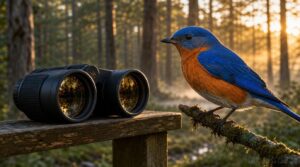
Close focus distance is easy to overlook — until you’re staring at a bird perched 10 feet away and your view goes blurry. Minimum focus distance usually runs 2 to several meters on high-power models.
A smooth focus mechanism, the right diopter setting, and adjustable eyecups all sharpen close-up clarity. Macro viewing capability depends heavily on adjustable focus and a reliable right diopter lock.
Best Uses for Bird Lovers

The right binoculars can completely change how you experience birds in the wild — whether you’re scanning a distant marsh or tracking a hawk mid-flight.
High-power optics open up scenarios that basic models simply can’t handle.
Here are the best situations where they’ll earn their place around your neck.
Long-distance Birdwatching
Long-distance birdwatching demands more than sharp eyes — it demands the right tool. High-power binoculars with 20× magnification or higher give you real control over distant species identification, even when Atmospheric Refraction and Light Pollution Management soften the image.
Respect Ethical Observation Distances by staying back; your field of view covers more than you think.
Seasonal Migration Timing rewards patience and long-distance viewing.
Wetland and Shorebird Viewing
Wetland birdwatching is where high-power binoculars truly earn their place. Tidal Timing dictates everything — shorebirds flood the mudflats at low tide, and then retreat to roosts at high tide. Mudflat access rewards early arrivals.
- Habitat Management shapes bird density across the day
- Predator Awareness keeps flocks moving — watch the edges
- Waterproof and fogproof builds handle marsh conditions without fogging
- Low-light Performance matters at dawn roosts
- 20×80 optics reveal distant species detail effortlessly
Raptor Watching From Overlooks
Raptors don’t wait — they rise fast on thermal columns between 10 a.m. and 2 p.m., and if your optics aren’t ready, you’ll miss the spiral. High power binoculars on a tripod deliver the image steadiness needed at overlooks, where wind gusts challenge handheld use above 15×.
| Overlook Factor | What It Signals | Why It Matters |
|---|---|---|
| Thermal Soaring | Warm air rising over open fields | Predicts raptor activity windows |
| Air Column Detection | Tight spiraling against blue sky | Confirms lift zones for scanning |
| Dawn Light Conditions | Low-angle sun, soft shadows | Tests low light performance early |
| Habitat Indicators | Adjacent wetlands, open slopes | Increases harrier and eagle sightings |
| Overlook Safety | Railings, stable ground | Enables tripod setup and stability |
Backyard Feeder Observation
Your backyard feeder sits just 10–15 meters away, but lighting challenges — deep shade, bright backlight, dawn gloom — demand solid low-light performance.
Feeder positioning near natural cover draws seasonal visitors like chickadees and cardinals.
With high-power binoculars offering generous eye relief and a wide field of vision, you’ll catch every subtle plumage detail.
Data logging each visit builds a rewarding long-term bird-watching record.
Stargazing After Birding Trips
When birding wraps up, the sky becomes your next field guide. Wait 20–30 minutes, set up your tripod, and let your binoculars’ low-light performance reveal Jupiter’s moons or Saturn’s rings.
Pick a dark site away from city glow for the clearest views.
Use Red Light Navigation to protect night vision, pack Warm Layering Tips and Insect Repellent Strategy, and practice Quick Sky Logging for records worth keeping.
Optical Quality and Build
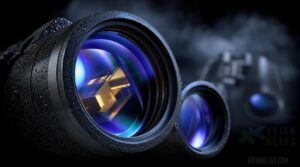
Glass and glass alone can make or break a binocular, no matter how good the specs look on paper. Everything from the prism type to the lens coatings shapes what you actually see through the eyepiece.
These critical elements determine performance, separating the sharp, reliable performers from the ones that let you down.
BAK-4 Versus BAK-7 Prisms
The glass inside your binoculars matters more than most people realize. BAK4 prisms use barium crown glass with a higher refractive index, delivering enhanced light transmission, edge illumination, and color accuracy — especially at dusk. BAK7 prisms cost less but can show reduced contrast in low light. For high-power optics, that price differential is worth it.
- BAK4 prisms deliver brighter, edge-to-edge clarity
- Color accuracy stays true even in complex backgrounds
- Low-light optical performance pulls ahead of BAK7
- Roof prism designs with BAK4 stay compact yet powerful
- Price differential reflects real, visible gains in the field
Porro Versus Roof Prisms
Now that prism glass types are covered, the shape of those prisms changes everything else.
| Feature | Porro Prism | Roof Prism |
|---|---|---|
| Bulk vs Compact | Bulkier, wider body | Slim, sleek |
| Light Transmission | Higher in simpler path | Slightly lower |
| Depth Perception | Stronger 3D effect | Moderate |
| Prism Alignment Sensitivity | More sensitive to drops | More stable |
| Cost Efficiency | Better value | Premium pricing |
Porro prism designs deliver richer depth and brighter images, while Roof prisms excel in portability.
Fully Multi-coated Lenses
Coating quality transforms good glass into great glass. Fully multicoated lenses apply antireflective coating to every air-to-glass surface, pushing light transmission gains toward 99%. This delivers brighter images, serious ghosting suppression, and a real color fidelity boost—especially in low light. FMC coatings also resist daily wear well.
Clean them gently with microfiber; that’s your maintenance best practice for protecting lens coating technology long-term.
Waterproof and Fogproof Designs
Weather doesn’t care about your plans — but sealed construction does.
Most premium high-power binoculars use O‑Ring Gaskets paired with Nitrogen Purge or Argon Sealing to lock moisture out and keep internal lenses clear through rapid temperature swings. Many meet an IPX7 Rating or full IP67 waterproof rating — that’s 1 meter submersion for 30 minutes.
Key weatherproofing features to look for:
- Nitrogen or Argon fogproof design for thermal stability
- O‑ring sealed barrels for waterproof integrity
- IPX7 or IP67 waterproof rating for field reliability
- Internal Desiccant Packs to absorb residual moisture during storage
Rubber Armor and Grip
Rubber armor coating isn’t just cosmetic — it’s your first line of defense. The elastomer texture gives you a secure ergonomic grip even with wet hands, while the rubber-coated barrel absorbs minor impacts through genuine impact absorption.
Temperature flexibility keeps the rubber pliable from -20°C to 60°C.
Shock-absorbing silicone rims and rubber eyecups add comfort.
Cleaning maintenance is simple: mild soap, soft cloth, done.
Buying Guide and Value Tips

Picking the right high-power binoculars comes down to more than just magnification numbers.
You must consider your budget, body (literally — some of these things are heavy), and usage in the field.
Here’s what you need to know before you buy.
Budget Versus Premium Models
Premium binoculars cost 2–4 times more than budget-friendly options, but their price-to-performance ratio often justifies the investment. Key upgrades include aircraft-grade aluminum construction, 99% light transmission coatings, and lifetime transferable warranties. These enhancements ensure superior durability and optical clarity compared to plastic-shelled budget models.
Budget binoculars handle the basics well, but premium options excel in long-term reliability and resale value. When prioritizing enduring performance and warranty coverage, a premium choice consistently wins the product comparison.
Tripod Needs Above 15x
Once you push past 15x magnification, a tripod isn’t optional — it’s essential. Image stabilization can only do so much when binoculars get heavy and bulky, like a 20×80 setup weighing 2 kg.
Choose a tripod with 5–8 kg load capacity for proper vibration damping, a pan-tilt head for precise alignment, and confirm your binoculars include a tripod adapter.
Center of gravity matters — keep weight close to the head. Regular setup maintenance keeps everything locked tight.
Weight and Portability
Weight shapes every field decision you make. The Celestron SkyMaster 20×80 tips the scales at 6.8 pounds — you’ll want dedicated carry solutions for that. Lighter options like the Vortex Kaibab HD at 3.9 pounds offer genuine portability without sacrificing performance.
- Collapsible design and lightweight construction trim bulk considerably
- Balance point and strap comfort determine fatigue over long sessions
- Soft cases protect your portable design between uses
Eye Relief and Eyecups
Eye relief determines whether you see the full image — or just a black ring. For glasses wearers, aim for at least 15mm. Adjustable eyecups, especially twist-up eyecups, let you dial in the precise distance. Rubber eyecups improve seal integrity and minimize light leakage.
| Eyecup Type | Best For |
|---|---|
| Twist-up eyecups | Spectacle compatibility |
| Fold-down rubber eyecups | Material durability, field use |
| Fixed eyecups | Lightweight builds |
Warranty and Included Accessories
A solid warranty is your safety net. Vortex offers a transferable lifetime warranty, while Celestron covers both optics and mechanics for life — no proof of purchase required. Nikon backs the ACULON with a lifetime optical warranty.
BetaOptics provides no warranty.
Most models include an accessory bundle: soft case, carrying strap, lens caps, and rain guards.
Extended coverage and international service vary by region, so check before buying.
Frequently Asked Questions (FAQs)
How often should I clean my binocular lenses?
Think of your lenses like skin — they need regular care, not just crisis management.
Wipe after dusty environments, handle salt spray maintenance immediately, and deep clean every two to four months.
Can image stabilization work without batteries or power?
Yes, but with limits. Mechanical dampening, passive gimbal systems, and counterweight balance can reduce shake without any power. Rigid frame construction and optical path optimization also contribute to stability.
However, nothing beats a tripod for true stability, as these passive methods have inherent constraints compared to fixed support systems.
What warranty coverage do most manufacturers typically offer?
Most manufacturers offer basic coverage for defects, a powertrain warranty for mechanical components, and rust protection against corrosion.
Extended warranty options exist, while the claim procedure usually requires authorized service centers.
Lifetime warranty and transferable warranty terms vary by brand.
Are refurbished high power binoculars worth buying?
Refurbished units can deliver strong performance consistency at 10–40% less than new pricing. Look for service guarantees of 6–24 months and verified accessory packages before buying.
Do binoculars lose magnification power over time?
No, magnification is locked into the lens design permanently.
However, Prism Misalignment, Lens Fungus, Coating Degradation, Seal Failure, or Impact Trauma can quietly erode optical clarity, making your view feel weaker than it actually is.
How do I clean high power binocular lenses?
Start with a blower for dust removal, then use microfiber cleaning with a lens pen. Avoid harsh cleaning solutions. Store with lens covers and silica gel for humidity storage.
Can high power binoculars damage your eyesight?
High power binoculars won’t damage your eyes on their own.
The real risks are skipping Solar Filtering, ignoring Diopter Calibration, and avoiding Stabilization Techniques — all of which cause eye strain over time.
What magnification works best for marine use?
7×50 sweetspot binoculars balance a broad sea view with low-light brightness, cutting through fog like a lighthouse.
The 10x marine standard suits most needs, while gyro stabilization ensures steady images when waves hit.
Are high power binoculars suitable for children?
They can be, but you’ll want to choose carefully. Look for lightweight builds, low-eye-strain designs with proper eye relief, simple focus systems, adjustable straps, and clear safety instructions.
Heavy and bulky models aren’t beginner-friendly.
How does altitude affect binocular optical performance?
Altitude thins the air, shifting the refractive index and triggering a thermal convection impact that blurs distant targets.
Atmospheric turbulence amplifies at higher magnification, while reduced air density actually cuts light transmission loss slightly.
Conclusion
The right pair of high power binoculars doesn’t just close the distance—it rewrites what your eyes believe is possible. Every spec you’ve read here exists to serve one purpose: putting sharp, bright, steady images in front of you when it matters.
Match the magnification to your tripod setup, the prism glass to your budget, and the build to your environment. Choose deliberately, and what once looked impossibly far will feel close enough to touch.