This site is supported by our readers. We may earn a commission, at no cost to you, if you purchase through links.
 The importance of calcium for birds can’t be overstated – it’s like the foundation of a house, supporting everything from strong bones to successful breeding.
Your feathered friends need calcium for proper skeletal development, muscle function, and blood clotting. During breeding season, hens require massive amounts to form sturdy eggshells that protect developing chicks.
Without adequate calcium, you’ll see weak bones, soft shells, and reproductive issues. Wild birds naturally find calcium in snail shells and limestone, but captive birds depend on you.
Cuttlefish bones, oyster shell grit, and calcium-enriched foods keep levels at their best. The intricate dance between hormones and calcium absorption reveals fascinating survival strategies, highlighting the importance of calcium for birds, and the need for strong bones and successful breeding.
Table Of Contents
- Key Takeaways
- Calcium Role in Birds
- Calcium Regulation Mechanisms
- Calcium Deficiency Symptoms
- Calcium Sources for Birds
- Calcium Health Impacts
- Frequently Asked Questions (FAQs)
- Why is calcium important for birds?
- What are the symptoms of calcium deficiency in birds?
- What happens if a bird gets too much calcium?
- What foods are high in calcium for birds?
- How much daily calcium do pet birds need?
- Can birds overdose on calcium supplements?
- Which bird species require the most calcium?
- Do wild birds get enough environmental calcium?
- When should breeding birds start calcium supplementation?
- Conclusion
Key Takeaways
- Your bird’s skeletal system depends on calcium for 90% of its bone mineral content – without adequate calcium supplements, you’ll see weakened bones, compromised flight ability, and structural problems that affect mobility and survival.
- Laying hens need 4g of calcium daily during egg production – that’s double their normal requirement, and most calcium absorption happens at night when eggshells form, making proper supplementation critical for strong shells.
- You’ll spot calcium deficiency through soft bones, growth problems, and thin eggshells – these symptoms can escalate quickly into serious deformities, reduced egg production, and life-threatening conditions like osteoporosis.
- Cuttlefish bone and oyster shell grit provide the most reliable calcium sources – these deliver concentrated calcium carbonate that’s easily absorbed, unlike seeds alone which won’t meet your bird’s nutritional demands.
Calcium Role in Birds
Your bird’s body depends on calcium for strong bones and proper muscle function.
This essential mineral becomes even more critical during breeding season when females need extra calcium to produce quality eggshells.
Structural Support
Your bird’s skeletal system depends on calcium for bone health and structural integrity.
Calcium makes up 90% of mineral content in strong bird bones, creating the lightweight yet durable framework needed for flight.
This essential mineral supports wing structure, beak formation, and overall bird skeletal health.
Without adequate calcium supplements for birds, you’ll see weakened bones and compromised bird bone growth affecting their mobility and survival.
Understanding the role of calcium regulation is vital for maintaining healthy birds.
Biochemical Reactions
Your bird’s body depends on calcium for countless biochemical reactions that keep it healthy.
This mineral acts like a master key, activating enzyme activity and cellular processes throughout your feathered friend’s system.
- Enzyme Activity – Calcium activates enzymes that drive metabolic pathways
- Molecular Interactions – Essential for protein binding and cellular communication
- Chemical Reactions – Powers muscle contractions and nerve signal transmission
- Calcium Homeostasis – Maintains proper balance through parathyroid hormone regulation
- Cellular Processes – Supports membrane function and intracellular signaling cascades
Egg Production
Your birds need calcium supplements for birds during egg production to maintain proper laying patterns and flock management.
Without adequate calcium for birds, you’ll see calcium deficiency affecting egg quality and yolk formation.
Here’s what happens during peak laying:
| Production Factor | With Calcium | Without Calcium |
|---|---|---|
| Daily Output | 1 egg/day | Irregular laying |
| Shell Thickness | Strong shells | Thin, weak shells |
| Flock Health | Active birds | Lethargic birds |
Laying hens require 4g calcium daily – that’s double what they need during rest periods.
Most calcium absorption happens at night when eggshell quality development occurs.
Proper calcium intake management is essential for maintaining healthy egg production and overall flock health.
Eggshell Formation
The calcium blueprint for eggshells requires precise mineral coordination.
Your bird’s body pulls calcium from bones and bloodstream to create strong shells.
This process demands adequate calcium absorption and mineral balance to prevent calcium deficiency.
Here’s what happens during shell formation:
- Calcium carbonate crystals form the shell’s foundation
- Shell thickness develops through layered mineral deposits
- Eggshell strength increases with adequate calcium rich foods
- Final shell quality reflects your bird’s calcium absorption efficiency
A balanced diet that includes natural calcium sources is vital for maintaining healthy bird health and preventing calcium deficiency to ensure healthy bird health.
Calcium Regulation Mechanisms
Your bird’s body uses four key hormones to keep calcium levels just right for healthy bones and strong eggshells.
These chemical messengers work together like a well-tuned team, with parathyroid hormone, calcitriol, estrogen, and calcitonin each playing specific roles in moving calcium where it’s needed most, ensuring healthy bones.
Parathyroid Hormone
Your bird’s parathyroid gland acts as the calcium control center, releasing parathyroid hormone (PTH) when blood calcium drops.
This hormone triggers rapid bone resorption within minutes, mobilizing stored calcium for immediate needs.
PTH maintains calcium homeostasis by balancing calcium metabolism between bones, kidneys, and intestines.
Proper hormonal balance guarantees your bird’s PTH function supports both daily activities and reproductive demands through efficient calcium regulation.
Calcitriol
Your bird’s digestive system transforms vitamin D into calcitriol, the active hormone that facilitates calcium absorption in the intestines.
This vitamin D3 metabolite works hand-in-hand with parathyroid hormone to maintain calcium homeostasis.
Without proper calcitriol levels, your feathered friend can’t absorb dietary calcium effectively, disrupting metabolic balance and compromising bone health throughout their system.
Supplementing with calcium carbonate may help address deficiencies.
Estrogen
Mother Nature’s secret weapon, estrogen, gives female birds a boost during egg production.
You’ll see how hormone balance and proper estrogen levels are key for bird health and calcium absorption.
Estrogen helps regulate calcium metabolism, ensuring eggshells stay strong. If estrogen dips, calcium and estrogen work together to support female reproduction, keeping hormonal regulation on track.
Calcitonin
Unlike other regulatory hormones, calcitonin’s role remains somewhat mysterious in avian physiology.
This hormone function appears limited compared to mammals, with uncertain regulatory role in calcium balance.
- Minimal Impact: Research shows calcitonin has little effect on calcium metabolism in most bird species
- Bone Health: Doesn’t substantially influence calcium mobilization from skeletal reserves during egg production
- Secondary Player: Takes backseat to parathyroid hormone and calcitriol in calcium deficiency prevention
- Species Variation: Some birds show slight response, but overall contribution to calcium and bone health stays questionable
Calcium Deficiency Symptoms
You’ll notice calcium deficiency symptoms developing gradually, starting with subtle changes in your bird’s behavior and physical condition.
These warning signs can escalate quickly into serious health problems that affect growth, bone strength, and reproductive success.
Growth Problems

When your bird doesn’t get enough calcium, you’ll notice stunted growth that’s hard to miss.
Calcium deficiency creates development issues that slow normal growth patterns substantially. Young birds experience growth delays as malnutrition effects take hold, preventing proper bone formation.
Nutrient deficiencies from inadequate calcium absorption lead to concerning development problems that require immediate calcium supplements for birds, which can help address malnutrition effects.
Soft Bones

Weakened bones become your bird’s silent enemy when calcium runs low.
Without proper calcium absorption, bone density drops dramatically, setting the stage for avian osteoporosis.
Your feathered friend’s skeletal system literally softens, creating serious fracture risk during normal activities.
This bone disease progresses quietly until even minor bumps cause breaks.
Calcium supplements for birds and a calcium rich diet restore bone strength before permanent damage occurs.
Deformities
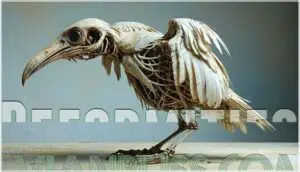
Beyond soft bones, calcium deficiency triggers visible deformities that can permanently affect your bird’s quality of life.
These structural abnormalities develop when insufficient calcium disrupts normal bone formation during growth periods.
- Beak Deformity – Curved or twisted beaks from weakened jaw bones
- Wing Malformations – Drooping or twisted wings affecting flight capability
- Leg Abnormalities – Bowed or crooked legs causing mobility issues
- Skeletal Problems – Spine curvature and rib cage distortions
- Feather Issues – Poor feather development due to compromised follicle support
Reduced Egg Production

When your hen’s calcium levels drop, egg yield takes a nosedive.
You’ll notice fewer eggs in the nest boxes, and those that do appear often have paper-thin shells that crack easily.
Smart flock management means watching for these red flags – hens straining to lay or skipping days entirely.
Proper calcium supplements for birds can turn things around fast, boosting both calcium and reproductive performance back to healthy levels.
Calcium Sources for Birds
You’ll need reliable calcium sources since seeds alone won’t meet your bird’s nutritional demands.
Common options include pecking stones, cuttlefish bone, and oyster shell grit, though absorption isn’t always guaranteed from these traditional sources.
Pecking Stones

You’ll find pecking stones work like a slow-release calcium supplement.
These mineral blocks let your bird self-regulate their calcium intake naturally. Most pecking stones contain calcium carbonate mixed with other minerals your bird needs.
They’re convenient because you can hang them in the cage and your feathered friend will nibble as needed. Look for stones specifically designed for your bird’s size to guarantee proper mineral intake and beak health.
The availability of pecking stone products can vary depending on the supplier.
Cuttlefish Bone

Cuttlefish bone delivers concentrated calcium carbonate that’s easily absorbed by your bird’s digestive system.
This natural bone supplement contains 85% calcium plus trace minerals like magnesium and zinc for ideal avian nutrition.
Your bird will naturally grind the cuttlefish bone, maintaining healthy beak structure while accessing essential calcium for strong bones and quality egg production in breeding birds.
The cuttlefish bone supplement provides a rich source of calcium carbonate for birds, supporting strong bones and quality egg production with its natural bone supplement.
Grit With Oyster Shells

Grit containing oyster shells works like nature’s multivitamin for your feathered friends.
This calcium-packed mixture helps birds process food while delivering the calcium supplements they need for proper shell formation.
Unlike standalone supplements, grit benefits include improved digestion and steady calcium absorption.
Your bird’s crop uses these tiny shell pieces to grind seeds effectively, making bird nutrition more efficient while supporting healthy bone development.
A balanced diet that includes natural calcium sources is essential for maintaining ideal bird health and preventing calcium deficiency.
This approach ensures that your birds receive the necessary nutrients for optimal health, with grit playing a crucial role in their overall well-being and nutrition.
Egg Food

Egg food delivers guaranteed calcium absorption compared to harder sources.
You’ll find these specially formulated supplements contain balanced calcium-to-phosphorus ratios that support proper egg nutrition and bird diet needs.
Commercial egg food provides reliable calcium rich nutrition for egg layers, ensuring consistent calcium supplements for birds during breeding seasons.
This food supplement approach eliminates guesswork in calcium and egg production requirements, directly supporting eggshell quality and thorough calcium and bird nutrition programs, which ensures proper egg nutrition.
Enriched Seed Mixtures

Beyond basic egg food, enriched seed mixtures offer a more extensive approach to avian nutrition.
These specially formulated blends combine traditional seeds with added calcium supplements and essential nutrients.
- Fortified blends contain chelated calcium that’s easily absorbed by your bird’s digestive system
- Multi-grain varieties pair calcium-rich ingredients with familiar seed favorites for better acceptance
- Pelleted additions within mixtures guarantee consistent calcium intake even when birds selectively eat
These enriched foods guarantee reliable calcium absorption compared to plain seeds alone.
The availability of Calcium Seed mixes supports the development of strong bones in birds.
Calcium Health Impacts
Understanding calcium’s health impacts helps you prevent serious problems in your feathered friends.
Poor calcium levels can lead to weak bones, failed breeding attempts, and life-threatening conditions that affect everything from daily movement to successful reproduction.
Eggshell Thickness
Within ideal calcium levels, your bird’s eggshell quality directly reflects dietary nutrition.
Proper calcium supplementation increases shell density from 0.8mm to 1.1mm thickness.
You’ll notice stronger egg strength with consistent calcium intake.
| Calcium Source | Shell Thickness | Cracked Eggs |
|---|---|---|
| No supplement | 0.8-0.9mm | 0.63% |
| Fine limestone | 1.1mm | 0.24% |
| Oyster shell | 1.1mm | 0.24% |
| Coarse limestone | 1.1mm | 0.24% |
Thickness measurement shows calcium supplements prevent fragile shells and protect developing embryos effectively, highlighting the importance of calcium supplementation and proper calcium intake.
Breeding Success
With ideal calcium for breeding birds, you’ll see dramatically improved reproductive performance.
Adequate calcium boosts egg quality and nesting success rates by up to 30%.
Your flock management becomes easier when hatch rates climb higher with proper calcium supplementation for breeding birds.
Think of calcium as your secret weapon for reproductive success – it’s the difference between frustrated attempts and thriving chicks filling your nesting boxes.
Maintaining proper calcium levels is essential for the overall health and breeding success of birds.
Skeletal Decalcification
When calcium levels drop, your bird’s body starts stealing calcium from bones to maintain blood calcium levels.
This bone loss weakens your bird’s skeleton and can lead to serious skeletal damage.
- Rubbery bones – Long bones become soft and bendable
- Visible deformities – Ribs flatten and sternum misshapes
- Fracture risk – Weakened bones break easily during handling
- Cage layer fatigue – Paralysis in laying hens from severe calcium deficit
The decalcification process happens gradually but accelerates during egg production when calcium demands peak.
Osteoporosis
When poor bone density becomes severe, you’re looking at osteoporosis – brittle bones that snap like twigs.
This calcium deficiency condition leaves your bird’s skeleton fragile and prone to fractures.
Calcium supplements for birds become life-savers here, literally rebuilding skeletal health from the inside out.
Don’t let weak bones ground your feathered friend.
Frequently Asked Questions (FAQs)
Why is calcium important for birds?
Like knights of old needed armor for battle, you’ll find calcium acts as your feathered friend’s structural foundation.
It strengthens bones, enables proper muscle function, supports nerve transmission, and guarantees strong eggshell formation during breeding season.
What are the symptoms of calcium deficiency in birds?
You’ll notice soft bones, growth problems, and deformities in young birds. Adult birds develop thin eggshells, reduced egg production, and osteoporosis. Gray parrots may experience nerve issues and convulsions.
What happens if a bird gets too much calcium?
Too much calcium can cause kidney problems, digestive issues, and interference with other minerals like phosphorus and magnesium. You’ll notice lethargy, poor appetite, and potential kidney stones forming.
What foods are high in calcium for birds?
Feeding your feathered friend becomes a nutritional treasure hunt when you’re targeting calcium-rich options.
You’ll find excellent sources in cuttlefish bone, oyster shell grit, dark leafy greens, broccoli, and calcium-fortified pellets for ideal bone health.
How much daily calcium do pet birds need?
Pet birds typically need 4-8% of their diet as calcium, roughly 20-40mg daily for small birds like budgies, and 100-200mg for larger parrots.
You’ll want higher amounts during breeding season.
Can birds overdose on calcium supplements?
Calcium overdose rarely occurs in birds since excess amounts get filtered through kidneys naturally.
You’ll typically see kidney damage before toxicity symptoms.
Monitor supplements carefully and provide balanced diets instead of relying solely on calcium-rich treats.
Which bird species require the most calcium?
Laying birds need the most calcium, especially during peak breeding season. You’ll find egg-laying hens, ducks, and breeding songbirds require substantially more calcium than non-reproductive birds to support eggshell formation.
Do wild birds get enough environmental calcium?
Wild birds often struggle to find adequate calcium in their natural environments, especially during breeding season when they’re producing calcium-rich eggshells.
You’ll see many species actively seeking alternative sources like snail shells.
When should breeding birds start calcium supplementation?
Sarah’s canary started laying soft-shelled eggs, signaling she’d missed the calcium window.
You’ll want to begin supplementing calcium two weeks before expected breeding season.
This gives your bird’s body time to build essential reserves for strong eggshells and healthy chicks.
Conclusion
Ultimately, the importance of calcium for birds is absolutely life-or-death for their wellbeing.
You’ve got the knowledge to provide proper calcium through cuttlefish bones, oyster shells, and enriched foods.
Monitor your birds for deficiency signs like soft bones or weak eggshells.
Regular calcium supplementation guarantees strong skeletal development, successful breeding, and peak health.
Your commitment to understanding calcium needs makes the difference between thriving birds and serious health problems.
- https://www.harrisonsbirdfoods.com/wp-content/uploads/2024/02/05_calcium.pdf
- https://lafeber.com/vet/calcium-in-the-avian-patient/
- https://fraservalley.wbu.com/the-need-for-calcium
- https://birdsupplies.com/blogs/news/144550983-your-complete-guide-to-bird-calcium-for-optimal-health-and-happiness
- https://academic.oup.com/biolinnean/article-abstract/136/2/321/6581820