This site is supported by our readers. We may earn a commission, at no cost to you, if you purchase through links.
A duck might look harmless floating in your pool, but it leaves behind more than footprints. A single duck can deposit up to a pound of feces per day, and those droppings carry E. coli, Salmonella, and parasites like Cryptosporidium—pathogens that chlorine doesn’t always neutralize.
What starts as a quirky backyard visit can quietly turn your pool into a health hazard. Ducks don’t choose pools randomly; still water, open sightlines, and the absence of predators make your backyard look like prime habitat. Keeping ducks out of pools requires understanding that logic—and using it against them.
Table Of Contents
- Key Takeaways
- Why Ducks Are Drawn to Swimming Pools
- Health and Maintenance Risks From Duck Visits
- Physical Barriers to Keep Ducks Out
- Visual and Sound Deterrents That Work
- Natural and Pet-Based Duck Deterrent Methods
- Top 5 Products for Duck Prevention
- Long-Term Maintenance for Duck-Free Pools
- Frequently Asked Questions (FAQs)
- How do I keep ducks out of my swimming pool?
- What is the best deterrent for ducks?
- Why do ducks keep going in my pool?
- Will a fake owl scare away ducks?
- What deters ducks from a swimming pool?
- Why do ducks keep coming to my pool?
- What to do when ducks land in your pool?
- How often do ducks typically visit residential pools?
- Are some duck species more attracted to pools?
- Can ducks damage pool liners or filtration systems?
- Conclusion
Key Takeaways
- Duck droppings carry E. coli, Salmonella, Cryptosporidium, and Giardia — pathogens that chlorine alone won’t reliably neutralize.
- Your pool attracts ducks because it mimics a safe, predator-free pond, and once they learn it’s safe, breaking that habit gets much harder.
- Physical barriers like pool covers and tall fencing outperform decoys and noise devices because ducks can’t adapt their way past them.
- No single deterrent works long-term — rotating methods every few days is what keeps ducks from catching on and coming back.
Why Ducks Are Drawn to Swimming Pools
Ducks don’t show up at your pool by calculated choice — they’re making a calculated choice.
So if you want to catch those moments, it helps to know what features make bird cameras worth the investment before your next feathered visitor shows up unannounced.
Your pool checks every box on their list of what makes a safe source.
Here’s what’s actually pulling them in.
Pool Water Stillness and Reflection
From the air, your pool looks nothing like a backyard feature — it looks like a pond. A calm, still surface acts as a mirror, reflecting sky and trees and signaling safety to passing ducks.
Water clarity and pool reflections are the first invitation. Without surface movement, stillness factors turn your water into a landing strip. Pool covers break that mirror effect fast.
Ducks are drawn to pools because they mimic natural ponds and can pose health concerns due to duck droppings contamination risks.
Lack of Natural Predators
Still water catches their eye, but predator scarcity keeps them coming back. Your backyard is a low-threat zone. No foxes, no raptors, no real danger.
Urban wildlife patterns have shifted duck behavior greatly — they’ve learned that human activity near pools signals safety, not risk. That’s duck habituation in action. Once they mark your pool as a safe spot, wildlife control becomes much harder.
Once ducks learn your pool is safe, breaking that habit becomes the real wildlife control challenge
To effectively prevent visits, consider the importance of, which remains the most reliable long-term strategy.
Nearby Food and Nesting Opportunities
Your yard isn’t just a pool habitat — to waterfowl, it’s a full habitat. Duck behavior is opportunistic, and your pool perimeter often sits next to everything they need.
- Manicured lawns double as feeding grounds for seeds, clover, and insects
- Damp soil and mulched beds expose earthworms and larvae
- Dense shrubs create ready-made nesting sites
- Spilled birdseed and pet food become reliable food sources
Lawn management and yard sanitation directly affect wildlife nuisance levels. Remove the buffet, reduce the draw.
Seasonal Duck Migration Patterns
Migration timing matters more than most pool owners realize. Migration routes and timing are crucial, as waterfowl follow predictable flyway migration routes each fall and spring — and your pool sits squarely in their path.
| Migration Phase | Typical Timing |
|---|---|
| Fall southward push | Late October – November |
| Spring return north | Late February – March |
| Urban stopovers peak | During cold fronts |
Duck seasonality explains why duck control and deterrence needs to stay active during these windows, not just when you spot the problem.
Health and Maintenance Risks From Duck Visits
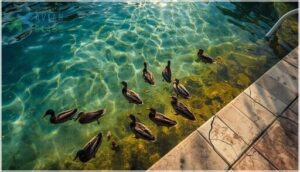
A duck splashing around in your pool might look harmless, but what they leave behind is a real problem. Their droppings carry bacteria and parasites that can throw off your water chemistry and push your equipment to its limit.
Here’s what you’re actually dealing with when ducks make themselves at home.
Parasites and Bacteria in Duck Droppings
Duck poop isn’t just a nuisance — it’s a real health threat. A single visit can introduce fecal pollution and serious waterborne pathogens into your pool water:
- E. coli and Salmonella cause gastrointestinal illness within hours of exposure.
- Cryptosporidium resists chlorine and survives up to seven days.
- Giardia cysts can remain infectious for weeks.
Duck feces hazards demand immediate action to protect pool sanitation.
Regular cleaning matters beyond just pools—dirty feeders also spread disease, as explained in this guide on why birds stop visiting your feeder.
Disruption of Pool Water Chemistry
One duck visit can quietly unravel your pool’s chemical balance. Duck poop introduces nitrogen, phosphorus, and organic waste that spike Chlorine Demand, trigger harmful Chemical Reactions, and compromise Pool Sanitation fast.
| Chemistry Problem | What Happens |
|---|---|
| pH Imbalance | Water drifts outside the 7.2–7.8 safe range |
| Chlorine Demand | Free chlorine drops toward zero rapidly |
| Algae Growth | Nutrient loading fuels blooms within days |
| Water Clarity | Suspended particles cloud the water quickly |
| Pool Safety | E coli and pathogens survive longer in unbalanced water |
Protecting Water Quality starts with keeping ducks out entirely.
Increased Cleaning and Equipment Strain
Every duck visit quietly stacks up the work. Duck poop clogs filters, strains pumps, and forces extra surface cleaning that eats into your schedule and budget.
Here’s what takes the hardest hit:
- Filter Maintenance – Cartridges clog faster, spiking pressure and cutting water quality
- Pump Efficiency – Extended run times and cavitation accelerate wear
- Surface Cleaning – Steps, tile, and floors need constant scrubbing
- Equipment Costs – Repeated strain shortens replacement cycles
Physical Barriers to Keep Ducks Out
In terms of keeping ducks out for good, physical barriers are your most reliable option. Unlike decoys or noise devices, they don’t lose effectiveness over time — ducks simply can’t get past them.
Here are three barrier approaches worth considering.
Full Pool Covers and Mesh Netting
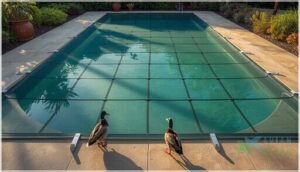
A cover is your first line of defense. Pool cover materials range from solid vinyl to high-density mesh netting types — each forming a physical barrier ducks simply can’t get past.
Mesh netting effectiveness comes from its tight weave and secure cover installation, using perimeter anchors that prevent birds from slipping under edges. These pool barrier systems eliminate the still, reflective water surface ducks are searching for, cutting off the invitation entirely.
Tall Fences and Poolside Obstructions
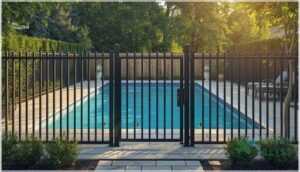
A fence does more than mark your boundary — it cuts off duck access at the source. Smart pool fencing and obstruction methods make a real difference.
- Use pool barriers at least 60 inches tall with vertical pickets spaced under 4 inches apart.
- Add solid lower panels to block water visibility from ground level.
- Install self-latching gates to maintain continuous yard screening without gaps.
Fence designs that combine height with visual blocking handle the wildlife control side effectively.
Strategic Landscaping Solutions
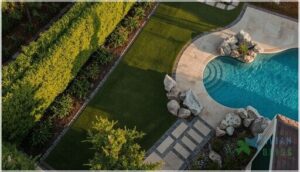
Your yard’s layout is one of the most underrated tools in wildlife control. Strategic landscaping barriers — not just pool fencing — reshape how ducks perceive your space from the air and ground.
| Landscaping Tactic | Duck Deterrent Effect |
|---|---|
| Dense perimeter shrubs | Blocks clear flight and landing paths |
| Coarse groundcover selection | Discourages waddling toward water |
| Removing fruit-bearing plants | Eliminates food-driven return visits |
| Rock clusters and hardscape | Breaks sightlines and approach routes |
| Short-mowed yard layout | Removes nesting cover near the pool |
Smart pool plant placement and habitat modification together make your backyard feel unsafe — not unwelcoming to you, but unreadable to them.
Visual and Sound Deterrents That Work
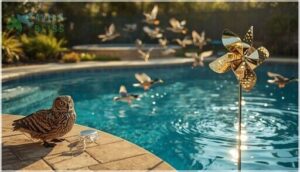
Physical barriers are your strongest line of defense, but they’re not always the only tool you need.
Sometimes ducks just need to be convinced your pool isn’t worth the trouble — and that’s where visual and sound deterrents come in. Here are three methods that can help make your pool a less welcome landing spot.
Predator Decoys and Inflatable Pool Floats
Predator decoys are one of the most accessible visual deterrents for duck control and deterrence. Predator realism matters — ducks respond to shape, posture, and eye placement.
For pool protection, rotate decoy placement every few days so ducks don’t adapt. Strong options include:
- Floating alligator heads
- Molded hawk or owl figures
- Inflatable snake pool floats
- Large swan inflatables
Float durability varies, so choose UV-resistant materials.
Reflective Tape and Moving Objects
Beyond visual decoys, reflective tape and moving objects add another layer of wildlife control and deterrents. Holographic tape throws unpredictable light flashes that make your pool look unsafe from above. Hang it at varied heights so ducks see warnings from every angle.
Wind devices like spinning reflectors keep motion constant. Combined, these motion deterrents and visual deterrents work together to keep ducks out of your pool effectively.
Motion-Activated Sprinklers and Noise Devices
Motion-activated sprinklers take animal deterrents up a notch. When a duck crosses the motion sensor, it triggers a short water burst — startling enough to break the pattern. Sprinkler effectiveness holds strong early in the season, though rotating placement helps prevent habituation.
- Motion deterrents cover up to 40-foot detection range
- Noise devices and ultrasonic deterrents disrupt approach behavior
- Pool alarms add a secondary alert layer when visual decoys fall short
Natural and Pet-Based Duck Deterrent Methods
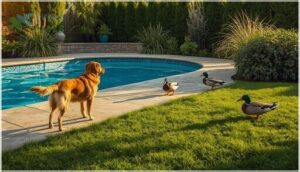
Sometimes the most effective deterrents aren’t gadgets — they’re things you already have or can easily change. Working with nature rather than against it generally produces longer-lasting results.
Here are three natural and pet-based approaches worth considering.
Using Dogs to Patrol The Pool Area
A dog is one of the most effective canine deterrents you can use for backyard wildlife control. Ducks recognize dogs as predators and will avoid pools where one patrols regularly.
With basic dog training tips — recall commands, reward-based sessions, and supervised duck chasing strategies — your dog becomes a reliable animal deterrent. Follow pool safety measures by teaching exit points and never leaving your pet unsupervised. Pet welfare considerations matter throughout.
Removing Food and Nesting Sites
Food source removal is your first real line of defense. Ducks don’t wander randomly — they follow food. Stop hand-feeding, pull bird feeders near the pool, and sweep fallen seed regularly.
Nesting site clearance matters just as much. Clear dense groundcovers, trim low shrubs, and store poolside clutter. Consistent yard sanitization and smart poolside landscaping eliminate the habitat cues that keep ducks treating your pool like home.
Duck-Repelling Vegetation Choices
Vegetation is one of the most underrated tools in backyard wildlife control. Tall grasses like pampas or Miscanthus grow 8 to 12 feet high, blocking the open sightlines ducks rely on.
Dense shrubs, coarse plants, and native plantings along the pool edge remove the clear “runway” they look for. Groundcovers that are tough or unpalatable keep the border intact — and ducks moving on.
Top 5 Products for Duck Prevention
Some products do a better job than others in terms of keeping ducks away for good. The right tools target duck behavior directly — whether that’s breaking their landing patterns, blocking access, or cleaning up the mess they leave behind.
Here are five worth knowing about.
Dolphin Robotic Pool Cleaner Nautilus CC Plus
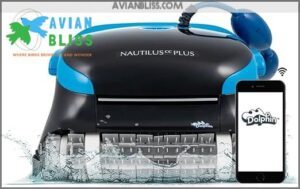
Ducks don’t just leave droppings — they leave behind bacteria that standard chlorination can’t always handle fast enough. That’s where the Dolphin Nautilus earns its place on this list.
Running on roughly 180 watts and costing about 5 cents per hour to operate, it circulates up to 4,500 gallons per hour, helping flush contaminants from every cycle. Its dual scrubbing brushes cover floors and walls thoroughly, and the Wi-Fi model lets you schedule cleanings remotely — so your pool stays cleaner between duck visits.
| Best For | Pool owners who want a hands-off cleaning routine and deal with birds, debris, or heavy use on a regular basis. |
|---|---|
| Primary Purpose | Pool cleaning |
| Power Source | Electric (180W) |
| Maintenance Level | Low |
| Chemical-Free | No |
| Automation | Yes |
| Best Use Case | Heavy pool use |
| Additional Features |
|
- Wi-Fi scheduling means you can set it and forget it — no more manual cleaning runs
- Scrubs floors and walls thoroughly, so contaminants don’t just settle at the bottom
- Top-load filter basket makes maintenance quick and painless
- Struggles with stairs and tight corners, so some spots may need manual attention
- Not compatible with 250V power setups, which rules it out for some international pools
- Can get tripped up by unusual pool shapes or features
Motion Activated Animal Repellent Sprinkler
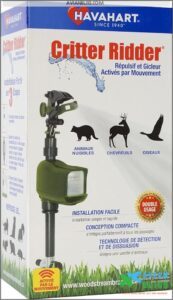
A sudden blast of cold water changes a duck’s mind fast. Motion-activated sprinklers detect warm-bodied animals up to 40 feet away with a 120-degree field of view, triggering an immediate spray the moment a duck approaches your pool edge.
Models like the Orbit Yard Enforcer run on four AA batteries for up to 7,500 cycles. Effectiveness is strongest in the first week or two, so reposition the unit every few days and pair it with other deterrents to stay ahead of habituation.
| Best For | Homeowners and pool owners who want a hands-off, chemical-free way to keep ducks and other animals away from their pool area. |
|---|---|
| Primary Purpose | Duck deterrent |
| Power Source | Battery (4xAA) |
| Maintenance Level | Low |
| Chemical-Free | Yes |
| Automation | Yes |
| Best Use Case | Open yard areas |
| Additional Features |
|
- Covers a wide area—up to 40 feet with a 120-degree field of view, so one unit can protect a good chunk of your yard.
- No chemicals or ongoing costs beyond batteries, making it a simple, low-maintenance option.
- Works instantly on detection, so animals get the message right away without any effort on your end.
- Animals can get used to it over time, so you’ll need to reposition it every few days to keep it effective.
- Battery-powered operation means you’ll need to keep an eye on power levels to avoid gaps in coverage.
- Works best as part of a broader deterrent strategy—relying on it alone may not be enough for persistent animals.
Bird Poultry Aviary Netting 50 Foot
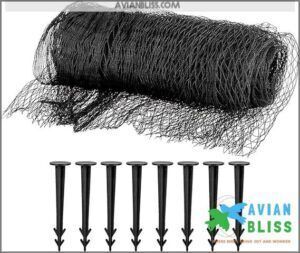
Think of it as a ceiling your pool finally gets. A 50-foot bird poultry aviary net covers up to 2,500 square feet and physically stops ducks from landing on the water entirely.
The knotted polyethylene mesh — usually 2 to 2.4 inches — blocks birds without trapping debris or blocking airflow. UV-resistant fibers hold up for 7 to 10 years in direct sun.
Black mesh nearly disappears overhead, so you keep the open feel of your pool area while eliminating the problem at the source.
| Best For | Homeowners who want a humane, hands-off way to keep deer, raccoons, cats, and other nuisance animals out of their garden or yard without chemicals or traps. |
|---|---|
| Primary Purpose | Duck exclusion |
| Power Source | None required |
| Maintenance Level | Very Low |
| Chemical-Free | Yes |
| Automation | No |
| Best Use Case | Full pool coverage |
| Additional Features |
|
- Works automatically — detects heat and movement, so you don’t have to do a thing
- Uses barely any water (just 2–3 cups per spray), so it’s easy on your bill and the environment
- Doubles as a regular sprinkler, so you’re getting two tools in one
- Can misfire from wind-blown trees or other moving objects, which gets annoying fast
- Batteries drain quicker than you’d expect, especially with frequent triggers
- Not a great fit for freezing climates — pipes can burst if temps drop below zero
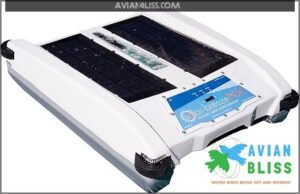
Solar Powered Pool Cleaning Robot
A still pool is an open invitation. A solar-powered cleaning robot changes that by keeping the surface in constant motion — and ducks simply don’t trust water that won’t hold still.
These robots run entirely on solar energy, storing power in onboard lithium batteries to keep working through clouds and into the evening. The slow, continuous movement breaks up reflective surfaces that attract ducks from the air and removes feathers and debris that give birds a reason to linger.
| Best For | Pool owners who want a hands-off way to keep their pool clean while also deterring ducks and other birds from hanging around. |
|---|---|
| Primary Purpose | Duck deterrent |
| Power Source | Solar + battery |
| Maintenance Level | Low |
| Chemical-Free | Yes |
| Automation | Yes |
| Best Use Case | Continuous deterrence |
| Additional Features |
|
- Runs on solar power, so no extra electricity costs — it basically pays for itself over time.
- Keeps the water moving constantly, which naturally discourages ducks from settling in.
- Works through cloudy days and into the evening thanks to onboard battery storage.
- Solar charging depends on sunlight, so performance may dip during long stretches of bad weather.
- The continuous movement might not deter every type of bird or wildlife.
- Upfront cost could be higher compared to manual cleaning options.
Inflatable Snake Pool Floats
Motion keeps ducks guessing — and so does the right visual threat. Inflatable snake pool floats tap into something hardwired in waterfowl: a fear of predators they can’t outswim.
These PVC decoys mimic diamondback rattlesnakes up to 6 feet long, complete with textured scales, coiled posture, and realistic eyes. Tie a small rock to the tail so it bobs naturally in the water. Rotate locations weekly, or ducks will figure out the ruse fast.
| Best For | Pool owners who want a hands-off way to keep ducks away without dealing with constant manual deterrents. |
|---|---|
| Primary Purpose | Pool cleaning |
| Power Source | Solar + battery |
| Maintenance Level | Low |
| Chemical-Free | No |
| Automation | Yes |
| Best Use Case | Surface debris removal |
| Additional Features |
|
- Taps into ducks’ natural fear of predators, so no chemicals or noise needed
- Easy to set up — just tie a weight to the tail and toss it in
- Moving with the water makes it look realistic enough to actually work
- Ducks catch on quickly, so you have to move it around often or it loses its effect
- Won’t hold up well in harsh weather, which can crack or fade the PVC fast
- Not a permanent fix — it’s one piece of a bigger duck-deterrent strategy
Long-Term Maintenance for Duck-Free Pools
Keeping ducks out of your pool isn’t a one-time fix — it’s an ongoing effort that rewards consistency.
The good news is that a simple routine, paired with a few smart adjustments over time, can make a real difference.
Here’s what long-term duck prevention actually looks like in practice.
Regular Pool and Yard Cleaning
Consistent pool care is your first line of defense. Skim droppings immediately, then follow up with water testing and shock treatment to restore safe chemistry.
Deck cleaning after each duck visit prevents bacteria from spreading. Yard maintenance matters too — rake yard debris, mow regularly, and remove food sources. Strong fence maintenance seals entry points.
Together, these pool sanitizing and outdoor pest control habits make your yard far less inviting.
Rotating Deterrent Methods for Effectiveness
Cleaning keeps your pool less inviting, but ducks adapt fast — that’s where deterrent rotation earns its place in wildlife control. Rotate bird deterrents every three to seven days to prevent duck habituation.
Swap your motion activated sprinkler, predator decoys, and reflective tape on a set schedule. Varying both the type and location disrupts wildlife adaptation patterns, preserving pool safety without constant hands-on effort.
Consulting Wildlife Experts When Needed
Sometimes deterrents aren’t enough, and that’s when professional assistance pays off. If ducks are nesting near your pool, expert consultation isn’t optional — moving an active nest without wildlife guidance can violate the Migratory Bird Treaty Act.
USDA Wildlife Services connects you with licensed wildlife control specialists who handle duck removal within full legal compliance. State wildlife agency websites also list qualified animal control and wildlife management professionals near you.
Frequently Asked Questions (FAQs)
How do I keep ducks out of my swimming pool?
Like uninvited guests who never read the room, ducks claim your pool without asking.
Smart wildlife control starts with understanding duck behavior — then combining pool safety nets, water quality management, and layered pool protection to keep ducks out for good.
What is the best deterrent for ducks?
Pool covers are the most reliable duck deterrent. They block open water cues entirely.
Motion sprinklers, predator decoys, and reflective tape each help, but physical exclusion outperforms them all for consistent waterfowl control.
Why do ducks keep going in my pool?
Your pool looks like prime real estate to a duck. Still water, no predators, and a lawn full of insects nearby — it checks every box for duck attraction, safety, and habitat.
Will a fake owl scare away ducks?
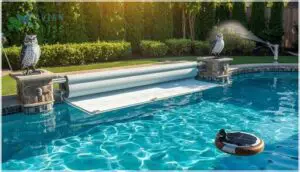
A fake owl can work as a short-term bird deterrent. Ducks recognize raptor silhouettes and may avoid the area at first — but owl decoy effectiveness fades fast once they realize nothing happens.
What deters ducks from a swimming pool?
Beating ducks at their own game comes down to layering defenses. Pool Surface Changes, Yard Adjustments, Water Deterrents, Visual Scare Tactics, and Pet Patrols combine into a reliable Wildlife Control and Deterrents strategy.
Why do ducks keep coming to my pool?
Ducks keep coming back because your pool checks every box for them — still water, clear sightlines, no predators, and a lawn full of food.
To wildlife, it looks like the perfect habitat.
What to do when ducks land in your pool?
Stay calm and gently shoo them off with slow movements. Then scoop out feathers and droppings, run your filter for 24 hours, and test chlorine levels before anyone swims.
How often do ducks typically visit residential pools?
Once mallards discover a calm, safe pool, visit frequency can climb to once or twice daily.
Seasonal patterns peak in spring, with some pairs establishing daily routines for one to four consecutive weeks.
Are some duck species more attracted to pools?
Yes. Mallards top the list — they’re urban ducks built for suburban life.
Their water preferences align perfectly with calm, still pools, making pool attraction almost instinctive for this adaptable duck species.
Can ducks damage pool liners or filtration systems?
Like a slow leak you don’t notice until it’s too late, duck droppings, liner damage, filter clogs, and pool chemistry swings quietly add up — turning routine pool maintenance into serious equipment wear.
Conclusion
Ducks don’t negotiate—they settle where conditions allow it. Keeping ducks out of pools isn’t a one-time fix; it’s a system you build and rotate.
Combine physical barriers with active deterrents, cut off food sources, and stay consistent. When one method loses its edge, swap it out.
Your pool is yours—a clean, safe space for your family, not a rest stop for passing wildlife. Hold that line, and the ducks will move on.
- https://jmpoolsupply.com/quack-free-zone-how-to-keep-ducks-away-from-your-pool/
- https://www.pumpandpoolpeople.com.au/how-to-keep-ducks-and-birds-out-of-your-pool/
- https://www.dfwwildlife.org/birds/
- https://katchakid.com/how-to-keep-ducks-out-of-a-swimming-pool-katchakid/
- https://www.supremespapool.com/products/duck-off