This site is supported by our readers. We may earn a commission, at no cost to you, if you purchase through links.
Most bird feeders do one thing: attract birds to a spot where disease spreads fast and food runs out the moment you stop refilling.
Native plants work differently—they feed birds around the clock, through every season, without a single trip to the store.
single oak tree hosts over 500 caterpillar species, which means songbirds raising nestlings have a protein source no feeder can match. Pair that with winterberry shrubs blazing red in December and black-eyed Susan seed heads standing through February, and your yard becomes a living pantry—stocked, self-renewing, and free.
Table Of Contents
- Key Takeaways
- Choose Native Plants to Attract More Birds Year-Round
- Oak Trees: The Undisputed King of Bird Food
- Black-Eyed Susan: Where Chickadees Check in but Never Check Out
- Winterberry Holly: December’s Bird Buffet When All Else is Gone
- American Holly: Where Christmas Birds Come Year-Round
- Seasonal Timing: When to Plant for Maximum Bird Appeal
- Regional Considerations: Matching Plants to Your Local Birds
- Top 8 Native Plant Products for Bird Habitat
- 1. Birdfy Smart Solar Bird House
- 2. Wellspring Trumpet Honeysuckle Live Plant
- 3. White Flowering Dogwood Tree
- 4. Ilex Red Sprite Winterberry Shrub
- 5. Native Plants Pollinator Gardening Guide
- 6. Australian Native Bird Attracting Plants
- 7. Native Plants for Bird Habitat
- 8. Classic 8cm Men’s Solid Lattice Tie
- Design a Layered Habitat That Feeds Birds All Year
- Frequently Asked Questions (FAQs)
- Conclusion
Key Takeaways
- A single oak tree hosts over 500 caterpillar species, making it the most powerful bird-feeding plant you can put in your yard — no feeder comes close.
- Native plants don’t just feed birds directly; they rebuild the insect food web birds actually evolved to depend on, delivering protein exactly when nestlings need it most.
- Leaving seed heads, leaf litter, and dead wood untouched through winter creates year-round forage and shelter that pesticides and over-tidying quietly destroy.
- Layering natives by height — canopy trees, understory shrubs, groundcover forbs — turns any yard into a self-sustaining habitat that works whether you’re watching or not.
Choose Native Plants to Attract More Birds Year-Round
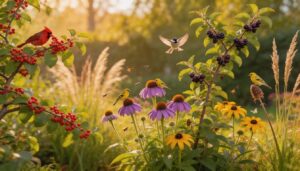
Native plants do something a feeder simply can’t — they rebuild the food web birds actually evolved to use. The right plants bring in insects, berries, and seeds across every season, not just when you remember to refill a tube.
That deep connection between birds and their habitat is exactly why native trees offer shelter and food birds instinctively recognize.
Here’s what to plant if you want birds showing up on their own schedule, all year long.
Why Native Plants Outperform Feeders for Bird Health
Feeders are fine — but native plants deliver something a feeder simply can’t match. Here’s what they quietly do all year:
- Supply natural insect protein that fuels nestling growth far better than sunflower seeds
- Offer nutrient-rich berries and seed heads with seasonal food continuity built in
- Reduce disease risk by spacing birds naturally across habitat complexity
These plants also create overstory and midstory layers that provide essential nesting sites.
That’s year‑round bird feeding through organic care — no refills required.
How Native Plants Support The Insect Food Chain
Native plants don’t just feed birds directly — they feed the insects that feed the birds. Caterpillar Host Diversity explodes when you plant species like oaks and native forbs: Seasonal Insect Emergence aligns perfectly with breeding season, delivering protein exactly when nestlings need it.
Leaf Litter Habitat shelters overwintering insects. Mycorrhizal Soil Networks boost insect biodiversity underground.
Native vegetation is basically a Pollinator Insect Boost with roots.
Replacing Non-Native Species With Bird-Friendly Natives
Swap out that invasive barberry or burning bush and you’ve already started building something real.
Native shrubs bring Pollinator Habitat Corridors, Soil Microbiome Restoration, and Invasive Species Removal into one decision.
- Native Shrub Diversity benefits co-evolved insects and birds that depend on them
- Winterberry and seed heads fuel birds through lean months
- Seasonal bloom sequencing eliminates food gaps across spring through fall
- Water Feature Integration draws birds year-round to your bird-friendly garden
- Layered natives outperform ornamentals — no synthetic inputs required
Oak Trees: The Undisputed King of Bird Food
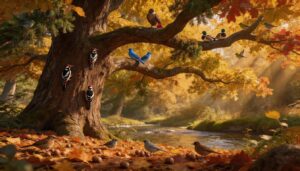
If you plant just one tree for birds, make it an oak. No other native tree comes close to as many species — from nestlings to winter residents.
Here’s what makes oaks so valuable, and which ones deserve a spot in your yard.
How Oaks Host Over 500 Caterpillar Species
A single oak does more for your bird-friendly garden than almost any other native tree — because it’s really a caterpillar factory. White oak relatives host over 500 species of moth and butterfly larvae.
Leaf chemistry, canopy microclimate, bark crevices, and leaf litter each support different waves of caterpillar succession.
That phenological timing matters: sequential hatches keep caterpillar host plants productive — and your birds fed — across the entire season.
Acorns as a High-Energy Winter Food Source
When caterpillar season winds down, oaks don’t stop giving — acorns take over. The acorn nutrient profile packs fat, carbohydrates, and key minerals into a compact winter fuel source that sustains over 100 vertebrate species. Mast year variability means crops swing dramatically, so plant multiple native trees to buffer lean years.
When caterpillar season ends, oaks keep feeding birds — acorns sustain over 100 species through winter
What makes acorns irreplaceable in a bird-friendly garden:
- Cache retrieval strategies — Blue Jays bury hundreds of acorns along woodland edges, unintentionally planting your next oak grove.
- Seed longevity — Red oak acorns persist well into winter, outlasting most seed heads and soft fruits in any seed mix.
- Acorn predator dynamics — Competition drives early caching, which ultimately spreads seeds and deepens your habitat’s food web.
Best Oak Species to Plant for Maximum Bird Benefit
Not every oak fits every yard — but the right match transforms your canopy into a living pantry.
Pin Oaks handle urban soils without complaint.
Northern Red Oaks grow fast and develop nesting cavities early.
White Oaks deliver the highest acorn yield and host the richest caterpillar communities.
| Oak Species | Caterpillar Host Value | Best Feature |
|---|---|---|
| White Oak | Outstanding | Acorn Yield + mossy bark habitat |
| Northern Red Oak | High | Fast growth, urban oak selection |
| Pin Oak | Moderate-High | Drought-resistant, tolerates compacted soil |
| Willow Oak | High | Harbors over 500 caterpillar species |
Black-Eyed Susan: Where Chickadees Check in but Never Check Out
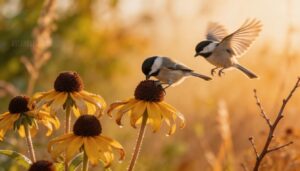
Black-eyed Susans don’t just look good in your yard — they work overtime from summer straight through winter.
The seed heads you’d normally cut back in fall are exactly what finches and sparrows are hunting for when everything else is buried or bare.
Here’s how to make the most of them, and what to plant alongside them.
Retaining Seed Heads Through Winter for Finches and Sparrows
Leave those seed heads alone. Seed Head Timing is everything — cut too early and you’ve just removed your best winter food source.
Black-eyed Susan stems stay sturdy through snow, giving finches and sparrows both food and Winter Perching Structures.
Seedhead retention also helps Insect Overwintering Habitat beneath the stalks.
Minimal Pruning Practices and a loose Groundcover Seed Mosaic of native seed-providing plants keep birds returning all season.
Pairing Black-Eyed Susan With Other Native Forbs
Black-eyed Susan doesn’t work alone — it works best with the right crew around it.
- Yarrow Texture Boost: Fine foliage softens bold Susan blooms while drawing beneficial insects
- Joe Pye Height: Tall structure anchors the back of any planting drift
- Coreopsis Bloom Extension: Extends seasonal bloom sequencing into midsummer gaps
- Bee Balm Nectar: Pulls hummingbirds into the mix alongside seed-eating birds
Native grasses and forbs for seed-eating birds thrive in these layered combinations — providing year-round food and shelter with native flora, your Black-eyed Susan patch helps anchor.
Goldenrod and Coneflower as Companion Seed Sources
Goldenrod and Purple Coneflower are a team — and birds know it. Their pollinator overlap draws late-season insects that fuel migrating songbirds, while wind‑assisted spread from goldenrod quietly expands your bird‑friendly garden over time.
Keep those seed heads standing through winter: seed head retention feeds finches and sparrows when little else remains. That’s microhabitat protection and late‑season forage working together—no effort required.
Winterberry Holly: December’s Bird Buffet When All Else is Gone
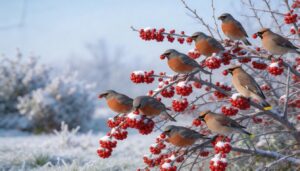
When every other shrub has given up for the season, winterberry holly is just getting started. It drops its leaves in late fall — on purpose — and lets those vivid red berries do all the talking.
Here’s what makes it one of the best things you can plant for birds in winter.
Why Winterberry Outshines Other Cold-Season Shrubs
Most cold-season shrubs tap out by November.
Winterberry (Ilex verticillata) doesn’t — its bright red contrast against bare stems makes it unmissable to foraging birds, and that extended fruit window stretches well into early spring.
It tolerates moist to average soils with low water requirements, bends to pruning flexibility without complaint, and slots into wildlife corridor integration naturally.
Year-round bird feeding with native berries starts here.
Pairing Male and Female Plants for Maximum Berry Production
Winterberry’s fruit show depends on one thing you can’t skip: pairing male and female plants correctly. Plan for one male per four to six females — that’s your sex ratio planning baseline.
Keep male plants within 50 feet for pollinator proximity and bloom synchronization. Cluster planting with genetic diversity across native shrubs like serviceberry strengthens cross-pollination and drives berry yields higher.
Eastern Bluebirds and Mockingbirds That Rely on Winterberry
Plant a few female winterberry hollies, and don’t be surprised when bluebirds claim the whole shrub. Eastern Bluebirds rely on winterberry’s berry water content and berry energy content to push through frigid nights — returning multiple times daily.
Mockingbirds overlap that same territory, competing briefly but mostly sharing.
Together, their winter foraging patterns turn your native shrubs into year-round feeding stations with built-in predator shelter.
American Holly: Where Christmas Birds Come Year-Round
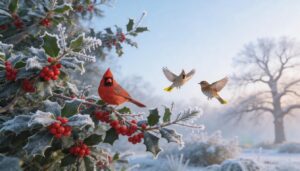
American holly does something most plants won’t — it holds its glossy red berries well into the coldest months, long after everything else has dropped. That kind of staying power makes it a cornerstone shrub for any bird-friendly yard.
what makes it work and what to plant alongside it.
Glossy Red Berries That Persist Deep Into Winter
American holly doesn’t bluff. Those glossy red berries cling to branches from November through February — protected by a waxy berry coating that keeps them plump even through freeze-thaw cycles. Snow-protected berries tucked under branches stay viable when the ground locks up tightly.
What makes it reliable:
- High-energy red fruit fuels cardinals and bluebirds through cold snaps
- Male-female ratio matters — plant one male per three females for full berry set
- Shrub cluster density multiplies foraging opportunities in small yards
- Viburnum and red twig dogwood extend the berry window before and after peak holly season
Companion Shrubs Like Inkberry and Possumhaw for Extended Supply
Holly carries the berry load through winter — but inkberry and possumhaw make sure nothing runs dry before spring. Both shrubs nail evergreen winter shelter and berry‑ripening sync across lean months.
For a birdfriendly garden, male female planting matters: you need both sexes for fruit.
Use a cluster planting strategy — group three to five plants — and you’ll get an insect habitat boost plus reliable winter wildlife support without a feeder in sight.
Virginia Creeper: Where Cardinals Host Their Family Reunions
Virginia creeper doesn’t just feed birds — it shelters them. Cardinals flock to dense vine thickets along fence edge planting sites, using the tangle as a winter roost shelter through cold nights.
Vine fruit timing peaks in September through October, giving migrators a late-season boost.
Incorporating native shrubs and vines for fruit and cover, like this, provides year-round food and shelter with native flora, no feeder required.
Seasonal Timing: When to Plant for Maximum Bird Appeal
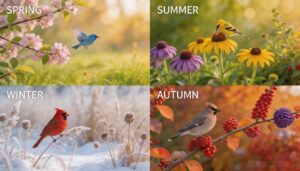
Timing matters more than most gardeners realize — plant the right species at the wrong moment, and birds simply move on before the food is ready. Native plants work best when their bloom and fruiting cycles line up with what birds actually need, season by season.
Here’s how to match your planting calendar to the birds showing up in your yard.
Spring Bloomers That Fuel Migrating Warblers
Warblers don’t wait — and neither should your garden.
Time your plantings so Serviceberry Fruit ripens just as migrants arrive, and let Redbud Bloom signal the early insect pulse they depend on.
Chokecherry Flowers and Allium Nectar extend that window further.
That seasonal bloom and fruit sequencing isn’t decorative — it’s a reliable fueling station built right into your yard.
Summer Nectar Plants for Hummingbirds and Late Migrants
Hummingbirds run on a tight schedule — and your yard either makes the cut or gets skipped. Tubular flower selection is everything here.
Trumpet honeysuckle and bee balm deliver nectar concentrations that fuel rapid energy intake at each migration stopover.
Plant them in sunlit microclimates, use bloom overlap strategies to avoid gaps, add pollinator-friendly companion plants nearby, and integrate a shallow water feature. Done.
Fall Fruiting Shrubs That Bridge The Gap to Winter
Fall is the last window before birds shift into survival mode. These berry-bearing native plants close that gap:
- Serviceberry — early fruit, high berry energy for migrating thrushes
- Winterberry Holly — fruit persistence straight into December
- Red chokeberry — disease resistance keeps berry production reliable
- Dogwood — microclimate shelter plus late-season fruit
- Little bluestem seedheads — the insect bridge when berries run out
Regional Considerations: Matching Plants to Your Local Birds
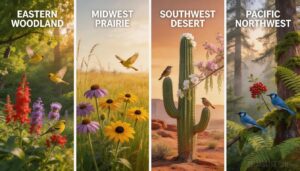
Not every native plant works everywhere — what draws warblers in Ohio won’t do much for a yard in Arizona. Your region shapes everything: the birds that visit, the insects they depend on, and the plants that actually thrive in your soil.
what works best, broken down by region.
Eastern US Natives for Songbirds and Migratory Species
The Eastern US is a migratory superhighway — and your yard can be a critical pit stop. Native trees like oak, serviceberry, and dogwood deliver insect host diversity that fuels warblers and thrushes on the move.
Seed persistence from coneflowers and black-eyed Susans bridges lean weeks.
Habitat connectivity through layered native plant backyard bird habitat provides seasonal bloom and fruit sequencing for migratory birds all year.
Midwest Prairie Grasses Like Little Bluestem and Switchgrass
Midwest yards have a secret weapon: little bluestem and switchgrass. Both grasses deliver seed nutrition deep into winter — their persistent seed heads feeding sparrows, finches, and mourning doves when little else is available.
They’re built for drought tolerance, fire resilience, and soil stabilization.
Plant them in masses for insect support, nesting cover, and genuine year-round feeding that costs almost nothing to maintain.
Southwest Xeriscaping With Cacti, Agave, and Trumpet Honeysuckle
Desert yards play by different rules — and that’s a good thing. Southwest xeriscaping turns drought-resilient soil and low-water irrigation into a bird habitat engine.
- Group cacti and agave using hydrozoning strategies to slash water use
- Lean on trumpet honeysuckle’s pollinator color palette to pull hummingbirds in
- Let spine habitat benefits shelter small roosting birds
- Plant native plants in well-drained soil to prevent root rot
- Stagger bloom windows so bird food sources never run dry
Using USDA Hardiness Zones to Select The Right Natives
Your USDA Hardiness Zone is the starting point — not the finish line.
Zone Matching narrows your plant list fast, but Microclimate Adjustments matter too: urban yards often run a full zone warmer.
Prioritize Ecotype Selection from regional nurseries to boost Plant Survival.
Your Planting Calendar follows from there.
| USDA Hardiness Zone | Recommended Natives | Key Bird Benefit |
|---|---|---|
| Zones 3–4 | Serviceberry, Bur Oak | Caterpillar host, winter acorns |
| Zones 5–6 | Dogwood, Winterberry | Year-round berries, nesting cover |
| Zones 7–8 | American Holly, Virginia Creeper | Persistent winter fruit, shelter |
Top 8 Native Plant Products for Bird Habitat
Native plants do most of the heavy lifting — but the right products can fill the gaps. Whether you’re just starting out or fine-tuning an established habitat, a few well-chosen additions make a real difference.
Here’s what’s worth a closer look.
1. Birdfy Smart Solar Bird House
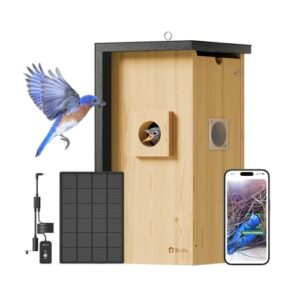
If you want to watch what’s actually happening inside your birdhouse, the Birdfy Smart Solar Bird House makes it genuinely possible. A built-in 1080p HD camera with night vision streams live footage straight to your phone — no wiring, no hassle.
The 3W solar panel keeps the 5200mAh battery charged off-grid. AI alerts notify you when birds arrive, nest, or fledge.
Natural fir wood blends into any backyard. At $149.99, it’s a front-row seat to nesting behavior without disturbing a single feather.
| Best For | Backyard bird lovers who want a hands-off way to watch nesting activity up close without spooking the birds. |
|---|---|
| Primary Purpose | Bird nesting monitor |
| Format | Physical device |
| Bird Benefit | Nesting habitat |
| Indoor/Outdoor Use | Outdoor |
| Target Audience | Bird watchers |
| Price Range | $149.99 |
| Additional Features |
|
- The built-in 1080p camera with night vision means you catch everything — first eggs, hatching, the whole story.
- Solar-powered with a solid 5200mAh battery, so it basically runs itself without constant recharging.
- The AI auto-identifies species and sends you alerts, so you never miss a big moment even when you’re not watching.
- The untreated fir wood can warp or mold over time, so you’ll need to keep an eye on it after a few seasons.
- Setup can be a little frustrating — the install video is only unlocked inside the app after you’ve already put it up.
- Only works on 2.4 GHz Wi-Fi, which can be spotty in busier networks or if your router is far from the yard.
2. Wellspring Trumpet Honeysuckle Live Plant
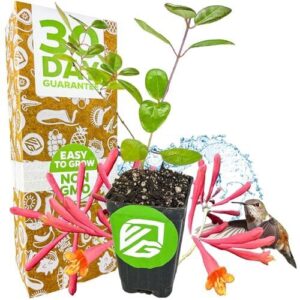
Once you’ve got the birdhouse sorted, it’s time to give visiting hummingbirds a reason to stay. Wellspring Gardens’ Trumpet Honeysuckle (Lonicera sempervirens) arrives as a live vine — small, yes, but built for the long game.
Those coral-red tubular flowers are basically a hummingbird magnet from late spring through early fall.
Train it up a trellis or fence and it’ll reach 10–20 feet. Arrives in a 3-inch pot, so give it room, steady water, and patience.
| Best For | Gardeners and patio enthusiasts who want to attract hummingbirds and butterflies with a fragrant, low-maintenance climbing vine. |
|---|---|
| Primary Purpose | Men’s accessory |
| Format | Physical accessory |
| Bird Benefit | None |
| Indoor/Outdoor Use | Indoor/Outdoor |
| Target Audience | General consumers |
| Price Range | Not specified |
| Additional Features |
|
- Those coral-red flowers are a proven hummingbird and butterfly magnet from late spring through fall.
- Works great on trellises, fences, or arches — can climb 10–20 feet once it gets going.
- Beginner-friendly once established, and doubles as a pretty accent for containers or window boxes.
- Plants arrive small and sometimes inconsistent in size or vigor — don’t expect a showstopper on day one.
- Needs careful sunlight acclimation at first, and real flowering likely won’t happen until the following season.
- Requires attentive watering and drainage early on — skip the care routine and you risk losing it.
3. White Flowering Dogwood Tree
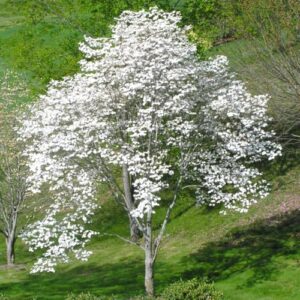
Few trees pull triple duty like the White Flowering Dogwood (Cornus florida). Spring brings those iconic white bracts — four broad petals framing tiny yellow‑green blooms — drawing early pollinators before most trees even leaf out.
By late summer, clusters of red berries ripen fast, and thrushes, waxwings, and robins show up like they got the memo. The dense branching shelters nesting birds all season.
It arrives at 10–16 inches, but give it a few years — it’s worth the wait.
| Best For | Gardeners and homeowners who want a low-maintenance ornamental tree that adds seasonal beauty, attracts wildlife, and grows into a genuine backyard centerpiece over time. |
|---|---|
| Primary Purpose | Pollinator attractant |
| Format | Live plant |
| Bird Benefit | Attracts hummingbirds |
| Indoor/Outdoor Use | Indoor/Outdoor |
| Target Audience | Home gardeners |
| Price Range | Not specified |
| Additional Features |
|
- Those white spring blooms are stunning — one of the earliest showstoppers in any yard
- Pulls double duty with red berries in late summer that birds absolutely love
- Ships already potted and ready to go, so getting started is easy
- Size and pot specs can be hit or miss — what shows up may not match what was listed
- Live plants take some stress during shipping, so it might look rough when it arrives
- Needs prompt care right out of the box — skip the watering and you could lose it fast
4. Ilex Red Sprite Winterberry Shrub

Red Sprite winterberry (Ilex verticillata) does one thing better than almost any other native shrub: it feeds birds when everything else has quit. Those oversized red berries — up to half an inch wide — cling through deep winter, drawing Eastern Bluebirds, mockingbirds, and robins straight to your yard.
It tops out at 3–4 feet, tolerates wet acidic soil, and ships container-ready from Green Promise Farms.
One catch: you’ll need a male pollinator like ‘Jim Dandy’ nearby to trigger that berry display.
| Best For | Gardeners in zones 3–8 who want low-maintenance winter color and love attracting birds to their yard. |
|---|---|
| Primary Purpose | Ornamental tree |
| Format | Live plant |
| Bird Benefit | Seasonal habitat |
| Indoor/Outdoor Use | Outdoor |
| Target Audience | Home gardeners |
| Price Range | Not specified |
| Additional Features |
|
- Huge red berries (up to ½ inch) that last all winter and bring in over 40 bird species
- Handles wet, acidic soil where most shrubs throw in the towel
- Compact size (3–4 ft) fits naturally into borders or works as a standalone accent
- Won’t produce berries without a compatible male plant like ‘Jim Dandy’ nearby
- Struggles in dry, alkaline soil or deep shade — not a fit for every yard
- At $67.99, you’re likely buying two plants to get fruit, so budget accordingly
5. Native Plants Pollinator Gardening Guide
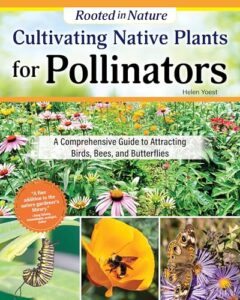
The Native Plants Pollinator Gardening Guide from Creative Homeowner packs serious science into 196 pages — without making you feel like you’re back in biology class. It covers region-specific planting recommendations across all major U.S. growing zones, bloom timing, water sources, and safe nesting sites.
For $19.99, you get actionable plans whether you’re converting a suburban lawn or restoring a community garden.
Beginners and experienced gardeners both find it useful — and the pollinator biology sections explain why your plant choices matter, not just what to plant.
| Best For | Home gardeners, teachers, and community groups across the U.S. who want science-backed guidance on building pollinator-friendly landscapes using native plants. |
|---|---|
| Primary Purpose | Wildlife shrub |
| Format | Live plant |
| Bird Benefit | Feeds 40+ species |
| Indoor/Outdoor Use | Outdoor |
| Target Audience | Wildlife gardeners |
| Price Range | $67.99 |
| Additional Features |
|
- Covers all major U.S. growing zones, so the advice actually applies to where you live
- Explains pollinator biology alongside planting tips, so you understand the "why" behind your choices
- At $19.99 and 196 pages, it’s an affordable, practical reference for beginners and seasoned gardeners alike
- Focused entirely on U.S. climate zones, so it’s less useful if you’re gardening outside the States
- Paperback only — no digital version or interactive tools to go along with it
- May feel a bit thin on detail for advanced horticulturists looking for deep dives on specific species or pest management
6. Australian Native Bird Attracting Plants
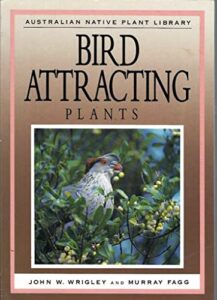
If you’re gardening in Australia, this 1990 HarperCollins reference is still worth hunting down. It covers native flowering shrubs — grevilleas, banksias, bottlebrush — alongside fruit-bearers like lilly pilly and seed producers like kangaroo grass.
Each entry pairs identification details with practical horticultural advice and ecological context. Yes, some taxonomy has shifted since publication. But the bird-plant relationships it describes? Those haven’t changed.
Honeyeaters still love banksia. bottlebrush blooms. Lorikeets still chase bottlebrush blooms. That core knowledge holds up fine.
| Best For | Gardeners, landscape designers, and conservation groups in Australia who want to attract native birds by choosing the right plants. |
|---|---|
| Primary Purpose | Pollinator guide |
| Format | Printed book |
| Bird Benefit | Habitat planning |
| Indoor/Outdoor Use | Indoor reference |
| Target Audience | Home gardeners |
| Price Range | $19.99 |
| Additional Features |
|
- Covers a solid range of native species — grevilleas, banksias, bottlebrush, lilly pilly — with real horticultural advice you can actually use.
- Pairs plant ID with ecological context, so you understand why certain birds are drawn to certain plants, not just which ones to grow.
- A reliable reference for habitat restoration projects and biodiversity planting, even decades after publication.
- Published in 1990, so some taxonomy and horticultural recommendations may be out of date.
- No digital edition available, and at 1.11 kg it’s not exactly something you’ll slip in a pocket for a nursery run.
- Only covers Australian native species — no use if you’re gardening anywhere else.
7. Native Plants for Bird Habitat
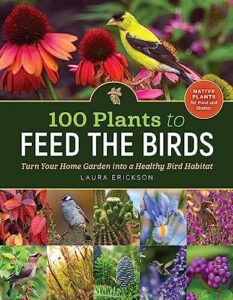
If you want one book that actually earns its shelf space, this is it. Native Plants for Bird Habitat covers 100 North American species — trees, shrubs, perennials — with full-color photos and range maps that make regional plant selection genuinely straightforward.
It’s organized around bird breeding, migration, and wintering cycles, so you’re not guessing what to plant or when.
At $12.99 for a 256-page hardcover, it’s less than a bag of birdseed — and it works a lot longer.
| Best For | Homeowners, birdwatchers, and gardeners who want to attract native birds by transforming their yard with the right North American plants. |
|---|---|
| Primary Purpose | Bird plant guide |
| Format | Printed book |
| Bird Benefit | Bird-friendly plants |
| Indoor/Outdoor Use | Indoor reference |
| Target Audience | Australian gardeners |
| Price Range | Not specified |
| Additional Features |
|
- Covers 100 native species with full-color photos and range maps — easy to find what works in your area
- Organized around bird breeding, migration, and wintering cycles, so the advice is actually timed to be useful
- Solid value at $12.99 for a well-built 256-page hardcover
- Strictly North America only — no help if you’re gardening outside the U.S. or Canada
- Range maps are general; don’t expect detailed soil or microclimate guidance
- The e-book version has reported technical issues, so stick with the physical copy
8. Classic 8cm Men’s Solid Lattice Tie

This one doesn’t belong here — and that’s worth saying plainly.
The Classic 8cm Men’s Solid Lattice Tie is a well-made necktie: silk-polyester blend, clean lattice weave, suitable for weddings or business meetings. It’s a solid gift for the well-dressed person in your life.
But it has nothing to do with native plants, bird habitat, or feeding wildlife. If you landed here looking for habitat guidance, skip this one and stay with the plants.
| Best For | Men who want a versatile, easy-knot tie that works equally well at a wedding or a Monday morning meeting. |
|---|---|
| Primary Purpose | Bird habitat guide |
| Format | Printed book |
| Bird Benefit | Year-round food source |
| Indoor/Outdoor Use | Indoor reference |
| Target Audience | North American gardeners |
| Price Range | $12.99 |
| Additional Features |
|
- The silk-polyester blend gives it a smooth look without being as fragile as pure silk
- The heavyweight lining makes it easy to tie a clean, crisp knot every time
- Works across a wide range of occasions — weddings, business, casual nights out
- Not 100% silk, so it may feel or drape slightly differently if you’re used to the real thing
- Needs gentle care — hand wash or dry-clean only, which adds a little hassle
- Fixed 8cm width won’t work for anyone who prefers a slim or wide cut
Design a Layered Habitat That Feeds Birds All Year
A bird-friendly yard isn’t just about what you plant — it’s about how you stack it. Think of your space in layers, each one pulling its own weight through a different season.
Here’s how to build that structure from the ground up.
Building Canopy, Understory, and Ground Layer Structure
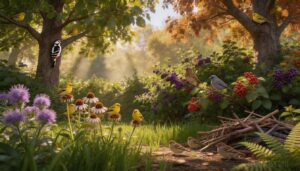
Think of your yard as a forest in miniature — built from Vertical Layers that birds navigate instinctively.
Start with native trees forming the canopy, let Canopy Gaps invite light and migrant activity, then fill the middle with shrubs offering Understory Nectar.
Drop to Groundcover Seedheads and tuck in Brush Piles at the edges.
Layering native plants by height transforms any space into a working habitat.
Install Shallow Water Features, Drippers, and Mud Puddles
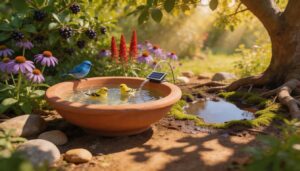
Your layered planting sets the stage — now water seals the deal.
Set a shallow birdbath (1–2 inches deep) on level ground away from deep shade: Basin Placement Tips matter here. Solar Pump Integration keeps flow steady without running electric lines.
- Dripper Flow Adjustment: 1–2 liters per minute mimics gentle rain
- Mud Puddle Construction: dig 2–4 inches deep, keep edges uneven
- Seasonal Water Management: increase drip rate in summer heat
Birds find mud puddles irresistible — don’t skip them.
Retaining Leaf Litter and Dead Wood for Overwintering Insects
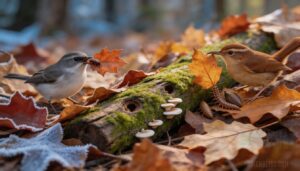
Water keeps birds coming—leaf litter and dead wood keep the food chain alive. A patch of leaf litter, paired with decaying logs, builds microhabitat complexity.
You’re banking microhabitat moisture, leaf litter depth, and invertebrate refuge for winter insect survival.
Check out the practical impact:
| Resource | Bird Benefit |
|---|---|
| Leaf Litter Depth | Winter Insect Survival |
| Dead Wood Decay | Invertebrate Refuge |
| Microhabitat Moisture | Seasonal Food Supply |
| Invertebrate Refuge | Pest Control |
| Litter Complexity | Year-Round Foraging |
Avoiding Pesticides to Protect The Bird Food Web
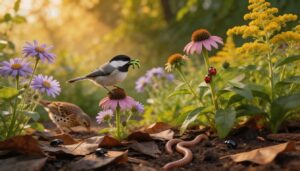
Leaf litter feeds the food web — pesticides break it. Even one broad-spectrum pesticide application can collapse the native insect reservoirs you’ve spent seasons building. Organic pest control keeps that web intact.
- Hand-pick pests instead of spraying
- Use Chemical-Free Mulching to suppress weeds naturally
- Apply neem oil only to targeted plants
- Build Beneficial Insect Habitat with flowering natives
- Follow Integrated Pest Management thresholds before acting
Native plant diversity does the heavy lifting — trust it.
Registering Your Yard as a Certified Wildlife Habitat
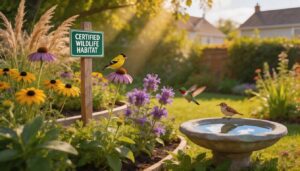
Once your habitat checks the boxes — food, water, shelter, nesting sites, and sustainable practices — the National Wildlife Federation’s Certification Application costs about twenty dollars and an honor‑system form.
There are no monitoring requirements or site visits.
Registering gardens with Certified Wildlife Habitat programs puts your native plant diversity and bird‑friendly design on the map, and the yard sign sparks community outreach you never planned for.
Frequently Asked Questions (FAQs)
What native plants feed birds in winter?
Winterberry holly, hawthorn haws, viburnum berries, and serviceberry fruit top the list.
Coneflower seeds and switchgrass seeds carry finches through frost.
Evergreen shelter ties it together — berry-bearing native shrubs as winter food sources that never quit.
Which native plants deter deer and rabbits effectively?
Spiky perennials like yarrow, aromatic repellents like mountain mint, thorny shrubs like juniper and holly, tough textures like spicebush and sumac, and height barriers from evergreen shelter all deter deer and rabbits effectively.
How do native plants affect local water runoff?
Native plants act like living sponges. Deep roots improve Root Zone Infiltration, cutting Runoff Volume Reduction dramatically. Riparian Buffer Strips filter pollutants. Stormwater Retention improves naturally — no infrastructure required.
Can container gardens support meaningful bird habitat?
Absolutely — even a Roman courtyard garden fed wildlife, and yours can too.
With smart Pot Size Optimization, Drainage Media, and Vertical Tiering, container setups deliver real microhabitat complexity for birds year‑round.
Conclusion
The less you do, the more birds you feed. That’s the quiet logic behind native plants year round bird food—a system built by nature, maintained by itself.
Plant an oak, leave the seed heads standing, skip the pesticides.
yard starts working while you’re not watching. Migrants find the insects. Bluebirds find the berries. Chickadees find the seeds.
You didn’t fill a single feeder. You built something better—a habitat that feeds long after you’ve gone inside.