This site is supported by our readers. We may earn a commission, at no cost to you, if you purchase through links.
 You’ll discover America’s most coveted rare bird sightings through real-time mapping platforms like eBird, which track vagrant species across migration corridors and coastal hotspots.
These digital treasure maps reveal where storm-blown Pacific wanderers, overshooting warblers, and climate-driven range expansions create birding gold mines from coast to coast.
Modern smartphone apps deliver instant alerts when rarities appear within your chosen radius, turning every birder into a connected member of a continent-wide surveillance network.
Weather patterns, seasonal migrations, and citizen science databases combine to paint an ever-changing picture of avian rarity distribution that’s more accurate than ever before, thanks to real-time mapping platforms.
Table Of Contents
- Key Takeaways
- Rare Bird Sightings USA
- Birding Apps and Technology
- EBird Alerts and Features
- Top Birdwatching Locations
- Conservation Efforts USA
- Frequently Asked Questions (FAQs)
- Where can I find rare bird sightings?
- How do I find out if a bird has a rare sighting?
- Does eBird track rare birds?
- Why are rare bird sightings so rare?
- Are there bird sightings in Florida?
- What is a bird rarity score?
- Who has seen 10,000 birds?
- What is a code 5 bird?
- What is the rarest bird right now?
- How do rare bird maps verify sighting accuracy?
- Conclusion
Key Takeaways
- You’ll access America’s premier rare bird tracking through eBird alerts and modern birding apps that deliver instant notifications when Code 3+ species appear within your chosen radius
- Storm patterns and weather events create the best rare bird opportunities, as hurricanes and unusual weather systems drive vagrant species far from their typical ranges into unexpected locations
- Real-time mapping platforms like eBird combine with smartphone technology to connect you to a continent-wide network of birders, ensuring you’ll never miss a mega-rarity in your area
- Conservation concerns affect over one-third of U.S. bird species, making your rare bird sightings and citizen science contributions critical for tracking population changes and supporting preservation efforts
Rare Bird Sightings USA
You’ll find some of North America’s most extraordinary avian visitors scattered across the continent, from vagrant Yellow-legged Gulls in Florida to long-staying Steller’s Sea-Eagles in Newfoundland.
These rare sightings create a treasure map for dedicated birders, with weather patterns and seasonal migrations bringing unexpected species far from their typical ranges, illustrating the concept of complete concepts in bird migration patterns.
**Weather patterns turn migration routes into surprise treasure hunts, delivering extraordinary species to unexpected destinations.
Long-Staying Rarities in USA
Beyond mere sighting maps, rare bird sightings reveal fascinating rarity duration patterns across American birding hotspots.
You’ll discover that habitat suitability directly influences how long uncommon species linger—like California’s Eurasian wigeon, which defied migration patterns for six consecutive winters.
These extended stays provide essential conservation needs data, helping researchers understand population viability while delivering exciting rare bird alerts for dedicated birders tracking unusual visitors.
Impact of Weather on Bird Migration
Weather acts as nature’s traffic controller, dramatically reshaping migration patterns and creating unexpected birding opportunities.
Nature’s winged migrants follow storm-carved highways, turning weather chaos into birding gold.
Hurricane Idalia scattered over 55 American Flamingos across Florida, while Hurricane Sally delivered Mississippi’s first Red-footed Booby.
Storm-driven birds often appear far from typical habitat ranges, transforming local birding hotspots into treasure troves for rare bird sightings and uncommon species discoveries.
Birding Apps and Technology
Modern birding apps transform how you track and identify birds in the field.
BirdBeacon offers App Accuracy through Smart Identification tools that match your photos with extensive databases, while Offline Birding capabilities let you access species information without cell service.
The live sightings map displays realtime bird sightings from your Community Sharing network, connecting birders nationwide who report discoveries instantly.
Your bird tracking app becomes a Personalized Journal that logs every sighting with GPS coordinates, weather data, and behavioral notes.
Bird alerts notify you when rare species appear nearby, turning your phone into bird tracking technology that rivals expensive field equipment.
These platforms combine artificial intelligence with crowdsourced data, creating identification systems that learn from millions of user submissions.
For example, the Merlin Bird ID app is known for its user-friendly interface and high accuracy.
Whether you’re chasing vagrant warblers or documenting backyard species, these tools provide unprecedented access to birding intelligence that would’ve taken decades to compile just twenty years ago.
EBird Alerts and Features

You’ll receive real-time notifications when rare birds appear in your chosen regions through eBird’s sophisticated alert system.
The platform automatically filters sightings based on ABA rarity codes and your personal birding history, ensuring you never miss a Code 3 species or higher in your area.
Personalized Rare Bird Alerts
You’ll receive personalized alerts customized to your specific reporting history and regional preferences.
eBird’s alert customization lets you set alert frequency, ensuring you don’t miss uncommon bird alerts while avoiding notification overload.
The rare bird database tracks your sightings, removing species you’ve already recorded from future bird alerts, which helps with reporting accuracy and data privacy.
Regional specificity means you’ll only get rare bird reports from areas you select, while regional preferences and reporting history remain protected throughout the system, ensuring a tailored experience with personalized alerts.
Needs Alerts for Unrecorded Species
eBird’s Needs Alerts notify you about species missing from your reporting history within specific regions.
These personalized birding alerts automatically update based on submission dynamics, removing species after you’ve recorded them.
Unlike standard uncommon bird alerts, Needs Alerts focus on expanding your personal bird sighting map through regional customization rather than flagging official rarities.
The Waterman Bird Club utilizes a rare bird alert system to notify members of notable sightings.
- Never miss that life bird – Get notified the moment someone spots a species you haven’t recorded yet
- Watch your list grow automatically – Species disappear from alerts once you’ve added them to your rare bird database
- Feel the thrill of discovery – Each ABA Rare Bird Alert becomes a potential adventure waiting to unfold
Alert Customization Options
You’ll customize your ABA Rare Bird Alert preferences through region specificity and species selection based on your reporting history.
Custom filters let you adjust alert frequency and receive email notifications for targeted bird species alerts.
Bird alert systems adapt to your eBird submissions, removing species you’ve already recorded while maintaining thorough bird notifications coverage.
Birds also use alarm calls to warn of danger, utilizing their unique communication methods for bird notifications.
Integration With ABA Rarity Codes
Now that you’ve tweaked your alerts, you’ll notice how the ABA Code System steps in to boost Rarity Alert Accuracy.
The American Birding Association’s codes help the bird tracker map sort rare bird sightings by region, but Code Application Challenges and Regional Code Variations mean the Data Validation Process matters.
ABA Rarities Alerts keep you on top of birding hotspots USA.
Top Birdwatching Locations
You’ll find America’s premier birding destinations scattered across diverse ecosystems, each offering unique opportunities to spot rare and migratory species.
These carefully selected locations represent the continent’s most productive hotspots, where geographic features, habitat diversity, and migration corridors create perfect conditions for exceptional bird sightings, making them ideal for exceptional bird sightings.
Eastern USA Birdwatching Hotspots

The East Coast’s premier birding hotspots USA showcase incredible migration corridors where millions of birds funnel through each spring and fall.
You’ll discover coastal birding treasures alongside surprising urban oases that attract rare bird sightings year-round.
- Cape May, New Jersey – Over 400 species annually with peak autumn migration creating spectacular hawk flights
- Central Park, New York – Nearly 200 migratory species in this urban oasis, with single-day counts reaching 100 species
- Magee Marsh, Ohio – The "Warbler Capital of the World" where birding trails offer unmatched spring migration viewing
- Hawk Mountain, Pennsylvania – Up to 20,000 raptors funnel through these inland habitats each fall, providing seasonal variety
For unparalleled bird diversity, consider visiting Montrose Point in Chicago.
Western USA Birdwatching Destinations
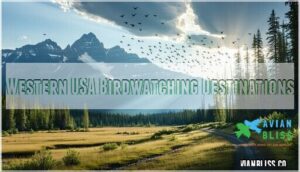
The Western USA transforms birding maps into treasure troves, where diverse ecosystems create premier bird watching locations across dramatic landscapes.
| Region | Key Species |
|---|---|
| Pacific Northwest | Tufted Puffins, Black Swifts |
| California Coast | 500+ species at Point Reyes |
| Desert Southwest | Rare vagrant species |
| Rocky Mountains | Western mountain specialists |
| Island Endemics | Leach’s Storm Petrels |
Point Reyes National Seashore claims the title of America’s birdiest national park, while Cape Flattery offers cliff-nesting marine birds.
California’s varied habitats support the nation’s highest species diversity, making birding locations map essential tools for tracking these western gems across the USA.
Birders often rely on detailed birding resources to enhance their experience.
Southern USA Birdwatching Locations
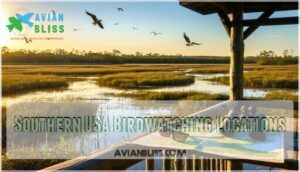
You’ll discover the South transforms into a birder’s paradise, where Texas leads with 623 species recorded and Smith Point Hawk Watch logs 100,000 raptors daily.
Florida ranks second nationally for endemic birds, while Louisiana’s Mississippi Flyway position creates prime Gulf Coast birding.
These Southern ecosystems offer unmatched coastal birding experiences across diverse USA birding locations maps.
The region’s birding activity relies on accurate birding maps data to track species migration patterns.
Northern USA Birdwatching Spots

Alaska’s birding scene delivers incredible diversity with high per-capita birdwatcher participation and exceptional arctic species at migration stopovers.
You’ll find Montezuma Birds flourishing in Minnesota’s wildlife refuges, while Adirondack Park and Vermont’s forests support dense checklist activity.
Yellowstone Wildlife offers uncommon western mountain species, and Pribilof Islands provide access to rare arctic birds on your bird watching map.
The best birding spots often involve understanding local bird watching spots to maximize sightings and enjoy the overall birding scene.
Conservation Efforts USA

You’re witnessing one of conservation’s most critical challenges, as over one-third of U.S. bird species now face high or moderate conservation concerns in 2025.
Successful grassroots campaigns like the Atlantic Coast’s American Oystercatcher recovery prove that targeted efforts can reverse declining populations when communities act quickly, which is a key example of how conservation concerns can be addressed.
Threats to Rare Bird Species
While you’re discovering incredible birdwatching locations across America, you’ll encounter species facing unprecedented challenges.
Rare bird sightings reveal troubling patterns as human impact accelerates extinction risk through multiple pathways.
The threats endangering our most precious bird species map includes:
- Habitat Loss – Over 2.9 million wetland acres vanished since the 1980s, destroying critical breeding grounds
- Climate Change – Rising temperatures shift migration timing for 35+ rare species, disrupting ancient patterns
- Pollution Effects – Pesticides caused population declines in 27 rare bird species from 2015-2022
- Invasive Predators – Non-native mammals threaten 61 rare North American bird species through nest predation
These conservation challenges demand immediate attention from birders and researchers alike. Understanding the current bird conservation status is vital for developing effective strategies to protect rare species.
Successful Conservation Campaigns
You’ll witness amazing comeback stories when conservation efforts succeed.
The California Condor population soared from just 22 birds in 1982 to over 560 today through captive breeding programs.
Species protection initiatives helped Kirtland’s Warbler triple its numbers to 2,300, earning removal from endangered lists.
These wildlife preservation victories prove eco friendly policies work for rare bird sightings recovery.
Importance of Habitat Preservation
When you preserve critical bird habitats, you’re basically saving entire ecosystems from collapse.
Habitat loss remains the primary threat to rare bird sightings across America, disrupting ecosystem balance and forcing species into unsuitable areas.
Wildlife conservation efforts focusing on biodiversity protection create environmental sustainability that benefits both bird migration patterns and local communities.
Your support for bird habitat conservation directly impacts whether future generations will witness these remarkable species in their natural environments, which is crucial for maintaining ecosystem balance, supporting wildlife conservation, and ensuring environmental sustainability.
Climate Change Impact on Bird Populations
Climate change now reshapes bird migration patterns across North America, creating unprecedented challenges for rare species conservation.
You’ll witness dramatic population shifts as warming temperatures force birds into unfamiliar territories, while extreme weather events disrupt traditional flyways.
- Over 50% of bird species have shifted ranges northward due to climate warming
- Spring migrations now occur 2 weeks earlier than in the 1970s, disrupting food timing
- Habitat loss threatens 389 species with 50% range reduction by 2080
- Extreme storms cause 25% nest failure rates among ground-nesting birds
- North America has lost 2.9 billion birds since 1970, representing 30% population decline
These climate shifts make rare bird sightings both more unpredictable and critically important for tracking species survival.
Frequently Asked Questions (FAQs)
Where can I find rare bird sightings?
Over one-third of U.S. bird species face conservation concerns, making rare sightings essential.
You’ll find rare birds through eBird’s alerts system, which tracks ABA code 3+ rarities nationwide, plus specialized apps like BirdBeacon for real-time notifications.
How do I find out if a bird has a rare sighting?
Check eBird’s rare bird alerts, use apps like BirdBeacon or Merlin, or follow automated bots on social media that track ABA Code 3-5 species for real-time notifications.
Does eBird track rare birds?
Yes, eBird tracks rare birds through specialized alert systems. You’ll receive email notifications for ABA code 3+ species and personalized alerts for birds you haven’t recorded in your selected regions.
Why are rare bird sightings so rare?
Habitat destruction, climate change, and human development squeeze rare species into shrinking refuges. Weather patterns, migration routes, and breeding cycles become disrupted. You’re witnessing nature’s increasingly fragile balance unraveling.
Are there bird sightings in Florida?
Florida boasts exceptional rare bird diversity, including Hurricane Idalia’s scattered American Flamingos (55+ individuals), Yellow-legged Gulls (potentially the state’s first record), and long-staying La Sagra’s Flycatchers nesting annually.
What is a bird rarity score?
A bird rarity score measures how uncommon a species is in a specific area using standardized codes.
You’ll see ABA codes 1-5, where higher numbers indicate rarer birds that excite birders more.
Who has seen 10,000 birds?
Ah, you’re asking about the legendary "10,000 species club" – those mythical birders who’ve apparently seen everything with wings.
While no official registry exists, veteran birders estimate fewer than 100 people worldwide have reached this milestone through decades of dedicated travel and obsessive listing, making it a truly exclusive and mythical achievement.
What is a code 5 bird?
A Code 5 bird represents the rarest category in the American Birding Association’s classification system.
You’ll encounter species with fewer than three accepted North American records, making each sighting extraordinarily significant for birders.
What is the rarest bird right now?
Mind-blowingly elusive, you’ll find the Steller’s Sea-Eagle in Newfoundland stands as North America’s rarest visitor.
This massive Asian raptor has defied odds, staying over eighteen months in unfamiliar territory, making it an extraordinary Code 5 rarity that’s enchanting birders continent-wide, with its presence being truly mind-blowingly elusive.
How do rare bird maps verify sighting accuracy?
You’ll find that rare bird maps rely on multiple verification layers including expert reviewers, photographic documentation, and cross-referencing with regional databases to guarantee accuracy before publishing confirmed sightings.
Conclusion
Armed with your smartphone and these digital tools, you’re now equipped to chase America’s most elusive avian treasures.
The rare bird sightings map USA networks transform every outing into a potential discovery, connecting you to a vast community of passionate birders.
Whether you’re tracking storm-driven vagrants or climate-displaced species, these real-time platforms guarantee you’ll never miss the next mega-rarity appearing in your region.
- https://support.ebird.org/en/support/solutions/articles/48000960317-ebird-alerts-and-targets-faqs
- https://watermanbirdclub.org/resources/rare-bird-alert/
- https://groups.google.com/g/mdbirding/c/ecsZc8fMeGw
- https://birda.org/best-birdwatching-apps-in-the-usa/
- https://bcbirdtrail.ca/field-notes/birding-101-essential-apps/