This site is supported by our readers. We may earn a commission, at no cost to you, if you purchase through links.
A wood thrush singing from a patch of suburban trees might seem unremarkable—until you realize that same species has vanished from forests where it thrived thirty years ago. Songbird populations don’t shift randomly. They follow precise ecological logic tied to climate zones, forest structure, and landscape connectivity.
Understanding where birds actually live, not just where they’ve been spotted once, separates casual observation from meaningful insight. A solid regional songbird distribution guide decodes those patterns—turning raw map data into a working picture of habitat quality, seasonal movement, and population health across every region you care about.
Table Of Contents
- Key Takeaways
- What Regional Songbird Distribution Maps Reveal
- How to Read Songbird Range Maps
- Regional Songbird Profiles by Habitat Type
- Northeastern Mature Hardwood Forests and Forest Thrushes
- High‑elevation Spruce–fir Specialists in The Northeast
- Boreal Conifer Forests and Northern Warbler Distributions
- Moist Lichen‑rich Forests and Canopy‑nesting Species
- Southeastern Shrublands and Edge‑dwelling Songbirds
- Suburban Gardens and Year‑round Backyard Songbirds
- Intermountain West Rangelands and Density‑based Maps
- Comparing Regional Hotspots and Local Endemism Patterns
- Using Distribution Data for Conservation Planning
- Identifying Priority Regions for Songbird Conservation
- Designing Protected Areas Around Core Breeding Ranges
- Targeting Habitat Restoration in Declining Strongholds
- Planning Corridors Along Migration Stopover Routes
- Evaluating Land‑use Changes Against Regional Maps
- Assessing Management Impacts on Target and Non‑target Species
- Monitoring Climate‑driven Shifts in Regional Distributions
- Integrating Distribution Models Into Policy Decisions
- Citizen Science Tools for Mapping Songbirds
- Using EBird Maps to Explore Regional Songbird Ranges
- Contributing Checklists to Improve Distribution Models
- Interpreting Trend and Abundance Layers for Your Region
- Ground‑truthing Range Predictions With Local Observations
- Combining Backyard Observations With Regional Datasets
- Supporting Adaptive Management With Shared Map Data
- Ethical Field Practices to Protect Mapped Nesting Areas
- Frequently Asked Questions (FAQs)
- Conclusion
Key Takeaways
- Range maps reveal far more than bird locations—they decode habitat quality, seasonal movement, and population health when you know how to read the colors, gradients, and gray zones, honestly.
- The gap between presence-absence data and abundance gradients is critical: knowing where a species thrives, not just where it’s been spotted, is what drives smart conservation decisions.
- Habitat type is destiny for songbirds—whether it’s mature northeastern hardwoods, boreal conifers, or suburban gardens, each ecosystem shapes behavior, nesting, and survival in predictable, mappable ways.
- Your backyard checklist and local field observations aren’t just personal records—they directly sharpen regional distribution models and fill the data gaps that guide real conservation policy.
What Regional Songbird Distribution Maps Reveal
Regional songbird distribution maps are more than pretty colors on a page; they’re compact summaries of where each species can actually live, and why.
Those maps become even more useful when you can tell apart look-alikes like the Blue Grosbeak and Indigo Bunting, two brushy-edge species whose ranges often overlap in surprisingly similar habitat.
They hint at habitat, climate, abundance, and even where our data are still thin.
In the sections below, we’ll unpack what these maps reveal, piece by piece.
Why Regional Distribution Matters for Songbird Ecology
Because songbird ecology is regional, range maps do more than show dots on a page; they reveal how species distribution reacts to climate niche alignment and edge population dynamics.
You can read:
- Seasonal resource matching and bird migration patterns
- Genetic flow patterns across landscapes
- Landscape connectivity impacts on survival synchrony
- Where habitat protection best aids conservation.
Recent research highlights gene expression variation across populations in black‑capped chickadee and American goldfinch.
Linking Songbirds to Habitats and Climate Zones
Range maps reveal how species align with specific climate zones and habitats. You’ll notice Habitat‑Zone Overlap where birds track Elevation‑Specific Niches and Seasonal Climate Matching. These songbird habitat range maps show Climate‑Driven Range boundaries shaped by Microhabitat Temperature Tolerance.
| Habitat Type | Climate Zone | Example Species |
|---|---|---|
| Boreal Conifer | USDA Zones 1–4 | Blackpoll Warbler |
| High-Elevation Spruce-Fir | Cool Montane | Bicknell’s Thrush |
| Northeastern Hardwood | USDA Zones 3–5 | Wood Thrush |
| Southeastern Shrubland | Humid Subtropical | Eastern Towhee |
Species distribution modeling helps you understand climate change impacts on wildlife and guide habitat protection along bird migration patterns. The Bicknell’s thrush decline of 48.5% over the past 15 years underscores the need for targeted conservation.
Spatial Niches and Habitat Suitability Filtering
Once you see how climate zones shape ranges, you can zoom in on where birds actually fit.
Spatial analysis and species distribution modeling test habitat suitability by asking: at what Elevation Gradient, Foraging Stratum, and Vertical Stratification does a species persist, and under what Matrix Quality?
Acoustic Partitioning, habitat preservation priorities, and ecological monitoring all fall out of that work.
Extent of Occurrence Versus Core Occupied Range
After modeling habitat filters, you still need range context.
- Extent of Occurrence captures Geographic Extent of species’ distribution.
- It draws a Range Boundary on range maps.
- Core occupied range marks habitats where birds persist, refining Habitat Metrics.
- You track higher Species Density cells to guide habitat preservation.
- Together, they sharpen Conservation Status and ecological monitoring.
Abundance Gradients Versus Simple Presence–absence
Two maps can cover the same region yet tell very different stories. Presence–absence shows where a species occurs, but abundance gradients reveal where it actually thrives—highlighting abundance hotspots and density trends that simple occupancy misses.
For conservation prioritization, that difference matters enormously. Detection bias inflates thin-edge records, so tracking habitat suitability alongside bird population dynamics gives you a far sharper read on species distribution and population trends.
Communicating Uncertainty and Data-deficient Regions
Not every corner of a range map tells the same story—and honest maps say so upfront. Dark gray zones flag areas where fewer than 100 checklists exist, while hatching and stippling act as Uncertainty Visuals and Transparency Indicators that signal shaky predictions.
These Data‑Deficiency Mapping tools, paired with Gap‑Focused Outreach, guide citizen science efforts toward understudied regions, strengthening Confidence Scales across species distribution, biodiversity monitoring, and ecological monitoring and conservation.
How to Read Songbird Range Maps

A range map looks simple at first glance, but there’s a lot packed into those colors and shaded zones.
Once you know what each element means, the whole picture clicks into place.
For a fuller picture of current ranges, monitoring, and climate pressures, see this detailed Caspian tern ecology and habitat guide.
Here’s what to pay attention to as you learn to read them.
Understanding Map Keys, Legends, and Color Codes
Think of a range map’s legend as your decoder ring. Without it, you’re just staring at colorful shapes. Red shades mark breeding zones, blue covers wintering areas, and purple signals year-round presence.
eBird’s Abundance Gradient Scales shift from pale yellow to deep purple as density rises. Gray patches are honest Uncertainty Indicators — the map simply doesn’t know yet.
Identifying Breeding, Migration, and Wintering Areas
Each color zone on range maps tells a specific seasonal story. Red Breeding Zones light up from May through July, Blue Winter Grounds anchor Neotropical migrants like wood thrushes in Central America, and Yellow Migration Corridors trace the flyways connecting them.
Watch for these three map signals:
- Red shading — core breeding habitat, confirmed by singing males
- Yellow bands — active migration corridors through stopover regions
- Gray patches — Data Gap Indicators where eBird’s Abundance Gradient Mapping has limited coverage
Interpreting Year‑round Versus Seasonal Residency
Purple doesn’t always mean “same bird, all year.” On range maps, that solid purple zone signals year‑round presence — but Turnover Dynamics can explain it just as well as true residency. American Robins demonstrate this perfectly: northern breeders fly south while wintering flocks move in, maintaining Purple Zone Criteria through population waves.
| Feature | True Residents | Seasonal Migrants |
|---|---|---|
| Resident Trait Indicators | Seed caching, territory defense | Breeding‑only habitat use |
| Seasonal Migration Contrast | None — stable year‑round | Distinct red/blue split |
| Data Density Thresholds | Weekly detections all 52 weeks | Seasonal cluster patterns |
Recognizing Gray Areas, Gaps, and Model Limits
Gray zones on range maps aren’t failures — they’re honest flags. When eBird’s species distribution models hit Data Deficient Regions, darker gray signals where Prediction Uncertainty and Model Extrapolation Risks make results unreliable.
Sampling Bias skews data toward well-watched trails, while Observational Bias Limits reduce accuracy in dense forests. Treat gray as a prompt: those areas need more citizen science checklists, not more assumptions.
Accounting for Map Resolution and Regional Scale
Resolution Trade‑offs shape everything you see on range maps. eBird’s 3 km grids catch fine Habitat Patch Detection that coarser scales miss entirely — Grain‑size Impacts matter.
Scale‑dependent Uncertainty grows when species distribution data gets aggregated to 27 km pixels.
Multi‑scale Modeling helps, but watch for these gaps in geospatial analysis:
- Local microhabitats vanish at broad scales
- Intermountain West rangelands appear deceptively uniform
- Habitat management strategies built on coarse maps can mislead
Detecting Long‑term Shifts in Mapped Ranges
Scale shapes what you see, but time shapes what it means. Comparing range maps decade by decade reveals Leading Edge Expansion at higher latitudes and Trailing Edge Contraction where drier conditions squeeze habitat. Climate-Driven Range Shifts show up as fading southern colors and deepening northern ones.
Citizen-Science Trend Analysis through eBird turns millions of checklists into Visual Change Indicators, making biodiversity monitoring and geospatial analysis genuinely accessible.
Regional Songbird Profiles by Habitat Type
Where a songbird lives tells you almost everything about it.
Habitat shapes their behavior, their nesting choices, and how far they travel each year.
Here’s a look at the key habitat types across North America and the songbirds that call each one home.
Northeastern Mature Hardwood Forests and Forest Thrushes

If you want to understand why habitat range maps show Wood Thrush clustered in the Northeast’s mature hardwoods, look at what these forests actually offer.
Canopy structure creates deep shade that keeps leaf litter moist, sustaining the leaf litter invertebrates that thrushes depend on.
Add moist microhabitats near streams, snag availability for insects, and occasional early successional patches, and you’ve got prime species distribution territory for forest ecology’s most iconic singers.
High‑elevation Spruce–fir Specialists in The Northeast

Move up from those hardwood hollows and the forest ecology changes fast. Above 2,500 feet, dense balsam fir and red spruce take over — and so do specialists like Bicknell’s Thrush, the Northeast’s rarest migratory songbird.
Songbird habitat range maps show these species squeezed into narrow montane bands.
Balsam fir decline, upslope competition from generalists, and wind development impacts make these climate refugia critical conservation targets facing a real mountaintop squeeze.
Boreal Conifer Forests and Northern Warbler Distributions

Head north past those montane spruce belts and you’re in full boreal territory — sprawling conifer forest stretching across Canada where warblers like Bay-breasted, Cape May, and Blackpoll define the soundscape.
Songbird habitat range maps reveal how tightly these species track spruce distribution:
- Spruce Budworm Outbreaks spike Cape May Warbler densities dramatically
- Fire Regime Impacts reset stand structure, shifting species distribution by age class
- Permafrost Thaw Effects and Habitat Edge Dynamics reshape habitat requirements annually
- Climate-Driven Range Modeling confirms Blackpoll’s breeding range shifted ~600 km northward — a vivid signal of climate change impacts on wildlife and evolving bird migration patterns
Moist Lichen‑rich Forests and Canopy‑nesting Species

Shift west to the fog-draped Pacific coast and you’re in a different world entirely.
Moist lichen-rich forests — think old Douglas-fir and Sitka spruce draped in Usnea and Bryoria — create unique Lichen Habitat Structure that defines species distribution here.
Canopy Microclimate Benefits keep nest sites cool and stable.
Marbled Murrelets exploit thick moss mats for Nest Platform Camouflage, making Old-Growth Preservation non-negotiable.
Climate-Driven Lichen Shifts now threaten these habitat requirements directly.
Southeastern Shrublands and Edge‑dwelling Songbirds

Down in the Southeast, Shrubland Succession shapes everything.
Prairie warblers, eastern towhees, and yellow-breasted chats don’t want tall timber — they need dense, tangled edges.
Fire-Driven Habitat renewal and logged clearings create the regenerating thickets these species depend on.
Understanding their Edge Nesting Strategies, Insect Foraging Tactics, and Seasonal Song Variation helps you connect Geographic Distribution of Species directly to habitat loss, habitat restoration, and broader songbird conservation goals.
Suburban Gardens and Year‑round Backyard Songbirds

Your backyard is closer to a wildlife corridor than you might think.
Your backyard may be the wildlife corridor songbirds need most
Northern cardinals, black‑capped chickadees, white‑breasted nuthatches, and downy woodpeckers all thrive year‑round in suburban gardens when habitat requirements are met. Smart Feeder Seed Selection, Native Plant Landscaping, and thoughtful Nesting Habitat Features dramatically boost bird diversity:
- Offer black oil sunflower seeds and suet for Seasonal Food Resources
- Plant native plants to support insect availability
- Maintain dense shrubs for nesting cover
- Practice Predator Management Strategies by placing feeders away from ambush points
- Support habitat restoration through vertical planting layers
Intermountain West Rangelands and Density‑based Maps

Out in the Intermountain West, sagebrush isn’t just scenery — it’s infrastructure.
Brewer’s Sparrows and Sage Thrashers respond sharply to a Sagebrush Cover Threshold near 40 percent, where density‑habitat relationships really click into gear.
Elevation Range Effects and Grazing Management Impacts both shape where birds land on range maps.
Habitat Covariate Modeling and Uncertainty Masking Techniques help managers turn point‑count data into practical habitat management decisions.
Comparing Regional Hotspots and Local Endemism Patterns

Not every region earns hotspot status equally.
The Southern Appalachians demonstrate striking Phylogenetic Concentration, with 11 endemic breeding taxa shaped by Climate Refugia Contrast spanning 21,000 years.
Meanwhile, California’s chaparral shows Endemic Hotspot Overlap across 9 resident songbirds.
Elevational Endemism Gradient patterns — like Bicknell’s thrush retreating above 5,000 feet — reveal how Human Impact Divergence and Species Distribution Modeling together sharpen Biodiversity Monitoring and Ecological Research Methods.
Using Distribution Data for Conservation Planning
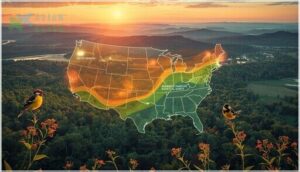
Distribution data is only as useful as what you do with it.
When you put range maps to work, they become one of the sharpest tools in a conservationist’s kit.
Here’s how to apply them across the most critical areas of planning.
Identifying Priority Regions for Songbird Conservation
Not all regions carry equal weight regarding saving songbirds. Distribution models help conservation biology pinpoint where action matters most:
- Boreal Hotspots host 300+ breeding species across Canada’s vast forests
- Northeastern Core Habitats anchor forest‑interior specialists facing steep declines
- Southeastern Shrubland Priorities and Intermountain Rangeland Refuges shelter edge‑dependent and grassland songbirds
Climate‑driven range shifts make biodiversity monitoring essential for staying ahead of these changes.
Designing Protected Areas Around Core Breeding Ranges
Knowing where songbirds concentrate is only half the job — protecting those spots takes deliberate design.
Core Size Metrics matter here: forest songbirds need patches of at least 40 hectares to support nesting pairs, while Buffer Width Standards of 330 feet retain most interior breeders. Habitat Connectivity Planning and Edge Effect Mitigation work together, embedding cores within broader forest mosaics to counter Habitat Fragmentation.
Targeting Habitat Restoration in Declining Strongholds
Once core breeding areas are protected, the real work begins: getting degraded land back in shape.
Distribution maps show exactly where to act. In the Intermountain West, conifer removal from sagebrush core habitat lifted Brewer’s Sparrow numbers by 55 percent within three years — a clear win for targeted habitat restoration and preservation.
Here’s what effective habitat management strategies look like on the ground:
- Sagebrush core recovery through mechanical conifer removal restores structure songbirds need
- Shrub-nest enhancement boosts daily nest survival for species like Yellow-breasted Chat
- Grassland buffer zones protect the 28 percent of grassland bird habitat sitting outside reserves
- Targeted reforestation rebuilds coastal forest corridors for declining forest thrushes
- Tracking population trends confirms which habitat preferences of bird species are driving recovery
Songbird conservation only sticks when restoration follows the map.
Planning Corridors Along Migration Stopover Routes
Restoration fixes local habitat, but birds don’t stay local.
Radar-Based Route Mapping now detects migratory songbirds lifting off every six to ten minutes across an 80 km radius, revealing Stopover Hotspot Prioritization targets covering over 2.4 million hectares in the eastern US.
Critically, 42 percent of key connectivity sites lack protection, and Seasonal Connectivity Gaps mean spring and fall routes barely overlap — so Deciduous Forest Protection and Urban Corridor Integration both matter for complete avian migration coverage.
Evaluating Land‑use Changes Against Regional Maps
When land use shifts, range maps become your early warning system.
Land-use Overlay techniques in ArcGIS combine regional range maps with real-world land cover at 300 m resolution, so land managers can see exactly where habitat fragmentation is biting hardest.
Buffer Impact Analysis, Fragmentation Metrics, and Trend Map Integration together sharpen Habitat Suitability Filtering — turning raw environmental change impact data into practical, targeted habitat management strategies.
Assessing Management Impacts on Target and Non‑target Species
Every management action has ripple effects beyond your target species.
Pesticide Side Effects can slash songbird abundance by over 90% in just two days.
Predator Removal Tradeoffs, Conifer Removal Benefits, and Grazing Management Balance all shift habitat structure in ways that affect non‑targets too.
Invasive Species Control, when paired with environmental impact assessment and species tracking tools, keeps biodiversity conservation grounded in real outcomes rather than good intentions.
Monitoring Climate‑driven Shifts in Regional Distributions
Climate change is quietly redrawing songbird range maps year by year. Tracking these shifts means watching five key signals:
- Poleward Range Shifts averaging 1.5 km north annually
- Elevational Migration Trends pushing species toward cooler mountaintops
- Phenology Mismatch Indicators revealing timing gaps between arrival and peak insect emergence
- Trailing Edge Declines at warmer range limits
- Climate Refugia Mapping pinpointing stable strongholds worth protecting
Integrating Distribution Models Into Policy Decisions
Distribution models don’t just sit in research papers — they drive real decisions.
Planners now use scale‑aligned zoning tools, matching spatial analysis of bird distribution to legal occupancy thresholds that determine listing status. Cross‑jurisdictional data standards keep habitat strategies consistent across state lines, while impact assessment frameworks and funding allocation metrics help wildlife management and conservation biology prioritize the landscapes where ecosystem management investment actually moves the needle.
Citizen Science Tools for Mapping Songbirds

You don’t need a research grant or a university affiliation to contribute meaningfully to songbird science — just a phone, some patience, and a good eye.
Citizen science platforms have quietly become some of the most powerful tools we’ve been for tracking where birds are, when they arrive, and how those patterns are shifting.
Here’s how you can tap into those tools and actually make a difference.
Using EBird Maps to Explore Regional Songbird Ranges
Think of eBird as your personal field guide gone digital. Its range maps use Seasonal Color Interpretation to reveal exactly where birds appear throughout the year—red for breeding, blue for wintering, yellow tracing Migration Corridor Visualization, and purple marking year-round residents.
Abundance Gradient Analysis shows density hotspots, while Data Deficiency Mapping honestly flags gray zones. Regional Hotspot Identification helps you pinpoint local citizen science birding patches with notable precision.
Contributing Checklists to Improve Distribution Models
Your checklist is a data point that actually matters. When you mark it complete—logging every bird seen or heard—eBird gains the absence data that makes Bird Distribution models sharper.
Complete Checklist Benefits kick in when effort details like duration and distance are included, letting eBird Data standardize results fairly. Use consistent Protocol Selection, coordinate Group Data Integration to avoid double‑counting, and trust the Quality Review Process to validate your records.
Interpreting Trend and Abundance Layers for Your Region
Once your checklists are flowing into eBird, reading the trend and abundance layers becomes your next skill.
Each 27×27 km grid cell blends local hotspots into one value—so Grid Resolution Limits mean you’re seeing neighborhood-scale averages, not backyard counts.
Seasonal Color Scaling shifts between seasons, so compare breeding maps to wintering maps separately.
Hover over trend circles for Confidence Interval Interpretation, and watch for pale cells flagging Data Gap Identification where population trends stay uncertain.
Ground‑truthing Range Predictions With Local Observations
Trend layers show you the big picture, but range maps don’t always match what’s actually outside your window. That’s where Field Validation earns its keep.
When you visit a gray zone and confirm a wood thrush singing in mature hardwood, you’re doing Habitat Confirmation and Data Gap Filling at once.
Your Observation Calibration feeds eBird’s Model Adjustment process, sharpening predictions for everyone.
Combining Backyard Observations With Regional Datasets
Your backyard feeder data does more than satisfy curiosity — it feeds directly into eBird’s regional models through Data Integration Methods and Bias Correction Techniques.
- Pool your yard counts to sharpen Fine‑scale Habitat Modeling by 20% accuracy
- Fill citizen science gaps in spatial analysis of bird distribution
- Align feeder observations for Temporal Trend Alignment across seasons
- Validate habitat requirements through Model Validation Strategies
- Extend bird migration coverage by 30% beyond forest surveys
Supporting Adaptive Management With Shared Map Data
Shared eBird data turns individual observations into something bigger — a feedback loop that sharpens habitat management strategies year after year.
Joint Ventures use this citizen science backbone for Iterative Planning, adjusting conservation targets when Real-time Monitoring flags unexpected declines.
Stakeholder Collaboration multiplies the effect: partners pool range maps, apply Uncertainty Integration to data gaps, and make Data-driven Decisions that actually move the needle for adaptive management.
Ethical Field Practices to Protect Mapped Nesting Areas
Getting close to a nest feels exciting, but your presence carries real consequences. Stay at least 25 meters from small nests and silence any audio playback nearby — recordings trigger territorial stress and attract predators.
Designated trails, approach from downwind for scent management, and time your visits to morning hours before 9 AM.
These small habits protect nesting behaviors and support long‑term conservation.
Frequently Asked Questions (FAQs)
How do songbirds communicate with each other?
Songbirds have one of the most complex communication systems on the planet. Using a specialized vocal organ called the syrinx, they produce songs, contact calls, and alarm signals to navigate their entire social world.
What do songbirds eat across different seasons?
Their diet shifts with the seasons.
Spring Insect Surge drives Summer Protein Focus, then Fall Fruit Buildup fuels migration, and Winter Seed Reliance carries them through the cold — classic Seasonal Diet Shifts.
How long do common songbird species typically live?
Most songbird species live 2–7 years on average, though juvenile mortality is steep—many don’t survive year one. Maximum longevity varies widely, with Blue Jays reaching nearly 27 years in rare cases.
Which predators pose the greatest threat to songbirds?
Cats are the deadliest threat, killing up to 4 billion birds yearly in the US alone.
Corvid nest raids, raptor adult hunting, mammal nest invaders, and reptile egg eaters compound losses substantially.
How does light pollution affect songbird behavior at night?
Light pollution throws songbird routines into disarray.
Dawn chorus shift starts earlier, dusk singing extension runs longer, nocturnal foraging increase strains sleep, and migratory disorientation risk rises sharply near bright city lights.
Conclusion
The wood thrush you hear today may not nest in that same patch of trees a decade from now—ranges shift, habitats thin, and the margin for error narrows quietly. That’s exactly why a reliable regional songbird distribution guide matters beyond curiosity.
It turns scattered sightings into a coherent story about what’s thriving, what’s retreating, and where your attention can actually make a difference. Read the maps. Trust the data. Then go listen.