This site is supported by our readers. We may earn a commission, at no cost to you, if you purchase through links.
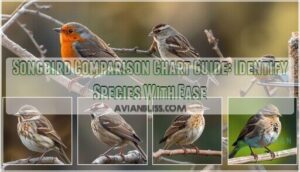
One morning you look at your feeder and realize half the birds seem to share the same outfit. The robin stands out, but is that streaked brown bird a Song Sparrow or a finch? When ID hinges on a wing bar or a faint eyebrow stripe, guessing stops feeling satisfying. Field marks start to mean something concrete.
A clear songbird comparison chart guides lines up size, silhouette, plumage, habitat, and voice side by side. With that kind of map, you start reading birds the way you read faces, spotting tiny cues that used to slide past you.
Table Of Contents
- Key Takeaways
- Key Features of a Songbird Comparison Chart
- Popular Songbird Species Compared
- Habitat, Range, and Seasonal Patterns
- Diet, Foraging, and Feeding Habits
- Conservation Status and Population Trends
- Using Comparison Charts for Bird Identification
- Frequently Asked Questions (FAQs)
- How do you identify a songbird?
- Why should you use a bird comparison chart?
- What is a songbird?
- What birds mimic the songs of other birds?
- What is the most common songbird in the United States?
- How many versions of songbird are there?
- What are the main types of songbirds?
- Which field guides pair best with comparison charts?
- Can comparison charts help identify juvenile songbirds?
- How do nighttime singers differ from daytime songbirds?
- Conclusion
Key Takeaways
- songbird comparison chart speeds up identification by letting you line up size, bill shape, plumage zones, habitat, and voice side by side instead of guessing from a single clue.
- Field marks like wing bars, eye stripes, and rump patches are more reliable than general color impressions, especially when separating look‑alike species like House Finch and Song Sparrow.
- Knowing a bird’s habitat, seasonal range, and feeding behavior adds context that plumage alone can’t give you — a Cardinal staying through winter or a bluebird favoring open grassland tells its own story.
- Conservation pressures from habitat loss, window collisions, cat predation, and climate shifts are stacking up on many songbird species, making population awareness a natural part of responsible birdwatching today.
Key Features of a Songbird Comparison Chart
Before you start comparing individual birds, it helps to know how the chart is organized.
For extra practice reading shapes and sizes in motion, this guide to identifying birds in flight walks through real examples.
Most songbird comparison charts highlight a few key features that make identification faster and more accurate. In the list below, you’ll see how it lays out core traits, from size and shape to color, behavior, and voice.
Essential Identification Criteria
Accurate Songbird Identification starts when you look for stable Species Characteristics instead of vague color impressions.
You scan Field Mark Patterns, Plumage Patterns in different Plumage Zones, and small clues like Iris Color that rarely change.
Then you add Vocal Signatures and Habitat and Behavioral Cues to lock in confident Bird Identification.
Considering overall size and shape can greatly aid identification.
| Clue | Example |
|---|---|
| Plumage | Zones |
| Bill | Shape |
| Vocal | Signatures |
Body Size, Shape, and Weight Categories
Once you’ve nailed the field marks, size tells the story fast. A good Bird Identification Guide groups species by Size Band Definitions — small, medium, large — so you’re not guessing.
Weight Range Indicators and Body Profile Silhouettes sharpen that picture further, while Sexual Dimorphism Notes and Tail Length Variations reveal subtle Species Characteristics that matter in Songbird Identification.
Understanding size and shape categories is essential for quick identification.
| Species | Size & Weight | Body Profile |
|---|---|---|
| Black-capped Chickadee | ~5 in / 0.4 oz | Compact, round |
| American Robin | ~10 in / 2.7 oz | Upright, sturdy |
| Blue Jay | ~11 in / 3 oz | Crested, broad-tailed |
Color Patterns and Plumage Markers
Color patterns are where bird identification really clicks. A pale supercilium variation above the eye, a bold malar stripe along the throat, or a bright rump patch color when a bird flies off — these plumage markers narrow your list fast.
| Plumage Marker | What to Look For |
|---|---|
| Wing Bar Patterns | Pale stripes on folded wing coverts |
| Undertail Coverts Contrast | Color difference beneath the tail base |
Behavioral and Vocal Characteristics
Once plumage narrows, your Songbird ID, behavior, and bird vocalization confirm what you’re seeing, especially at Dawn Chorus timing and during foraging.
That early window is where everything clicks—check best time for bird watching in the UK to plan around peak vocal activity.
| Behavioral Traits | Songbird Characteristics |
|---|---|
| Learning Phases shape Song Repertoire Size | Territorial Soft Songs signal threat |
| Foraging Vocalizations coordinate flock feeding | Patterns support Bird ID in charts |
Larger repertoires and bolder displays usually signal stronger health and territory control.
Popular Songbird Species Compared
Some songbirds look surprisingly similar at first glance, and that’s exactly where a comparison chart earns its keep.
Knowing what sets each species apart makes identification feel less like guesswork and more like second nature.
Here’s a closer look at a few of the most common species you’re likely to spot.
American Robin Vs. Northern Cardinal

Two birds that often trip up beginners are the American Robin and Northern Cardinal. Your best starting point is size — robins run 9 to 11 inches with an upright stance, while cardinals sit stockier at around 8 to 9 inches.
Bill shape seals the deal: robins carry a slim yellow bill; cardinals have a thick, seed‑cracking red one. Cardinals stay put in winter, making feeder preference a reliable clue for your bird comparison chart.
House Finch Vs. Song Sparrow

Although your first glance may blur them together, House Finch and Song Sparrow separate quickly once you focus on Bill morphology and plumage contrast in your bird identification work.
- Bill morphology: chunky finch, slender sparrow.
- Plumage contrast and streaky songbird characteristics on sparrow.
- Feeding strategies and territorial behavior around feeders.
- Note vocal differences in your complete bird species comparison chart.
Eastern Bluebird and Other Common Species
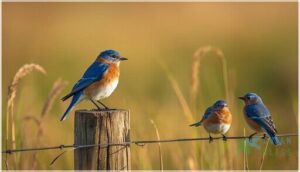
The Eastern Bluebird stands out in any bird identification lineup — its belly color contrast (clean white against rusty orange) and throat hue differences from Western and Mountain Bluebirds make field separation straightforward.
Its bill robustness comparison also helps: it is stockier than its relatives.
Listen for its soft song warble texture across open fields, and watch for nesting box preference in grassy habitat.
Habitat, Range, and Seasonal Patterns

Knowing where a bird lives tells you almost as much as what it looks like.
Different songbirds are tied to specific habitats, regions, and seasons — and that context can make or break an identification. Here’s what to look for when using a comparison chart to track habitat, range, and seasonal patterns.
Typical Habitats for Charted Songbirds
You quickly see that habitat types anchor every serious Habitat and Distribution chart. Forest Edge strips hold Northern Cardinals, Open Fields favor Eastern Bluebirds, and Suburban Gardens keep chickadees close to home.
Shrublands and Riparian Wetlands round out Species Diversity, highlighting Ecological Importance, Habitat Preservation priorities, and subtle Bird Migration Patterns cues.
- Forest Edge shelter
- Suburban Gardens habitat
- Riparian Wetlands
Regional Distribution and Migration Trends
Migration defines how you read Habitat and Distribution maps.
| Region | Key Route | Note |
|---|---|---|
| East | Atlantic | Flyway Overlap |
| Central | Mississippi | Wintering Hotspots |
| Plains | Central | Latitude Shifts |
| West | Pacific | Climate‑Driven Range |
| Cities | Mixed | Urban Stopovers |
Across flyways, Bird Migration and Bird Migration Patterns group Songbird Species into broad corridors. You notice Migration Patterns most where Latitude Shifts and Wintering Hotspots stand out.
Seasonal Presence and Breeding Ranges
Think of your chart as a yearly calendar for birds, not just a map.
Seasonal patterns show Resident vs Transient status, highlight Migration Windows, and reveal Breeding Timing for local breeding and nesting.
When you match Habitat clues and Seasonal Habitat Use with Migration Patterns and subtle Range Shifts, your Bird Identification becomes clearer and more confident with each season.
Diet, Foraging, and Feeding Habits

What a bird eats shapes nearly everything about how it behaves in the wild. A songbird’s bill, foraging style, and preferred food sources all work together in ways that make each species surprisingly easy to read once you know what to look for.
Here’s what to pay attention to when comparing diet and feeding habits across species.
Bill Shape and Dietary Preferences
Shape tells the story: conical bills mark Seed Crackers like finches, while thin tweezers-style bills signal Insect Catchers such as warblers.
Wider, flat bills fit aerial hunters, and curved slender bills often belong to Nectar Feeders or Fruit Eaters in mixed flocks.
Beak functions, diet, and foraging power bird identification techniques, guide species identification, bird behavior, and sharpen habitat clues.
Feeding Behaviors and Food Sources
Bill shape hints at what a bird eats, but watching how it actually feeds tells the fuller story.
Gleaning accounts for over half of all songbird prey attacks, with species like kinglets using hover‑gleaning techniques to pluck insects mid‑flight.
Ground seed foraging defines sparrows, while seasonal insect shifts push robins toward fruit in fall.
Morning feeding peaks mean early observation rewards you most.
Attracting Songbirds With Feeders
Once you understand how songbirds forage, attracting them becomes straightforward. Smart feeder placement—about 10–12 feet from shrubs—balances predator safety with quick cover access.
Here’s what works:
- Hang feeders at varied heights for height variety
- Offer a seasonal seed and food mix
- Keep feeders clean to protect backyard birds
- Space stations apart to reduce competition
Conservation Status and Population Trends
Beyond field marks and songs, it also helps to know how each species is actually doing in the wild. In this section, you’ll see which songbirds are struggling, which are rebounding, and how their numbers are changing over time.
Use the list below as a quick reference to match each species in the chart with its current conservation outlook and trend.
Endangered and Recovering Songbirds
Some recovery success stories genuinely inspire.
The Kirtland’s warbler bounced back from fewer than 200 breeding pairs to over 2,300 singing males through habitat restoration techniques like prescribed burning and jack pine planting.
Meanwhile, the Florida grasshopper sparrow holds on with only 40–60 breeding pairs.
Conservation status tracking through population monitoring methods helps guide ongoing community engagement programs and avian species conservation efforts.
Threats Highlighted in The Chart
When you scan the comparison chart, you quickly see how multiple pressures stack up on songbirds. Habitat loss, Window collisions, Cat predation, Pesticide exposure, and Climate mismatch all shape each species’ Conservation Status.
Habitat loss, collisions, predation, pesticides, and climate shifts are rapidly stacking pressures against songbird survival
The chart links these threats to Environmental Conservation, Wildlife Conservation, and Habitat Conservation Strategies, helping you focus your Species Conservation efforts where they matter most right now.
Using Comparison Charts for Bird Identification

In this section, you’ll see how to actually use a comparison chart, not just read the labels. We’ll walk through simple ways to scan the rows and columns, then match what you see and hear to the birds around you.
Use the points below as a step‑by‑step guide whenever you have a chart in front of you.
How to Read and Navigate The Chart
Think of a comparison chart as your personal bird ID decoder. Start by checking the legend — icon decoding tells you what habitat symbols, seasonal shading guides, and status codes mean. Then pick your strongest clue and scan that column. From there, use row-by-row matching across size, color, and habitat to confirm your bird.
| Feature | Column Scanning Use | Row-by-Row Matching |
|---|---|---|
| Body Size | Narrow candidates quickly | Confirm with weight range |
| Plumage Pattern | Spot shared field marks | Separate look-alike species |
| Habitat Type | Rule out unlikely birds | Cross-check seasonal shading guide |
This Complete Bird Species Comparison Chart approach is one of the most reliable birdwatching tips for confident songbird identification.
Integrating Visual and Auditory Cues
Pairing what you see with what you hear is where songbird identification really clicks.
Field Marks‑Calls connections, Habitat Sound Pairings, and Behavioral Sound Matching all sharpen your reading. Modern charts even offer Spectrogram‑Visual Links and Temporal Vocal Overlays so you can cross‑reference plumage patterns, habitat clues, and bird vocalization in one glance.
| Cue Type | Visual Marker | Auditory Signal |
|---|---|---|
| Field Marks‑Calls | Wing bars, eye‑rings | Chip note vs. trill |
| Habitat Sound Pairings | Dense brush, open meadow | Descending whistle, buzzing trill |
| Temporal Vocal Overlays | Dawn silhouette, perch height | Robin’s whinny, Cardinal’s whistle |
| Spectrogram‑Visual Links | Yellow underparts, dark eye line | Evenly spaced trill bands |
| Behavioral Sound Matching | Ground-foraging, tail-flicking | Sharp "tik" through leaf litter |
Frequently Asked Questions (FAQs)
How do you identify a songbird?
You identify a songbird by layering visual cue integration, auditory signature matching, and behavioral posture clues together — size, plumage patterns, bird vocalization, and habitat clues all pointing toward one confident answer.
Why should you use a bird comparison chart?
Using a bird comparison chart gives you Faster Field ID and clearer species recognition than a bird identification guide, boosting Beginner Confidence, Memory Retention, Visual Clarity.
Supporting bird identification, bird behavior analysis, and Space Efficiency.
What is a songbird?
A songbird belongs to the suborder Passeri — roughly 4,000 species defined by a complex syrinx anatomy, perching foot structure, and vocal learning ability that sets them apart from all other birds.
What birds mimic the songs of other birds?
Northern mockingbirds, brown thrashers, gray catbirds, European starlings, superb lyrebirds headline Mimicry Species List.
Behavior, bird songs reveal Regional Mimicry Variations, Learning Mechanisms, Non‑Bird Sound Imitations, Seasonal Mimicry Patterns. Songbird identification, bird identification guide, birdwatching.
What is the most common songbird in the United States?
Northern Cardinal tops most bird species identification lists.
Its year-round presence, range expansion northward, and feeder attraction make it America’s most commonly spotted songbird, with population density exceeding 100 million across the eastern United States.
How many versions of songbird are there?
There are roughly 10 major desktop releases, plus mobile and hardware variants.
The Nightingale Successor fork extended its Fork Lineage beyond the 2013 shutdown, giving the platform dozens of distinct builds across its full Release Count.
What are the main types of songbirds?
Songbirds fall into around 55 families, grouped by family classifications like finches, thrushes, warblers, and sparrows.
Each brings distinct vocal repertoires, morphological adaptations, and migratory strategies worth noting in any bird comparison chart.
Which field guides pair best with comparison charts?
Sibley/Peterson guides complement Illustration style.
Range map integration, Audio cue alignment, and Seasonal filter syncing are also supported.
Digital app synergy from Merlin Bird ID, All About Birds, and Cornell Lab of Ornithology Bird Identification Bird Species Comparison Chart.
Can comparison charts help identify juvenile songbirds?
Yes, comparison charts can help identify juvenile songbirds by highlighting plumage patterns, gape flange indicators, size‑wing ratios, seasonal juvenile timing, and behavioral juvenile cues that distinguish young birds from adults.
How do nighttime singers differ from daytime songbirds?
Like shifts of musicians on a stage, daytime birds lead the Dawn chorus, using Territory timing and Pitch adaptation.
While nightingales’ Nocturnal repertoire shows Vocal complexity, shaped by bird migration, ecology, behavior, ornithology, and songbird identification.
Conclusion
Subtle, shared, shifting signals in songbirds invite you to slow down and study. With a songbird comparison chart guide at hand, you’re not guessing; you’re gathering clues. Size, shape, color, and voice become anchors, not accidents.
As you compare similar species, your eye grows steadier and your ear more selective. Each careful look builds a mental library. Soon, that streaked brown bird isn’t a mystery—it’s a familiar neighbor you can greet by name each day.
- https://www.perkypet.com/advice/bird-watching/attracting-songbirds/identifying-popular-songbirds
- https://academy.allaboutbirds.org/plumage-variations/
- https://www.gardeningknowhow.com/garden-how-to/beneficial/common-types-of-songbirds
- https://merlin.allaboutbirds.org
- https://academic.oup.com/auk/article/138/2/ukab011/6228530