This site is supported by our readers. We may earn a commission, at no cost to you, if you purchase through links.

Most people walk past dozens of songbirds each morning without recognizing a single one. Yet a skilled birder can close their eyes and name five species within minutes—just from sound.
That gap isn’t talent. It’s training. Bird songs follow real, learnable patterns, and once you understand the structure behind them, the noise transforms into something closer to a conversation. Each species carries a distinct musical signature—its own pitch, rhythm, and phrasing—that sets it apart from every neighbor in the canopy.
These songbird melody identification tips will sharpen your ear, connect the sounds to the birds, and turn any morning walk into something far more rewarding.
Table Of Contents
- Key Takeaways
- Key Features of Songbird Melodies
- Essential Tools for Melody Identification
- Effective Techniques for Recognizing Bird Songs
- Overcoming Common Identification Challenges
- Enhancing Birding Enjoyment and Skills
- Frequently Asked Questions (FAQs)
- What’s the best bird song identifier app?
- Which songbird has the prettiest song?
- How do weather conditions affect songbird vocal activity?
- Can songbirds learn new melodies throughout their lives?
- Do urban environments alter how songbirds communicate?
- Which songbirds are most active during winter months?
- How does habitat type influence a songbirds repertoire?
- Conclusion
Key Takeaways
- Bird songs follow learnable patterns built on pitch, rhythm, and repetition — so recognizing species by ear is a trainable skill, not a natural gift.
- Apps like Merlin Bird ID and tools like spectrograms give you a fast, practical edge by turning sound into something you can both hear and see.
- Starting with common local species and pairing visual cues with song (like a Cardinal’s red crest with his ‘cheer‑cheer‑cheer’) builds identification skills faster than studying in the abstract.
- Consistent practice habits — dawn listening sessions, field journals, and mnemonic phrases — compound over time and turn background noise into a recognizable conversation.
Key Features of Songbird Melodies
Every bird has its own musical signature, and once you learn to hear it, you’ll never mistake a robin for a wren again.
This guide to songbird call recognition breaks down exactly what patterns to train your ear on.
Songbird melodies aren’t random noise — they follow real patterns you can actually learn.
Here’s what to listen for.
Differences Between Songs and Calls

Not all bird vocalizations are created equal. Songs and calls serve completely different roles in a bird’s life:
- Functional Purpose — Songs attract mates; calls coordinate flock movement.
- Duration Length — Songs last seconds to minutes; calls stay under one second.
- Structural Complexity — Songs have melodic phrases; calls are simple chirps.
- Learning Mechanism — Songs require tutors; calls emerge instinctively.
- Seasonal Timing — Songs peak in spring; calls happen year-round.
Understanding alarm calls respond to threats helps identify danger signals.
Common Patterns and Phrases
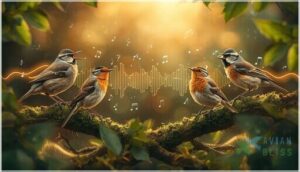
Once you know the difference between songs and calls, the next step is recognizing patterns. Most bird song patterns fall into four types: Phrase Types, Series Patterns, Warble Patterns, and Trill Patterns. Then there are Motif Sequences — repeated syllable groups like the Cardinal’s “birdie‑birdie.”
Bird song analysis becomes easier when you match what you hear to these categories. Think of it as bird song mnemonics in action. For visual reference, see the American Robin identification guide.
Pitch, Rhythm, and Repetition
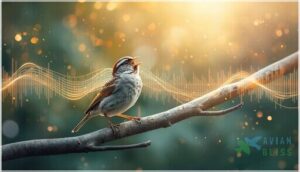
Patterns give you the shape of a song — but pitch, rhythm, and repetition bring it to life. Listen for Contour Patterns first: does the note rise, fall, or curve? Then track Tempo Variations.
Chipping sparrows trill at roughly 15 syllables per second — fast and steady. Repetition Structures, Relative Pitch Shifts, and Spectral Shape Cues sharpen your bird song analysis, turning raw sound into confident bird song identification.
Essential Tools for Melody Identification

right tools make all the difference when you’re learning bird songs.
You don’t need a lot of gear, but a few key resources will sharpen your ear faster than going it alone.
A solid starting point is brushing up on bird identification by song and calls, which gives your ears a real framework before you ever hit the field.
Here’s what’s worth having in your birding toolkit.
Best Bird Song Apps (Merlin, Audubon, Etc.)
Your phone is already a powerful field companion. Merlin Bird ID tops the list — it exceeds 90% accuracy on clear recordings and processes dawn chorus through smart neural networks.
Download Regional Packs for Offline Mode use anywhere. BirdNET offers Confidence Scores and global Bird Sound Analysis and Spectrograms across 6,000+ species.
Audubon rounds things out with Community Sharing features. These bird song identification apps genuinely change how you listen.
Using Audio Recorders for Field Practice
Recording your own clips takes bird song learning to the next level.
Grab a Zoom H4n or MixPre-3 II — both deliver clean audio without overwhelming beginners.
Smart Mic Placement near the source beats boosting gain later.
Enable Pre-record Mode so you never miss a song’s opening notes.
Use Wind Noise Reduction with a windscreen, practice Data Logging after each session, and your bird listening skills will sharpen fast.
Spectrograms and Sound Visualization
Seeing bird’s song changes everything. A spectrogram turns sound into a visual map — time runs left to right, pitch climbs the frequency axis upward to 10 kHz.
Frequency Axis Interpretation shows warbler chips as sharp upward slants; thrush phrases drop downward.
Color Mapping Significance reveals louder notes as brighter marks. Harmonic Pattern Analysis, Time-Frequency Resolution, and Spectrogram Calibration Tips inside Merlin sharpen your bird song identification technology skills fast.
Effective Techniques for Recognizing Bird Songs

Knowing your tools is one thing — using them well in the field is another.
A few simple habits can sharpen how quickly you recognize a song and lock it into memory. Here’s what actually works.
Practicing in Optimal Conditions (Time of Day, Weather)
Timing your practice makes all the difference. The dawn chorus peaks about 30 minutes before and after sunrise — that’s your golden window.
- Step outside when winds stay under 5 mph for the clearest songs
- Aim for mild temperatures around 15–21°C (60–70°F)
- Clear skies and low humidity sharpen every pitch and phrase
Environmental factors like calm wind and weather effects directly shape what you hear during active listening and bird song identification.
Starting With Common Local Species
bird song identification journey close to home. Your backyard or local park holds a beginner species list worth mastering first.
In Saxony, that means the chaffinch, blue tit, great tit, and European robin — birds with distinct, recognizable songs.
Use bird song apps like Merlin for birding by ear practice. Local habitat guides and seasonal song peaks shape what you’ll hear when.
Using Mnemonics and Memory Aids
Think of mnemonics as shortcuts your brain actually enjoys. The Yellow Warbler‘s "Sweet, sweet, sweet, I’m so sweet" is a perfect example of rhythmic phrases that stick fast.
Try personal story associations — connect a song to a moment you remember. Mobile flashcard apps, cultural song mnemonics, and visual mnemonic charts all sharpen your bird song identification without making birding by ear feel like homework.
Connecting Visual and Audio Cues
eyes and ears work best as a team. When you spot a male Northern Cardinal with his bold red plumage and raised crest, that visual fingerprint prepares you for his sharp “cheer‑cheer‑cheer.” This is plumage‑song matching in action.
Spot a Cardinal’s bold red crest and your ears will already know his cheer-cheer-cheer
Size‑frequency correlation, behavior‑song linkage, and posture‑vocal display all sharpen your birding by ear skills — turning every bird field guide into a richer, more complete experience.
Overcoming Common Identification Challenges

Even with the right tools and practice, some moments in the field will still trip you up. Two birds can sound almost identical, and mistakes happen to everyone — even experienced birders.
Here are a few common challenges you’ll face, and how to work through them.
Distinguishing Similar-Sounding Species
Some birds sound nearly identical — and that’s where bird song identification gets tricky.
Focus on subtle timbre differences first.
A Song Sparrow’s buzz sits lower than a Bewick’s Wren’s thin, nasal tone.
Micro-pattern variations matter too: pitch direction, rhythm gaps, phrase length.
Habitat-linked calls, seasonal song shifts, and geographic dialects all shape bird vocalization patterns, so knowing your local species sharpens bird species recognition fast.
Avoiding Common Mistakes and Misidentifications
Even skilled birders slip up — and most mistakes fall into familiar traps.
Watch out for these common bird song identification errors:
- Dialect confusion: Songs shift regionally, sometimes by 200–500 Hz between nearby populations
- Noise masking: Wind above 10 mph distorts high‑frequency notes, mimicking different species
- Temporal variability: Breeding songs sound nothing like sparse winter phrases
- Individual variants: One bird’s song can differ 20 % from its neighbor’s
Knowing these pitfalls sharpens your techniques to improve bird song recognition fast.
Practice Exercises for Skill Improvement
Knowing the pitfalls is half the battle. Now it’s time to fix them through steady practice. These practice exercises target the exact gaps that trip up most birders.
| Exercise | Method | Goal |
|---|---|---|
| Morning Drills | 15‑min dawn sessions | Build pattern memory |
| Spectrogram Games | Bird Song Hero app | Visual sound matching |
| Mnemonic Sessions | Repeat phrases aloud | Lock in species recall |
| Field Spotting | Follow unknown songs | Link sound to sight |
| Recording Review | Slow‑down playback | Catch subtle differences |
Pick one technique weekly and watch your bird song ID sharpen fast.
Enhancing Birding Enjoyment and Skills

Getting better at birding isn’t just about knowing more songs — it’s about enjoying the journey along the way.
The good news is there are real, practical ways to grow your skills and stay connected to what makes birding rewarding. Here’s what can make a genuine difference.
Joining Birding Communities and Events
You don’t have to learn bird songs alone — community makes it faster and more fun. Local Club Meetups, Birding Events, and festivals connect you with birders who’ve already cracked the tricky IDs you’re still puzzling over.
- Join Local Audubon chapters for Field Trip Planning and expert-led walks
- Explore Birding Festival Guides like the Biggest Week in American Birding each May
- Engage in Online Forum Participation through eBird or BirdForum
- Use Birding App Community and Science features in Merlin to compare notes
Contributing to Citizen Science Projects
Contributing your recordings to platforms like eBird turns casual listening into real bird conservation work. Merlin’s sound ID feeds directly into citizen science databases that follow strict Metadata Standards and Data Validation processes.
Your audio recorders and birding apps don’t just help you — they help researchers track species across continents. Community Training and Impact Reporting show exactly how each uploaded bird song identification shapes protection efforts.
Tracking Progress With Personal Notes and Recordings
Keeping a field journal sharpens your ear faster than you’d expect. Log Consistency matters — note the date, location, and weather for every outing.
Build a personal audio library with Audio Archive Tagging so you can review bird song patterns and variations later. Run a weekly Progress Review Schedule, use Confidence Scoring per species, and watch your Seasonal Trend Charts reveal real growth.
Staying Motivated and Making Birding Fun
Turn birding into a game. Try Audio Scavenger Hunts — identify 10 species by ear on a single walk.
Use eBird to earn Community Badges and build Seasonal Songlists that track your growth.
Mindful Listening Sessions, even just 15 quiet minutes, sharpen your birding-by-ear techniques fast.
Joining a local club adds Birding Enjoyment and Connection that keeps the whole journey rewarding.
Frequently Asked Questions (FAQs)
What’s the best bird song identifier app?
Merlin Bird ID takes the crown — no tweets about it!
It’s the top pick for bird song identification, with offline accuracy, wide regional coverage, and a clean user interface that makes it a breeze to use.
Which songbird has the prettiest song?
Cultural preferences shape which bird songs feel "prettiest," but many point to the Wood Thrush or Hermit Thrush.
flute-like, echoing melodies consistently top regional favorites across human perception studies and historical composers’ writings.
How do weather conditions affect songbird vocal activity?
Weather rewrites the dawn chorus daily.
Temperature Influence, Wind Suppression, Humidity Enhancement, and Pressure Shifts all shape bird vocalization patterns — so understanding these environmental factors affecting bird songs sharpens your bird song identification instantly.
Can songbirds learn new melodies throughout their lives?
Yes — some songbirds never stop learning.
Open‑ended learning lets species like starlings and canaries add new melodies through seasonal plasticity, driven by neural neurogenesis.
This flexibility even boosts mating advantages, giving varied singers an edge.
Do urban environments alter how songbirds communicate?
Absolutely. Urban birds adjust their songs in astonishing ways.
They shift to higher frequencies, boost amplitude, sing earlier at dawn, simplify song structure, and adapt to echo distortion — all driven by acoustic ecology and city noise.
Which songbirds are most active during winter months?
Black-capped Chickadees, Dark-eyed Juncos, and Northern Cardinals lead resident winter species activity. Watch feeder activity patterns peak on calm mornings.
Snowbird flock dynamics shift daily with weather and daylight singing peaks.
How does habitat type influence a songbirds repertoire?
Habitat shapes everything a bird sings. Urban birds expand their repertoires and shift to higher frequencies, while forest species narrow their bandwidth.
Grassland singers push faster trill rates. Your local habitat literally rewrites the song.
Conclusion
canopy was never silent—you just hadn’t learned its language yet. quiet exchange between species, and now you have the tools to join that conversation.
songbird melody identification tips don’t just sharpen your ears; they reshape how you experience the world outside your door.
Start with one bird. Then another. Before long, what once sounded like background noise becomes something you’d genuinely miss on a quiet day.
- https://merlin.allaboutbirds.org/
- https://www.bing.com/ck/a?!&&p=468af87a073e7cbfa12a1d832757e6feb93d758b191a073b24f2841c0fa29dabJmltdHM9MTc1NjUxMjAwMA&ptn=3&ver=2&hsh=4&fclid=1929bbe3-d37a-6178-26e5-adf9d22060e5&psq=Bird+songs+are+sounds+birds+make+to+communicate+&u=a1aHR0cHM6Ly9iaW9sb2d5aW5zaWdodHMuY29tL2hvdy1iaXJkcy11c2UtdGhlaXItc29uZ3MtdG8tY29tbXVuaWNhdGUtYW5kLXN1cnZpdmUv
- https://apps.apple.com/us/app/merlin-bird-id-by-cornell-lab/id773457673?utm_source=chatgpt.com
- https://play.google.com/store/apps/details?hl=en-US&id=com.labs.merlinbirdid.app&utm_source=chatgpt.com
- https://www.audubon.org/magazine/beginners-guide-common-bird-sounds-and-what-they-mean