This site is supported by our readers. We may earn a commission, at no cost to you, if you purchase through links.
Around 10,400 known bird species share this planet with us—and scientists keep finding more.
That number sounds manageable until you realize it spans everything from a two-inch bee hummingbird to a nine-foot ostrich that can’t fly but can outrun a horse.
Birds colonized nearly every habitat on Earth, from Arctic tundra to scorching desert, long before humans arrived.
Their secret? Uncommon adaptability built over 150 million years of evolution.
Understanding the different types of bird species means unlocking patterns in how life itself solves problems—through feathers, beaks, bones, and behavior.
Table Of Contents
- Key Takeaways
- What is a Bird? Key Facts About Avian Species
- Major Bird Species Classification Systems
- Types of Bird Species by Habitat
- Birds of Prey and Predatory Bird Species
- Flightless and Endangered Bird Species
- Frequently Asked Questions (FAQs)
- What are the 8 classification of birds?
- What are some common bird species?
- What are some bird species names?
- How do birds communicate with each other?
- What economic impact does birdwatching generate annually?
- How do migratory birds navigate long distances?
- What role do birds play in ecosystems?
- Which birds are known for their intelligence?
- Which bird species live the longest in the wild?
- How do birds navigate during long-distance migration?
- Conclusion
Key Takeaways
- Birds trace their roots back 150 million years to feathered dinosaurs, and every adaptation you see today — hollow bones, hooked beaks, air sac systems — is evolution’s answer to a specific survival problem.
- With 10,400+ known species spread across every habitat on Earth, birds are classified into 40+ orders using genetics, fossils, and physical traits, making taxonomy a living, constantly-updating science.
- Flightless birds like ostriches and penguins didn’t lose the evolutionary lottery — they traded wings for other superpowers, like running 43 mph or diving 565 meters underwater.
- Right now, 223 bird species face extinction, driven by habitat loss, climate shifts, invasive predators, and building collisions — but targeted conservation efforts are actively pulling some species back from the edge.
What is a Bird? Key Facts About Avian Species
Birds are one of the most fascinating groups of animals on the planet — and surprisingly, there’s more to them than feathers and flight.
From their surprisingly complex social behaviors to their unique hollow bones, birds have plenty of secrets waiting to be uncovered — beginner-friendly bird facts worth exploring if you’re just getting started.
Understanding what actually makes a bird a bird starts with a few key ideas. Here’s what you need to know.
Evolution and Prehistoric Origins of Birds
If you want to truly understand birds, start with their past. Bird evolution traces back roughly 150 million years to theropod dinosaurs — small, feathered carnivores.
Archaeopteryx‘s significance lies in showing us that shift firsthand, blending wings with teeth.
Feather origin began as insulation, not flight.
By the Cretaceous, avian diversity exploded, with early flight mechanics shaping the skies we see filled today.
Further details on theropod dinosaur ancestors can be found in the theropod dinosaur ancestors.
Core Physical Characteristics That Define Birds
From those ancient dinosaur roots, modern birds kept the good stuff — and added more.
Their Feather Structure alone is impressive: barbs and barbules locking together like tiny zippers.
Hollow Bones cut weight without losing strength.
The Air Sac System pushes oxygen through continuously, fueling demanding flight.
Beak Morphology, Wing Structures and Aerodynamics, Plumage Types and Colors, and even Magnetoreception — every feature tells a story about survival.
How Birds Are Scientifically Classified
All those features you just read about — feathers, hollow bones, beaks — actually help scientists figure out where each bird fits in the family tree.
Bird classification, or taxonomy, uses morphological keys, molecular phylogeny, genetic barcoding, and the fossil record to sort over 10,400 species into bird orders, families, genera, and species. Biogeographic zones also factor in, shaping avian diversity and species identification worldwide.
The system relies on bird taxonomic ranks to organize species.
Major Bird Species Classification Systems

Scientists don’t just call a bird a bird and move on — they’ve built a whole system to sort nearly 10,000 species into groups that actually make sense.
That system starts broad and gets more specific the deeper you go.
Here’s how the major classification layers break down.
Palaeognathae Vs. Neognathae: Key Differences
Think of birds as split into two big family trees. Palaeognathae — think ostriches and emus — share a rigid palate structure with limited jaw flexibility, plus a flat sternum lacking a sternum keel. Neognathae have more flexible jaws and dominate bird classification today. Here’s what sets them apart:
- Palaeognaths lay larger eggs relative to body size.
- Parental care varies widely, often paternal in tinamous.
- Flightless birds evolved flat sternums for ground life.
Overview of The 40+ Bird Orders
Over 40 bird orders exist today, each shaped by millions of years of adaptive radiation. Order Diversity Metrics shift as new DNA data rewrites old assumptions.
Passeriformes alone hold 5,000+ species, reflecting notable avian diversity.
Geographic Distribution varies wildly — some orders span continents, others stay island‑bound.
Morphological Trends like beak shape and wing structure tell you exactly how each order carved out its ecological niche.
How Families, Genera, and Species Are Organized
Within bird classification, each level builds on the last — like nesting dolls. Bird orders break into families, genera, and species using binomial nomenclature and diagnostic keys. Here’s how taxonomic hierarchy works in ornithology:
- Families share ancestry and distinct traits
- Genera group closely related species
- Species can interbreed — it’s the base unit
- Type specimens anchor each name for researchers worldwide
Avian diversity depends on these phylogenetic clades staying organized.
Types of Bird Species by Habitat
Where a bird lives shapes pretty much everything about it — diet, behavior, and even the way it looks. Birds have carved out a home in nearly every corner of the planet, from dripping rainforests to frozen tundra.
Here’s a look at the main habitat types and the birds you’ll find thriving in each one.
Forest and Rainforest Bird Species

Rainforests are basically the quintessential bird apartment complex — over 2,000 species packed into layered canopies, each carving out its own niche. Canopy foraging specialists, frugivores driving seed dispersal, and nectarivores with brush-tipped tongues all coexist here.
Endemic plumage evolved partly for species recognition in dense foliage.
But deforestation disrupts nesting strategies and avian diversity rapidly, and climate impact keeps reshaping habitat and distribution in ways scientists are still tracking.
Wetland, Coastal, and Aquatic Bird Species

Wetlands are where some of the most fascinating water birds on the planet make their living. These wetland habitats offer everything — nesting vegetation among reeds and cattails, rich mudflats for feeding, and shallow bays that concentrate prey.
Feeding morphology tells the whole story: long probing bills, flat filter bills, spear-like beaks.
Migratory stopovers depend on these spaces, but human disturbance and water level impacts keep shrinking them quickly.
Grassland and Savanna Bird Species
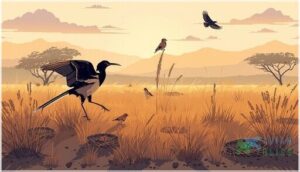
Open grasslands are alive with bird activity — don’t underestimate them.
- Seasonal Migration follows rainfall, not just seasons.
- Ground Nesting species camouflage eggs in earth‑tone grasses.
- Beak Specializations range from seed‑grinding to insect‑catching.
- Display Flights and duet songs reinforce pair bonds.
- Agricultural Threats shrink habitat and destabilize nesting grounds fast.
Habitat preservation keeps species diversity intact here.
Desert and Arctic Tundra Bird Species

Extremes test birds like nothing else.
In deserts, water conservation isn’t optional — species extract moisture directly from seeds and produce highly concentrated waste to survive.
In the Arctic tundra, ptarmigans shift plumage from brown to white, a camouflage strategy perfectly timed with snowfall.
Both habitats demand smart nesting microhabitats, precise thermal regulation, and carefully timed migration patterns to raise chicks successfully.
Birds of Prey and Predatory Bird Species

Birds of prey are some of nature’s most skilled hunters, built from the ground up for speed, precision, and power.
They fall into a few distinct groups, each with their own hunting style and physical toolkit. Here’s a closer look at the major predatory bird species you should know.
Hawks, Eagles, and The Order Accipitriformes
Hawks, eagles, and their kin belong to Accipitriformes — over 250 species built to hunt. Their Beak Mechanics are hard to beat: sharply hooked for tearing flesh clean.
Their Talons Structure locks onto prey with a serious grip. Vision Adaptations let them spot movement from astonishing distances.
Nesting Behaviors often involve long-term pairs. These birds of prey show notable habitat diversity, thriving from forests to open deserts.
Falcons and The Order Falconiformes
Falcons take a different approach than hawks. These birds of prey belong to Falconiformes and rely on Stooping Flight — diving at prey rather than wrestling it down.
Their Beak Morphology includes a tomial tooth that severs prey quickly.
Territorial Displays, Urban Adaptation, and Conservation Challenges all shape their bird behavior and ecology across notable habitat diversity.
Owls: Nocturnal Predatory Bird Species
Owls work the night shift — and they’re built for it. Unlike falcons, they don’t chase. They wait, listen, and strike. Belonging to the order Strigiformes, with over 200 species, owls are true nocturnal birds of prey found across nearly every habitat.
What makes them special:
- Facial Disk Acoustics funnel sound straight to asymmetrical ear placement, pinpointing prey under snow or leaves.
- Silent Wing Feathers with soft, fringed edges let them fly without warning.
- Nocturnal Vision Adaptations — rod-packed eyes — gather light in near‑total darkness.
- Rotational Neck Mobility compensates for fixed eyes, letting species like the Barred Owl and Great Horned Owl scan wide angles.
Conservation status varies widely, but habitat loss threatens many.
Key Physical Adaptations for Hunting
bird of prey adaptation tells a story of precision. Here’s how their tools stack up:
| Adaptation | Function | Example |
|---|---|---|
| Talon Mechanics | Grip prey with 300+ newtons of force | Bald Eagle |
| Hooked Beak | Tear flesh efficiently | Red-tailed Hawk |
| Silent Flight Feathers | Approach prey undetected | Barn Owl |
| Visual Acuity | Track fast movement with pinpoint accuracy | Peregrine Falcon |
muscular power bursts, sharp beak shapes and functions, and wing structures built for speed — these feathered creatures’ flight go hand in hand with bird intelligence and communication during a hunt.
Flightless and Endangered Bird Species

Not every bird takes to the sky — some have traded wings for other notable traits, while others are fighting just to survive.
Flightless species like ostriches and penguins have their own fascinating stories, and so do the many birds currently teetering on the edge of extinction.
Here’s a closer look at what makes these birds stand out.
Ostriches, Emus, Rheas, and Other Ratites
Ratites are some of the most fascinating flightless birds on Earth. Their Ratite Feathers lack the interlocking structure flying birds have — so they’re soft and loose, almost hair-like.
Here’s what makes them stand out:
- Ostriches reach 9 feet tall and hit Bird Speed of 43 mph
- Emus weigh up to 90 pounds across Australian habitat
- Rheas lay Large Eggs in shared nests — males do the incubating
- Cassowaries carry razor-sharp claws through rainforest terrain
- Kiwis are tiny, nocturnal, and built for forest floors
Their evolution and history traces back millions of years, shaped by continental drift rather than Ratite Migration.
Penguins and Aquatic Flightless Bird Species
Penguins traded flight for something better — mastery of the ocean. Their wings became powerful flippers, and their thermal insulation keeps them warm in freezing waters.
Diving physiology lets emperor penguins reach depths of 565 meters. They rely on social breeding colonies for safety, and predator avoidance depends on their countershaded plumage.
Molting cycles refresh their feathers annually. These impressive water birds face growing conservation threats across their Southern Hemisphere habitats.
Most Endangered Bird Species in 2026
Right now, 223 bird species sit at the highest risk of extinction.
The Great Indian Bustard numbers fewer than 300 individuals. The Mariana Crow? Under 200.
Critical Habitat Sites like Alliance for Zero Extinction locations protect last-resort populations, and Population Monitoring drives Recovery Success Stories — think Hooded Grebes and African Penguins.
Solid bird conservation strategies are genuinely turning things around for these endangered species.
Leading Causes of Bird Species Decline
Birds don’t disappear overnight — threats to bird populations stack up quietly until populations can’t recover.
Bird populations don’t vanish overnight — threats accumulate silently until recovery becomes impossible
- Habitat Loss — Deforestation and farming clear nesting sites faster than birds can relocate.
- Climate Change — Shifting seasons knock breeding out of sync with food supplies.
- Invasive Species — Rats and cats devastate island birds with no defense.
- Collision Mortality — Buildings and power lines kill hundreds of millions annually.
- Hunting Pressure — Poorly regulated harvests drain adult populations beyond recovery.
Frequently Asked Questions (FAQs)
What are the 8 classification of birds?
There are 40+ bird orders, not Key ones include Passeriformes (songbirds), Accipitriformes (hawks), Strigiformes (owls), and Psittaciformes (parrots), spanning ratite taxonomy, waterfowl clades, flightless bird lineages, and bird-of-prey families.
What are some common bird species?
You’ll spot urban dwellers like Rock Pigeons on city streets, backyard feeders attracting chickadees and nuthatches, field foragers such as Mourning Doves along roadsides, and water edge species like American Robins near riparian corridors.
What are some bird species names?
Some well-known bird species include American Robin, Northern Cardinal, and House Sparrow from Passeriformes.
You’ll also find Raptors like eagles, Waterfowl like mallards, Songbirds, Penguin varieties, Tropical songbirds, and Endemic island birds worldwide.
How do birds communicate with each other?
From songs to feather displays, bird communication is surprisingly rich.
They use bird songs, alarm calls, allopreening touch, and mechanical drumming — each signal shaped by bird behavior, intelligence, and social structure.
What economic impact does birdwatching generate annually?
Birdwatching generated $6 billion in direct spending in 2022, supporting 4 million jobs and $2 billion in labor income.
Tax revenue, equipment sales, and tourism revenue combined to produce roughly $279 billion in total economic output.
How do migratory birds navigate long distances?
Migratory birds carry a built-in GPS most tech companies would envy. They combine a magnetic compass, sun compass, star navigation, reference mapping, and even olfactory cues to cross continents without missing a beat.
What role do birds play in ecosystems?
Birds are ecological workhorses.
They handle seed dispersal, pollination services, pest control, and nutrient cycling all at once.
Lose them, and entire food web dynamics unravel — taking biodiversity and ecosystem stability with them.
Which birds are known for their intelligence?
Sharp as a tack, corvids and parrots top the list.
Raven social strategies, Kea problem solving, and Grey Parrot cognition showcase impressive bird intelligence across avian species studied in ornithological research.
Which bird species live the longest in the wild?
Albatross longevity tops the charts — Wisdom, a Laysan albatross, is at least 74 years old and still nesting. Parrot lifespan rivals that, with kakapos reportedly exceeding 90 years in the wild.
How do birds navigate during long-distance migration?
Think of it like a built-in GPS.
During bird migration, they use a Magnetic Compass, Sun Compass, Star Compass, Magnetic Map, and even olfactory cues to navigate accurately across thousands of kilometers.
Conclusion
From a bee hummingbird hovering over a tropical flower to a wandering albatross crossing entire oceans, the types of bird species reveal just how creative evolution can be.
Each habitat shaped a different solution.
Each threat exposed a different vulnerability.
Birds aren’t just wildlife—they’re living evidence of what persistence and adaptation look like over millions of years.
Pay attention to the birds around you.
They’ve been quietly solving Earth’s hardest problems long before we showed up.