This site is supported by our readers. We may earn a commission, at no cost to you, if you purchase through links.
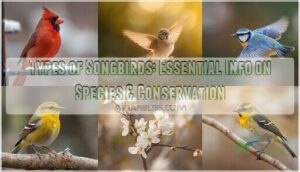
A flash of crimson at your feeder, a burst of yellow bouncing across the yard, or that liquid trill echoing through the trees at dawn—you’re witnessing one of nature’s most successful experiments. Songbirds, with roughly 4,000 species in the suborder Passeri alone, dominate nearly every habitat on Earth, from bustling city parks to remote rainforests. Yet most of us can barely name a handful beyond the robin or cardinal.
Understanding the types of songbirds around you isn’t just about identifying pretty plumage—it’s about recognizing which species need your help most and how your own backyard can become a refuge in an increasingly fragmented landscape.
Whether you’re drawn to the electric-blue flash of a bluebird or the cheeky antics of a chickadee, knowing what makes each species unique transforms casual bird-watching into meaningful conservation.
Table Of Contents
- Key Takeaways
- Songbird Species Overview
- Attracting Songbirds Effectively
- Songbird Habitats and Distribution
- Songbird Classification Diversity
- Conserving Songbirds Successfully
- Frequently Asked Questions (FAQs)
- What type of bird is a songbird?
- What are the different types of songbirds?
- Do songbirds have a vocal organ?
- Are all birds that make vocalizations songbirds?
- What do songbirds have in common?
- How many types of songbirds are there in the world?
- Are all birds songbirds?
- What order do songbirds belong to?
- How many types of songbirds are there?
- What is the biggest killer of songbirds?
- Conclusion
Key Takeaways
- Songbirds (suborder Passeri) represent roughly 4,000 species with specialized vocal organs called syrinxes, dominating nearly every habitat on Earth from rainforests to suburban backyards, yet face population declines of up to 41% due to habitat fragmentation and pesticide use.
- Creating effective songbird refuges requires layering native plants to achieve 70% native species diversity with 35-40% shrub cover density, which studies show explains over half the variation in songbird richness while supporting the insect biomass that breeding chicks need for survival.
- Simple backyard conservation actions like installing properly sized nest boxes (1¼” holes for chickadees, 1½” for bluebirds) achieve 88% breeding success rates and directly counter the loss of natural tree cavities from development and habitat destruction.
- Eliminating pesticides is critical since neonicotinoids kill songbirds with just one treated seed and landscapes have become 48 times more toxic to pollinators than a generation ago, while gardens using glyphosate support 25% fewer house sparrows than chemical-free alternatives.
Songbird Species Overview
You’ll find some of the most enchanting songbirds right in your own backyard if you know what to look for. Each species brings its own personality—from bold red cardinals to cheerful robins hopping across your lawn.
Let’s break down five common songbirds you’re likely to encounter and what makes each one unique.
Northern Cardinal Characteristics
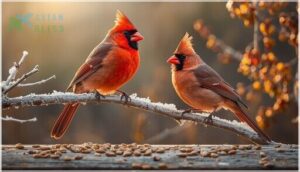
The Northern Cardinal stands out among songbirds with its vibrant red plumage—though only males sport that iconic color, while females wear subtler reddish-brown feather colors. You’ll spot these non-migratory birds year-round across eastern North America, where their breeding habits include raising multiple broods.
Their cardinal diet consists mainly of seeds, and their cheerful song patterns mark territories spanning woodlands to suburban gardens. The Northern Cardinal’s feeding behavior is characterized by its preference for sunflower seed sources in various environments.
American Robin Traits
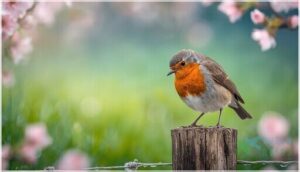
If you’ve admired cardinals, you’ll recognize American Robins just as easily—that rusty-red breast is unmistakable. With roughly 370 million individuals thriving across North America, these songbirds embody resilience in wildlife ecology. Their behavior shifts dramatically through seasons: you’ll spot them hopping across lawns hunting earthworms in spring, then gorging on berries during robin migration in fall. Bird feeding stations attract them less than natural food sources do. Understanding bird conservation efforts is vital for protecting songbird populations.
Here’s what makes their nesting habits noteworthy:
- They build sturdy mud-reinforced cups that cradle usually four eggs
- Fledgling care lasts just 15 days before young robins take flight
- Parents often raise multiple broods, showcasing tireless dedication to songbird conservation
Eastern Bluebird Features
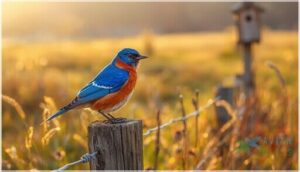
Eastern Bluebird males flash electric-blue backs and rusty-red chests—feather patterns that’ll stop you mid-step. About 23 million strong across North America, they’re thriving thanks to smart bird conservation work.
You’ll catch them in open habitats, snapping up insects or berries depending on the season. Their breeding habits revolve around cavity nesting, making bluebird nesting boxes essential for boosting populations where natural sites have vanished.
Black-capped Chickadee Description
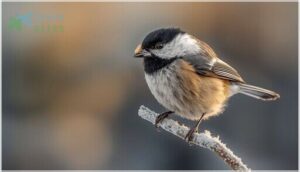
If you’re after a bird that breaks all the rules of “small equals boring,” meet the Black-capped Chickadee. About 39 million strong across North America, these feisty little acrobats sport sharp black caps, bright white cheeks, and complex chickadee behavior that’ll keep you hooked:
- Feather patterns create bold contrast—black, white, and gray mixing perfectly
- Beak structure manages seeds, insects, and suet with equal skill
- Nesting habits favor tree cavities, where 6–8 eggs hatch after 13 days
- Flocking dynamics shift seasonally, bringing winter companions to your feeders
You’ll spot them anywhere from Canadian boreal forests to suburban bird watching hotspots, their “chickadee-dee-dee” call announcing their presence before you even see them. Minnesota alone hosts nearly 2 million, and populations keep climbing—up 2.53% annually since 1967 in that state.
For songbird identification, they’re unmistakable: grab some sunflower seeds and watch these gutsy performers own your backyard.
American Goldfinch Details
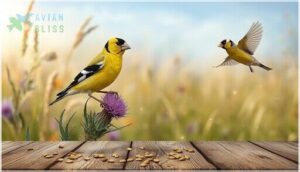
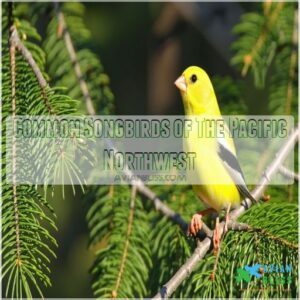
You’ll recognize the American Goldfinch by its sunny yellow breeding plumage and bouncing flight—one of roughly 43 million across North America. These songbirds favor thistle and sunflower seeds for bird feeding, nesting later than most (5 eggs, 13-day incubation) to sync with seed crops.
While continental numbers drop 0.17% yearly, flock behavior and Goldfinch migration patterns still make songbird identification easy in meadows and backyards alike.
Attracting Songbirds Effectively
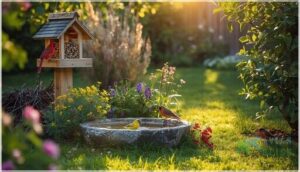
You don’t need fancy equipment or a master plan to bring songbirds into your yard. A few strategic changes to your outdoor space can transform it into a haven that attracts finches, robins, cardinals, and dozens of other species.
Let’s break down the essentials that’ll have these feathered visitors singing outside your window.
Provide Food Sources
Want to roll out the welcome mat for songbirds? Start with smart seed selection—black oil sunflower seeds draw finches and chickadees like magnets. Position your bird feeders strategically in open areas with nearby cover, and mix in native plants that offer natural food supplements year-round.
During winter foraging season, high-fat suet becomes essential fuel. Understanding each songbird species’ diet transforms your space into a bird-friendly gardening haven for garden birdwatching.
Offer Water Options
Beyond feeders, fresh water transforms your yard into a songbird sanctuary. Birdbath design matters—keep water depth around 1–2 inches with textured surfaces for secure footing. Moving water attracts more species than still basins; even a simple dripper works wonders.
Change water every couple days to prevent disease and support bird conservation efforts. During winter, heated baths provide unfrozen fresh sources when natural water locks up, making your wildlife gardening space essential year-round habitat for bird friendly gardening enthusiasts.
Create Suitable Habitats
Think of your yard as a stage where vertical layers steal the show. Stack native plantings from ground covers through shrubs to tall trees—research shows that complexity in vegetation structure explains more than half the variation in songbird richness.
Boost shrub density to 35–40% cover for peak nesting habitat, and leave dead wood standing; cavity nesters prefer snags with 20+ cm diameter.
This landscape mosaic approach to wildlife habitat creation and bird-friendly gardening beats manicured lawns every time for habitat preservation.
Avoid Pesticide Use
Your yard can become a death trap when pesticides enter the picture. Skip toxic chemicals entirely—studies show gardens using glyphosate support 25% fewer house sparrows, while neonicotinoids delay migration by days and kill with just one treated seed.
Embrace pesticide alternatives through sustainable landscaping: native plants need minimal fuss, beneficial insects handle pests naturally, and bird-friendly gardens with eco-friendly methods strengthen ecosystem balance.
Wildlife conservation starts when you choose nature conservation over convenience.
Songbird Habitats and Distribution
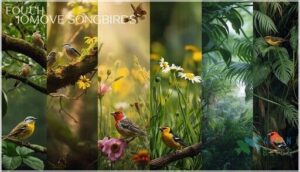
Songbirds don’t just pick any spot to call home—they’ve adapted to thrive in remarkably different environments across the globe. From dense forests to your own backyard, these birds have carved out niches that suit their unique needs and behaviors.
Let’s explore the key habitats where you’re most likely to encounter these vocal performers.
Forest Environments
Forests shelter more than half of the world’s passerines—you’re looking at the richest songbird real estate on the planet. But here’s the catch: habitat fragmentation is tearing these woodland floors and tree canopy systems apart. In eastern Canada alone, over 60% of forest-dwelling species have declined as their homes shrink and splinter. Forest ecology reveals why this matters—songbirds need intact landscapes, not isolated patches. Forest fires, while sometimes natural, combined with fragmentation create a one-two punch for bird conservation.
To support habitat preservation and wildlife management, consider:
- Maintaining connected forest corridors rather than isolated fragments
- Protecting mature woodlands with layered canopy structure
- Advocating for strategic land-use planning near remaining forests
Grassland Habitats
Grasslands—those wide-open sweeps of native plants and swaying stems—support roughly 61% of land cover in key wintering grounds like South America’s Gran Chaco. Meadowlarks and bobolinks thrive where prairie conservation maintains habitat complexity.
Yet habitat fragmentation and annual loss rates above 1% threaten songbird migration routes. Grassland ecology hinges on ecosystem services these birds provide: pest control, seed dispersal, and pollination.
Wildlife management through controlled burns preserves the structural diversity your backyard visitors depend on year-round.
Urban Areas
Cities mightn’t seem like songbird havens, but urban planning that prioritizes green spaces changes everything. Before-and-after studies reveal that forest fragments within 1 km of new development lose breeding songbirds fastest—yet small parks under 2 hectares with native vegetation can rival larger green spaces for species richness.
You’re witnessing city wildlife adapt in real time. Urban ecology hinges on structural diversity: mix trees with shrubs, add water features, and suddenly your backyard birding transforms. Bird friendly design means higher impervious surface thresholds matter less.
Want habitat preservation that works? Plant natives, skip pesticides, and watch bird conservation unfold right outside your window.
Suburban Gardens
Between city parks and wild forests lies your suburban garden—a potential hotspot for songbird species. Studies show forest fragments near development lose birds fastest, but you can buck that trend.
Layer native landscaping from ground covers to canopy, skip pesticides, and add bird feeders strategically. This bird-friendly approach to gardening for wildlife works: interconnected green spaces support richer suburban wildlife than isolated patches.
Your backyard birding starts with thoughtful garden design that makes urban ecology personal.
Songbird Classification Diversity
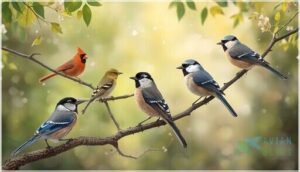
You might think songbirds are just pretty voices in your backyard, but they’re actually part of one of the most diverse groups in the animal kingdom. The suborder Passeri contains roughly 4,000 species spread across dozens of families, each with its own evolutionary story and unique features.
Let’s break down how scientists organize these extraordinary birds and what makes each group stand out.
Suborder Passeri Overview
If you’re hearing birdsong, you’re probably listening to a member of Passeri—the songbirds that dominate nearly half the world’s avian diversity. With around 5,200 species spread across 125 families, this suborder showcases remarkable Oscine Diversity.
What sets them apart? Their syrinx, a specialized vocal organ with up to six muscle pairs, facilitates the Vocal Complexity you hear each morning.
Passeri Evolution began in Australia roughly 30–40 million years ago, radiating globally to transform Songbird Taxonomy and fill forests, grasslands, and even your backyard with melody.
Common Songbird Families
You’ll discover songbird diversity among familiar Passeriformes families—each one breaking free from ordinary expectations. The major types of songbirds include:
- Finch families (Fringillidae): 230+ species with cone-shaped bills for seed-cracking, featuring cardinal diet preferences and seasonal finch migration patterns
- Thrush habitat specialists (Turdidae): 15 genera spanning deserts to rainforests globally
- Sparrows (Emberizidae): Demonstrating complex sparrow behavior across temperate regions
- Warblers: Masters of warbler songs with intricate melodies
These Passeri songbird species represent nature’s vocal revolutionaries.
Songbird Evolution History
Imagine this: songbirds rewrote the rules of avian biology roughly 60 million years ago. Genetic studies and fossil records reveal that Passeriformes originated in Australia during the Oligocene, with basal lineages spreading across Gondwanan landmasses. Species divergence accelerated as songbirds colonized Eurasia around 40 million years ago, creating biogeographic patterns that shaped modern bird species distribution.
| Evolutionary Timeline | Key Events in Ornithology |
|---|---|
| 70–60 million years ago | Initial Passeriformes diversification begins |
| 47.3 million years ago | Songbird ancestor emerges in Australia |
| 40 million years ago | Major dispersal into Northern Hemisphere |
| 23–16 million years ago | Rapid expansion through Southeast Asia |
| Late Miocene–Pleistocene | Sharp diversification rate increases |
Distinct Plumage Characteristics
Sexual dimorphism shapes how you’ll identify songbirds—males often flaunt elaborate plumage coloration while females wear subtler tones. Northern Cardinals sport vivid red feathers, and American Goldfinches shift from dull winter plumage to striking breeding yellow. Orioles and Tanagers display carotenoid-based hues acquired through diet, while melanin creates the rich blacks and browns you’ll notice on many species. These songbird markings aren’t random—they’re strategic mating displays honed over millennia.
- Carotenoid pigments produce the vibrant yellows, oranges, and reds in roughly 45% of species
- Melanin generates darker feather patterns and contributes to iridescent structural colors
- Tropical songbirds usually show more pronounced sexual dimorphism than temperate relatives
- Beak shapes vary dramatically across families, reflecting specialized feeding strategies
Conserving Songbirds Successfully
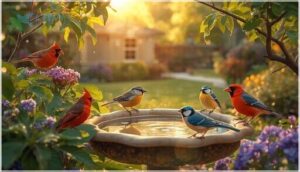
You don’t need a degree in conservation biology to make a real difference for songbirds. Simple, practical actions in your own yard can create safe havens that help these birds thrive.
Here are four straightforward ways you can support songbird populations right where you live.
Planting Native Plants
Native Gardens are a rebellion against bland, lifeless lawns—your chance to break free from chemical dependency. When you plant native species, you’re not just gardening; you’re staging a comeback for songbirds that have lost 41% of their populations to habitat destruction. Aim for at least 70% native plant diversity to boost insect abundance and support thriving bird communities.
Planting native species fights back against habitat destruction that’s wiped out 41% of songbird populations—your yard can stage their comeback
Here’s your roadmap to ecosystem balance:
| Plant Type | Wildlife Support Benefits |
|---|---|
| Trees | Shelter, nesting sites, insects |
| Shrubs | Food sources, protective cover |
| Perennials | Seeds, pollinators, insects |
| Grasses | Nesting material, seed heads |
| Vines | Fruit, vertical habitat |
This habitat preservation method transforms yards into biodiversity conservation zones, supporting garden wildlife and environmental sustainability.
Installing Nest Boxes
Think of nest boxes as safe havens in a world where natural cavities are vanishing—your chance to change the odds for cavity-nesting songbirds. When you choose the right nest box designs, you’re not just putting up wood; you’re giving species like chickadees and bluebirds fighting odds in a landscape stripped of dead trees.
Proper birdhouse placement means mounting on metal poles with predator guards, keeping climbing threats at bay. Box maintenance matters too—clean out old nesting materials each season to prevent parasites.
Studies show that well-managed nest boxes achieve 88% breeding success, proving your effort directly fuels bird conservation and habitat preservation methods that work.
Offering Birdhouses
Well-designed birdhouses can be game-changers for cavity nesting songbirds that have lost natural roosting boxes to development. Choose nest box designs with entrance hole sizes matched to your target bird species—1¼” for chickadees, 1½” for bluebirds. Proper birdhouse placement matters: mount on poles with predator guards, face entries away from prevailing winds, and provide ventilation near the roof.
Your backyard birding tips start here:
- Give displaced songbirds a fighting chance when old-growth trees disappear
- Watch fledglings take their first flights from boxes you installed yourself
- Join the rebellion against habitat loss with simple, powerful action
- Create refuge in a world that’s forgotten what wild birds need
Protecting Beneficial Insects
Protecting insects isn’t some side quest—it’s the whole game. Research shows that as non-native plants increase in your yard, insect biomass drops, which directly slashes songbird breeding success. That’s because chicks need protein-packed caterpillars and beetles to survive.
Your eco-friendly practices matter: ditch pesticides that have made landscapes 48 times more toxic to pollinators than a generation ago. Plant native species to boost pollinator health and biodiversity support. These wildlife management strategies create ecosystem balance and health that feeds the birds you’re trying to save.
Frequently Asked Questions (FAQs)
What type of bird is a songbird?
Songbirds belong to the suborder Passeri—a massive group of over 4,000 species with incredibly complex vocal organs.
Their syrinx lets them produce the melodious songs you hear, setting them apart from other birds.
What are the different types of songbirds?
Ever wonder what makes Northern Cardinals, with their vibrant red feathers, so different from the cheerful American Goldfinches flitting through your backyard?
You’ll find Northern Mockingbirds, Orioles, Finches, and Sparrows—each displaying unique beak shapes and feather coloration that reveal their specialized nesting habits and stunning bird vocalization abilities.
Do songbirds have a vocal organ?
Yes, you’ll find that songbirds possess an impressive vocal organ called the syrinx, positioned where the trachea splits into bronchi. This specialized structure facilitates their exceptional song production through paired, independently controlled sound sources.
Are all birds that make vocalizations songbirds?
Not quite—while songbirds master vocal learning through their syrinx function, many non-songbirds like parrots and hummingbirds also vocalize.
Bird classification separates these talented mimics from true songbird species based on evolutionary lineage and avian behavior.
What do songbirds have in common?
All those cheerful voices? They’re powered by the syrinx, a specialized vocal organ that sets songbirds apart.
You’ll also notice their shared talent for vocal learning, letting them master complex melodies through practice and social behavior.
How many types of songbirds are there in the world?
Scientists keep revising songbird counts like they’re chasing a moving target—current tallies put true songbirds (Passeri) at roughly 4,700 species, representing nearly half of all bird species worldwide and dominating global avian diversity through sheer evolutionary success.
Are all birds songbirds?
Not every bird you hear is a songbird. While songbirds make up roughly half of all avian species with around 4,000 types worldwide, many birds lack their specialized vocal abilities and complex songs.
What order do songbirds belong to?
Perched at the top of bird taxonomy, songbirds belong to Passeriformes, the most species-rich avian order. Within it, you’ll discover roughly 6,000 passerines—with around half classified as true songbirds in suborder Passeri.
How many types of songbirds are there?
You’re looking at over 4,000 songbird species within Passerines—that’s roughly 60% of all birds on Earth. These oscines span 140+ families, from tiny kinglets to corvids, making avian research and conservation efforts incredibly diverse.
What is the biggest killer of songbirds?
You’ll find that outdoor and feral cats kill between 3 and 4 billion birds yearly in North America—the largest direct human threat.
Window collisions follow, claiming up to a billion songbirds annually.
Conclusion
The smallest backyard can shelter the largest threats—or solutions—for songbirds. Now that you’ve got solid types of songbirds information, you hold real power: plant that native shrub, skip the pesticides, mount a nest box. Each choice ripples outward, turning your patch of earth into a lifeline.
Cardinals, chickadees, and goldfinches don’t need grand gestures—they need your consistent, informed action. Start today, because fragmented landscapes heal one yard at a time.
- https://pubmed.ncbi.nlm.nih.gov/36283383/
- https://science.ebird.org/en/use-ebird-data/the-ebird-taxonomy/2024-ebird-taxonomy-update
- https://jzar.org/jzar/article/view/734
- https://www.birdfamiliesoftheworld.com/passeriformes-family-groups/
- https://bigbird.alibaba.com/question/how-many-species-are-there-of-birds