This site is supported by our readers. We may earn a commission, at no cost to you, if you purchase through links.
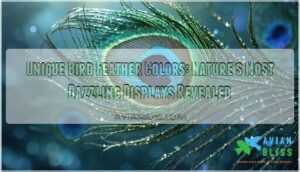 You’ll discover that unique bird feather colors come from an incredible mix of pigments and microscopic structures.
Melanin creates blacks and browns, while carotenoids produce brilliant reds, oranges, and yellows.
But here’s where it gets fascinating – many of the most stunning blues and greens aren’t from pigments at all.
They’re created by tiny structures that bend light like nature’s own prisms. Think of a peacock’s tail or a hummingbird’s throat that shifts from emerald to ruby as it moves.
These iridescent displays happen because specialized cells scatter light waves in different directions. What’s really remarkable is how some birds can actually change their feather colors based on what they eat or where they live.
Table Of Contents
- Key Takeaways
- Beautiful Bird Feathers
- Bird Feather Color Types
- Iridescent Feather Colors
- Unique Feather Color Mechanisms
- Rare Bird Feather Colors
- Frequently Asked Questions (FAQs)
- What are the most beautiful bird feathers?
- What colors do birds have?
- How do I choose the most beautiful feathers?
- Do birds have iridescent feathers?
- How do birds produce colorful feathers?
- Why are hummingbird feathers different colors?
- What is the rarest bird feather color?
- What are the colors of bird feathers?
- How do birds regenerate lost feather colors?
- Can feather colors change with bird age?
- Conclusion
Key Takeaways
- You’ll find bird feather colors come from two main sources – pigments like melanin (blacks/browns) and carotenoids (reds/yellows) that birds get from their diet, plus structural colors created by microscopic feather structures that bend light to produce blues and iridescent effects
- Iridescent feathers create nature’s most dynamic color displays – peacocks, hummingbirds, and other birds use tiny nanostructures that act like prisms, shifting colors from emerald to ruby as viewing angles change during courtship and communication
- Diet directly affects feather vibrancy – flamingos get their pink from eating shrimp and algae, while captive birds often show duller colors than wild ones because they can’t access the same pigment-rich foods that create brilliant plumage
- Some of the world’s rarest feather colors face extinction threats – climate change and habitat loss endanger species like the Resplendent Quetzal and Scarlet Macaw, making conservation efforts crucial for preserving these extraordinary natural color displays
Beautiful Bird Feathers
You’ll discover that the most stunning bird feathers in nature combine brilliant pigments with intricate structural elements to create colors that seem almost impossible.
These remarkable displays range from the iridescent blues and greens of peacock trains to the electric cobalt of hyacinth macaws, each serving specific purposes in survival and reproduction.
Peacock Train Feathers
When you see a peacock’s train feathers fanned out in full display, you’re witnessing one of nature’s most sophisticated courtship mechanisms.
Nature’s most dazzling display unfolds when peacocks spread their magnificent, jewel-toned train feathers in courtship.
These iridescent plumes showcase incredible Train Feather Evolution through millions of years of sexual selection.
Here’s what makes peacock feathers so extraordinary:
- Courtship Display Mechanics – Males position their trains at precise angles to catch light and create mesmerizing eye-spot patterns that females find irresistible
- Feather Pattern Genetics – Each ocellus (eye-spot) contains specific genetic codes that determine color intensity and Iridescence Angle Variance across the plume
- Symbolic Feather Meanings – These iridescent bird feathers have represented beauty and divinity across cultures for centuries
These unique characteristics combined highlight the remarkable nature of peacock feathers, making them a fascinating subject of study in the context of evolution, genetics, and cultural symbolism.
Kingfisher Plumage
Many kingfishers showcase dazzling blue and orange plumage that serves dual purposes in their river habitat.
This kingfisher iridescence creates perfect camouflage function while hunting, as vibrant bird feathers blend with water’s shifting colors.
The iridescent bird feathers evolved through diet influence and color evolution, producing nature’s most effective aquatic camouflage through colorful plumage.
Some species, like the Azure Kingfisher, also exhibit incredible azure feathers.
| Kingfisher Feature | Function |
|---|---|
| Blue dorsal feathers | Water surface camouflage |
| Orange breast plumage | Underwater invisibility |
| Iridescent sheen | Light reflection mimicry |
| Metallic highlights | Predator confusion |
| Color intensity | Mate attraction signal |
Blue Jay Vibrant Feathers
Blue Jay’s vibrant feathers showcase nature’s brilliant engineering, with structural coloration creating their stunning blue appearance through light refraction rather than pigments.
Their colorful plumage varies regionally, influenced by Jay Coloration Genetics and environmental factors.
During Blue Jay Molting periods, these vibrant bird feathers serve as Feather Health Indicators, while their impressive Mimicry and Plumage abilities make them remarkable examples of bird feather colors in action.
Hyacinth Macaw Cobalt Feathers
Hyacinth Macaw cobalt feathers showcase nature’s most intense blue coloration through specialized feather structure and light reflection.
You’ll notice their vibrant cobalt intensity results from microscopic nanostructures that scatter blue wavelengths while absorbing others.
These exotic feather colors evolved through macaw genetics and habitat influence in Brazil’s wetlands, creating plumage that enhances color perception for mate selection and species recognition.
Bird Feather Color Types

When you examine bird feathers closely, you’ll discover that nature creates their stunning colors through four main mechanisms: pigments and structural properties working together in fascinating ways.
These color-producing systems include melanin pigments for dark hues, carotenoid pigments for bright reds and yellows, porphyrin pigments for unique reds and greens, and structural colors that create blues and iridescent effects through light manipulation.
Melanin Pigments
Deep within feather structures, melanin pigments create the foundation of bird coloration.
You’ll find two types: eumelanin produces black, brown, and gray hues, while pheomelanin generates buff and reddish tones.
This melanin synthesis strengthens feather structure, providing durability alongside camouflage colors.
From cardinal’s deep blacks to jay’s subtle grays, melanin forms nature’s most reliable feather pigmentation system.
Carotenoid Pigments
You’ll find carotenoids create the most vibrant reds, oranges, and yellows in bird feather pigmentation.
These dietary carotenoids from fruits and crustaceans undergo pigment deposition directly into growing feathers.
Flamingo coloration depends entirely on these carotenoid compounds, while spoonbill intensity varies with carotenoid intake.
Bird coloration through these bird pigments requires constant dietary renewal, making carotenoid variation common across seasons and habitats.
Porphyrin Pigments
Beyond their basic color production, porphyrins create spectacular red hues, pinks, browns, and turaco greens through unique biochemical processes.
These bird pigments showcase remarkable UV fluorescence properties, making owl plumage glow under ultraviolet light while enhancing bird feather pigmentation complexity.
Some birds also use melanins for coloration.
- Porphyrin production generates vibrant reds and pinks in certain bird species through specialized metabolic pathways
- UV fluorescence causes porphyrin-rich feathers to emit visible light when exposed to ultraviolet radiation
- Turaco greens result from turacoverdin, a unique copper-containing porphyrin found exclusively in turaco bird feather colors
Structural Colors
Unlike pigments that absorb light, structural colors in feathers work through light refraction and scattering.
You’ll find feather nanostructures create blues, whites, and iridescent mechanisms that shift colors as viewing angles change.
These microscopic feather structures bend light waves, producing UV reflection invisible to humans but essential for bird communication.
Color shifting occurs when ordered layers of keratin and melanin interact with incoming light, creating the dazzling iridescent feathers you see on peacocks and hummingbirds.
Iridescent Feather Colors
You’ll discover that iridescent feathers create nature’s most mesmerizing light shows, shifting from deep emerald to brilliant sapphire as birds move through sunlight.
These dynamic colors result from microscopic structures in feathers that bend and reflect light at different angles, producing the shimmering effects you see in peacocks, hummingbirds, and frigatebirds.
Peacock Iridescent Feathers
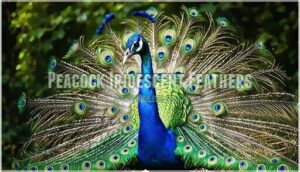
You’ll witness nature’s most sophisticated optical illusion when peacocks unfurl their magnificent train feathers.
These stunning plumage displays showcase iridescence physics through microscopic feather nanostructure that creates shifting blues and greens.
During courtship display rituals, peacock evolution has perfected this dazzling spectacle for mate selection purposes:
- Layered melanin creates structural colors
- Keratin barbules act as tiny prisms
- Light interference produces color-shifting effects
- Humidity enhances bird feather iridescence intensity
This remarkable display function transforms ordinary feathers into living kaleidoscopes.
Hummingbird Iridescent Feathers
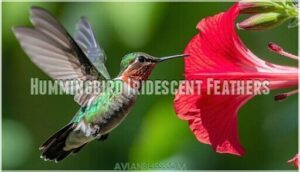
You’ll discover that hummingbirds possess nature’s most dynamic iridescent feathers, with gorget coloration shifting dramatically through precise muscle control and specialized feather structure that manipulates light refraction for mate attraction.
They also require a high energy intake to sustain their metabolism.
| Species | Gorget Color | Display Behavior |
|---|---|---|
| Ruby-throated | Crimson flash | Dive displays at specific angles |
| Anna’s | Magenta crown | Positioning for maximum light reflection |
| Allen’s | Copper-orange to red | Targeted flashing at mates or rivals |
These structural colors result from ordered melanin and keratin nanostructures creating bird feather iridescence that changes with viewing angle, making hummingbirds living jewels in flight, with their mate attraction behaviors being highly dependent on these visual displays, and their ability to manipulate light refraction.
Frigatebird Iridescent Feathers

You’ll notice frigatebirds’ jet-black plumage transforms dramatically when sunlight strikes at specific angles, revealing stunning purple-tinged hues through specialized nanostructures.
These frigatebird nanostructures create iridescent feathers by manipulating light refraction, producing colors that shift from deep blue-black to violet depending on your plumage angle.
This bird feather iridescence serves multiple purposes during courtship displays, where males position themselves strategically to maximize light scattering effects and showcase their evolutionary advantage to potential mates.
Mechanisms of Iridescence

Feather structures create iridescent colors through ordered layers of melanin and keratin nanostructures that manipulate light refraction.
These microscopic arrangements produce dynamic color shifting as viewing angles change, making structural colors appear different from each perspective.
- Light refraction bends wavelengths through feather structures, creating brilliant hues
- Nanostructure layers act like tiny prisms, separating light into component colors
- Viewing angles determine which wavelengths reach your eye, causing color shifting
- Iridescent variations result from light scattering through different microscopic arrangements
Unique Feather Color Mechanisms

You’ll discover that bird feather colors emerge through remarkable mechanisms beyond simple pigments, involving everything from diet and environment to microscopic structures and blood flow.
These unique processes create some of nature’s most extraordinary color displays, from flamingos’ carotenoid-driven pink hues to peacocks’ humidity-responsive iridescent blues.
Diet Influence on Feather Color
Bird nutrition directly shapes feather coloration through carotenoid sources like crustaceans and fruits.
Flamingo diets rich in algae and shrimp produce vibrant pink hues, while lorikeet nectar consumption creates rainbow plumage.
Macaw nutrition from diverse rainforest foods intensifies red and yellow tones.
Finch pigmentation fades without adequate carotenoid intake, demonstrating how food sources control diet-induced color changes in avian species.
A deficiency in vitamin A can lead to dull, brittle plumage.
Environmental Factors
Beyond diet, your environment plays a massive role in shaping feather color variations.
UV-B exposure causes Color Fading in many species, while Habitat Humidity affects pigment stability.
Stress Impact from urbanization alters pigment production, and Pollution Effects change how colors develop.
High-altitude birds show darker melanin for UV protection, demonstrating how bird ecology and environmental factors directly influence what you see in nature.
Nanostructures and Feather Color
You’ll discover that microscopic structures within feathers create stunning colors through light refraction, not pigments.
These intricate keratin arrangements produce wavelength-specific scattering, resulting in vivid blues and greens that shift with viewing angles.
- Blue Jay feathers contain nanostructures that scatter blue light while absorbing other wavelengths
- Keratin and air pocket density determines the brightness and hue of structural coloration
- Melanosome spacing affects how light interacts with feather surfaces
- Photonic nanostructures can amplify underlying pigment colors beyond what pigments achieve alone
- Small variations in nanostructural organization create species-specific color differences
These evolutionary advantages help birds communicate, attract mates, and display health through their remarkable feather color mechanisms.
Blood Flow and Feather Color
You’ll observe fascinating Color Intensification in birds like moorhens and coots, where Feather Follicles receive increased blood flow during Courtship Display.
These Physiological Mechanisms create temporary color shifts in soft tissues, though true bird feather colors remain fixed after molting.
Blood flow affects Temperature Regulation and signals mating readiness, demonstrating how feather color mechanisms extend beyond pigments to include dynamic feather blood flow effects and feather color transformations that enhance bird feather function.
Rare Bird Feather Colors
You’ll discover that some of the world’s most spectacular feather colors exist in only a handful of bird species, making them nature’s rarest gems.
These extraordinary birds showcase color combinations and intensities that seem almost impossible, from the Scarlet Macaw’s blazing red-blue-yellow palette to the Resplendent Quetzal’s ethereal emerald glow.
Scarlet Macaw Vibrant Feathers

These magnificent rainforest dwellers showcase some of nature’s most striking plumage through their scarlet, blue, and yellow feathers.
Their vibrant colors result from high carotenoid concentrations, which they obtain from their diverse rainforest diet and use for essential social signaling within their flocks.
To enhance their feather vibrancy, consider macaw specific food.
- Macaw Coloration Genetics influence how effectively these bird species colors develop and maintain their intensity throughout molting cycles
- Rainforest Diet Impact directly affects feather health indicators, with pigment-rich foods essential for maintaining brilliant plumage displays
- Captive Breeding Colors often appear duller than wild counterparts due to limited access to natural carotenoid sources
Resplendent Quetzal Iridescent Feathers
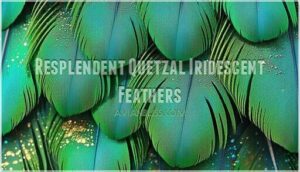
You’ll find the Resplendent Quetzal’s iridescent feathers shimmer with emerald and gold hues, created by microscopic nanostructures that bend light at different angles.
This Quetzal feather structure produces stunning visual effects that shift as you move.
Ancient Mesoamerican cultures revered these vibrant colors for ceremonial purposes, establishing deep Quetzal cultural symbolism.
Today, habitat fragmentation threatens their conservation status, making protection efforts critical for preserving these remarkable plumage displays in Central American cloud forests.
Turquoise-browed Motmot Bright Feathers

You’ll notice turquoise-browed motmots create their stunning bright feather hues through a fascinating combination of blue structural colors and yellow pigments.
These colorful birds showcase remarkable motmot plumage camouflage among Central America’s dappled forest light, while their distinctive racket-tail function serves essential roles in visual signaling during courtship displays.
Making them standout examples within the avian color spectrum, they are truly unique creatures.
Conservation of Rare Feather Colors
Climate change threatens bird conservation efforts worldwide, putting stunning bird feather beauty at risk.
When habitats disappear, you’ll witness declining bird diversity and compromised bird species identification.
- Habitat Loss: Deforestation reduces pigment-rich food sources essential for vibrant feather coloration
- Poaching Threats: Illegal hunting targets birds with rare colors, depleting populations rapidly
- Captive Breeding: Programs maintain Genetic Diversity while preserving natural coloration traits
Frequently Asked Questions (FAQs)
What are the most beautiful bird feathers?
Like nature’s jewelry box spilling brilliant gems, you’ll discover the most stunning feathers among peacocks’ iridescent blue-green trains, hummingbirds’ color-shifting gorgets, and scarlet macaws’ vibrant red-blue-yellow plumage that captures sunlight perfectly.
What colors do birds have?
Birds display an incredible spectrum of colors including vibrant reds, blues, greens, yellows, oranges, and purples.
You’ll see these hues created through pigments like melanin and carotenoids, plus structural light refraction producing iridescent effects.
How do I choose the most beautiful feathers?
You’ll want to focus on iridescent feathers that shift colors at different angles, like peacock train feathers or hummingbird gorgets.
Look for vibrant pigmentation from carotenoids creating reds and yellows, or structural blues and greens from light refraction through feather proteins.
Do birds have iridescent feathers?
You’d think birds were just showing off, but yes, they absolutely have iridescent feathers.
These rainbow-shifting colors come from microscopic structures that bend light differently at various angles, creating those mesmerizing color changes you see.
How do birds produce colorful feathers?
You’ll discover that birds create stunning feathers through two main methods: pigments and structural coloration.
Pigments like melanin produce blacks and browns, while carotenoids create vibrant reds and yellows from their diet, showcasing structural coloration is not the focus but rather an introduction to the variety of colors.
Why are hummingbird feathers different colors?
You’ll see hummingbird feathers shimmer because they contain microscopic structures that bend light at different angles, creating iridescent colors that shift from copper-orange to red during their elaborate courtship displays.
What is the rarest bird feather color?
Coincidentally, the rarest bird feather color you’ll encounter is pure white without any pigment—true structural white.
Unlike pigment-based colors, this requires perfectly aligned microscopic structures that scatter all light wavelengths equally, making it exceptionally uncommon in nature, due to the need for perfectly aligned microscopic structures.
What are the colors of bird feathers?
You’ll find bird feathers display an amazing spectrum of colors through pigments and structural mechanisms.
Melanins create blacks, browns, and grays, while carotenoids produce brilliant reds, oranges, and yellows like cardinals sport brilliant colors.
How do birds regenerate lost feather colors?
You’ll notice that when birds molt, they don’t just regrow plain feathers—they rebuild their entire color palette through precise biochemical processes and structural arrangements.
That recreate their original vibrant appearance.
Can feather colors change with bird age?
Yes, you’ll see feather colors change as birds age.
Young birds often sport duller, brownish plumage that gradually brightens into vibrant adult colors through successive molts.
Some species, like roseate spoonbills, intensify their pink hues throughout their lifetime.
Conclusion
Beyond imagination, unique bird feather colors represent nature’s most spectacular artistry, where microscopic structures create breathtaking displays that shift and shimmer with every movement.
You’ve discovered how pigments and light-bending nanostructures work together, creating everything from peacock iridescence to hummingbird throat patches.
These remarkable adaptations showcase evolution’s creativity, reminding us that the most stunning beauty often emerges from the tiniest details in nature’s design.
- https://avianreport.com/bird-feather-colors/
- https://evolution.earthathome.org/kingfishers/vce/museum-science/plumage/
- https://prumlab.yale.edu/sites/default/files/prum_1999_ioc_anatomy.pdf
- https://www.syfy.com/syfy-wire/iridescence-in-bird-feathers-has-been-demystified
- https://pmc.ncbi.nlm.nih.gov/articles/PMC8691833/