This site is supported by our readers. We may earn a commission, at no cost to you, if you purchase through links.
Most people can name a dozen waterbirds off the top of their head—ducks, geese, maybe a heron or two. But here’s the thing: over 900 species of birds call aquatic environments home, and they’ve evolved some of the most specialized adaptations in the animal kingdom. From the diving prowess of loons to the filter-feeding bills of flamingos, waterbirds have cracked the code on surviving where land meets water.
Whether you’re scanning a local pond or planning a birding expedition to a coastal hotspot, knowing your waterbird species list transforms casual observation into genuine discovery. These birds aren’t just pretty faces on the water—they’re ecosystem engineers, migration marvels, and reliable indicators of environmental health.
Table Of Contents
Key Takeaways
- Over 900 waterbird species have evolved specialized adaptations like webbed feet, waterproof feathers, and unique bill shapes that let them thrive in aquatic environments from freshwater ponds to open oceans.
- Waterbirds act as ecosystem engineers by controlling prey populations (reducing fish by 15–40%), dispersing seeds that kickstart 12% of wetland plant growth, and cycling nutrients that boost marsh productivity by up to 60%.
- Waterbird populations have dropped 15% in the past three decades due to habitat loss (half of all freshwater wetlands destroyed since 1900), pollution, climate change shifting migration timing, and habitat fragmentation isolating breeding groups.
- Conservation efforts through 30,000+ protected areas, habitat restoration projects (boosting nesting success by 12–25%), and citizen science monitoring are proving effective at stabilizing threatened waterbird populations across critical flyways.
What Are Waterbirds?
Waterbirds are species that depend on aquatic environments for their survival, from freshwater ponds to open oceans. They’ve evolved striking adaptations like webbed feet, waterproof feathers, and specialized bills that let them thrive where land birds can’t.
Understanding what makes a bird a ‘waterbird’ starts with three key concepts that separate them from their landlocked cousins.
Definition and Classification
Waterbirds aren’t just any birds hanging around water—they’re species that depend on aquatic environments for survival. Think ducks paddling through ponds or herons stalking fish in marshes. These birds span multiple taxonomic systems and bird orders, showcasing remarkable water bird diversity through evolutionary history.
Here’s how species classification breaks down:
- Anseriformes include ducks, geese, and swans with their signature webbed feet
- Pelecaniformes cover herons, ibises, and pelicans built for wading or diving
- Gaviiformes feature loons—those haunting-voiced lake specialists
- Aquatic adaptations range from semi-aquatic dabbling to full-time swimming lifestyles
Understanding these bird identification basics helps you recognize water birds wherever you explore.
Common Physical Traits and Adaptations
You’ll spot water birds by their signature gear: webbed feet for paddling, waterproof feather structure maintained by preen glands, and specialized beak morphology—ducks filter-feed with flat bills while herons spear fish with sharp beaks. Buoyancy control comes naturally since these avian species run 5–15% less dense than land birds.
Bird identification gets easier once you recognize these water bird characteristics shaped by aquatic lifestyles. Understanding research network tools can also aid in species identification and study.
Key Ecological Roles in Aquatic Ecosystems
Beyond their swimming prowess, these birds power aquatic ecosystems in surprising ways. You’ll find them shaping entire food webs through nutrient cycling—their droppings boost marsh productivity by up to 60%. Here’s how water bird species maintain ecological balance:
- Trophic interactions: Herons and grebes slash prey fish populations by 15–40% during breeding
- Seed dispersal: Waterfowl kickstart 12% of wetland plant recruitment
- Ecosystem engineering: Ducks graze vegetation, cutting algal blooms
- Biodiversity conservation: Their presence signals healthy habitat preservation needs
Understanding AP study guides can help students learn about the importance of conservation and ecology.
Major Groups of Waterbird Species
Waterbirds aren’t just one big happy family—they’re split into distinct groups based on their body structure, lifestyle, and evolutionary history. Think of these groups as different neighborhoods in the bird world, each with its own quirks and specialties.
Let’s break down the main families you’ll encounter when you’re out exploring wetlands, coastlines, and open water.
Ducks, Geese, and Swans
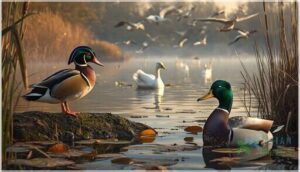
You’ll find Mallards, Canada Geese, and Wood Ducks almost everywhere—this family spans over 120 species worldwide. Their beak adaptations include flat bills perfect for filtering food, while waterfowl behavior shifts dramatically with seasons.
Migratory patterns guide them across continents, and feather maintenance through preen oils keeps them waterproof.
Nesting habits vary: some Gadwall prefer dense marsh grasses, while waterfowl like Wood Ducks choose tree cavities.
Herons, Ibises, and Cranes
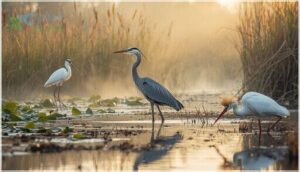
You’re looking at about 64 heron and egret species plus 15 crane species worldwide, with the highest diversity in tropical wetlands.
Wading behaviors differ sharply—herons spear fish with pointed beaks, while ibises probe mud in shallow habitats.
Crane conservation has stabilized some populations by 10–30% in protected areas, but habitat loss still threatens these striking water birds across Asia and Africa.
Loons and Grebes
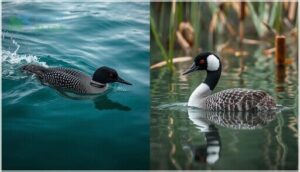
You’ll find just 5 loon species and about 20 grebe species worldwide, yet both groups show striking aquatic adaptations that set them apart from other water birds.
Here’s what makes these bird species special:
- Breeding habits: Loons need large, fish-rich lakes; grebes tolerate varied freshwater types with emergent vegetation for nesting behaviors
- Migration patterns: Climate change shifts loon timing by 1–3 weeks in high latitudes
- Feeding strategies: Specialized foot-propulsion drives underwater hunting success
Pelicans, Spoonbills, and Cormorants
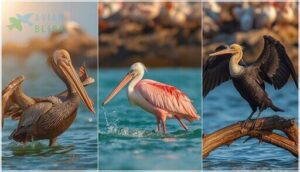
Pelicans, spoonbills, and cormorants bring wild diversity to coastal waters—8 pelican species, 9–11 spoonbills, and roughly 40 cormorants spread across fish-rich habitats worldwide. Their beak adaptations tell the story: pelicans scoop with pouches, spoonbills sweep shallow tides, cormorants dive deep.
You’ll see their social behaviors in massive roosting colonies on cliffs and islands, where nesting habits anchor entire aquatic ecosystems despite fishing pressures threatening some populations.
Egrets, Bitterns, and Other Notable Waterbirds
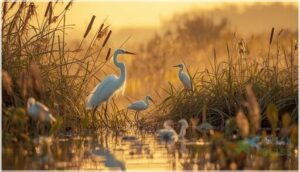
Egrets and bitterns (40–50 Ardeidae species) thrive in tropical wetlands and arid oases, with the American bittern preferring dense reedbeds while little bitterns nest in open marshland. Waterbird feeding patterns and avocet behavior span tidal flats where stilts and oystercatchers join 100+ regional bird species in estuarine hotspots.
You’ll witness wetland ecology shaped by:
- Egret migration driven by seasonal habitat changes
- Bittern habitat specialization in freshwater marshes versus mangroves
- Endemic waterfowl adapting to localized water birds niches
- Ornithology surveys tracking abundance shifts across wetlands
Waterbird Habitats and Global Distribution

Waterbirds aren’t picky about their zip codes—they’ve claimed everything from mountain lakes to tropical coastlines. Where you find them depends on what they eat, how they move, and whether they’re the staying type or prefer a good cross-continental road trip.
Let’s break down the main landscapes these birds call home and the routes they travel to get there.
Freshwater Environments (Lakes, Rivers, Wetlands)
Think of freshwater habitats as nature’s bustling diners—lakes, rivers, and wetlands host about 40% of the world’s water birds. You’ll spot diverse bird species in these aquatic ecosystems, from mallards dabbling among aquatic plants to herons stalking freshwater fish in shallow edges.
Wetland restoration directly boosts water quality and ecosystem services, supporting roughly 1,200–1,500 species globally.
Marine and Coastal Regions
You’ll find water birds thriving along temperate coastlines where tidal zones create vibrant feeding grounds for shorebirds and seabirds alike. Marine and freshwater ecosystems merge here, supporting at least 120 species despite threats from coastal erosion and marine pollution.
Coastal conservation efforts are critical—protected areas now cover 15–25% of key habitats, helping safeguard seabird migration routes through these vulnerable aquatic ecosystems.
Migratory Routes and Seasonal Movements
Beyond these essential coastal zones, waterbirds follow ancient flyway patterns across continents—some species travel up to 70,000 km annually. You’ll witness seasonal movements that sync with climate-driven resource peaks, though warming has hastened spring migration by 2–5 days per decade. Bird migration depends on strategic stopover ecology, where travelers rebuild 20–40% of their body mass before continuing their journey.
- Route Optimization – Major migratory routes funnel through bottlenecks like the Yellow Sea
- Migration Timing – Spring arrivals now precede peak food by 1–3 weeks
- Stopover Refueling – Coastal wetlands provide 70% of essential stopover resources
- Seasonal Shifts – Autumn departures vary more than spring due to local conditions
Regional Hotspots for Waterbird Diversity
Where do waterbirds truly thrive? East Asian monsoon wetlands harbor 25–40% of global water bird diversity—the Yangtze and Pearl River basins pulse with species richness you won’t find elsewhere. Meanwhile, the Mediterranean captures 12–18% of waterbird species and their habitats during seasonal influxes.
These wetland ecosystems face habitat fragmentation, yet conservation efforts in protected corridors show 8–12% increases in migratory patterns and aquatic ecosystems stability.
Waterbird Species Identification Guide
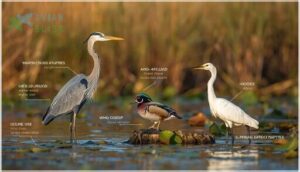
Spotting waterbirds in the wild becomes way easier when you know what to look for. The trick is learning to read their visual clues, behaviors, and sounds like a field guide come to life.
Let’s break down the key features that’ll help you identify any waterbird you come across.
Distinctive Plumage and Markings
Look closely, and you’ll see a living color wheel unfolding across wetlands. Plumage patterns tell you exactly who’s who among water birds:
- Mallard males flash iridescent green heads with white neck rings—perfect for birdwatching beginners
- Canada Goose sports a black head with distinctive white chinstrap
- Great Egrets wear all-white plumage with black legs for high contrast
Feather colors and migratory markings aren’t just pretty—they’re camouflage strategies and recognition signals refined over millennia. Ornithology reveals nature’s identification system.
Bill Shapes and Feeding Behaviors
A duck’s flat bill strains tiny invertebrates like a living sieve—that’s Bill Morphology in action. You’ll spot herons with dagger-sharp beaks built for spearing fish, while pelicans scoop entire schools with that massive pouch.
These Feeding Adaptations reveal each water bird’s lifestyle: spoonbills sweep muddy shallows by touch, and cormorants grip slippery prey with hooked tips. Jaw Mechanics and Beak Functions reveal the whole foraging story.
Vocalizations and Social Behavior
You can decode water bird species by their calls—geese honk, cranes trumpet, and loons wail with that haunting cry. Listen for 5–7 distinct call patterns per species: alarm, contact, courtship. Dawn and dusk bring peak vocal activity, up 30–50% from midday.
Colonial breeders like herons use synchronized duets to strengthen pair bonds, boosting fledgling survival by 8–12% through better communication styles and flock dynamics.
Tips for Birdwatching and Species Recognition
Sharpen your observation skills by investing in quality optical gear—8× binoculars offer wider views for tracking fast-moving avian species in wetlands, while 10× lets you catch finer plumage details. Field guides reduce identification errors during counts, and species differentiation improves with practice.
- Study bill shapes and feeding patterns to distinguish similar water birds
- Focus birding techniques on dawn and dusk when birds are most active
- Join citizen science projects to support bird species conservation status monitoring
- Practice in regional hotspots where waterbird diversity peaks during migration
Conservation Status and Threats to Waterbirds
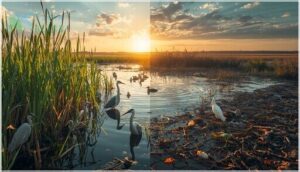
Waterbirds face some serious challenges in 2025, and understanding what’s threatening them is the first step to helping. From vanishing wetlands to shifting weather patterns, these birds are traversing a world that’s changing faster than they can adapt.
Here’s what you need to know about the threats they’re facing and the conservation work that’s giving them a fighting chance.
Major Threats (Habitat Loss, Pollution, Climate Change)
You’re watching waterbirds vanish before our eyes. Habitat Loss has wiped out half of all freshwater wetlands since 1900—agriculture and urban sprawl devour breeding grounds, while Wetland Degradation from Pollution Effects like plastic and heavy metals kills chicks and poisons adults.
Waterbirds are vanishing as habitat loss has destroyed half of all freshwater wetlands since 1900, with agriculture, urban sprawl, and pollution poisoning their breeding grounds
Climate Change throws migration timing into chaos, and Habitat Fragmentation isolates populations.
Without Environmental Protection and Wildlife Conservation, Ecosystem Disruption accelerates, threatening species survival across every flyway.
Conservation Initiatives and Protected Areas
You can’t save waterbirds without saving their homes—that’s where Protected Areas and Conservation Networks step in. Over 30,000 nature reserves and wildlife sanctuaries now shelter waterbird populations, covering 16% of critical habitats worldwide.
Habitat Restoration projects have expanded nesting sites by 28% since 2010, while Wetland Management programs boost breeding success by up to 25%.
These conservation efforts deliver real Ecosystem Services, proving Environmental Protection works when we commit.
Importance of Monitoring and Research
You can’t protect what you don’t measure—that’s why Population Trends matter. Research Methods track water birds through satellite data, revealing avian migration patterns shifting 1.2 days later over 20 years. Here’s what monitoring delivers:
- Global waterbird populations dropped 15% in three decades
- Habitat Quality varies wildly, even in protected zones
- Citizen science powers 35–50% of birdwatching records
- Data Standardization ensures Conservation Outcomes actually work
How to Support Waterbird Conservation Efforts
You can make a real difference in waterfowl survival through habitat restoration projects that boost nesting success by 12–25% in five years.
Join community engagement initiatives—your birdwatching records fuel wildlife conservation databases.
Push for pollution reduction in local wetlands and climate adaptation plans that protect migratory stopover sites.
Advocate for conservation funding that prioritizes environmental protection, because species preservation depends on action, not just good intentions.
Frequently Asked Questions (FAQs)
How do waterbirds communicate with their young?
Like a secret language in the reeds, water birds use contact calls, chick signals, and brooding behaviors to coordinate feeding.
Parental calls guide young through vocal learning, strengthening bonds critical for avian ecology and survival.
What diseases commonly affect waterbird populations?
Avian influenza and botulism trigger mortality events in water birds worldwide.
Waterborne pathogens, parasite ecology shifts, and disease surveillance help conservation efforts protect ecosystems and biodiversity through birdwatching and ornithology monitoring programs.
Can waterbirds drink saltwater or only freshwater?
Most water birds can’t handle seawater tolerance like true seabirds. Their osmoregulation mechanisms work best with freshwater dependence.
Coastal species with salt glands manage saltwater intake briefly, but freshwater stays essential for healthy drinking behaviors across waterfowl populations.
How long do different waterbird species live?
Good things come to those who wait—and waterbirds prove it. Swans glide through 20+ years, geese reach 15, while ducks average 7–
Seabirds like albatrosses? They’re breaking records at 68 years, redefining wildlife survival patterns.
Conclusion
Think of your waterbird species list as a passport to hidden worlds most people walk right past. Every pond, marsh, and coastline holds stories written in webbed feet and curved bills—you just need to know the language.
Whether you’re tracking a rare bittern in the reeds or watching pelicans dive-bomb breakfast, you’re witnessing adaptations millions of years in the making. Get out there, binoculars ready, and let the water’s edge teach you something wild.