This site is supported by our readers. We may earn a commission, at no cost to you, if you purchase through links.
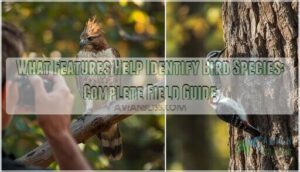
You spot movement in the branches overhead—brown, maybe gray, flitting between leaves. But which of the 400+ North American species just crossed your path? Bird identification isn’t guesswork. It’s a systematic skill built on reading specific physical markers, behavioral patterns, and environmental context.
A red-tailed hawk‘s distinctive belly band tells a different story than a Cooper’s hawk’s rounded tail tip. The way a nuthatch creeps headfirst down tree bark separates it instantly from woodpeckers that only climb up.
Learning what features help identify bird species transforms random sightings into precise observations, turning every walk into a field study where size, shape, color, sound, and movement combine to reveal each species’ unique signature.
Table Of Contents
Key Takeaways
- Bird identification relies on five essential physical markers—size and shape comparison, plumage patterns, bill structure, distinctive markings like eye rings and wing bars, and seasonal molting changes that alter appearance throughout the year.
- Behavioral observations, including feeding styles, flight patterns, social tendencies, and mating displays, often provide the decisive clues when physical features alone can’t confirm a species.
- Habitat and geographic range narrow identification possibilities by up to 80% before you even examine field marks, since each ecosystem supports specific species adapted to those environmental conditions.
- Mastering bird vocalizations through sonogram analysis and distinguishing songs from calls transforms auditory cues into confident identifications, often detecting species before visual confirmation is possible.
Key Physical Features for Bird Identification
When you spot a bird in the field, you’ll notice certain physical traits that act like fingerprints—no two species share the exact same combination. Your ability to read these features quickly separates casual observers from confident identifiers.
Start by observing size, beak shape, and tail length—these basic bird identification characteristics help you narrow down possibilities even before noting color.
Every bird’s unique combination of physical traits is its fingerprint—spotting them quickly turns you into a confident identifier
Let’s break down the five essential physical characteristics you’ll rely on most when putting a name to that bird in your binoculars.
If you’re trying to identify the black-bellied whistling duck, start with its striking plumage patterns and body shape.
Size and Shape Comparison
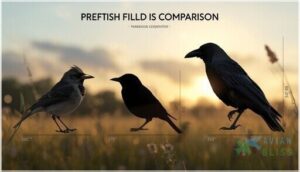
Body proportions reveal your first clue in bird identification. You’ll judge size variation by comparing your target to familiar species nearby—a sparrow-sized flash or crow-like silhouette?
Shape matters too—a long tail versus a stocky body, or the curve of the bill, all help you confirm what you’re seeing using visual bird identification methods.
Field marks become clearer when you analyze shape: short-tailed and stocky versus long-winged and slender. Morphology comparison—tail length, wing shape, bill structure—separates lookalikes.
Silhouette identification works even in poor light!
Plumage Patterns and Coloration
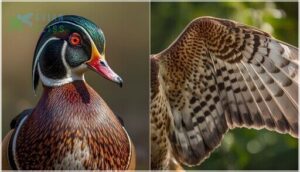
Once you’ve noted shape, color patterns act as nature’s ID cards. You’ll spot field marks like wing bars, eye rings, and breast streaking—each species carries its own signature.
Feather structure reveals plumage texture: mottled, scaled, barred, or spotted. Watch for iridescence effects that shift with angle.
Remember molting cycles change color variation seasonally, so spring birds may look completely different by fall!
Tracking these shifts becomes easier when you understand how physical features change throughout the year.
Bill and Beak Structure

After noting plumage, look closely at bill structure—it’s one of the most reliable field marks for bird species recognition. Beak shape and bill size reveal diet and lifestyle instantly.
- Culmen length separates long-billed shorebirds from short-billed passerines at a glance
- Hooked mandibles in raptors aid prey manipulation and handling
- Tomial edge serrations help insectivores grip slippery prey efficiently
- Nasal features and cere coloration distinguish similar species when combined with plumage data
Eye Rings, Wing Bars, and Markings

Beyond bill structure, you’ll find that eye ring patterns and wing bar colors act as nature’s fingerprints. Eye ring color contrasts with surrounding plumage in most field guides for key taxa, while wing bars—primary versus secondary—separate closely related species in over 40% of North American birds.
Crown stripes and facial markings paired with these features boost your identification confidence instantly, even accounting for molt variations across seasons.
Seasonal Molting and Color Changes
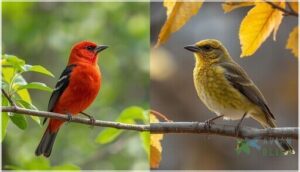
Molt patterns reshape plumage throughout the year, making color shifts essential field marks for accurate bird identification. Fresh feathers after post-breeding molts reveal brighter hues, while pre-alternate molts add breeding colors before mating season.
Seasonal plumage changes can also alter the sounds birds make, so identifying bird calls and noises alongside visual cues gives you a complete picture of which species you’re observing.
Watch for these feather replacement changes:
- Mosaic patterns mixing worn and fresh plumage during gradual molts
- Pigment shifts altering brightness and irridescence changes
- Seasonal camouflage adaptations in species like ptarmigans
- Molt limits showing age through contrasting feather generations
Behavioral Clues to Identify Bird Species

Once you’ve noted a bird’s appearance, watching how it acts can seal the identification. Different species have signature behaviors—how they hunt for food, move through the air, interact with others, and attract mates.
These patterns often give you the final clue you need when physical features alone aren’t enough.
Feeding Habits and Foraging Styles
You’ll spot feeding habits that reveal species identity faster than any field marks. Understanding these foraging techniques turns habitat knowledge into instant bird size and behavior clues! Watch how a bird hunts—insectivores glean arthropods from bark, while granivores selectively pick ripe seeds from the ground.
| Foraging Style | Prey Type | Key Behavior |
|---|---|---|
| Insect Gleaning | Arthropods | Rapid bursts on foliage |
| Seed Selection | Ripe seeds | Ground scratching |
| Fruit Foraging | Ripe fruits | Following fruiting cycles |
| Prey Capture | Fish/aquatic | Plunging strikes |
Flight Patterns and Movements
You’ll decode flight styles through wing beats and aerodynamics that separate families instantly. Small passerines pump 8–12 beats per second, while raptors cruise at 2–3.
Watch for soaring techniques on thermals versus undulating bursts—these field marks matter as much as wing bars!
Migration patterns reveal unique aerial displays: looping swoops and tail fanning distinguish breeding birds across migration routes.
Social Behaviors: Solitary Vs. Flocking
Observing whether a bird forages alone or joins a flock gives you instant identification clues. Solitary behavior signals species that defend exclusive ranges outside breeding season, while flocking dynamics reveal birds that share food locations and boost group vigilance against predators.
- Solitary foragers like thrushes minimize parasite transmission and competition
- Flocks enable social learning about ephemeral food patches
- Mixed-species groups improve predator avoidance through sentinel alarm calls
- Facultative flockers shift between solitary and group modes seasonally
Nesting and Mating Displays
When you witness coordinated courtship displays near a nest site, you’re watching species-specific mating rituals that confirm identification. Wing flicks, tail fanning, and synchronized duets during nest defense reveal pair bonding strength and breeding stage.
These avian characteristics tied to nesting behavior offer reliable field marks—watch for food provisioning patterns and the intensity of territorial displays to distinguish closely related species.
Habitat and Range as Identification Tools

Where you find a bird matters just as much as what it looks like. Different species stick to specific habitats and geographic ranges, which instantly narrows down your identification options.
Let’s explore how location and environment work as powerful identification tools in the field.
Preferred Environments and Ecosystems
Understanding habitat is like holding nature’s decoder ring—you’ll narrow your identification candidates by 80% just by knowing where you are. Each ecosystem offers distinct ecological niches that shape which species you’ll encounter:
- Temperate deciduous forests support seasonal migrants and cavity nesters adapted to leaf-fall cycles
- Tropical rainforests host canopy specialists thriving in high-humidity, multi-layered vegetation
- Grasslands favor ground-foragers with open-country adaptations and long-distance visibility
- Wetlands attract wading species exploiting aquatic invertebrates and emergent plants
- Urban habitats concentrate edge-adapted generalists capitalizing on human-modified landscapes
Forest ecology, wetland conservation, and grassland management studies reveal how ecosystem diversity drives species distribution—critical knowledge for wildlife observation and environmental conservation efforts.
Geographical Distribution and Migration
You’ll spot seasonal range shifts when Migration Patterns align with five major flyway dynamics guiding billions across continents. Documented breeding and wintering ranges reveal how climate effects drive latitudinal movements, with some species expanding northward as habitat constraints ease.
Tracking these Avian Migration Patterns through citizen science platforms helps you predict arrivals—stopovers along flyways signal where refueling birds concentrate during peak transit windows.
Habitat Specialization and Adaptation
Microhabitat Use separates specialists from generalists—cavity nesters need standing deadwood while ground-foragers prefer open understory. Adaptive Strategies like strong tarsi or webbed feet reveal Ecological Niches and Adaptation, shaping Bird Species Recognition across ecosystems.
You’ll recognize Habitat Fragmentation impacts when Species Richness drops in isolated patches. That’s why Habitat Conservation matters—protecting these Ecosystem Services maintains the diversity enabling accurate field identification.
Identifying Birds by Sounds and Calls

Bird vocalizations reveal a hidden world of identification—you’ll often hear a species before you ever see it. Learning to distinguish between different types of sounds, from territorial songs to short alarm calls, sharpens your field skills dramatically. The right audio tools and techniques will transform those mysterious chirps into confident IDs.
Types of Bird Vocalizations
Bird sounds break into two main categories: songs and calls. You’ll hear males belting out songs during breeding season to claim territory and attract mates, while both sexes produce calls year-round for everyday communication.
Here’s what separates them:
- Songs feature complex, structured sequences with repeating phrases
- Calls are shorter, simpler sounds for immediate needs
- Contact calls help flockmates stay connected
- Alarm calls signal danger with sharp, urgent notes
- Begging calls communicate hunger, especially in young birds
Recognizing Songs Vs. Calls
Song structure reveals the difference. Songs flow with melodic phrases that repeat and extend over several seconds—think of a Northern Cardinal’s “cheer-cheer-cheer” sequence. Calls snap out as quick, single notes for immediate alerts.
You’ll notice songs need vocal learning in many species, creating regional dialects, while call patterns stay uniform. This species recognition skill sharpens your audio analysis and transforms how you interpret bird sounds and bird behavior in the field.
Using Sonograms and Audio Tools
Sonogram interpretation transforms bird sounds into visual graphs you can analyze. You’ll see frequency patterns as vertical shapes on a time axis—high-pitched chips appear in upper bands, while low hoots cluster below.
Audio analysis tools measure pitch contours and tempo for species recognition. Match your spectrogram reading against reference recordings to confirm vocalization types and sharpen your bird identification accuracy in ornithology fieldwork.
Essential Tools and Best Practices for Bird ID

You can’t identify birds with your eyes alone—you need the right gear and a solid approach. The best birders combine quality optics, reliable reference tools, and careful record-keeping to sharpen their skills over time.
Let’s look at the essential equipment and practices that’ll transform you from a casual observer into a confident identifier.
Choosing and Using Binoculars
You’ll want binoculars with 10x to 12x binocular magnification and a 42 mm objective for sharp bird identification. Look for fully multi-coated lens coating and roof or porro prism design—roof prisms pack lighter for birdwatching trips.
Check field views and close focus distance; wider angles help track fast movers.
Don’t overlook ergonomic fit—comfortable eye relief prevents fatigue during long birding sessions!
Field Guides and Bird ID Apps
Field guides and birding apps are your toolkit for decoding field marks in real time. You’ll find App Features like audio playback, interactive range maps, and quick filters for Mobile Identification. Digital Guides mirror classic Field Guide Design but add Birding Software perks—think seasonal plumage notes and user-generated sightings.
- High-res photos
- Audio libraries
- Taxonomic sorting
- Migration data
- Regional species lists
Keeping Field Notes and Life Lists
Your field notes are the backbone of serious birding—a permanent record of every sighting, behavior, and field mark. Record keeping demands a table format: date (ISO 8601), location, weather, and species tracking with scientific names.
Review entries against your field guide to confirm bird identification. Back up your data standardization system digitally, and your journaling techniques will power lifelong discoveries in bird species mastery.
| Field | Example Entry |
|---|---|
| Date | 2026-01-13 |
| Location | Mill Creek, 38.5°N |
| Weather | Clear, 12°C, light wind |
| Species | Setophaga coronata (Yellow-rumped Warbler) |
| Field Marks | Bright yellow rump, white throat, gray upperparts |
Ethical Birdwatching Practices
Responsible Tourism starts with silence and distance—you’ll minimize disturbance by staying 15+ meters from active nests and avoiding playback calls during breeding season.
Birding Ethics demand respect for protected areas and private land.
Your Wildlife Observation contributes to Conservation Biology when you report sightings accurately through Sustainable Birding platforms like eBird, supporting Wildlife Conservation while practicing Bird Friendly, Eco Ethics-centered Birdwatching that protects species for future generations.
Frequently Asked Questions (FAQs)
How does weather affect bird identification accuracy?
Weather conditions directly impact your ability to spot field marks clearly. Fog, rain, and poor lighting effects can reduce identification accuracy by 20–40%, while wind destabilizes binoculars and obscures critical details like bill structure.
Can juveniles be identified using adult features?
You’ll spot differences fast: juvenile plumage often lacks adult field marks. Bills, eyes, and molt patterns vary by age.
Species variation complicates identification—post-juvenile feather development reveals reliable features for accurate age identification.
What role does time of day play?
You’ll notice more activity during dawn chorus and crepuscular activity periods when birds vocalize and forage actively.
Diurnal patterns shift feeding habits throughout the day, while light levels affect plumage visibility for accurate identification.
How do hybrids complicate species identification efforts?
Hybrids throw a wrench in the works—you’ll see mosaic traits blending parental field marks, hear mixed vocal repertoires, and face taxonomic debates that blur species boundaries.
This makes genetic analysis essential when color patterns and bird behavior don’t match your guide.
Are there identification differences between male females?
Sexual dimorphism means males often show brighter plumage or distinct color patterns compared to females.
You’ll notice these differences most clearly during breeding season, when behavioral cues also help distinguish the sexes.
Conclusion
You’ve earned your wings. Every field mark you’ve studied—what features help identify bird species from bill shape to flight style—becomes second nature with practice.
Size anchors your first impression. Color patterns narrow the possibilities. Behavior and habitat seal the ID.
Next time that silhouette crosses the sky or that call pierces the dawn chorus, you won’t just wonder. You’ll know. Your binoculars are ready. The field awaits your trained eye.